

- Agentforce
Salesforce publishes one number for Agentforce and it looks settled. $2 per Conversation. Your actual Agentforce conversation cost depends on something that price tag never tells you, which is what triggers the charge in the first place.
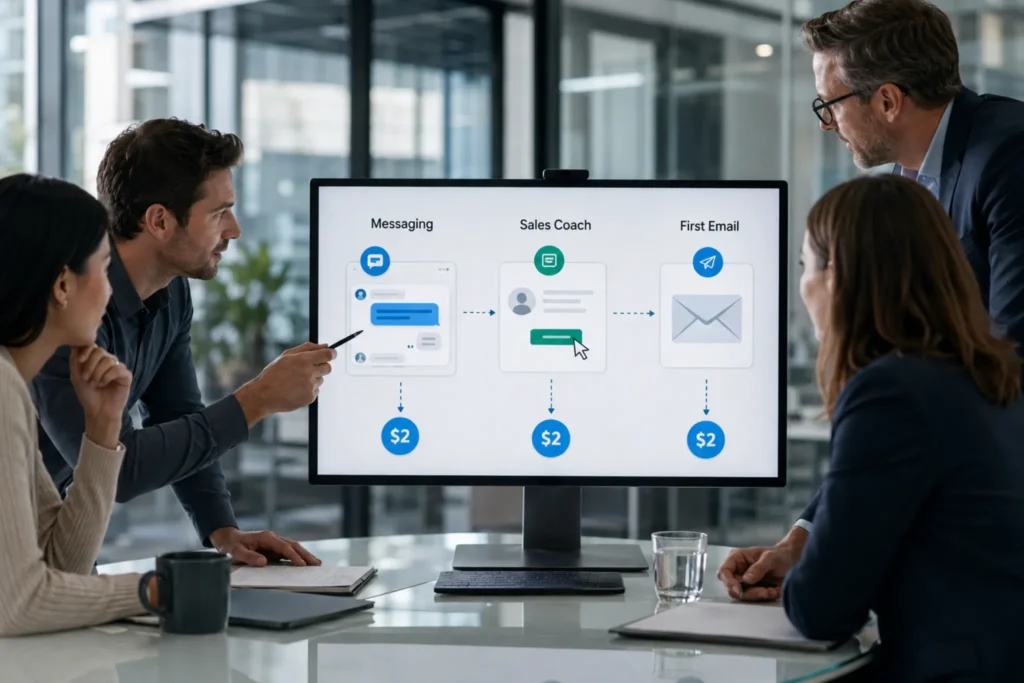
And that changes by product. ASA Messaging bills when a conversation window opens. Sales Coach bills when a seller clicks a button. SDR bills when an agent sends its first email to a lead. Three products, three completely different things drawing down the same $2 unit.
So your forecast lives or dies on which event you count. Message volume tells you almost nothing about your Agentforce conversation cost, and there’s no shortcut around working out which trigger applies to you. We built this page at VALiNTRY360 to walk the billing rules as Salesforce documents them, then show you what the arithmetic does once real volume arrives.
What Does Your Agentforce Conversation Cost Actually Buy?
Here’s the published picture, line by line.
- Published rate: $2 USD per Conversation, listed on Salesforce’s current pricing page and subject to whatever your contract negotiates from there.
- Eligible usage: customer-facing Agentforce agents under the applicable Conversation SKU, which excludes employee-facing agents and Voice deployments.
- Billing unit: one qualifying Conversation event, defined differently for each Agentforce subtype rather than by a single shared rule.
- Buying route: Salesforce currently excludes conversation-based pricing from PayGo and Pre-Commit, which leaves Pre-Purchase as the route.
- Multiplier: 1 for all three subtypes on the current rate card, so one qualifying event draws exactly one Conversation from entitlement.
- Tracking method: Digital Wallet, provided at no cost for enabled products, reporting consumption and remaining balance in near real time.
Two of those lines matter more than the rate itself. Customer-facing scope is the first filter, so employee-facing agents and Voice sit outside this SKU entirely. If you’re rolling out a mix, you’ll be pricing on more than one meter at once and this rate only covers part of the bill.
That restriction is worth stating plainly, because at least one published pricing guide admits outright that it couldn’t confirm whether the $2 rate is limited to customer-facing agents. It is. Salesforce’s Agentforce pricing page scopes Conversations that way, and the Conversations Rate Card lists only ASA Messaging, Sales Coach and SDR as usage types.
The second line to watch is the buying route. Pre-Purchase keeps entitlement and usage as separate ideas. You buy a quantity of Conversations up front and draw them down as qualifying events occur, which means you’re committing to an Agentforce conversation cost months before you hold a single day of your own consumption data.
One more thing this figure doesn’t cover. Implementation, integrations, and the AI and data usage running underneath an interaction all sit outside it, and your contracted rate can differ from the published one once volume and term enter the negotiation. Our Agentforce AI consulting team maps how a workload actually behaves to a commercial model before a quote reaches procurement.
What Counts as an Agentforce Conversation?
This is the question the price tag doesn’t answer, and it’s where every Agentforce conversation cost estimate either works or falls apart. Salesforce Help currently lists three Conversations billable usage subtypes, and each one consumes a Conversation on a completely different event with its own forecasting input.
Subtype | Consumption trigger | Forecasting input |
ASA Messaging | A qualifying conversation window opens | Conversation starts per channel |
Sales Coach | A user clicks Get Feedback after a role play or stand-and-deliver session | Feedback submissions |
SDR / Engagement | The agent sends the initial email to a lead | Leads entering outreach |
ASA Messaging
This is the one most buyers picture when they hear “per conversation”, and it runs on windows rather than exchanges. A customer can send you 15 messages inside one open window and you’re charged once.
So the number driving your Agentforce conversation cost here is unique conversation starts per channel. That’s smaller than message volume, and it’s a different number from case volume, which is what most teams reach for first.
Sales Coach
No customer, no window. What you’re forecasting here is coaching adoption.
A seller runs a role play or a stand-and-deliver session and nothing happens on the meter. The charge lands when they click Get Feedback. A session that ends without a feedback request never touches your entitlement at all, which makes the click-through rate on feedback requests the figure to model rather than the session count.
SDR and Engagement
SDR charges you at the first outbound email to a lead. Everything after that for the same lead is included, and a restart after cancellation consumes another.
Sit with that for a second, because it makes email volume an actively misleading input. Every follow-up your agent sends that lead is already covered. The number that moves the meter is leads entering outreach, not emails sent.
Most deployments start with one subtype and add a second later. A service team starts with ASA Messaging, a sales org starts with SDR, and running both means keeping two forecasts against one shared entitlement, because everything draws from a single pool.
Which is why multiplying message count by $2 gives you a wrong answer in all three products. What you want is the count of qualifying trigger events, and that’s a different number and a different report in each case. Salesforce documents all three in its Agentforce Conversations billable usage types reference. Our Agentforce for Service work begins by measuring conversation starts rather than case volume, because that’s the input your Agentforce conversation cost actually tracks.
How ASA Messaging Conversation Windows Start and End
The window is where this gets specific, and where most published guidance gets it wrong. A window opens when the customer sends a message for the first time after the previous window has ended, or when the service agent sends a configured welcome message first. That second trigger is the one to notice. Your meter can start before the customer types anything.
How it closes depends on the channel.
Channel | How the window ends |
Enhanced Web Chat, unauthenticated | When the user explicitly clicks End Conversation |
Enhanced Web Chat, authenticated | 24 hours after the window starts |
In-App Chat | 24 hours after the window starts |
24 hours after the window starts | |
Facebook Messenger | 24 hours after the window starts |
Apple Messages for Business | 24 hours after the window starts |
SMS | 24 hours after the window starts |
Bring Your Own Channel | 24 hours after the window starts |
The next message after a window closes opens a new billable one.
The 24-Hour Rule Runs From the Start, Not From the Last Message
Read that rule carefully, because it’s the single biggest lever on your Agentforce conversation cost. The clock runs from when the conversation starts, not from the last message, and Salesforce describes no inactivity timer anywhere in its current documentation.
Here’s what that does in practice. A customer who messages you three times across one afternoon on WhatsApp costs you one Conversation. The same customer messaging once a day for three days costs you three.
Same message count. Triple the bill. And no volume forecast you build will ever surface the difference.
That pattern isn’t unique to Conversations either, which is worth knowing before you assume another meter would behave differently. Salesforce scopes its Help Agent resolutions by a window too, with actions inside a ten-minute call window counting as a single resolution however many questions the agent answers. Window-based billing is the shape Salesforce keeps reaching for, and how often a new window opens is what moves your invoice.
Authenticated vs Unauthenticated Enhanced Web Chat
Unauthenticated Enhanced Web Chat deserves its own look, because its window closes when the user clicks End Conversation and almost nobody does that. They close the browser instead.
Read literally, that means an abandoned unauthenticated session leaves the window open, and a customer coming back later lands inside one you’ve already paid for. Good news for your bill, if it holds.
Confirm the practical behaviour with your account team before you build a channel strategy on it, because the documented rule and what you observe on a live org are worth checking against each other.
Salesforce sets out the channel rules in its considerations for Agentforce Service Agent page. Our Agentforce Digital Engagement practice tests each deployed channel against its documented rule, and because channel mix is a commercial decision as much as a service one, our Agentforce Contact Center team prices each option before rollout.
Events That Can Create or Repeat a Billable Conversation

Seven events, and you can check every one of them in your own reporting today. Pull these numbers before you size an entitlement, because this is what the meter counts and what your forecast has to predict.
- A customer opens a new ASA messaging window. Look at unique conversation starts per channel per month in your Messaging session reports. It will be smaller than your message volume and different from your case volume.
- A configured welcome message fires first. Check each Messaging channel for an automated welcome. A welcome that sends before the customer speaks has already opened the window and started billing you for a contact that may go nowhere.
- A previous 24-hour window expired and the customer came back. Run a distribution of repeat contacts by hours since last contact, and treat everything past the 24-hour mark as a second billable Conversation rather than a continuation.
- An unauthenticated web user ends a conversation and returns. Count End Conversation clicks against return visits, and measure browser abandonment separately, since the documented window stays open in that case and the return lands inside it.
- A seller clicks Get Feedback. Pull feedback submissions from Sales Coach, counted separately from coaching sessions held. A session that ends without a feedback request never reaches the meter.
- An SDR agent sends its first email to a lead. Count leads entering agent outreach against total emails sent. The gap between those two figures is nurture activity you are not charged separately for.
- Cancelled SDR outreach restarts. Check campaign cancellation and re-enrollment logs. Each qualifying restart costs you another Conversation on a lead you already paid to reach, which turns campaign hygiene into a cost control.
Our Salesforce Service Cloud implementation services team validates items 1 through 4 during testing, because messaging, routing and session configuration are what decide how many of these events your deployment actually generates.
Agentforce Conversation Cost From 1,000 to 50,000 a Month
Illustrative arithmetic using Salesforce’s current $2 public list rate. Contract terms and other consumption are excluded.
Monthly conversations | Monthly public-rate amount | Annual public-rate amount |
1,000 | $2,000 | $24,000 |
5,000 | $10,000 | $120,000 |
10,000 | $20,000 | $240,000 |
25,000 | $50,000 | $600,000 |
50,000 | $100,000 | $1,200,000 |
The curve is linear, which is exactly why it is easy to underestimate. A mid-sized service team handling 10,000 conversation starts a month is looking at $240,000 a year on this meter alone, before any other Salesforce usage joins it. There is no volume break in the published rate either, so your ten-thousandth conversation start costs precisely what your first one did.
One caution there, because other pricing guides get this wrong. At least one publishes a volume discount table running from $2.00 down to $1.00 at enterprise scale. Salesforce publishes no such tiers anywhere. Discounts exist in negotiated contracts, which is a different thing from a rate card, and building a model on invented tiers is how a budget ends up short.
Two forecasting errors cost you real money here, and Pre-Purchase makes both of them expensive. Underestimate your conversation starts and you are buying more entitlement mid-term at whatever rate is going. Overestimate them and you are holding entitlement you cannot use, because the Conversations Rate Card states that Conversations must be used before the Order End Date on your Order Form, with no rollover permitted.
Why the December 2024 Rate Card Matters
Worth noticing before you sign a multi-year commitment. The Conversations Rate Card is dated December 2024. The Flex Credits Rate Card was updated on 21 April 2026.
Put them side by side and the difference in attention is hard to miss. The Conversations card lists one usage type at a multiplier of 1 and fits on a single page. The Flex Credits card lists four Agentforce action types, four prompt tiers, three speech meters and eleven Data 360 usage types with four volume tiers each, and it has been revised at least twice in that period.
We are not predicting anything about what Salesforce will do with the Conversations SKU, and we would not. It is an observation you should weigh: twenty-one months without a revision, on the meter you would be committing to for a full term, while the alternative is being actively developed. Ask your account team where the Conversations SKU sits on the roadmap before the term length gets agreed, not after.
Measuring against a real pilot beats modelling from assumptions every time, which is why our Agentforce Quickstart exists as a way to get a traffic baseline before a large commitment.
How Many Agentforce Conversations Are Free?
Salesforce Foundations includes credits covering the first 1,000 conversations with Agentforce for Service. At the $2 list rate that is $2,000 of entitlement at no charge, available to customers on Enterprise Edition and above.
That matters more than a free tier usually would, and here is why. Every forecasting method on this page depends on knowing your real conversation starts, your channel mix, your repeat-contact distribution and whether a welcome message is quietly opening windows before customers speak. None of those numbers exist until an agent is live.
A thousand conversations is enough to produce all four. Run one channel for a month, pull the session reports, measure how many contacts land either side of the 24-hour boundary, and you have replaced four assumptions with four measurements before any money changes hands. That is the cheapest cost model you will ever build.
Two limits worth knowing. The allocation covers Agentforce for Service specifically, so it gives you nothing on Sales Coach or SDR. And 1,000 conversations disappears quickly once real traffic finds the channel. Treat it as a way to calibrate a forecast, not as a way to run a deployment.
What Sits Outside the $2 Meter?
Five layers can show up on the invoice around a Conversation charge, and your Agentforce conversation cost covers only the first of them.
- The conversation meter. Measures qualifying Conversation events drawn from your Pre-Purchased entitlement, priced at the rate your contract sets. Investigate before contracting, then monthly after launch.
- Model and AI usage. Measures Einstein Requests, which the Conversations Rate Card says certain Agentforce features may consume alongside Conversations. Worth checking if your agent design calls the LLM heavily or generates long replies.
- Data consumption. Measures Data 360 or Data Services usage, depending on which consumption card your contract carries. Relevant as soon as agents are grounded in unified data, a knowledge corpus, or documents you upload.
- Connected systems. Measures APIs, middleware, and the external systems your agent actions reach on either side of the interaction. Applies the moment an agent writes to anything outside Salesforce.
- Delivery and operations. Measures configuration, testing, monitoring and support, including the metered portion of your build and test cycle. Investigate at scoping, then monthly once the agent is live and owned.
One naming conflict is worth handling carefully rather than smoothing over. The Conversations Rate Card still says Data Services Credits while newer Salesforce documentation talks about Data 360. Those labels are not interchangeable, and your active contract and Digital Wallet cards decide which one applies to you.
The billing constructs behind these units appear in Salesforce’s Agentforce and generative AI usage and billing documentation. Agentforce Flex Credits sit outside this stack entirely, since they cannot run in the same org as Conversations.
Our Data 360 team at VALiNTRY360 sizes the data layer against the agent design rather than a generic profile count, and our Salesforce integration services practice scopes the connected-systems layer separately from the agent build. If the data layer is the piece you are least sure about, our guide to what Agentforce costs once Data 360 is counted prices it in full.
Conversation Pricing vs Flex Credits and Other Salesforce Options
Salesforce currently publishes five consumption units a service buyer will run into, and two of them cost $2. Which makes comparing them harder than it looks.
Pricing unit | Billing event | Workload input | Planning issue |
Conversations, $2 | A qualifying Conversation window or event | Conversation starts by subtype | Pre-Purchase only, no rollover |
Flex Credits, $500 per 100,000 | Each metered action, prompt, or data operation | Actions per interaction | Cannot share an org with Conversations |
Help Agent Resolutions, $2 | A qualifying Help Agent resolution | Resolutions completed | Includes unmetered actions and Data 360 queries per resolution |
Service Portal Login, $4 | A portal login session | Logins per month | Includes unmetered activity during a 24 hour login session |
Service Portal Member, $10 | A named portal member per month | Member count | Unmetered queries with unlimited sessions, so it prices access rather than usage |
A $2 Conversation and a $2 Resolution are different billing events with different inclusions, so matching prices tell you nothing about matching value. Both the Resolution and the Login unit bundle activity a Conversation does not, and the Login unit prices a portal session rather than a support interaction, which puts it in this comparison for teams running a self-service portal and nowhere else.
The Member unit goes further in the same direction, pricing a named person per month with unmetered queries and unlimited sessions. Salesforce publishes all three on its customer self-service pricing page, and the direction of travel is worth reading: two of those three price access or outcome rather than activity, which is not where the Conversation meter sits.
Agentforce Flex Credits give the cleanest arithmetic comparison. At $500 per 100,000 credits one credit lists at $0.005, the April 2026 rate card puts a standard action at 20 production credits, and that makes a standard action $0.10 at list. Divide one by the other and you get a benchmark: $2 ÷ $0.10 = 20 standard actions.
Treat that as arithmetic and nothing more. Your Agentforce conversation cost and the action meter measure different things, and Salesforce publishes no conversion between them beyond that division. A real deployment also consumes prompts, Voice and data operations, your contracted rates will differ from list on both sides, and the two models cannot coexist in one org, which makes this a decision you take once.
If comparing models is the question you actually arrived with, rather than understanding the Conversation unit, our comparison of all three Agentforce pricing models covers it directly, and our Agentforce rate card breakdown prices every action type on the credits side.
When Does Your Agentforce Conversation Cost Get Expensive?
This is a VALiNTRY360 calculation model built on Salesforce’s published public pricing. The workloads are constructed to test the meter rather than drawn from customer accounts, and every figure shows its inputs so you can rerun them against your own.
Workload A: The Short FAQ
One conversation. Two standard actions to look up an order status and reply. Your Agentforce conversation cost is $2. The action benchmark is 2 × $0.10 = $0.20. Other usage to check: one Einstein Request if the reply is generated. Nothing would change this, because it is as thin as an interaction gets.
Result: the Conversation meter charges 10 times the action equivalent.
Workload B: The Multi-Step Service Case
One conversation. Fourteen actions across identity checks, a policy lookup, an update and a confirmation. Agentforce conversation cost: $2. Action benchmark: 14 × $0.10 = $1.40. Other usage to check: prompts and any grounded data retrieval. What would move it is the action count, and that is a design decision rather than a customer behaviour.
Result: the two meters land within 43% of each other.
Workload C: Repeat Contact Across Days
Three conversations, because each 24-hour window closes before the next contact arrives. Four actions per contact, twelve in total. Conversation price: 3 × $2 = $6. Action benchmark: 12 × $0.10 = $1.20. Other usage to check: whether your channel mix pushes contacts across window boundaries. What moves it is how often contacts fall either side of one.
Result: the Conversation meter charges 5 times the action equivalent.
Workload D: The Action-Heavy Workflow
One conversation. Thirty-five actions in a long troubleshooting session. Conversation price: $2. Action benchmark: 35 × $0.10 = $3.50. Other usage to check: Voice actions at 30 credits each where the channel is voice. What moves it is your escalation rate, since a session handed off early never reaches this count.
Result: the Conversation meter costs 57% of the action equivalent.
Look at those four together and the pattern is clear. The flat $2 rewards deep work inside a single window and punishes thin, repeated contact. It is cheap for Workload D and expensive for Workloads A and C.
So your Agentforce conversation cost turns on two variables and only two: how much work gets done inside a window, and how often new windows open. Neither of those shows up in a headcount, a case count or a message count, which is why so many estimates miss.
Measure both before you compare the models against each other. Cost per useful outcome is the figure worth carrying into procurement, and Flex Credits change that calculation rather than settling it.
Case Study: What 18,000 Agentforce Conversations Cost at List Rate
Salesforce publishes customer results on its own newsroom, and one of them is stated in the exact unit this page bills on. reMarkable has handled over 18,000 service conversations through Agentforce since deployment.
What Salesforce publishes is the volume rather than the invoice, which is more useful than it sounds. The volume is the number a forecast has to get right, and the invoice follows from it.
- Published volume: over 18,000 service conversations handled by Agentforce since deployment, reported by Salesforce.
- List-rate arithmetic: 18,000 × $2 = $36,000 under the Conversation meter at published rates.
- What is not published: the commercial model, the contracted rate, or whether Conversations are the meter in use at all.
- What the figure does show: a service deployment of that size reaching five figures on the Conversation meter before any other consumption is counted.
- The forecasting lesson: miss the volume estimate by 20% and that number moves by $7,200. That is the cost of a bad baseline, not a bad rate.
Salesforce publishes deflection figures alongside the volumes, and those decide how many conversation windows open in the first place. OpenTable reached 73% of restaurant web queries within three weeks, Datasite resolves 70% of day-to-day chat questions, and Fisher & Paykel moved self-service from 40% to 70%. Salesforce collects these on its Agentforce metrics page.
Read those as demand signals for the meter, because that is what they are. A higher deflection rate means Agentforce is opening more of the windows itself, which pushes your spend up at the same time as it pushes your human cost per contact down.
Both numbers move together. Only one of them lands on the Salesforce invoice, and it is the one going the wrong way.
Which is the whole case for measuring conversation starts before you sign rather than after. Deflection is the outcome most service teams are buying, and it is also the input that drives the meter upward as the agent gets better at its job.
Why Sales Coach and SDR Need Different Cost Forecasts
Neither product has a customer messaging window, so the messaging model gives you nothing usable for either one. Both need a forecast built from their own trigger.
Sales Coach
Forecast from eligible sellers, role-play and stand-and-deliver sessions run per seller, the share of those ending in a Get Feedback click, and adoption ramp across the rollout. The method is simple enough: eligible coaching sessions multiplied by the percentage that end in a click.
Adoption moves this figure more than anything else. An unused coaching tool consumes nothing at all. A well-adopted one consumes on every submission a seller makes. So forecast the ramp rather than the steady state, because month one and month nine produce very different consumption from the same seller population. Our Agentforce for Sales team models this against seller headcount and enablement cadence.
SDR and Engagement
Forecast from leads entering agent outreach, initial emails sent, cancellations, restarted outreach and campaign growth. The method is initial outreach events plus qualifying restarted outreach, since subsequent agent activity for a lead stays inside the initial Conversation and adds nothing.
Restart behaviour is the line to watch. A team that cancels and relaunches campaigns frequently pays a second time for leads it has already reached, and each Conversation can also consume Einstein Requests when it calls the LLM, so the outbound meter rarely runs alone. Our Agentforce for SDR Agent work starts with lead enrollment volume rather than email volume.
Run both forecasts separately, then add them to your messaging number. A single blended estimate across three products will be wrong in three different directions at once. We keep the three components visible in the model, because spend moves for entirely different reasons in each one.
Checklist: What to Measure Before Buying Conversations
Ten numbers, and every one of them already exists somewhere in your reporting. Collect them from a live period rather than a design document, because the gap between how a channel was configured and how customers actually use it is exactly where forecasts break.
- Monthly conversation starts. Unique messaging session starts by month, taken from your Messaging session reports across a representative period.
- Channel mix. Session volume split across Web Chat, In-App, WhatsApp, SMS and every other deployed channel, measured over a full month.
- Authenticated versus unauthenticated web traffic. The ratio between them, since each carries a different window end rule and therefore a different billable count.
- Repeat-contact rate. Distribution of hours between contacts from one customer, bucketed either side of the 24-hour boundary that closes a window.
- Welcome-message configuration. Whether an automated welcome fires before the customer speaks, checked separately on every channel you have deployed.
- Work completed per conversation. Average action count per session, taken from agent design documents and validated against your testing logs.
- SDR initial outreach volume. Leads entering agent outreach per month, alongside restart frequency and the cancellation rate behind it.
- Sales Coach Get Feedback usage. Feedback submissions per month, counted separately from the coaching sessions that produced them.
- Other AI and data consumption. Your active Digital Wallet cards and the usage each one meters alongside the Conversation entitlement.
- Expected growth and unused-entitlement risk. Month-over-month trend measured against your Order End Date, tracked in both directions rather than only upward.
Work that list and your Agentforce conversation cost stops being a guess. And if you do not have an agent live yet, every one of those ten numbers can come from the free Foundations allocation described above. Our team at VALiNTRY360 runs it as a pre-purchase assessment, since those ten inputs are what decide the number.
How to Forecast Conversation Demand Before Launch
The what is the count of qualifying billing events your workload will generate. The why is that Pre-Purchased entitlement is finite and expires at the Order End Date. The how is a monthly forecast rolled into a contract-term total, built in this order.
- Baseline volume. Current monthly conversation starts, measured from live reporting rather than estimated from case counts or ticket volume.
- Billing trigger. The subtype rule that applies to each agent you run, since messaging, Sales Coach and SDR each count a completely different event.
- Channel and authentication state. The end rule per channel, which decides how many separate windows a given contact pattern produces over a month.
- Repeat-contact behaviour. The share of customers returning after their window closes, which multiplies windows without multiplying customers.
- Monthly growth. Expected trend across the contract term, applied month by month rather than as an annual average that flattens the shape.
- Peak-month factor. Seasonal or campaign-driven spikes, which raise the term total by more than a smoothed average ever suggests.
- Rollout ramp. Pilot volumes differ from production volumes, so model the months between them rather than pricing the endpoint alone.
- Pre-purchase buffer. Headroom for forecast error, sized against how confident your baseline actually is and how volatile the traffic has been.
- Resulting entitlement requirement. The sum of the adjusted monthly figures across the term, checked against the Order End Date before anything is signed.
Build it monthly rather than annually. An annual average hides the peak months that decide whether you run short, and it hides the quiet months that decide whether you finish the term holding entitlement you cannot use.
Forecast Sales Coach from Get Feedback events and SDR from initial outreach on their own, then add all three into one entitlement figure while keeping the components visible. Your total is only as accurate as the weakest of those three inputs, and errors compound across a full term.
Forecasting discipline is not a nice-to-have on a consumption product. Gartner predicted on 25 June 2025 that over 40% of agentic AI projects would be cancelled by the end of 2027, naming escalating costs, unclear business value and inadequate risk controls as the three causes. The first of those is what an unmeasured Pre-Purchase commitment produces.
How Build Choices Change Your Conversation Volume
Five build decisions affect when a billing window opens, and each of them moves your Agentforce conversation cost without appearing anywhere on a price list. Test each one rather than assuming the effect.
- Welcome message. Possible billing effect: a configured welcome can open an ASA Messaging window before the customer sends anything. Validation: run the deployed messaging path end to end and check whether a session registers against your entitlement.
- Authentication. Possible billing effect: authenticated Enhanced Web Chat closes 24 hours after the start, while unauthenticated closes only on an End Conversation click. Validation: test both journeys separately and compare the session records they produce.
- Channel selection. Possible billing effect: each channel carries its own documented end rule, so one contact pattern produces different window counts across channels. Validation: map billing behaviour per deployed channel before go-live.
- Routing and session continuation. Possible billing effect: how a customer enters or resumes a messaging experience decides whether a new window opens or an existing one continues. Validation: test the actual handoff path rather than assuming a transfer rule Salesforce has not documented.
- SDR restart behaviour. Possible billing effect: restarting cancelled outreach for a lead consumes another Conversation against the same prospect. Validation: test campaign cancellation and re-enrollment logic against your consumption records.
One more thing people miss: testing is metered in places. Salesforce says building in Agentforce Builder is not metered, while previewing an agent in chat or voice is, and testing through Testing Center and sandbox is metered to cover compute. Budget for the build cycle rather than treating non-production activity as free, because a thorough test pass across several channels lands before a single customer reaches the agent.
How to Monitor Conversation Spend and Decide Whether to Switch
Digital Wallet is where consumption becomes visible. Salesforce provides it at no cost for enabled products and reports usage in near real time, with threshold alerts and usage trends. Five things to look at each month.
- Conversations consumed against forecast. Warning: consumption running above 110% of plan for two consecutive months. Action: reforecast the remaining term before the balance forces the decision for you.
- Entitlement remaining against months left. Warning: current burn rate implies exhaustion before the Order End Date. Action: model the shortfall in months and open the purchase discussion early.
- Consumption by subtype. Warning: one subtype growing faster than the business driver behind it. Action: audit that product’s trigger against its actual event volume for the period.
- Daily conversation starts. Warning: an unexplained step change with no matching movement in traffic. Action: check for a welcome-message, routing or channel configuration change made that week.
- Projected Order End Date balance. Warning: material entitlement forecast to go unused before the term closes. Action: redirect volume where you can, and size the next term against measured demand rather than the original plan.
Reporting shows you the position without changing it, and no threshold alert stops a service when an entitlement runs down. So this review needs a named owner with time for it. Set the cadence monthly for the first two quarters, because consumption patterns only settle after the rollout ramp completes, and the early months are when a configuration change is cheapest to catch.
Switching models is possible, and deliberate. A customer moving to Flex Credits has to swap all existing Agentforce Conversation SKUs, and the two cannot run in the same org, so revisit the choice once you hold real data on work completed per window and how often new windows open. Flex Credits become the better fit when that data says so and not before.
Salesforce documents the tracking in its Digital Wallet usage monitoring guidance. Our Agentforce Managed Services team at VALiNTRY360 runs this review monthly, and our Salesforce Service Cloud support practice handles the channel and routing changes that follow from it. On the credits side, our guide to avoiding Flex Credit runaway covers the equivalent discipline.
Why Buyers Work With a Certified Salesforce Partner on Conversation Pricing
We are a certified Salesforce partner, which means we hold the current rate cards, we can read your active Digital Wallet cards against your contract, and we sit in the conversation where term length and entitlement quantity actually get decided.
On a Pre-Purchase product, three things follow from that.
The entitlement gets sized against measured demand rather than a design document. Conversations expire at the Order End Date with no rollover, which makes over-buying exactly as expensive an error as under-buying. We run the ten-number checklist above before a quantity is agreed, using the free Foundations allocation where an agent is not yet live.
The configuration decisions that move the meter get tested before go-live. A welcome message, an authentication choice and a channel mix each change how many windows open, and none of them appear on a price list. Testing those on a live org costs you hours. Discovering them on an invoice costs you a term.
The naming conflicts get resolved against your actual contract. Data Services Credits or Data 360. Conversations or Flex Credits. Which consumption cards are active. These look like semantics right up until a forecast is built on the wrong one and every number in it is wrong.
We do not compete on rate. We compete on whether the entitlement you buy matches the demand you generate.
What This Looks Like in Practice: VALiNTRY360 Case Studies
Forecasting method is easy to describe and much harder to hold to when a contract deadline is moving.
Our Salesforce case studies cover the delivery work behind the numbers on this page: service deployments where conversation starts were measured on a live channel before an entitlement was sized, channel strategies chosen against documented window rules rather than assumed ones, and monitoring cadences that caught a configuration change in the month it happened rather than at term end.
If your org is not ready for that conversation yet, a Salesforce health check covers the data, routing and permission questions that decide whether any of these forecasts would hold up. And if you want a second opinion on an entitlement quantity before you sign, talk to our team. That conversation costs considerably less than a term of unused entitlement.
FAQs About Agentforce Conversation Cost
How much does Agentforce cost per conversation?
Salesforce lists Conversations at $2 each for customer-facing agents, bought through the Pre-Purchase route. That is a public list rate, and your contracted rate can differ once volume and contract term are negotiated. Pricing checked 11 September 2026.
What counts as one Agentforce conversation?
The trigger depends on the subtype. ASA Messaging consumes one when a qualifying conversation window opens, Sales Coach when a user clicks Get Feedback after a coaching session, and SDR when the agent sends its initial email to a lead.
Does every Agentforce message cost $2?
No. Messaging bills on windows, so a customer can exchange many messages inside one open window and consume a single $2 Conversation. What you pay tracks how often new windows open, which is a different number from message volume.
How long does an Agentforce conversation last?
It depends on the channel. Authenticated Enhanced Web Chat, In-App Chat, WhatsApp, Facebook Messenger, Apple Messages for Business, SMS and Bring Your Own Channel all end 24 hours after the window starts, not 24 hours after the last message. Unauthenticated Enhanced Web Chat ends only when the user explicitly clicks End Conversation.
Are there free Agentforce conversations?
Yes. Salesforce Foundations includes credits covering the first 1,000 conversations with Agentforce for Service, available to Enterprise Edition customers and above. At the $2 list rate that is $2,000 of entitlement at no charge, and it is enough traffic to measure your real conversation starts, channel mix and repeat-contact pattern before you commit to a Pre-Purchase quantity.
Can a welcome message start a billable conversation?
Yes. Salesforce documents that an ASA Messaging conversation window can begin when the service agent sends a pre-configured welcome message first, before the customer sends anything. Check your channel setup, because this is the most common way a bill runs ahead of forecast.
What triggers a Sales Coach conversation charge?
A user clicking Get Feedback after a role play or stand-and-deliver session. The coaching session itself consumes nothing, so a seller who practises and never requests feedback never reaches the meter. The figure to forecast is the share of sessions ending in a click, not the number of sessions run.
How does Salesforce bill Agentforce SDR conversations?
One Conversation is consumed when the SDR agent sends its initial email to a lead. Subsequent activities for that lead stay inside the initial Conversation. Restarting outreach for the same lead after cancellation consumes another, which makes campaign hygiene a cost control.
Does Agentforce Voice use conversation pricing?
No. Conversation pricing covers customer-facing agents under the applicable Conversation SKU and excludes Voice. Voice meters separately on the credits side, where a Voice action costs 30 Flex Credits against 20 for a standard action, with speech-to-text and text-to-speech carrying their own multipliers on top.
What is the difference between a Conversation and a Help Agent Resolution?
Both list at $2 and they are different billing events. A Conversation is consumed when a qualifying window or trigger event occurs, whether or not the customer’s issue gets solved. A Help Agent Resolution is consumed only when the agent resolves an issue autonomously, and Agentforce processing and Data 360 queries are unmetered during that interaction. Matching prices do not mean matching inclusions.
Is Agentforce cost per conversation lower than Flex Credits?
It depends on your workload. At list rates $2 equals 20 standard actions, so deep sessions favour the flat unit and thin, repeated contacts favour metered actions. The two also cannot run in the same org, so this is a decision you take once rather than one you revisit quarterly.
Do unused Agentforce conversations roll over?
No. The current Conversations Rate Card states that Conversations must be used before the Order End Date on your Order Form, and no rollover is permitted. Over-buying entitlement on a Pre-Purchase model is as real a cost risk as under-buying.
What happens if you run out of Agentforce conversations mid-term?
Service does not stop and nothing blocks it. Digital Wallet reports consumption and remaining balance without enforcing either, so usage continues past the entitlement and you buy more at whatever rate is available at that point in the term. Monitoring the projected Order End Date balance monthly turns that into a planned purchase rather than an unplanned one.
Can Conversations and Flex Credits run in the same Salesforce org?
No. Salesforce states the two are not supported in the same org. Moving from Conversations to Flex Credits means swapping all existing Agentforce Conversation SKUs, which is a contract change rather than a setting.
How can I estimate Agentforce cost per conversation before launch?
Run a pilot and measure conversation starts by channel, repeat-contact patterns either side of the 24-hour mark, SDR outreach volume and Sales Coach feedback events. Add expected growth, then size the entitlement against your contract term. The Foundations free allocation covers enough traffic to produce most of those numbers at no cost.
Related Posts
- Agentforce
Salesforce Consulting vs Implementation vs Managed Services
A company calls a firm and asks for "Salesforce consulting," expecting the team to configure the platform and go live in 6 weeks. Another buys an implementation and assumes the same people will keep fixing things a year later. A…
- Agentforce
Salesforce Technical Debt: What It Costs and How…
A small field change takes three days because nobody's sure what it'll break downstream. A deployment fails, gets patched, and fails again the next sprint. An old Flow keeps running untouched because nobody documented what it actually does. Somewhere in…
- Agentforce
Salesforce Dreamforce 2026: Your Complete Guide to Everything…
Salesforce Dreamforce 2026 wrapped up on September 17 at Moscone Center in San Francisco, and here is the one-line summary: this was the year Salesforce told the world its own user interface is optional. The headline announcement was AIforce, a…