

- Agentforce
Salesforce prices Agentforce in Flex Credits. The rate card tells you a standard action costs 20 credits, and stops there. What a credit is worth, which of your agent’s steps count as actions, whether your sandbox is cheaper, and why the same customer request can cost 20 credits one day and 200 the next are all answered somewhere else.
Those answers sit across the card itself, the Salesforce Agentforce pricing page, a supplemental card most buyers never open, and roughly a dozen Salesforce Help pages. Two pairs of those Help pages contradict each other, and this article prints both sides of each conflict and leaves it open.
This article works through the current Agentforce Rate Card row by row and converts every published multiplier into a public list-rate dollar amount.
Rate card checked September 4, 2026. The current Salesforce-linked Flex Credits Rate Card is dated August 31, 2026, which supersedes the June 17 version still cited across most third-party articles. VALiNTRY360 rechecks that link on every engagement, because Salesforce states that usage types and multipliers can change.
What the 2026 Agentforce Rate Card Actually Measures
A rate card row carries five pieces of information, and a forecast breaks if you read only the number in the middle.
Usage type. The activity Salesforce records. Standard Action, Custom Voice Action, Advanced Prompt and Help Agent Resolution are separate usage types, and the word “Agentforce” sits in front of several of them without meaning the same thing in each.
Unit. What gets counted. One executed action, one prompt unit of up to 2,000 tokens, one rounded-up voice minute, one hour of transcription, one million characters, or one resolved help session, depending on the row you are reading.
Multiplier. The Agentforce Flex Credits consumed per unit. This is the only number most third-party summaries reproduce, and on its own it settles almost nothing about what you will actually pay in a given month.
Environment. The second rate column some rows carry. Standard and custom actions fall from 20 credits to 16 in pre-production and Voice actions fall from 30 to 24, while prompts and Speech Foundations carry one multiplier for both environments.
Credit price. What turns consumption into an Agentforce credit cost you can put in a budget. Salesforce Agentforce pricing lists credits at $500 per 100,000, which works out to $0.005 each, though the contracted rate our Agentforce AI consulting team negotiates for a client can differ from the published one.
Salesforce’s own billing documentation describes the sequence in the same order: it counts raw units, maps them to usage types, then converts them using “a unit price or multiplier defined in the Agentforce Rate Card.”
Four commercial rules sit alongside those five fields. Some Salesforce services include a Flex Credit entitlement defined on your Order Form, and credits must be used before the Order End Date, because the August 31 card states that “no rollover will be permitted.”
Salesforce can also revise usage types and multipliers at will, and a footnote on that same card warns that pilot features may consume credits where the pilot terms say so.
The multiplier tells you consumption. Whether that consumption is already covered by an entitlement is a separate question with a separate answer, and the two get confused constantly.
The current Flex Credits and Conversation cards are linked from the Salesforce Agentforce and Data 360 Rate Cards hub, which is the address worth bookmarking, since the PDF filenames change with every revision. The Voice Minutes supplemental card is not listed there and has to be found separately.
Every Core Agentforce Usage Type and Credit Cost
Here is the Agentforce block of the current card. Every Agentforce action cost below is converted at the public rate, and the dollar figures show list-rate equivalents, so your contracted credit rate may produce different numbers.
Usage type | Production credits | Sandbox credits | Public rate, production | Public rate, sandbox |
|---|---|---|---|---|
Standard Action | 20 | 16 | $0.10 | $0.08 |
Custom Action | 20 | 16 | $0.10 | $0.08 |
Standard Voice Action | 30 | 24 | $0.15 | $0.12 |
Custom Voice Action | 30 | 24 | $0.15 | $0.12 |
Starter Prompts | 2 | 2 | $0.01 | $0.01 |
Basic Prompts | 2 | 2 | $0.01 | $0.01 |
Standard Prompts | 4 | 4 | $0.02 | $0.02 |
Advanced Prompts | 16 | 16 | $0.08 | $0.08 |
Slackbot Standard Action | 40 | not published | $0.20 | not published |
Slackbot Advanced Action | 200 | not published | $1.00 | not published |
Converting Agentforce Flex Credits to dollars is one line: public-rate cost = multiplier x $0.005, where $0.005 comes from the $500-per-100,000 price on the Salesforce Agentforce pricing page.
Two rows deserve a second look before you fix any Agentforce credit cost in a model. Prompts carry the same multiplier in production and sandbox, so pre-production prompt work costs exactly what production costs. And a Slackbot advanced action runs at 200 credits, ten times a standard Agentforce action, on the same card and drawing from the same pool.
The August 31 card carries three more meters outside the Agentforce block, all converted here at the same rate: Leads Worked at 400 production and 320 sandbox, which is $2.00 and $1.60; Personalization Decisioning at 100 credits per thousand decisions, which is $0.50; and Help Agent Resolutions at 400 production, which is $2.00. Those three, plus Speech Foundations, Customer 360 Platform and Data 360, are covered further down. Every figure above comes from the Flex Credits Rate Card dated August 31, 2026, which our Salesforce consulting services team maps against a client’s workload before any number reaches a budget.
What Actually Counts as a Billable Agentforce Action
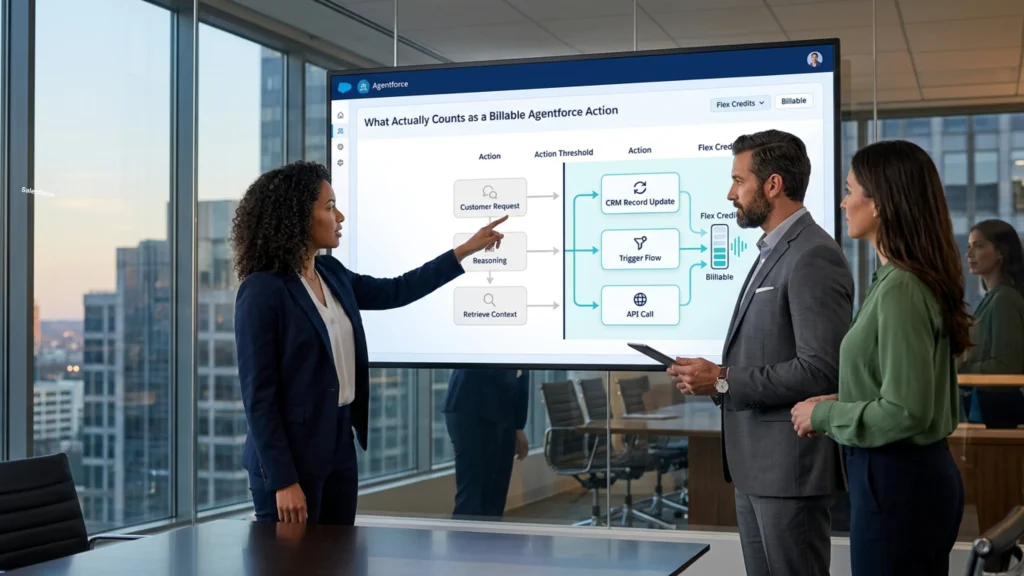
Not every step you can see in an agent’s trace carries an Agentforce action cost, and the distinction moves forecasts by a wide margin.
Salesforce’s billing documentation is direct about the trigger: “Agent actions are billed when they’re run, whether they’re run deterministically (for example, in reasoning instructions) or during agent reasoning with an LLM.” Taking the LLM’s choice out of an action does not make that action free.
The same page is equally direct about what falls outside the meter, and separating the two is the first thing our note on Agentforce for Service asks a support team to do: “Utilities (escalations to a representative, setting variables, or transitions to another topic) aren’t billed as agent actions.” An agent flow showing twelve steps might contain seven billable actions and five utilities.
VALiNTRY360 works each step through this sequence before it enters a model:
Step executes
→ Is it an action or a utility? Utilities stop here and cost nothing.
→ Is it text or Voice? Text uses 20 credits, Voice uses 30.
→ Is it production or pre-production? Text drops to 16, Voice to 24.
→ Does a product-specific billing page override the general counting rule?
→ Count one billable unit at the multiplier that survived those four checks.
That last branch matters more than it looks. The general Flex Credits billable usage types page says “every standard action called by the agent is metered as one standard action, irrespective of the number of tokens processed.” Salesforce’s Considerations and Limitations page for Agentforce for Pharmacy Benefits Reverification says the opposite for that feature: “Each standard agent action includes the processing of up to 10,000 tokens,” and “processing 20,001 tokens is 3 standard actions.”
Both pages are live today, and neither is wrong. The general rule holds unless the specific product you have deployed publishes its own counting limit, so every 20-credit figure in this article carries that qualification.
Check the billing page for your feature before you assume one action equals one charge. Under the general rule a 12-step flow is 12 charges; under the Pharmacy Benefits rule a single step processing 20,001 tokens is 3.
Standard and Custom Actions: Same Rate, Different Context
Building a custom action does not move you into a higher billing tier. The current card puts the Agentforce action cost for both at the same multiplier, and the differences sit everywhere except the rate card row.
Field | Standard Action | Custom Action |
|---|---|---|
Origin | Supplied by Salesforce and listed in the Standard Agent Action Reference, available as soon as the feature is enabled | Built by you in Agentforce Builder, or produced when a change to a standard reference action needs a replacement |
Production rate | 20 Flex Credits per call, which is $0.10 at the public rate of $500 per 100,000 credits | 20 Flex Credits per call, identical to the standard rate and unaffected by who built the action |
Sandbox rate | 16 Flex Credits per call, which is $0.08, and the card extends that rate to scratch orgs | 16 Flex Credits per call, again identical, so pre-production testing costs the same either way |
Licensing check | Per-user add-on required for Automotive, Communications, Financial Services, Manufacturing, Field Service and IT Service Desk actions | No add-on gate on the action itself, though anything it calls carries its own entitlement |
Billing check | Metered once per call under the general rule | Salesforce’s Generative AI Considerations for Agentforce Prospecting warns that “async calls to Salesforce AI in custom action implementation may incur additional charges” |
The action multiplier prices the call. Everything the call reaches prices itself, so a custom action that queries Data 360, runs a prompt template and hits an external API consumes 20 credits for the action plus whatever those three services charge under their own usage types.
Editing a standard action does not automatically create a custom one. Salesforce allows the underlying flow or prompt template of some standard actions to be edited while the action still uses the standard reference, and the classification changes only when the edit requires a replacement action. Sales teams designing action sets will find that workflow context in our guide to Agentforce for Sales.
How Prompt Credits Grow with Token Usage
Prompts are metered separately from actions, on their own four-tier scale, and the tier is only half of the Agentforce credit cost.
The four classes run Starter at 2 credits, Basic at 2, Standard at 4 and Advanced at 16, in production and sandbox alike. At the public rate that is $0.01, $0.01, $0.02 and $0.08 per billed prompt unit. Advanced Prompt metering is live: Salesforce’s Data 360 billing considerations documentation states that Salesforce “will start metering the use of Advanced Prompts on July 21, 2026,” which puts it about six weeks into effect at the time of writing.
The other half is the token rule. Salesforce’s Considerations for Agentforce Sales Management page documents prompt processing in units of up to 2,000 tokens, rounded upward, with a worked example: “a prompt with a total of 6,500 input and output tokens will be metered as 4 prompts.”
Run 6,500 tokens through each class and the spread opens up:
Starter, 4 units x 2 credits = 8 credits = $0.04
Basic, 4 units x 2 credits = 8 credits = $0.04
Standard, 4 units x 4 credits = 16 credits = $0.08
Advanced, 4 units x 16 credits = 64 credits = $0.32
One logical prompt became four billed units, and the Advanced class costs eight times the Starter class for the same request. A long system prompt, a large retrieved context and a verbose response all push token volume up, and every 2,000-token boundary crossed adds another unit.
Two qualifications keep this Agentforce credit cost accurate, and our Salesforce AI solutions practice checks both before a prompt template ships. The card’s prompt footnote scopes these multipliers to “Agentforce 1 Edition Customers and Agentforce for Sales/Service/Industries Customers and any other Products that no longer use Einstein Requests,” so some products still meter through Einstein Requests instead. And the 2,000-token rule appears on a feature-specific considerations page while the general billing page stays silent on it, which is the same qualification that applies to action token limits and which follows every prompt figure quoted here.
Identify the product and its billing model first, then the prompt class, then the token volume. Reverse that order and you get a number with more decimal places than evidence.
Voice Actions or Voice Minutes: Which Meter Applies
Voice has two meters, and running both against the same call double-counts your forecast.
Factor | Voice Actions | Voice Minutes |
|---|---|---|
Billing unit | One executed Voice action | One rounded-up minute |
Production multiplier | 30 credits, $0.15 | 60 credits, $0.30 |
Pre-production multiplier | 24 credits, $0.12 | 48 credits, $0.24 |
Where it is published | The main Flex Credits Rate Card | A supplemental card dated February 3, 2026 |
Forecasting input | Action count per call | Call duration |
Precedence is published and unambiguous. The supplemental card states that “the Agentforce Voice Actions usage types set forth on the Flex Credits Rate Card do not apply to Customers that have purchased Agentforce Voice Minutes and instead the Agentforce Voice Minutes usage type applies.” Salesforce’s Voice documentation repeats it: “When Agentforce Voice Minutes are available in your org, only Agentforce Voice Minutes are metered, and Voice Actions usage types are not applied to the same activity.”
Rounding is where minute-based forecasts drift, and it is the correction VALiNTRY360 makes most often on a voice estimate. The rule sits on the Voice considerations page while the multipliers sit on the card: usage rounds up to the next full minute, so 60 seconds bills as 1 minute and 61 seconds bills as 2. A queue of short calls averaging 70 seconds bills at twice the rate a naive duration model predicts.
Neither route is cheaper in the abstract. A four-action call billed as actions costs 120 credits. The same call running three minutes billed as minutes costs 180.
Change either number and the answer flips, so check which usage type your org has enabled in the Agentforce Voice considerations documentation and the Voice Minutes supplemental rate card before modeling either one.
Eight Rate Card Mistakes That Distort Credit Forecasts
Every Agentforce Rate Card mistake below comes from a rule Salesforce currently publishes, and each one moves a forecast in a predictable direction.
- Counting escalations, variable assignments and topic transitions as billable actions. Salesforce excludes all three, so a forecast built by counting every visible step in a flow runs high by however many of those steps are utilities.
- Budgeting a premium for custom actions. Standard and custom both sit at 20 production credits and 16 sandbox, so the premium overstates the license line and hides the real exposure, which is whatever the action calls.
- Treating a long prompt as one billed unit. A 6,500-token prompt bills as 4 units under the Sales Management considerations rule, so single-unit assumptions understate prompt spend by whatever multiple your token volume implies.
- Blending the four prompt classes into one average rate. Advanced costs eight times Starter, so a blended figure overstates cheap traffic and understates expensive traffic in the same model.
- Assuming pre-production is free. Sandbox actions cost 16 credits and sandbox Voice actions 24, the card extends both to scratch orgs, and prompts and Speech Foundations cost the same in either environment.
- Reading Testing Center as ordinary sandbox execution. Salesforce publishes two different answers on this, covered in the next section, so a forecast that picks one without saying which is guessing.
- Counting Voice Actions in an org where Voice Minutes take precedence. Voice Actions do not accrue on the same activity, so counting both inflates voice forecasts by roughly the ratio between the two meters.
- Filling in a TBA row with your own estimate. Headless Platform Interaction is published as TBA, the row exists because Salesforce has not set a multiplier, and a number invented there propagates through every total built on it.
What Testing, Sandbox and Scratch Org Usage Consumes
Development activity is the part of the forecast teams leave out, and one of the five states below is genuinely disputed in Salesforce’s own documentation.
- Building and configuration. Assembling topics, actions and instructions executes nothing, so nothing meters until an agent actually runs against a request.
- Builder preview. Salesforce publishes no metering rule for previewing an agent inside Agentforce Builder, and the builder overview pages are silent on credits, so measure it in Digital Wallet before you assume either answer.
- Testing Center. The considerations page says testing is unmetered as of Summer ’26; the overview page says running tests consumes requests and credits. Both are live, and the considerations page adds that Data 360 queries from Testing Center are still metered.
- Sandbox and scratch org. The August 31 card applies one multiplier to both: actions at 16 credits, Voice actions at 24, and prompts and Speech Foundations at their full production rate with no pre-production discount at all.
- Production. Full multipliers on every usage type, no discount anywhere, and the environment against which every other line in this list should be compared.
The Testing Center split is worth quoting in full. The Testing Center considerations page says that “as of Summer ’26, testing in Agentforce Testing Center is unmetered and doesn’t consume Einstein Requests or Flex Credits.” The Agentforce Testing Center overview page says “running tests consumes requests and credits.”
Until Salesforce reconciles the two, budget for the metered reading and measure the actual figure against Digital Wallet once agents are running.
Model pre-production explicitly. A team running a four-week action-tuning cycle across three sandboxes can consume a visible share of an annual entitlement before a single customer touches the agent, which is why our Agentforce Quickstart engagements meter the pilot from day one.
How Action Count Changes the Cost of a Single Task
The multiplier holds steady at 20 credits while the Agentforce action cost of a completed task moves with the number of actions the workflow fires. Salesforce’s own pricing page publishes worked examples ranging from one action to five.
The four models below are VALiNTRY360 calculations of Agentforce Flex Credits using Salesforce’s published public rate. They are arithmetic. None of them is a benchmark, a market average or a claim about any customer’s usage.
- Single lookup. 1 action x 20 credits = 20 credits = $0.10, matching Salesforce’s “Answer Question with Knowledge” example. Adjacent meter: none, unless the knowledge retrieval touches Data 360. What changes it: a long retrieved answer that pushes prompt tokens past a 2,000-token boundary and adds a prompt unit.
- Short workflow. 3 actions x 20 credits = 60 credits = $0.30, matching Salesforce’s case-management example of identifying a customer, retrieving their cases and adding a comment. Adjacent meter: prompt units for any generated summary. What changes it: an authentication retry that fires the identify action a second time.
- Multi-step workflow. 5 actions x 20 credits = 100 credits = $0.50, matching Salesforce’s field service example, which calls the appointment slot action twice inside one flow and sits at the center of our Agentforce Field Service work. Adjacent meter: Data 360 queries behind the scheduling lookup. What changes it: how many slots a customer reviews before accepting one.
- Extended workflow. 10 actions x 20 credits = 200 credits = $1.00, with no published Salesforce equivalent. Adjacent meters: prompts, Data 360 and external service calls. What changes it: whether the design consolidates steps into fewer actions or chains them one at a time.
Run the same four models in a sandbox and only the action line moves, because actions drop from 20 credits to 16 while any prompt or Data 360 consumption behind them stays at its production rate. Model 3 falls from 100 credits to 80 on the action line alone.
Model 1 and Model 4 differ tenfold in cost for one completed task at an unchanged multiplier, and that gap is a design decision made by whoever built the agent. Consolidating two lookups into one action saves 20 credits every time the workflow runs, which at 50,000 runs a month is 1 million credits, or $5,000 at the public rate.
What the Rate Card Looks Like at Real Volume
Small models make the arithmetic clear. Enterprise traffic is what shows whether the meter you land on matters, and Salesforce has published one deployment large enough to test it.
Salesforce runs Agentforce on its own Help site, which takes more than 60 million visits a year against a knowledge base of over 740,000 articles, both figures published on the customer story linked below. Customers searched that library, failed to find the right resource, and opened a case.
The published figures cover conversation volume, resolution rate, escalation rate, and the caseload human agents carried over the same period. Salesforce names Service Cloud and Data 360 as part of the deployment on the same page. Every number in the table is a direct quotation from that page.
Area | Figure as published by Salesforce |
|---|---|
Conversations handled | More than 1.7 million to date |
Resolution rate | About 76% of customer queries resolved without a human |
Escalation rate | 5% of inquiries escalated to a human Support Engineer |
Complex cases worked by humans in the same period | 1.3 million |
Now set the rate card against those volumes. Salesforce does not bill itself, so nothing below is a statement of what Salesforce paid or of which usage type it bought. Both figures are conditional arithmetic run on published volumes at the public rate.
If that traffic were billed as actions, at a conservative 3 actions per conversation, 1.7 million x 3 x 20 credits would be 102 million credits, which would be $510,000 at the public rate.
If the same traffic were billed as Help Agent Resolutions instead, the 76% that resolved would be roughly 1.29 million resolutions x 400 credits, which would be 516.8 million credits, or about $2.58 million.
Same workload, two published rows, a fivefold difference in the hypothetical total. The two meters do not stack either: Salesforce’s Flex Credits billable usage types page states that when a session is successfully resolved, “any Agentforce actions or Data 360 queries run during that interaction are included and not billed separately.”
Usage type does more to an annual number at this scale than the multiplier attached to it, and VALiNTRY360 runs this comparison first on any deployment above a few hundred thousand sessions. Every figure in the table comes from the Salesforce Help site deployment story.
What Else Appears on the 2026 Flex Credit Rate Card

Four more groups sit on the card, and each one prices something an Agentforce workflow can trigger. All multipliers below are read from the August 31, 2026 card.
Help Agent Resolutions. 400 credits in production and 0 in sandbox, which puts the production figure at $2.00 and makes pre-production testing of this usage type free. It is an outcome meter, so you are billed once for a resolved session and the steps inside it fall under that single charge. The billable usage types page splits it into four channel-specific types covering email, enhanced chat and portal, third-party messaging, and voice, so check which channels your contract covers.
Speech Foundations. Speech to Text at 150 credits per hour of transcription, which is $0.75. Text to Speech at 6,000 credits per million characters, which is $30. Translation at 4,000 credits per million characters, which is $20. All three carry the same multiplier in sandbox as in production, and per-hour and per-million-character units behave nothing like per-action ones, so confirm the unit before estimating anything.
Customer 360 Platform. The card lists Headless Platform Interaction as TBA, so there is no published multiplier and no dollar equivalent to derive from it. Check the hub again before you budget a headless workload, and design around the possibility that a number appears later in the year. Teams building in that direction will find the architecture context in our Agentforce Headless Agents overview.
Data 360. The card’s third page lists eleven Data 360 usage types, each with four production tiers and a flat sandbox rate, covering prep, unification, segmentation, activation, zero-copy sharing, queries, unstructured processing, intelligent processing, streaming pipeline, real-time pipeline and code extension. Volume tiers mean the multiplier falls as consumption rises, so a per-unit figure taken from the top tier misprices a large estate. Our Data 360 practice sizes that consumption against the agents that actually query it.
Two further meters sit outside those groups: Leads Worked at 400 production and 320 sandbox, which is $2.00 and $1.60, and Personalization Decisioning at 100 credits per thousand decisions, which is $0.50. Custom actions reaching outside Salesforce add exposure that no card row prices, and connecting those systems cleanly is what our Agentforce Integration Services team handles.
How Entitlements and Unmetered Use Change the Math
A published multiplier tells you how many Agentforce Flex Credits a unit consumes. Whether that consumption turns into a new invoice line depends on four things the card does not print.
- Included Flex Credits. Salesforce editions and add-ons grant credit entitlements on the Order Form, the figure our AI readiness assessment pins down first, and consumption still accrues at the rate-card multiplier while incremental spend starts only once the entitlement is exhausted. Verify the granted number against your contract, because Salesforce Agentforce pricing states those figures differently across its own pages.
- Unmetered user-based AI. Salesforce’s Considerations for Agentforce Employee Agent page states that “unmetered usage applies if a user has the Unmetered User-Based AI permission,” and its Metering for Agentforce and Generative AI Usage page adds that the usage must execute as the current user and is “limited to a maximum of 30 LLM calls per minute per user.” The exemption does not extend downward, since the Employee Agent page notes that credits can still be consumed by related features such as Agentforce Data Library or Audit and Feedback.
- Standard-action subscription requirements. A 20-credit multiplier prices consumption and leaves entitlement open, and the Standard Agent Action Reference attaches per-user add-on requirements to Automotive, Communications, Financial Services, Manufacturing, Field Service and IT Service Desk actions. Confirm the add-on exists before you plan a workflow around one of those actions.
- Product-specific metering. The card’s prompt footnote applies to products “that no longer use Einstein Requests,” and some products still use them. Read the billing page for the specific feature you have deployed instead of assuming the general card governs it, which is the same qualification that applies to the token rules above.
Answering these four before the build starts costs an afternoon. Discovering them in month three costs a quarter of the forecast. VALiNTRY360 treats the entitlement question as a separate exercise from the multiplier question, because the two fail independently and for different reasons.
Twelve Inputs to Collect Before Forecasting Flex Credits
Each input below has a place it can be read from. Together they cover every variable the Agentforce Rate Card leaves to you.
Input | Evidence to collect |
|---|---|
Agent type | Whether the agent is customer-facing, employee-facing or headless, read from its configuration |
Salesforce product | Whether Flex Credits or Einstein Requests apply, read from that product’s billing page |
User license and permission | Whether Unmetered User-Based AI is assigned, from the permission set assignment report |
Standard or custom action | The action’s origin in the builder, since the multiplier matches but maintenance and licensing do not |
Text or Voice | The action type itself, since channel names mislead and the gap is 20 credits against 30 |
Voice Actions or Voice Minutes | Which usage type is enabled in the org, because only one of the two applies |
Production or pre-production | Every environment that will execute agents, including scratch orgs at the sandbox rate |
Executions per business request | Action traces from a pilot, since one user message can fire five actions |
Prompt class | Starter, Basic, Standard or Advanced, read from the prompt template configuration |
Prompt token volume | Input plus output tokens sampled from real transcripts, since both count toward the 2,000-token unit |
Adjacent service usage | Data 360 queries, Speech Foundations and external API calls, traced across one complete workflow |
Entitlement and Order End Date | The granted credit figure and its expiry from the Order Form, noting that unused credits do not roll over |
How to Build and Validate a Monthly Flex Credit Forecast
The first four stages build the number. The fifth is what keeps it honest after the agents go live.
- Map every usage type the workload touches. Actions, Voice, prompts, resolutions, Speech Foundations and Data 360. A missing usage type is the most common reason a forecast lands low, and the twelve inputs above are what make the map complete.
- Apply the current multiplier to each. Take them from the live card each time, since a cached PDF goes stale within weeks. Salesforce revised the main Flex Credits card between June 17 and August 31 of this year alone, and the Voice Minutes supplemental card carries its own separate date.
- Forecast monthly units per type to get the Agentforce credit cost. Executions, prompt units, rounded minutes and resolutions. Use pilot measurements where you have them and label the rest as estimates so the two are never confused later.
- Total the credits. Sum units multiplied by multipliers across every applicable usage type to get total Agentforce Flex Credits. Multiply by $0.005 for a list-rate illustration, or by your contracted credit rate for a real budget figure.
- Compare the forecast against Digital Wallet. Salesforce’s usage documentation describes the chain as measurement, usage-type categorization, then conversion “by using a unit price or multiplier defined in the Agentforce Rate Card,” and points customers to Digital Wallet for metered usage. Salesforce’s Monitor Usage for Consumption-Based Products page adds that Digital Wallet updates several times a day, carries a Last Processed timestamp, and breaks consumption down by service, by day and by org, with production and sandbox tracked separately.
Two contract facts make that fifth stage a monthly job. Salesforce Agentforce pricing states there is “no overage penalty” and that exceeding entitlement bills “at your contracted rate billed monthly in arrears,” so overruns arrive as cost instead of as a service interruption.
Credits also expire at the Order End Date, so a large unused balance is a loss running in the other direction. The mechanics sit in Salesforce’s Agentforce and generative AI usage and billing documentation, and our Agentforce Managed Services team keeps the loop running after go-live.
Frequently Asked Questions
What is the Agentforce Rate Card?
It’s the Salesforce document that lists every metered Agentforce activity as a usage type, gives the unit being counted, and sets the Flex Credit multiplier consumed per unit. The current version is dated August 31, 2026 and is linked from Salesforce’s rate cards hub.
How much does one standard Agentforce action cost?
The Agentforce action cost is 20 Flex Credits in production and 16 in a sandbox or scratch org. At the Salesforce Agentforce pricing rate of $500 per 100,000 credits, that’s $0.10 and $0.08. Your contracted credit rate may differ from the public one.
Do custom Agentforce actions cost more than standard ones?
No. Both sit at 20 production credits and 16 sandbox credits. The difference shows up in what the action calls, since Salesforce warns that async calls to Salesforce AI inside a custom action implementation may incur additional charges.
How much does an Agentforce Voice action cost?
Standard and custom Voice actions both run at 30 Flex Credits in production and 24 in pre-production, which is $0.15 and $0.12 at the public rate. Orgs with Voice Minutes enabled bill at 60 credits per rounded-up minute instead, and Voice Actions do not apply to that same activity.
How are Agentforce prompts billed?
By class and by token volume. Starter and Basic are 2 credits, Standard is 4, Advanced is 16, in both production and sandbox. Each unit covers up to 2,000 tokens rounded upward under a feature-specific Salesforce rule, so a 6,500-token prompt bills as 4 units.
Does the number of tokens in an action change what it costs?
Salesforce publishes two answers. The general billable usage types page says a standard action is metered once “irrespective of the number of tokens processed,” while the Pharmacy Benefits page sets a 10,000-token limit per action and counts 20,001 tokens as 3 actions. Check your product’s billing page.
Does Agentforce sandbox testing consume Flex Credits?
Yes. The card applies a sandbox multiplier to pre-production environments “which include sandboxes as well as scratch orgs.” Actions cost 16 credits and Voice actions 24. Prompts and Speech Foundations carry the same multiplier in both environments.
Does Agentforce Testing Center consume Flex Credits?
Salesforce’s Testing Center considerations page says that as of Summer ’26 it’s unmetered and doesn’t consume Einstein Requests or Flex Credits, while the Testing Center overview page still says running tests consumes requests and credits. Data 360 queries from Testing Center remain metered either way.
Is every step inside an Agentforce workflow a billable action?
No. Salesforce states that utilities including escalations to a representative, setting variables and transitions to another topic aren’t billed as agent actions. Executed actions are billed whether reasoning selected them or instructions called them deterministically.
How do I estimate monthly Agentforce Flex Credits?
Multiply monthly units by the current multiplier for every usage type the workload touches, total the Agentforce Flex Credits, then convert at your contracted credit rate. Compare the result against entitlement, and validate it against Digital Wallet once the agents are live.
Related Posts
- Agentforce
Agentforce 1 Edition at $550 Per User Per…
Agentforce 1 Edition is the $550 per user per month tier Salesforce introduced in 2025 to sell CRM and agentic AI as one line item instead of a base license plus a stack of add-ons. On September 3, 2026, Salesforce…
- Agentforce
How to Avoid Flex Credit Runaway: 9 Ways…
Agentforce Cost Optimization starts at the moment an agent is designed, not when the first invoice arrives. A Salesforce agent does not spend money because it exists. It spends money when it interprets intent, retrieves context, calls a tool, writes…
- Agentforce
Agentforce $2 Per Conversation: What Counts as a…
Salesforce publishes one number for Agentforce, and it looks settled. $2 per Conversation. The billing event behind that number changes depending on which Agentforce product you run. ASA Messaging bills on a conversation window, Sales Coach bills when a seller…