

- Agentforce
Agentforce Cost Optimization starts at the moment an agent is designed, not when the first invoice arrives. A Salesforce agent does not spend money because it exists. It spends money when it interprets intent, retrieves context, calls a tool, writes back to a record, repeats a failed step, hands off to a person, or runs through a monitored usage type. That is why Agentforce Flex Credits behave less like a static license and more like a metered operating layer inside the workflow.
The public pricing signal is clear enough for planning. The Salesforce Agentforce pricing page lists Flex Credits at $500 per 100,000 credits, conversations at $2 per conversation, and Digital Wallet visibility for tracking Agentforce usage. Those numbers help, but they do not protect a buyer from Agentforce runaway costs. The risk sits inside the work. A routine support interaction can burn 5-8 actions after authentication, account lookup, knowledge retrieval, case update, escalation logic, and logging are counted.
That makes Agentforce cost control a design problem, a governance problem, and a managed-operations problem at the same time. A team can estimate Agentforce usage billing from a rate card, but the real bill depends on actions per support interaction, failed actions, repeated retrieval, voice usage, data readiness, testing volume, user adoption, and ownership discipline. A broader Agentforce pricing planning discussion should therefore separate the price of a credit from the behavior that consumes credits.
TL;DR
- Flex Credit runaway is usually a workflow issue. Agentforce Cost Optimization fails when teams model one average interaction instead of the actual sequence of actions inside each outcome. Agentforce Flex Credits may look predictable at the quote stage, then become Agentforce bill shock when real users create messy, repeated, or unsupported flows.
- Digital Wallet visibility helps, but it is not the whole control system. The Agentforce Digital Wallet can show usage, but Agentforce cost control still needs ownership, action limits, retry reviews, and monthly analysis by agent, intent, channel, action type, and outcome.
- The 5-8 action support interaction is the first warning sign. A simple support answer may only need two actions. A more realistic support interaction can require 5-8 actions before it is resolved, and complex workflows can exceed that. That is where Agentforce usage billing starts to surprise teams.
- Runaway costs come from small patterns repeated at volume. Failed tool calls, broad retrieval, voice actions, testing traffic, seasonal spikes, and employee overuse may look harmless in isolation. At scale, they create Agentforce credit consumption that finance did not approve and operations did not notice early enough.
- The right goal is cost per outcome, not lowest credit burn. AI agent cost optimization should ask whether credits produce resolved cases, faster handle time, fewer escalations, cleaner records, or better seller productivity. A cheap agent that creates rework is not optimized. An expensive agent that saves measurable time may be worth it if the model is understood.
The Direct Answer: Flex Credit Runaway Is Preventable, But Not Automatic
Cost Risk | What It Looks Like In Agentforce | Why It Surprises Buyers | First Control |
Action depth creep | A support flow grows from 3 actions to 8 actions after real data and escalations are added. | The estimate used demo behavior, not production behavior. | Measure actions per support interaction before launch. |
Retry and failure loops | The agent calls the same tool again after weak data, incomplete input, or ambiguous intent. | Failed attempts may still create operational cost and review effort. | Track failed actions and repeated retrieval separately. |
Voice and channel mix | Voice, chat, portal, email, and Slack use different patterns and action depth. | One blended average hides expensive channels. | Model every high-volume channel separately. |
Governance gaps | Agents get broad tool access and retrieve more context than needed. | Flex Credit usage monitoring starts after spend has already grown. | Restrict action menus and source access by use case. |
Ownership gaps | IT watches configuration, finance watches the invoice, and no one owns cost per outcome. | Agentforce cost overrun becomes visible too late. | Assign a business owner for every agent and wallet view. |
The direct answer is that Agentforce Cost Optimization is possible when the operating team treats credits as a live consumption system. It is not enough to know that Agentforce Flex Credits are available. The team has to know which agents are consuming them, why they are consuming them, and whether the consumption is tied to an outcome that matters.
The hard part is not the formula. The hard part is instrumentation. Agentforce runaway costs appear when the usage model is hidden inside the agent design. Cost control begins when every agent has a work unit, an action budget, a data boundary, a failure review, and a wallet owner.
Why Do Agentforce Bills Surprise Teams Before They Notice?
Agentforce usage billing is attractive because it lets teams scale AI without buying every capability as a fixed seat. The risk is that consumption-based AI pricing moves with behavior, not with the budget spreadsheet. A service agent does not ask whether finance planned for five actions or nine actions. It follows instructions, retrieves what it can, repeats when context is weak, and calls the tools it was allowed to use.
Salesforce Help explains that usage types are converted into Flex Credits through multipliers in the Agentforce rate card and that metered usage can be monitored in Digital Wallet through the Salesforce Agentforce usage and billing guidance. That is important because the Agentforce Digital Wallet gives visibility into consumption. But visibility is not the same as prevention. Prevention requires a design standard that keeps Agentforce credit consumption within the workflow’s value.
Gartner’s warning that more than 40% of agentic AI projects may be canceled by the end of 2027 because of escalating costs, unclear value, or inadequate risk controls through the Gartner agentic AI project forecast should be read as a budgeting warning. Agentforce bill shock is rarely one massive mistake. It is usually the accumulation of many small, unmanaged consumption behaviors.
The 9 Ways Agentforce Bills Surprise You
1. You Model Conversations, But The Bill Follows Actions
The first Agentforce cost overrun happens when buyers estimate conversation volume but ignore actions per support interaction. A customer may start one conversation, but the agent might authenticate the user, retrieve the account, check entitlement, read a policy, update a case, create a follow-up task, and log the result. That single interaction can burn 5-8 actions before it is complete. Agentforce Cost Optimization therefore needs an action map, not only a conversation forecast.
2. Retrieval Repeats Because The Knowledge Base Is Weak
Repeated retrieval is one of the most common causes of Agentforce runaway costs. When knowledge articles are duplicated, stale, regional, or poorly titled, the agent may retrieve too much context or retrieve again after an answer fails. That increases Agentforce credit consumption and creates trust issues. Cost control starts with source authority. The agent should know which repository wins, which document is retired, and which answer requires escalation. This is why Data 360 services belong in the cost discussion when the agent depends on governed customer, product, policy, or case context.
3. Tool Access Is Broader Than The Use Case Needs
An agent with too many tools can become expensive quickly. Broad access may look flexible in a demo, but it encourages unnecessary calls in production. If a password reset agent can call account history, entitlement, support history, billing, shipping, and order tools, the flow may become deeper than the problem requires. Agentforce cost control improves when each agent has a precise action menu. The smallest effective toolset is usually cheaper, safer, and easier to test than a large toolset.
4. Failed Actions Are Treated As Errors, Not Spend
Failed actions are often tracked as technical defects, but they are also cost signals. An agent may call an API with missing information, run into a permission boundary, retry a lookup, or hand off after partial work. Even when the customer outcome is not completed, the process still creates testing, monitoring, support, and sometimes credit consumption. Flex Credit usage monitoring should separate successful actions from failed actions so the team can see where the bill is rising without value.
5. Voice Usage Uses A Different Cost Shape
Voice can change the unit economics because voice interactions tend to include transcription, summaries, routing, verification, and follow-up. Even when the public rate card shows specific voice multipliers, the bigger issue is behavior. A five-minute chat and a five-minute voice call do not create the same action path. Agentforce Cost Optimization should model voice support separately from chat, portal, email, and Slack. Blending them creates Agentforce bill shock because the high-cost channel disappears inside the average.
6. Testing Traffic Burns More Than Expected
Testing is required, but it should not be invisible. Teams often run more prompts, retries, edge cases, role tests, and regression checks than the original budget assumed. That is healthy from a trust perspective, but it can still create Agentforce usage billing that finance did not expect. The Agentforce testing guide is relevant because safe deployment requires testing normal requests, unsupported prompts, permission boundaries, bad data, and failure paths. The cost model should include pre-production and regression usage.
7. Employee Agents Become Daily Habits
Employee-facing agents can create steady consumption because users ask questions all day. A service rep may summarize cases, draft responses, retrieve policies, check entitlements, and update records repeatedly. A sales manager may ask for pipeline analysis, opportunity risk, and account next steps every morning. Agentforce credit consumption then follows adoption. That is good only when the adoption improves work. For employee agents, Agentforce cost control should compare heavy, regular, and light users instead of multiplying one average across the whole company.
8. Seasonal Spikes Break The Average Month
Averages hide seasonality. Retail, healthcare, insurance, education, travel, and public sector workflows may spike around renewals, enrollment windows, holidays, claims periods, campaigns, and outages. If the agent is priced from an average month, peak periods create an Agentforce cost overrun. The better model includes normal month, peak month, and stress month scenarios. McKinsey’s 2025 AI survey notes that many organizations are still moving from experimentation toward scaling through the McKinsey State of AI 2025 survey. That maturity gap is exactly why peak usage should be modeled before rollout.
9. Cost Is Not Tied To Outcomes
The final surprise is strategic. Teams may track credits consumed, but not cost per resolved case, cost per qualified lead, cost per completed employee request, or cost per successful handoff. Without outcome measurement, Agentforce Cost Optimization becomes credit minimization rather than business optimization. Stanford HAI’s 2025 AI Index reports that organizational AI adoption rose to 78% in 2024 and generative AI use in at least one business function reached 71% through the Stanford AI Index economy data. High adoption makes measurement more urgent, not less urgent.
12 Flex Credit Cost Controls Buyers Should Put In Place Before Scaling Agentforce

1. Create An Action Budget For Every Agent
Every production agent should have a planned action budget. That budget defines how many actions a normal request should need, how many actions a complex request may need, and when the agent should stop and escalate. This is the practical center of AI agent cost optimization because it turns Agentforce Flex Credits into a controlled operating model rather than a vague usage pool. When the agent exceeds the action budget, the team should inspect intent, data quality, tool choice, and fallback behavior.
2. Separate Simple, Routine, And Complex Intents
One blended average is the fastest path to Agentforce bill shock. A two-action order-status request should not sit in the same average as an eight-action support issue or a twenty-action regulated workflow. The cost model should separate simple, routine, and complex intents. Then Agentforce usage billing can be reviewed by the intent family, not only by total wallet draw. That makes the source of runaway costs easier to identify.
3. Use The Agentforce Digital Wallet As A Review Tool, Not A Receipt
The Agentforce Digital Wallet should not be checked only after finance asks why credits are gone. It should be part of a regular operating review. The owner should review credits used by the agent, channel, use case, action type, and business owner. Agentforce Digital Wallet data becomes useful when it is paired with success metrics, failed-action data, and user behavior. Without that context, it shows spend but not cause.
4. Track Actions Per Support Interaction
Actions per support interaction should be a weekly or monthly metric for service agents. It tells the team whether workflows are getting deeper, cleaner, or messier. If a support agent moves from five actions to eight actions without better resolution quality, the workflow needs review. The metric also helps compare Agentforce Flex Credits against conversation pricing because action depth is the real cost driver.
5. Put Limits On Retrievers And Source Access
Over-retrieval can increase cost and reduce answer quality. Agents should not retrieve every available document just because the source is technically connected. Retrieval design should define approved sources, authority rules, retired content, regional rules, and fallback behavior. Salesforce data governance services matter here because data boundaries are also cost boundaries. Clean source access reduces repeated retrieval and lowers avoidable Agentforce credit consumption.
6. Review Failed Actions Separately From Failed Conversations
A failed conversation may include several successful actions and several failed actions. Looking only at the final outcome hides the internal spend pattern. Flex Credit usage monitoring should show whether failures are caused by missing data, permission problems, API errors, unclear prompts, or unsupported requests. When failed actions drop, Agentforce cost control improves even if total usage grows.
7. Build A Testing Wallet For Launch And Regression
Testing needs its own budget. Pre-launch tests, edge-case tests, role-based tests, prompt revisions, and regression checks create real usage. They should not be mixed with production assumptions. A testing wallet helps the team see how much spend is tied to safe deployment. It also prevents the common mistake of treating the first full production month as a surprise when the testing phase already showed action depth.
8. Monitor Voice As A Separate Channel
Voice-heavy workflows need a separate cost model and a separate Agentforce Digital Wallet review. Voice conversations often add transcription, summary, intent classification, workflow routing, and follow-up actions. That does not mean voice agents are a bad use case. It means Agentforce cost optimization should compare voice cost per outcome against current call center cost, not against chat action averages.
9. Add A Peak-Month Forecast
Seasonality should be in the first forecast, not the renewal conversation. Every model should include a normal month, a peak month, and a stress month. The peak model should show the impact of higher volume and deeper actions. If a peak month creates Agentforce runaway costs, the team can cap actions, route low-value requests differently, or reserve deeper flows for the highest-value cases.
10. Assign One Owner To Cost Per Outcome
Agentforce cost control fails when cost ownership is split across IT, finance, and operations without one accountable owner. Every agent should have a business owner who tracks cost per resolved case, cost per lead, cost per update, or cost per employee request. This owner should work with Salesforce admins and finance to explain whether higher Agentforce credit consumption is justified by higher value.
11. Review Governance Before Expanding Tool Access
New actions should not be added casually. Every new tool expands what the agent can do and what it can consume. Deloitte’s agentic AI research found that only 21% of surveyed organizations had a mature governance model in place through the Deloitte agentic AI governance findings. For Agentforce, AI agent governance controls should decide which actions are approved, reversible, logged, and worth the spend.
12. Use Managed Reviews After Launch
Agentforce Cost Optimization is not finished at go-live. Agent behavior changes when users change, data changes, policies change, and workflows expand. Agentforce managed services and Salesforce managed support services become relevant because ongoing reviews can catch credit drift, failed actions, prompt changes, data issues, and usage spikes before they turn into recurring Agentforce cost overrun.
The Cost-Control Operating Model
Control Layer | What To Monitor | Review Rhythm | Cost Question |
Usage | Credits by agent, channel, usage type, and owner | Weekly during launch, monthly after stabilization | Which agent is consuming more than expected? |
Workflow | Actions per support interaction, retries, escalations, and failed actions | Monthly | Is extra consumption producing a better outcome? |
Data | Source quality, retrieval misses, duplicates, retired content, and permissions | Monthly or after source changes | Is weak data making the agent work harder? |
Governance | Approved actions, human review, rollback, and audit logs | Release cycle | Are new actions worth the risk and cost? |
Value | Cost per resolved case, qualified lead, completed task, or successful handoff | Monthly and renewal cycle | Is the credit spent tied to business value? |
This operating model converts consumption-based AI pricing into a management practice. Agentforce Cost Optimization is not only about lowering the bill. It is about seeing where the bill comes from and deciding whether the spend belongs in the workflow.
The FinOps Foundation’s State of FinOps research notes that AI spend management is becoming part of cost and value management, with AI requiring attention to usage visibility, forecasting, and business value through the State of FinOps 2025 report. The same logic applies to Agentforce Flex Credits. The buyer needs allocation, forecasting, optimization, and value tracking. That is the discipline that prevents Agentforce bill shock.
Case Study: Agentforce Action Monitoring Prevented Flex Credit Cost Runaway
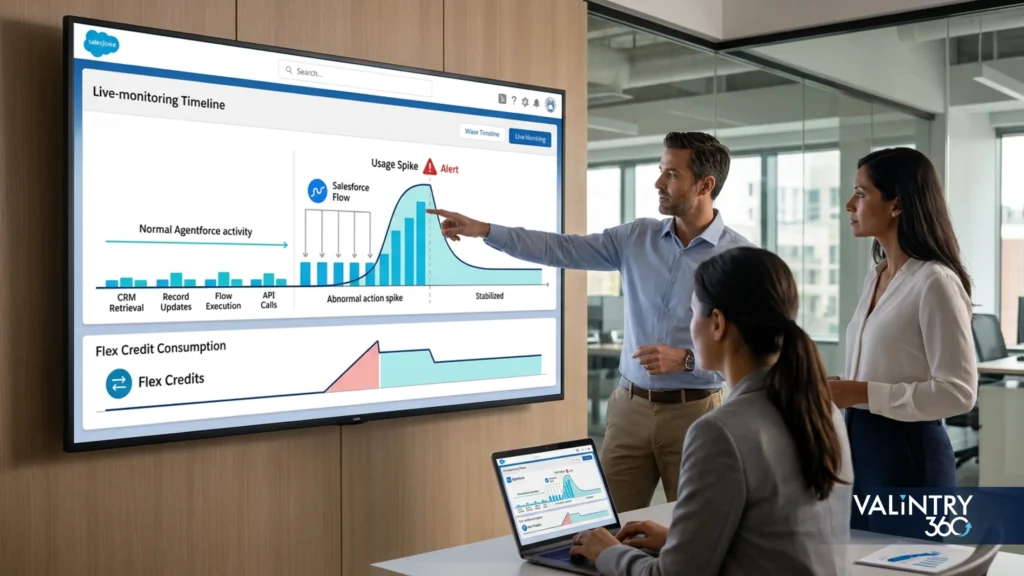
When A Simple Agent Became More Expensive Than Expected
A Salesforce service team planned to deploy an Agentforce support agent for approximately 30,000 monthly interactions. The initial forecast looked manageable because the team expected each interaction to require roughly three standard actions: identify the customer, retrieve the relevant knowledge, and provide an answer.
The problem was that the forecast measured conversation volume without measuring workflow depth.
Once realistic testing began, the team discovered that production-style support interactions often required authentication, account lookup, case-history retrieval, entitlement checks, knowledge retrieval, record updates, escalation logic, and logging. The typical interaction moved closer to 5–8 actions, while complex cases required even more.
That difference changed the expected Flex Credit consumption significantly.
The Cost Drivers We Found
The team reviewed the agent workflow instead of simply increasing the usage budget. Five patterns were responsible for most of the unexpected consumption:
- Repeated retrieval: Duplicate or weak knowledge content caused the agent to retrieve more context than necessary.
- Failed actions: Permission gaps and incomplete inputs triggered unsuccessful lookups and additional processing.
- Deeper workflows: Escalations and record updates added actions that were absent from the original estimate.
- Channel differences: Voice and chat were being treated as one blended usage pattern.
- Testing volume: Edge cases, retries, permission testing, and regression checks were not separated from production assumptions.
The issue was therefore not simply the price of Flex Credits. The real issue was how the agent performed work.
Rebuilding The Cost Model
Instead of forecasting one average cost for every interaction, the team divided the service workload into simple, routine, and complex intents.
Control Area | Before Review | After Review |
Cost model | Conversations only | Actions per interaction |
Simple requests | One blended average | Defined action budget |
Complex cases | Same forecast as routine work | Higher budget with escalation rules |
Failed actions | Treated mainly as technical errors | Tracked as consumption signals |
Channel usage | Chat and voice blended | Separate channel forecasts |
Wallet review | Periodic visibility | Regular operational review |
Cost metric | Total credit consumption | Cost per business outcome |
This gave the team a more realistic view of where Flex Credits were being consumed and why.
The Operating Changes
The team introduced an action budget for each agent and intent family. Simple requests were kept within tighter boundaries, while complex workflows received additional actions only where the business outcome justified them.
Knowledge sources were also reviewed to reduce unnecessary retrieval. Failed actions were monitored separately from successful interactions so permission problems, API failures, and missing data could be identified before they became recurring consumption patterns.
The Agentforce Digital Wallet became part of the operating review rather than a dashboard checked only after spending increased. Usage was examined by agent, intent, channel, action type, and business owner.
Testing also received its own usage allowance so that launch and regression activity would not distort the production forecast.
What Changed?
The team moved from asking “How many conversations will the agent handle?” to asking:
“How many actions does each business outcome require, and is that consumption producing enough value?”
That shift made the cost model more actionable. A two-action status request could be optimized differently from an eight-action service workflow. Voice could be forecast independently. Failed actions could be investigated as cost signals. New tools could be reviewed for both business value and consumption impact.
The Business Lesson
The project did not demonstrate that Flex Credits were inherently expensive. It demonstrated that unmodeled agent behavior can make a reasonable forecast unreliable.
Agentforce Cost Optimization became a workflow discipline: define the work unit, establish action boundaries, monitor consumption, review failures and repeated retrieval, separate channels, and connect credit usage to outcomes.
The key lesson for Salesforce buyers is simple: Flex Credit runaway usually starts inside the workflow—not on the invoice.
When action depth, data quality, tool access, testing, governance, and business outcomes are monitored together, teams can identify consumption problems early and scale Agentforce based on measurable value rather than assumptions.
How Governance Keeps Cost Control From Becoming Guesswork?
Governance is not only a risk topic. It is a cost topic. NIST’s AI Risk Management Framework organizes AI risk work around govern, map, measure, and manage functions through the NIST AI Risk Management Framework. That sequence maps well to Agentforce cost control. Govern who owns the agent. Map the workflow and data. Measure actions, failures, and value. Manage changes before the agent’s behavior drifts.
AI agent governance controls should be practical. They should define who can approve new actions, which sources the agent can retrieve, what usage threshold triggers review, what logs must be kept, when a human must approve an answer, and how wallet usage is explained. A governance model that does not touch spend will not stop Agentforce runaway costs. A spend model that does not touch governance will not stop risky over-automation.
What Not To Do When The Bill Starts Rising?
Do not cut Agentforce Flex Credits blindly. Lowering the wallet may only hide the real issue and reduce service quality. First, find which agents, intents, channels, and actions changed. Do not blame adoption before checking action design. Higher usage can be healthy if it produces lower handle time or better deflection. Do not compare every workflow to the same action budget. A password reset and a regulated service case should not have the same cost target.
Do not wait until renewal. The renewal conversation should summarize months of Agentforce Digital Wallet reviews, not reveal the first serious cost analysis. Do not assume the lowest credit burn is the best result. AI agent cost optimization should optimize cost per outcome. A workflow that spends more credits but removes expensive manual rework may be stronger than a cheaper workflow that leaves humans to clean up the case.
Do not treat Agentforce cost control as a one-time implementation task. The Agentforce consultant roadmap and governance checklist is useful because Agentforce work requires scope discipline, action boundaries, and operating ownership. Cost control is part of that lifecycle.
A Reusable Monthly Review Worksheet
Monthly Review Field | How To Read It | Warning Sign | Action To Take |
Credits used by agent | Compare actual usage with forecast by agent and owner. | One agent consumes a rising share without better outcomes. | Review prompts, actions, and source access. |
Actions per outcome | Divide actions by resolved cases, completed tasks, or qualified leads. | Action depth rises while success stays flat. | Tune the workflow and remove unnecessary steps. |
Failed and repeated actions | Count retries, permission failures, tool errors, and repeated retrieval. | Failures increase after a release or data change. | Fix data, permissions, API handling, or fallback logic. |
Channel mix | Compare chat, voice, portal, Slack, and email patterns separately. | Voice or employee usage exceeds the blended forecast. | Create a separate forecast and control threshold. |
Cost per business result | Tie spend to handle time, deflection, cycle time, rework, or revenue movement. | Credits grow but outcome value does not. | Pause expansion until the use case is redesigned. |
This worksheet keeps Agentforce Cost Optimization grounded in operations. The goal is not to make the Agentforce Digital Wallet a finance-only dashboard. The goal is to give service, sales, operations, IT, and finance the same language for Agentforce cost control.
The Honest Answer
Agentforce Flex Credits are not the problem. Unmodeled agent behavior is the problem. Flex Credits are useful because they let teams buy consumption, pilot carefully, and scale the workflows that prove value. They become risky when buyers estimate only conversation volume, ignore actions per support interaction, and review spend after the bill arrives.
Agentforce Cost Optimization works when every agent has an action budget, a data boundary, a tool boundary, a testing allowance, a Digital Wallet review, and a cost-per-outcome metric. Agentforce runaway costs usually start when those controls are missing. Agentforce bill shock usually ends when the team can explain why credits were consumed and what result those credits created.
The practical answer for buyers is to manage Agentforce usage billing as a living operating model. Start with a forecast. Launch with limits. Monitor Agentforce credit consumption by agent and intent. Review failed actions and repeated retrieval. Tie every credit pool to an outcome. Then expand only when the business case proves that the extra spend is improving service, productivity, revenue, or operational capacity.
Frequently Asked Questions
- What is Agentforce Cost Optimization?
Agentforce Cost Optimization is the practice of controlling Agentforce usage billing by managing actions, Flex Credits, Digital Wallet visibility, workflow design, data quality, governance, and cost per outcome. It focuses on why credits are consumed, not only how many credits were used.
- What causes Agentforce runaway costs?
Agentforce runaway costs usually come from underestimated action depth, repeated retrieval, failed actions, broad tool access, voice usage, testing traffic, seasonal spikes, and weak ownership. The common pattern is that the agent performs more work per interaction than the forecast assumed.
- What is the Agentforce Digital Wallet?
The Agentforce Digital Wallet is Salesforce’s usage visibility mechanism for tracking consumption. Buyers can use it to monitor credit use, but Agentforce cost control still requires operating reviews by agent, use case, channel, action type, and business outcome.
- How do Agentforce Flex Credits affect cost?
Agentforce Flex Credits are consumed when eligible usage types run. Cost depends on the number of actions, prompts, voice actions, or other usage types multiplied by the applicable credit multiplier and price per credit. That makes workflow design central to Agentforce Cost Optimization.
- What are actions per support interaction?
Actions per support interaction are the number of agent steps required to complete one support outcome. They can include authentication, account lookup, knowledge retrieval, entitlement check, case update, escalation, message generation, and logging.
- Why can a support interaction burn 5-8 actions?
A real support interaction often needs more than one answer. The agent may need to identify the customer, retrieve data, check rules, update records, log activity, and hand off when confidence or policy requires it. That is why a simple volume estimate can miss Agentforce credit consumption.
- How can buyers prevent Agentforce bill shock?
Buyers can prevent Agentforce bill shock by creating action budgets, separating intents, tracking failed actions, reviewing Digital Wallet usage monthly, monitoring voice separately, and measuring cost per resolved outcome. The goal is to see cost drivers before renewal.
- Is the lowest credit usage always best?
No. Low credit usage is not useful if the agent creates rework or poor outcomes. Agentforce cost control should optimize cost per business result, such as resolved case, completed task, qualified lead, or reduced manual effort.
- How often should Agentforce usage billing be reviewed?
Review Agentforce usage billing weekly during launch and monthly after stabilization. Reviews should compare forecasted credits with actual credits, identify failed or repeated actions, and assess whether spend is improving business outcomes.
- How does data quality affect Agentforce cost?
Poor data quality can increase retrieval, retries, failed actions, and human rework. Clean, governed data reduces avoidable Agentforce credit consumption and makes answers more reliable. Data quality is both a trust control and a spend control.
- What role does governance play in Agentforce cost control?
Governance defines who owns the agent, which actions are allowed, which sources can be used, when human review is required, and how changes are approved. Strong AI agent governance controls prevent risky and unnecessary consumption.
- Should voice usage be modeled separately?
Yes. Voice interactions can have different cost behavior because they may include transcription, summarization, routing, and follow-up actions. Voice-heavy workflows should have their own forecast and Agentforce Digital Wallet review.
- Can managed services reduce Agentforce cost overrun?
Managed services can reduce Agentforce cost overrun when they include usage reviews, failed-action analysis, prompt changes, release checks, source maintenance, and monthly cost-per-outcome reporting. They help catch drift after launch.
- What is the best metric for Agentforce Cost Optimization?
The best metric is cost per business outcome. Examples include cost per resolved case, cost per qualified lead, cost per completed employee request, cost per successful handoff, and cost per avoided manual task.
- What is the honest answer for buyers?
Agentforce Flex Credits are useful when behavior is measured and governed. They create risk when teams forecast only volume and ignore action depth, retries, data quality, voice usage, and human review. Cost control is an ongoing operating model.
Related Posts
- Agentforce
Agentforce Rate Card: Every Action Type and Its…
Salesforce prices Agentforce in Flex Credits. The rate card tells you a standard action costs 20 credits, and stops there. What a credit is worth, which of your agent's steps count as actions, whether your sandbox is cheaper, and why…
- Agentforce
Agentforce 1 Edition at $550 Per User Per…
Agentforce 1 Edition is the $550 per user per month tier Salesforce introduced in 2025 to sell CRM and agentic AI as one line item instead of a base license plus a stack of add-ons. On September 3, 2026, Salesforce…
- Agentforce
Agentforce $2 Per Conversation: What Counts as a…
Salesforce publishes one number for Agentforce, and it looks settled. $2 per Conversation. The billing event behind that number changes depending on which Agentforce product you run. ASA Messaging bills on a conversation window, Sales Coach bills when a seller…