
Salesforce Experience Cloud Implementation
End-to-end Experience Cloud implementation with secure portals and automated workflows
VALiNTRY360 provides expert Salesforce Experience Cloud Implementation, creating portals, communities, and digital experiences that connect customers, partners, and employees. Our approach combines secure access, real-time CRM data, and self-service capabilities to reduce service costs, improve engagement, and enhance partner performance. With tailored Salesforce Experience Cloud implementation services, we design solutions users enjoy, streamline workflows, and ensure seamless integration with existing Salesforce environments, delivering measurable business value and scalable digital ecosystems.
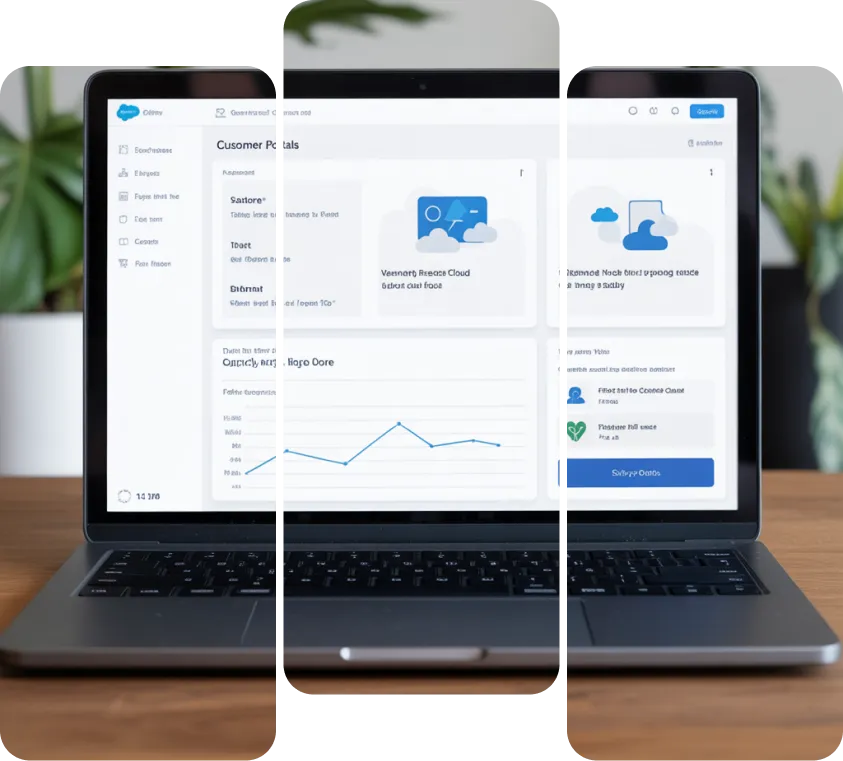
VALiNTRY360 Delivers Experience Cloud That Works for Your Business
We provide expert Salesforce Experience Cloud implementation that turns licensed Experience Cloud into a high-performing portal aligned with your business goals. We combine deep platform knowledge, strategy, and hands-on design to build portals, communities, and digital experiences that reduce service calls, improve self-service, and boost partner productivity. Our approach ensures solutions integrate with your data, processes, and user needs rather than relying on templates, delivering measurable business impact across customer, partner, and employee interactions.
36%
Avg reduction in support
case volume
2.8×
Higher partner revenue productivity
91%
Customers prefer self-service when it's easy to navigate
52%
Increase in user engagement across portals and communities
Experience Cloud in Salesforce: How the Platform Connects Your Users
Experience Cloud is Salesforce’s platform for creating connected digital experiences-portals, communities, and sites that extend CRM capabilities to customers, partners, and employees who need access to real-time data.
Digital Experience Platform
Build branded, role-based environments for your users, directly tied to your Salesforce data. Experience Cloud ensures each user sees relevant information while maintaining consistent branding and navigation.
Native CRM Integration
Unlike external portal solutions, Experience Cloud Salesforce is fully native, providing seamless access to cases, accounts, opportunities, and resources without complex API setups.
Low-Code, Configurable Builder
Experience Builder allows layout, navigation, branding, and components to be configured with minimal development effort, speeding implementation and simplifying maintenance.
Role-Based Access & Security
Profiles, permission sets, and sharing rules control access at the record level, ensuring users only see authorized data without compromising usability or security.
Einstein AI & Automation Ready
Experience Cloud works with Einstein AI for personalized recommendations, Einstein Search for smarter knowledge retrieval, and Salesforce Flow for automated workflows in your portals.
Mobile-Responsive by Default
All Salesforce Experience Cloud sites are responsive on mobile devices, and Salesforce Mobile Publisher can package portals as branded iOS or Android apps for consistent access anywhere.
Our Services: What We Delivers
We provide end-to-end Salesforce Experience Cloud implementation services, covering strategy, portal design, configuration, integration, workflow automation, user enablement, and ongoing support. Through our approach, we ensure every Experience Cloud portal connects users efficiently and delivers measurable business value.
We begin by understanding your business goals, user groups, and current Salesforce environment to create a tailored Experience Cloud architecture aligned with long-term engagement.
- Portal type and template selection
- User journey and experience mapping
- Data model and security architecture
- License and access model planning
Through our Salesforce Experience Cloud implementation, we configure, build, and test portals covering structure, navigation, components, branding, and access. We ensure every element is functional, secure, and aligned with the needs of your users.
- Experience Builder configuration
- Custom LWC component development
- Profile, permission, and sharing setup
- Branded theme and UX design
We integrate your Experience Cloud portal seamlessly with the Salesforce ecosystem and external systems. Our implementation ensures users have real-time access to cases, opportunities, accounts, and other CRM data without extra steps or duplication.
- Service Cloud case and knowledge integration
- Sales Cloud account and opportunity connectivity
- Third-party ERP and system integrations
- Data Cloud unified profile activation
Through our Experience Cloud services, we automate operational workflows, from case routing and approvals to onboarding and escalations. Our team designs automation that reduces manual effort, speeds processes, and improves portal efficiency for every user.
- Salesforce Flow automation design and build
- Approval process configuration
- Trigger-based notification workflows
- Automated onboarding sequences
We ensure your portal succeeds by driving adoption. Through training, onboarding programs, and change management, we help customers, partners, and internal teams engage fully with your Experience Cloud portal for long-term value.
- Administrator training and documentation
- User onboarding experience design
- Internal team change management
- Launch communication planning
Our team continues to monitor and optimize your Experience Cloud portal. We provide performance reviews, feature enhancements, Salesforce release support, and managed service options, keeping your portal efficient, relevant, and aligned with business goals.
- Usage analytics and performance reviews
- Feature expansion and enhancement sprints
- Salesforce release management support
- Managed services retainer options
Why Your Business Can’t Afford to Ignore Experience Cloud
Customer, partner, and employee expectations have changed. They want digital access, real-time data, and self-service options on their own schedule. Through VALiNTRY360’s Salesforce Experience Cloud implementation services, organizations can deliver these experiences efficiently while leveraging their Salesforce investment.

Customers Expect Digital Self-Service
Through our implementation, buyers can check order status, submit cases, view invoices, and access answers without contacting support. Well-designed Experience Cloud portals by VALiNTRY360 reduce service workload and improve user satisfaction.
Partner Programs Need Structured Infrastructure
Our team builds partner portals using Experience Cloud Salesforce that standardize deal registration, marketing fund access, co-marketing tools, and pipeline visibility, enabling partners to perform efficiently with minimal overhead.
Internal Teams Need Connected Workspaces
With VALiNTRY360’s Salesforce Experience Cloud services, employee communities centralize documents, training, workflows, and communications, helping distributed teams work consistently and effectively.
Existing Salesforce Investment Is Being Underutilized
Through our approach, Experience Cloud in Salesforce extends your Salesforce investment to external stakeholders without separate platforms, duplicate data models, or complex integrations.
Support Costs Are Rising Without a Deflection Strategy
By implementing self-service portals and AI-powered search through VALiNTRY360, organizations can deflect 30–40% of inbound support requests, reducing operational costs.
Disconnected Experiences Damage Brand Perception
Our Experience Cloud Salesforce implementation ensures consistent, branded, high-quality portals that build trust and reinforce your organization’s reputation at every digital touchpoint.
How We Helps You Overcome Common Experience Cloud Challenges
Through our Salesforce Experience Cloud Implementation services, VALiNTRY360 helps organizations unlock the full potential of Experience Cloud. Many businesses license the platform but struggle to deliver consistent, efficient, and scalable digital experiences. We address common challenges in customer, partner, and employee engagement while improving operational efficiency.
Customer Self-Service Efficiency
1/6Challenge: Customers often contact support for tasks they could complete themselves, increasing operational costs and response times.
Our Solution: Through VALiNTRY360’s Salesforce Experience Cloud implementation, we design intuitive self-service portals that allow customers to access invoices, submit support tickets, and check order status without contacting support, reducing case volume and improving satisfaction.
Partner Program Management
2/6Challenge: Manual partner tracking through spreadsheets and emails creates inefficiency and errors, limiting partner performance and growth.
Our Solution: Our Salesforce Experience Cloud implementation partner approach builds structured partner portals that standardize deal registration, co-marketing access, and pipeline visibility, enabling partners to operate efficiently while giving your team full oversight.
Employee Collaboration and Knowledge Sharing
3/6Challenge: Distributed teams often lack centralized access to documents, workflows, and training materials, causing miscommunication and inconsistent operations.
Our Solution: Through our Salesforce Experience Cloud services, we implement employee communities that centralize knowledge, processes, and communications, giving teams a single hub to work effectively and reducing operational friction.
Maximizing Existing Salesforce Investment
4/6Challenge: Many organizations underutilize Salesforce because external stakeholders cannot access relevant CRM data without complex integrations.
Our Solution: With VALiNTRY360’s Salesforce Experience Cloud expertise, we extend Salesforce data directly to customers, partners, and employees via native portals, eliminating the need for separate platforms or duplicated data models.
Reducing Support Costs
5/6Challenge: Rising support calls and emails without deflection strategies increase costs and burden service teams.
Our Solution: We leverage Salesforce Experience Cloud CMS and AI-powered search to create self-service knowledge bases and automated workflows, deflecting up to 40% of inbound inquiries while maintaining high service quality.
Ensuring Consistent Brand Experience
6/6Challenge: Fragmented or unbranded digital experiences diminish customer trust and partner confidence.
Our Solution: Through VALiNTRY360’s Salesforce Experience Cloud implementation, we design portals and communities with consistent branding, responsive design, and optimized user journeys, delivering a professional and cohesive digital presence at every touchpoint.
Core Capabilities That Make Experience Cloud Work for You
Through our Salesforce Experience Cloud implementation services, organizations gain portals, communities, and digital experiences designed to connect customers, partners, and employees efficiently. Our team leverages native Salesforce capabilities, AI-powered tools, and workflow automation to deliver scalable, secure, and measurable digital solutions that improve engagement, reduce support load, and optimize business processes across every stakeholder interaction.
Customer Self-Service Portal
Through VALiNTRY360’s Salesforce Experience Cloud implementation services, we build portals that let customers submit cases, track requests, access knowledge articles, view orders, update information, and communicate with your team, all directly connected to your CRM.
Partner Relationship Management Portal
Our Salesforce Experience Cloud Partners approach creates structured partner portals with deal registration, MDF requests, co-marketing libraries, pipeline visibility, and certification management, helping scale your partner program efficiently.
Discussion Communities & Peer Collaboration
With experience in cloud Salesforce communities, VALiNTRY360 designs moderated forums for customers, partners, or employees to post questions, share answers, and collaborate with experts, reducing one-to-one support while building a knowledge-sharing network.
Intelligent Knowledge Base & Search
Through Salesforce Experience Cloud CMS, we organize and surface knowledge articles with AI-powered search and Einstein recommendations, ensuring users find answers quickly, reducing case creation, and improving first-contact resolution.
Salesforce Flow Automation Within the Portal
VALiNTRY360 implements workflow automation within Experience Cloud portals, including case routing, approval chains, notifications, onboarding sequences, and escalations, all natively, eliminating the need for external automation tools.
Portal Analytics & Experience Intelligence
Through Salesforce Experience Cloud services, we track portal performance, user engagement, search success, case deflection, and community activity, giving actionable insights to continuously optimize customer, partner, and employee experiences.
Portal Use Cases:
Experience Cloud Portals Across Every Function
Through VALiNTRY360’s Salesforce Experience Cloud implementation services, organizations can deliver portals that connect customers, partners, and employees with the right information, workflows, and resources all in real-time and fully integrated with Salesforce.
Self-Service Case Management
Through our implementation, customers can submit cases, track progress, add comments, upload attachments, and receive automated updates without contacting support directly, improving efficiency and satisfaction.
Knowledge Base &
FAQ Portal
We create structured, searchable knowledge bases with AI-powered recommendations that allow customers to resolve common questions independently, reducing inbound case volume and increasing self-service adoption.
Account & Order Management
With VALiNTRY360’s Salesforce Experience Cloud services, customers gain direct visibility into account history, orders, invoices, contracts, and entitlements, eliminating repetitive support requests and freeing your team to focus on high-value tasks.
Customer Community & Peer Support
We enable moderated customer communities where users ask questions, share best practices, and interact with experts, building scalable peer-support networks that reduce one-to-one support and increase product adoption.
Deal Registration & Pipeline Management
Partners can register deals, track opportunity stages, and manage pipelines directly within the portal, using automated routing and approval workflows to reduce manual coordination and email dependencies.
MDF Request & Approval Workflows
Through our implementation, partners submit market development fund requests with automated approval routing, budget visibility, and reimbursement tracking, ensuring MDF programs scale efficiently.
Partner Learning & Certification Center
We deliver training content, product certifications, and onboarding paths directly in the portal, keeping your channel knowledgeable, compliant, and able to sell effectively.
Co-Marketing Asset Library
Our portals provide partners with on-demand access to approved marketing materials, product collateral, and brand assets, with access control to ensure the right materials reach the right partner tier.
Employee Intranet & Company Hub
VALiNTRY360 creates centralized employee portals for company announcements, policy documents, org charts, and operational updates, reducing reliance on email and improving information accessibility.
HR Self-Service & Request Management
We enable employees to submit PTO requests, access benefits, complete onboarding tasks, and track HR cases directly in the portal, reducing manual workload while improving the employee experience.
Field Team Operations Portal
Our implementation provides field teams with mobile-optimized access to accounts, cases, assets, and operational data, including offline capabilities for low-connectivity environments.
Cross-Departmental Collaboration
Through structured workspaces, cross-functional teams can collaborate on projects, share documents, manage tasks, and maintain records, all integrated with Salesforce workflows and data.
B2B Reorder & Account Portal
Through our Salesforce experience cloud services, business customers can place repeat orders, manage accounts, view pricing agreements, track purchase history, and submit billing inquiries, all within authenticated, ERP-integrated portals.
Service Contract & Entitlement Management
Customers and account managers gain visibility into contracts, entitlements, renewal dates, and SLAs, with automated alerts and renewal workflows embedded directly in the portal.
Digital Onboarding Experiences
VALiNTRY360 designs structured onboarding journeys that guide new customers through task assignments, resource delivery, and automated next-step progression to accelerate time-to-value.
Quote & Proposal Access Portal
We enable customers to review, accept, and digitally sign quotes and proposals, with CPQ integration ensuring accurate, real-time pricing and contract access for authorized users at any time.
Our Proven Experience Cloud Delivery Approach
Through our Salesforce Experience Cloud implementation services, we use a structured, phased methodology that reduces risk, controls scope, and ensures your portal launches on time while performing optimally for users and administrators alike.
Discovery & Requirements Definition
We engage stakeholders to capture objectives, user needs, and success metrics for your portal.
- Conduct sessions with stakeholders to understand business and user goals
- Document portal requirements, data needs, and process workflows clearly
- Deliver a readiness assessment guiding design, scope, and implementation
Architecture Design & Technical Planning
We define portal architecture, data models, integrations, and automation before configuration.
- Design data models, user profiles, permission sets, and sharing rules
- Map integrations, navigation, and automation requirements for clarity
- Document technical specifications to align VALiNTRY360 and client teams
Portal Build, Configuration & Customization
Our certified team configures the portal, adds branding, and builds custom components.
- Configure page layouts, navigation, components, and branded themes
- Develop custom Lightning Web Components for specialized portal needs
- Implement automation, approval workflows, and notifications via Flow
Testing, Security Validation & QA
We validate functionality, data access, integrations, and performance before launch.
- Conduct user acceptance testing with representatives from each audience
- Verify security, access controls, and data sharing function correctly
- Test integrations and performance for real-time data and load stability
Launch, Training & User Onboarding
We manage go-live, train admins, and support end-user adoption efficiently.
- Execute staged launch from sandbox to production with pilot users
- Deliver administrator training and documentation for internal management
- Provide user onboarding guides and communication templates for launch
Post-Launch Optimization & Ongoing Support
We monitor performance, resolve issues, and optimize portals continuously.
- Track portal usage, address post-launch issues, and review analytics
- Offer managed services and seasonal Salesforce release management
- Provide enhancements and proactive recommendations for portal growth

Robust Technical Architecture
1/4VALiNTRY360 designs Experience Cloud portals with a scalable, modular architecture that supports multiple user types and complex business processes. We optimize structure, navigation, and component placement for performance and future growth.
- Fast and reliable access across portals and devices
- A system designed to scale with business growth
- Smooth integration of new features or communities
Security & Access Control
2/4We implement role-based access, profiles, permission sets, and sharing rules to protect sensitive data without compromising usability. Our solutions meet enterprise security requirements and regulatory standards.
- Access only to the data they are authorized to see
- Compliance support for HIPAA, GDPR, SOC 2, and other standards
- Protection for CRM and portal data from unauthorized access
Salesforce & External System Integrations
3/4Through our Experience Cloud Salesforce services, we integrate portals with Service Cloud, Sales Cloud, ERP systems, marketing platforms, and other external applications to enable real-time data flow.
- Seamless access to CRM and external system data
- Accurate, up-to-date information across platforms
- Business processes without manual data entry or duplication
Mobile & Responsive Design
4/4VALiNTRY360 ensures all Experience Cloud portals are mobile-responsive and optimized for various devices. We also leverage Salesforce Mobile Publisher for branded native apps, enabling anytime, anywhere access.
- Access to portals and communities on any device
- A consistent user experience across desktop and mobile
- Improved adoption and engagement for customers, partners, and employees
Personalization & Optimization: Experience Cloud Portals That Adapt to Every User
Through VALiNTRY360’s Salesforce Experience Cloud implementation services, we ensure that your portals, communities, and digital experiences are built on a robust, secure, and scalable architecture. Our approach connects all stakeholders while maintaining data integrity, compliance, and seamless access to Salesforce and external systems.
Experience Cloud Expertise Across Every Sector
Through our Salesforce Experience Cloud implementation services, we deliver industry-specific portals, communities, and digital experiences. Our team aligns architecture, data models, compliance, and user journeys to the unique requirements of each sector, ensuring measurable business impact and user adoption.








Why VALiNTRY360:
The Partner That Delivers What Others Only Promise
Through VALiNTRY360’s Salesforce Experience Cloud implementation services, we combine deep Salesforce expertise, industry knowledge, and user-focused design to deliver portals, communities, and digital experiences that go beyond features solving real business challenges while maximizing your Salesforce investment.
- Expert Experience Cloud Specialists
Our team holds advanced certifications in Salesforce Experience Cloud, Sales Cloud, Service Cloud, Data Cloud, and MuleSoft. Through VALiNTRY360, every portal implementation is managed by certified experts, ensuring quality, technical accuracy, and no reliance on subcontractors for critical components.
- Over Years of Salesforce Platform Depth
We have been building on Salesforce since its early releases. Through our experience, we understand component interactions, configuration limits, and long-term maintainability, enabling salesforce experience cloud implementation that performs reliably years after go-live.
- Outcomes-Driven, Not Feature-Driven
We focus on solving real business challenges — reducing support costs, improving partner performance, and enhancing customer retention. Every decision through VALiNTRY360’s experience cloud salesforce services is evaluated against measurable business outcomes, not just portal features.
- User Experience Built In, Not Added On
Portal adoption depends on quality UX. Through our salesforce experience cloud implementation partner services, we incorporate user journey design, information architecture, and usability principles from the start, ensuring portals are intuitive, engaging, and widely adopted.
Salesforce Experience Cloud Implementation Services
Experience Cloud Implementation Led by Certified Experts
Launching a portal means getting licenses, sharing rules, branding, and data access right from day one. VALiNTRY360's team holds Experience Cloud Consultant, Platform App Builder, Platform Developer, and Platform Administrator II certifications, so we build responsive sites, configure secure external access, develop Lightning components for custom needs, and connect everything to your core Salesforce data. You launch a portal users adopt quickly, with a Salesforce-Branded Partner since 2018.
Salesforce Credential Deck
4 Core Specializations
- CERTIFIEDPlatform Developer
Salesforce Experience Cloud Implementation FAQ by VALiNTRY360
Yes. Through our salesforce experience cloud implementation services, we customize portals to reflect unique workflows, approval processes, and data structures, ensuring every portal supports your specific business objectives while remaining secure, scalable, and user-friendly.
We manage controlled go-lives, pilot testing, and step-by-step migration. With experience cloud salesforce expertise, we ensure your portal transitions smoothly, avoiding downtime, data errors, or integration issues, while maintaining alignment with your broader Salesforce environment.
Absolutely. Our team connects Experience Cloud portals to ERP, HR, marketing, and other third-party systems. Through salesforce experience cloud services, users gain real-time access to unified data, ensuring workflows are seamless and business operations remain efficient.
Through our implementation, portals include analytics dashboards tracking user engagement, case deflection, portal adoption, and performance metrics. VALiNTRY360 ensures actionable insights are available to optimize every experience and drive measurable business outcomes.
Yes. We design salesforce experience cloud implementation solutions for global organizations, including multiple languages, locale-specific content, and region-specific compliance, ensuring consistent and secure portal experiences for customers, partners, and employees across all locations.
Through VALiNTRY360’s experience cloud salesforce services, portals remain flexible. We provide post-launch optimization and managed support for updating themes, branding, navigation, and layouts, allowing your portal to evolve alongside business changes and user requirements.
We combine UX-focused design, structured onboarding, training programs, and adoption monitoring. VALiNTRY360 ensures salesforce experience cloud implementation results in portals that users understand, engage with fully, and rely on for daily operations and collaboration.
Yes. We configure Salesforce Flow, Einstein AI recommendations, automated workflows, and notifications within Experience Cloud portals. Through experience cloud salesforce, users experience faster approvals, smarter knowledge retrieval, and improved operational efficiency across all processes.
VALiNTRY360 implements enterprise-grade security architecture with role-based access, sharing rules, encryption, and compliance controls. Our salesforce experience cloud services ensure your portal meets GDPR, HIPAA, SOC 2, and industry standards while protecting sensitive user and business data.