
- Agentforce
Salesforce Dreamforce 2026 wrapped up on September 17 at Moscone Center in San Francisco, and here is the one-line summary: this was the year Salesforce told the world its own user interface is optional. The headline announcement was AIforce, a “live interface layer” that carries your Salesforce data, workflows, permissions, and governance into Claude, Slack, and whatever AI tool your people already use. Right behind it came Koa (Salesforce’s first CRM reasoning model), a family of seven ready-to-deploy agents, and bigger partnerships with Google Cloud, AWS, and Siemens.
That is a lot to absorb in three days. Our team at VALiNTRY360 followed every keynote, press release, and session from this year’s Dreamforce conference so you don’t have to. In this guide we’ll walk you through what Dreamforce is, what was announced (all fourteen announcements, not just the headlines), who spoke, how 2026 built on Salesforce Dreamforce 2025, what’s coming at Dreamforce 2027, and what it all means for your Salesforce roadmap.
Dreamforce 2026 in Brief
- Dates and venue: September 15 to 17, 2026, Moscone Center, San Francisco, with free streaming on Salesforce+
- Theme: “Becoming an Agentic Enterprise”
- Headline announcement: AIforce, launching with Claudeforce, Slackforce, and Agentforce Coworker
- New model: Koa, a CRM reasoning model built with NVIDIA on Nemotron 3 Super
- New agents: Casey, Fin, Paige, Carter, Hunter, Marshall, and Piper
- Partnerships: Expanded Google Cloud, AWS, Siemens, and Anthropic collaborations
- Speakers: Marc Benioff with Dario Amodei, Jensen Huang, Sam Altman, Roland Busch, Omar Sultan Al Olama, and Travis Kalanick
- Dreamfest: Usher and Gwen Stefani at Oracle Park on September 16
- Next year: Dreamforce 2027 runs September 21 to 23, 2027, in San Francisco
What Is Dreamforce?
Dreamforce is Salesforce’s annual flagship conference, held each fall in San Francisco, where the company unveils its biggest product announcements, hosts thousands of learning sessions, and brings together customers, partners, developers, and admins from around the world. It is the single most important event on the Salesforce calendar and, over the past few years, one of the largest AI-focused business conferences anywhere.
If you searched “what is dreamforce” hoping for the short version, here it is: part product launch, part training event, part networking gathering, and part music festival. Salesforce uses the Dreamforce stage to set its product direction for the year ahead, which is why the announcements matter to anyone who runs their sales, service, marketing, or commerce operations on the platform.
Who Attends Dreamforce and Why
The Dreamforce conference draws a mix of audiences. Business leaders come to understand where Salesforce is heading and what to budget for. Admins and developers come for hands-on training, certification prep, and the role-based keynotes. Partners and ISVs come to meet customers and show off integrations. And plenty of people come simply because the Salesforce ecosystem is a career, and Dreamforce San Francisco is where that career community gathers.
Salesforce and Dreamforce: Why the Event Shapes the Roadmap
The relationship between Salesforce and Dreamforce is unusually tight. Most enterprise software companies announce products throughout the year. Salesforce concentrates its most consequential launches into three days each fall, then spends the following twelve months delivering on them. That means what happens at SFDC Dreamforce is a reliable preview of what will show up in your org’s release notes over the next year.
A Brief History of Dreamforce
Dreamforce began in 2003 as a modest customer gathering and grew into the largest software conference in the world, at one point exceeding 170,000 registrations. Recent editions map neatly onto Salesforce’s AI journey: generative AI in 2023, the Agentforce debut in 2024, Agentforce 360 and Data 360 in 2025, and now AIforce and Koa in 2026.
Dreamforce 2026 Overview: Dates, Venue, Theme, and Format
Dreamforce 2026 ran September 15 to 17 at Moscone Center in San Francisco, with the main keynote and hundreds of sessions streamed free on Salesforce+. The stated theme was “Becoming an Agentic Enterprise,” a continuation of the agentic message from Salesforce Dreamforce 2025 but with a decisive shift toward interfaces, models, and partnerships.
|
Detail |
Dreamforce 2026 |
|
Dates |
September 15 to 17, 2026 (Trailblazer Bootcamp September 12 to 14) |
|
Venue |
Moscone Center (North, South, West), San Francisco |
|
Theme |
Becoming an Agentic Enterprise |
|
Format |
In person plus free Salesforce+ streaming (September 15 to 18) |
|
Sessions |
1,600+ breakouts, 50+ keynotes, 150+ hands-on trainings, 240+ community roundtables |
|
In-person attendance |
Roughly 43,000 according to industry coverage; official figures pending |
|
Dreamfest |
Usher and Gwen Stefani, Oracle Park, September 16 |
|
Investor Day |
September 16, 1:00 PM PT, St. Regis San Francisco |
How the Three Days Were Structured
Day one belonged to Marc Benioff’s main keynote, which ran the full two hours and packed in AIforce, Koa, Customer 360 updates, and three separate guest conversations. Day two, the busiest of the three, brought the Agentforce keynote titled “From Fast Start to Real ROI,” Investor Day, the Siemens conversation, and Dreamfest. Day three closed with the Admin Keynote, “Bring the Agentic Enterprise to Life,” and a conversation with Travis Kalanick.
The Backdrop: AI Safety Took the Main Stage
Dreamforce 2026 landed in the middle of an industry-wide debate about whether AI is moving too fast. The CEOs of NVIDIA, OpenAI, and Anthropic all appeared on the same stage in the same week, one day after Jensen Huang publicly pushed back on calls from Sam Altman and Dario Amodei to slow the pace of development. That context gave this year’s Dreamforce Salesforce keynotes an unusual weight beyond product news.
What Was Announced at Dreamforce 2026? Every Major Announcement Explained
Most recaps of Salesforce Dreamforce 2026 stop at four or five headlines. We went through the keynotes, every Salesforce press release, and the analyst coverage from the show floor, and we count fourteen distinct announcements that deserve a proper explanation. Some landed on the keynote stage on September 15. Others were announced in the weeks before and set up the whole event. Here is every one of them, in plain English, with what it actually does and what it means for your business. Start with the table if you want the overview, then read the entries that matter to you.
|
# |
Announcement |
What it is |
Availability |
|
1 |
AIforce |
Live interface layer that brings Salesforce into any AI tool |
Launched September 15 |
|
2 |
Claudeforce |
Salesforce inside Claude and Claude Cowork |
Open beta |
|
3 |
Slackforce |
Salesforce inside Slack with Surfaces, Slackbot, Slack CRM, Slack Code |
Beta |
|
4 |
Agentforce Coworker |
AI teammate inside the Lightning interface |
Generally available |
|
5 |
Koa |
First CRM reasoning model, built with NVIDIA |
Pilot |
|
6 |
Enterprise AI Harness |
Six-product architecture including Salesforce Guardian and Agent Fabric |
Rolling out |
|
7 |
Seven job-ready agents |
Casey, Fin, Paige, Carter, Hunter, Marshall, Piper |
GA except Hunter (November 2026) |
|
8 |
Customer 360 updates |
New agents and features across nine product areas |
Varies by product |
|
9 |
Google Cloud partnership |
Hyperforce on Google Cloud, Gemini Enterprise, UCP commerce |
Phased through fall 2026 |
|
10 |
AWS partnership |
Amazon Quick, Bedrock models, Agentforce Voice with Amazon Connect |
Phased through fall 2026 |
|
11 |
Siemens partnership |
Agentforce with Teamcenter SLM for industrial sales and service |
Announced September 15 |
|
12 |
Headless 360 and MCP |
60+ MCP tools exposing every cloud to any agent |
Open beta and GA components |
|
13 |
Product naming reset |
“Agentforce” dropped from CRM app names |
Observed, not formally announced |
|
14 |
Trust, education, and adoption metrics |
Zero data retention pledge, $27M grants, 30K Agentforce customers |
Announced September 14 to 15 |
1. AIforce: The Live Interface Layer
AIforce was the single biggest announcement of Salesforce Dreamforce 2026. Salesforce describes it as a live interface layer that brings the full power of Salesforce to wherever people and agents work. What does that mean in practice? It means your employees no longer have to open a Salesforce tab to look up a record, update an opportunity, or trigger a workflow. They can do it from Claude, from Slack, or from an AI assistant embedded in Lightning, and the answer comes back with the same permissions, business rules, and governance that apply inside the app.
AIforce sits on top of what Salesforce now calls the Agentic Enterprise stack. Data 360 provides harmonized data, metadata, and memory. Customer 360 provides business logic, processes, permissions, and actions. Agentforce supplies the digital workforce. AIforce is the delivery layer that makes all of it accessible through virtually any AI interface. On stage, Benioff framed it as “AI replaces the UI” and called it “a whole new layer for your systems.”
Salesforce is being careful about how it describes what AIforce is not. It is not a standalone app, and it is not a new permissions model. Admins connect once and access follows whatever permissions already exist. That design choice is the heart of the pitch: your existing security model becomes the boundary for every new surface.
What it means for your business: AIforce shifts the question from “how do we get people to log into Salesforce?” to “how do we get Salesforce to show up where people already are?” That is a meaningful change for adoption, especially for frontline roles that have historically resisted CRM data entry. It also raises the stakes on data quality and permission hygiene, because every gap in your org becomes visible in every interface at once. Our Salesforce integration consulting team has been fielding exactly these questions since the keynote.
2. Claudeforce: Salesforce Inside Claude
Claudeforce is the first of AIforce’s three launch surfaces and the product of Salesforce’s expanded partnership with Anthropic. Announced in late August and formally launched at Dreamforce, it packages Salesforce data, permissions, and a library of prebuilt sales skills into a ready-made MCP server that runs inside Claude and Claude Cowork. A user can ask for an update across their deals, get an answer grounded in live CRM data, and then take action on those deals without entering Sales Cloud.
Claudeforce is now in open beta. Customers can install it from AppExchange into a Claude Enterprise account or find it in Claude’s Enterprise Marketplace. Anthropic’s head of enterprise products described the security model simply: Claude only sees what the person is allowed to see, because users authenticate with their own credentials. Salesforce and Anthropic ran Claudeforce internally as “customer zero” with roughly 4,000 daily active users before opening it up.
Patrick Stokes, Salesforce’s president of applications, demonstrated the Sales Cloud in Claude skill live on stage and announced it is available in open beta at no additional cost. Developers get a Salesforce Development plugin for Claude Code with more than 40 skills. Rohan Kumar, Salesforce’s president of platform and engineering, suggested that over time Claude Cowork users will be able to build entirely new custom interfaces on top of Salesforce data through natural language instructions alone.
What it means for your business: If your sales or service teams already use Claude, Claudeforce removes a real friction point. But it also means governance decisions about which AI assistants can touch CRM data are now urgent rather than theoretical. Our Agentforce governance framework covers the questions we walk clients through before switching this on.
3. Slackforce: Salesforce Inside Slack
Slackforce applies the same architecture to Slack. It is essentially the next evolution of Slackbot, with one significant addition called Slack Surfaces, which let Slackbot generate rich, interactive Salesforce interfaces directly inside a Slack conversation. Benioff previewed it on X a week before the event as “a live Salesforce UI” spanning Sales, Service, Marketing, Tableau, Data 360, and Slack with governed access in the flow of work.
Slackforce bundles four capabilities. Surfaces provide live, shareable interfaces. Slackbot acts as a reasoning assistant across Slack and CRM data. Slack CRM lets users update Salesforce records from a Slack prompt. Slack Code enables multiplayer coding sessions in Slack, with Claude as a founding partner. Claude is the default model for Slack AI and Slackbot under the Claudeforce partnership, and Salesforce reports Slackbot is driving 8.1 million hours of annualized productivity gains internally.
What it means for your business: Slack has quietly become Salesforce’s most important interface, and Dreamforce 2026 made that official. Organizations that have kept Slack and Salesforce loosely connected should revisit that architecture. Our guide to integrating Slack with Salesforce explains the patterns that make Slackforce useful rather than noisy.
4. Agentforce Coworker: The AI Teammate in Lightning
Agentforce Coworker is the third AIforce surface, and the only one immediately generally available. First announced in May 2026, it embeds an AI teammate inside the existing Lightning experience for organizations that want an agentic layer without leaving the interface their teams already know. It reasons across accounts, history, and related records, surfaces insights, and takes actions within the user’s existing permissions.
The proof point Salesforce chose was Adecco Group. Its CEO, Denis Machuel, joined Benioff on stage to describe a rollout of Agentforce Coworker across more than 40 countries following a successful pilot in the UK and France. That sequencing, pilot in two markets and then scale, is a useful template for any enterprise planning its own deployment.
What it means for your business: Coworker is the lowest-risk entry point into AIforce because it changes nothing about where work happens. For teams still building Lightning habits, it is the logical first step. Our Agentforce consulting practice typically recommends starting here before expanding to Claudeforce or Slackforce.
5. Koa: Salesforce’s First CRM Reasoning Model
Koa is a purpose-built reasoning model for CRM work. Think of it as a model that has been trained to think like an experienced Salesforce admin rather than a general chatbot. Salesforce developed it with NVIDIA by post-training the Nemotron 3 Super open model with a proprietary synthetic dataset modeled on nearly 27 years of Salesforce deployment knowledge. Salesforce is emphatic that no customer data was used in training and that it controls the model weights and runs inference inside its own trust boundary.
The performance claim is that Koa matches or exceeds leading frontier models on CRM actions with three times fewer errors. Salesforce positions it for long-running, multistep enterprise workflows, and Rohan Kumar gave the example of a service agent working out the next best step in a complicated customer case. Named pilots include 1-800Accountant, Baxter Credit Union, Engine, Formula 1, UChicago Medicine, and Xero. Kumar described the model as still in its early innings.
What it means for your business: Koa signals that Salesforce believes enterprise AI needs domain-specific models rather than general-purpose ones alone. For buyers, the practical guidance is patience: the benchmark is Salesforce’s own, the pilots are ongoing, and Koa is meant to become one option in a model layer rather than a mandatory replacement. Model choice is now an architecture decision, and it belongs in your roadmap discussion.
6. The Enterprise AI Harness: Six Products Becoming One Control Plane
If AIforce was the headline, the Enterprise AI Harness was the blueprint. Announced on September 10 and explained in depth during the keynote, it is the architecture the entire week sat inside. Salesforce’s argument is that frontier models are intelligent but know nothing about a specific organization, so they need a “harness” that supplies context, memory, and governance. The harness consolidates six products:
- Informatica discovers, catalogs, and curates data assets across lakehouses, warehouses, and SaaS apps
- Data 360 turns curated data into context, including zero-copy access across systems
- Tableau builds the business semantic layer so every agent shares one definition of terms like revenue or ARR
- Salesforce Guardian, formerly the Einstein Trust Layer, handles security and governance and adds agent identity capabilities that constrain agents beyond the user’s permissions
- MuleSoft Agent Fabric manages the digital workforce through a single registry that tracks performance, monitors cost, and governs agents at scale
- Agentforce Studio is where teams build AI-led experiences on top of the harness
Kumar was candid that these are separate products today and that Salesforce is working to simplify them into a single composable platform he called an AI Control Plane.
What it means for your business: The Harness is the clearest map yet of how Salesforce’s acquisitions and products fit together. It also tells you where the work is: data curation, semantic definitions, and agent governance are prerequisites, not afterthoughts. Our Salesforce Data 360 practice starts every AI engagement at this layer for exactly that reason.
7. Seven Job-Ready Agents
Shortly before Dreamforce, Salesforce announced a portfolio of seven prebuilt agents, each named and scoped to a job rather than a feature. Business users can configure them without IT involvement, which represents a real shift from the “build your own agent” message of Salesforce Dreamforce 2025.
|
Agent |
Job it does |
Status |
|
Casey |
Resolves customer queries across voice, SMS, WhatsApp, and chat; already used on help.salesforce.com |
Available |
|
Fin |
Customer service agent from Salesforce’s Fin acquisition; works across multiple CRM systems |
Available |
|
Paige |
Resolves employee IT and HR requests across Slack, portals, and agentic interfaces |
Available |
|
Carter |
Shopping assistant that helps customers discover, compare, and purchase in natural language |
Available |
|
Hunter |
Outbound sales agent that builds pipeline, engages leads, and prepares forecasts |
Pilot; GA expected November 2026 |
|
Marshall |
Builds and runs supply chain and finance processes, assigning back-office agents to each step |
Available |
|
Piper |
Engages, qualifies, and converts inbound B2B leads across websites and inboxes |
Available |
Stokes acknowledged the reasoning directly: handing customers a platform and saying “build an agent” creates friction, so for common use cases Salesforce now ships agents that work out of the box.
What it means for your business: Prebuilt agents lower the barrier to a first deployment dramatically, but “configure without IT” does not mean “deploy without governance.” Each agent inherits your data, knowledge, and permission model, so the quality of those inputs determines the quality of the agent. Our Agentforce readiness assessment exists to check those inputs before an agent goes live.
8. Customer 360 Updates Across Nine Product Areas
Benioff and Stokes walked through a broad set of Customer 360 updates spanning nine product areas. The items called out on stage included:
- Sales Cloud: New agent capabilities and the Sales Cloud in Claude skill
- Service Cloud: Updates tied to the global Agentforce Contact Center push
- Marketing Cloud: A new campaign agent that Benioff said “builds campaigns by itself”
- Commerce Cloud: A shopper agent, agentic commerce search, and headless B2B commerce
- Field Service: Voice-to-form capture in multiple languages and a new scheduling agent
- Frontline workforce management: Delivered inside Slack
- IT Service Management: A CMDB and service graph
- Revenue Cloud: Revenue skills and MCP tools
- Data 360: Expanded zero-copy connectivity with BigQuery and AWS services
What it means for your business: These are the updates most likely to affect your org’s next release cycle. The campaign agent, shopper agent, and scheduling agent are all candidates for quick wins if your data foundation is ready. Our Salesforce implementation services team maps each of these to specific client workflows rather than treating them as a checklist.
9. Expanded Google Cloud Partnership
Salesforce and Google Cloud announced a multi-dimensional expansion. Hyperforce, Salesforce’s infrastructure platform, will run natively on Google Cloud with general availability targeted for November 2026 in North America. Salesforce’s headless architecture now connects to Gemini Enterprise, so pipeline checks, account summaries, and case triage become available to any agentic workflow built there, along with Tableau analytics through the Tableau MCP server. Gemini models are available inside Agentforce’s Prompt Builder and Reasoning Engine. Commerce Cloud merchants can let shoppers discover and check out products directly within Google Search, including AI Mode, using the Universal Commerce Protocol. The Data 360 and BigQuery zero-copy integration expands to more regions this fall.
What it means for your business: If your organization has standardized on Google Workspace or Gemini, Salesforce data is about to be far closer to hand. The commerce angle is particularly notable for retailers.
10. Expanded AWS Partnership
On the same day, Salesforce deepened its collaboration with AWS. New integrations bring Salesforce data, context, and actions into Amazon Quick. AWS frontier agents for DevOps, Security, FinOps, and Partner Central are coming into Slack. Agentforce customers gain access to Amazon Bedrock’s full range of models, including Anthropic and NVIDIA with OpenAI models coming soon. Data 360 zero-copy extends to more AWS products, and Informatica’s MCP servers are now accessible from Bedrock AgentCore and Amazon Quick. Most interesting for service leaders: a new approach to secure agent-to-agent communication between Amazon Connect and Agentforce Voice, going live this fall, so a call that starts with an AI agent on Connect can hand off live to an Agentforce agent that pulls account history.
What it means for your business: Salesforce announcing near-identical stories with both hyperscalers on the same day is itself the signal. Model Context Protocol has stopped being a developer standard and become infrastructure. Your integration strategy should assume Salesforce capabilities will be discoverable from wherever your agents run.
11. Siemens Partnership: Agentforce Meets Industrial Engineering
Salesforce and Siemens announced a new chapter in their partnership that connects Agentforce with Siemens Teamcenter Service Lifecycle Management so engineering-grade answers flow directly into sales, service, and customer workflows. A service technician can identify the right spare parts for a specific serial number before the first site visit, and a customer can find and order a part without calling a hotline. Siemens is also using Piper to qualify every inbound lead for its 18,000 sellers and expects Agentforce Operations, built on Regrello, to cut supplier onboarding from weeks to days. Siemens CEO Roland Busch joined Benioff on stage and noted that every third manufacturing line in the world is automated with Siemens technology.
What it means for your business: This is the most concrete manufacturing use case Salesforce has ever put on the Dreamforce stage. If you run Salesforce for manufacturing, the pattern of connecting product lifecycle data to front-office agents is now a reference architecture rather than an experiment.
12. Headless 360 and the MCP Foundation
Headless 360, announced August 19, is the foundation AIforce stands on. It exposes every Salesforce cloud as reusable enterprise capability that any authorized AI agent can discover and use through open standards. The Headless 360 MCP server offers more than 60 tools covering data access, workflow execution, approval routing, and record management, so agents running in Claude, ChatGPT, Cursor, Amazon Quick, or Gemini Enterprise can invoke Salesforce capabilities at runtime without custom integration work. At Dreamforce, Salesforce productized this into the Headless Toolkit, which gives developers MCPs, APIs, plugins, skills, and developer tools. The Headless 360 MCP Server and Headless Experience Layer are in open beta; the Data 360 MCP Server, Slackbot MCP capabilities, and more than 100 Agent Skills are generally available.
What it means for your business: Stokes put it plainly: raw MCP servers require a technical person to wire up each environment, so AIforce packages them into solutions you can just turn on. For developer-led organizations, though, the Headless Toolkit is the more powerful option. Our Agentforce headless agents page covers when to choose each path.
13. The Quiet Renaming: “Agentforce” Drops from App Names
Here is one you will not find in a press release. It was never formally announced, but it was visible across the event and on Salesforce’s website. The CRM applications renamed at Salesforce Dreamforce 2025, when Sales Cloud became Agentforce Sales and Marketing Cloud became Agentforce Marketing, have reverted to their original names. Salesforce now refers to Sales Cloud, Service Cloud, Marketing Cloud, and Commerce Cloud again, with Agentforce reserved for the agent platform itself.
What it means for your business: Practically, nothing changes in your org, but it does clarify the vocabulary. Agentforce is the platform for building and running agents. The clouds are the applications. AIforce is the interface. If your internal documentation adopted the 2025 names, expect to update it.
14. Trust Commitments, Education Grants, and Adoption Metrics
Three smaller announcements rounded out the picture. First, Benioff made an unusually direct trust pledge from the stage, stating that customer data does not go into Salesforce models and that Salesforce models are built with zero data retention and tested repeatedly by its security teams. Second, Salesforce announced $27 million in new education grants, including $18 million for public school districts in San Francisco, Oakland, New York City, Chicago, and Indianapolis and $9 million for educator and career-readiness organizations. Third, Salesforce shared adoption numbers: Agentforce now counts 30,000 customers and has delivered 7 billion agent work units, and its Agentic Enterprise Index reports agent deployments more than doubled year over year.
What it means for your business: The zero data retention statement is now something you can reference in vendor risk reviews. The adoption numbers suggest the platform has crossed from early adopter territory into mainstream deployment, which affects how much peer benchmarking is available to you.
For a shorter, prioritized take on which of these matter most, our team ranked the nine updates we believe deserve immediate attention in Dreamforce 2026 Announcements: 9 Updates Ranked on LinkedIn.
Agentforce Conversation Cost From 1,000 to 50,000 a Month
Illustrative arithmetic using Salesforce’s current $2 public list rate. Contract terms and other consumption are excluded.
Monthly conversations | Monthly public-rate amount | Annual public-rate amount |
1,000 | $2,000 | $24,000 |
5,000 | $10,000 | $120,000 |
10,000 | $20,000 | $240,000 |
25,000 | $50,000 | $600,000 |
50,000 | $100,000 | $1,200,000 |
The curve is linear, which is exactly why it is easy to underestimate. A mid-sized service team handling 10,000 conversation starts a month is looking at $240,000 a year on this meter alone, before any other Salesforce usage joins it. There is no volume break in the published rate either, so your ten-thousandth conversation start costs precisely what your first one did.
One caution there, because other pricing guides get this wrong. At least one publishes a volume discount table running from $2.00 down to $1.00 at enterprise scale. Salesforce publishes no such tiers anywhere. Discounts exist in negotiated contracts, which is a different thing from a rate card, and building a model on invented tiers is how a budget ends up short.
Two forecasting errors cost you real money here, and Pre-Purchase makes both of them expensive. Underestimate your conversation starts and you are buying more entitlement mid-term at whatever rate is going. Overestimate them and you are holding entitlement you cannot use, because the Conversations Rate Card states that Conversations must be used before the Order End Date on your Order Form, with no rollover permitted.
Why the December 2024 Rate Card Matters
Worth noticing before you sign a multi-year commitment. The Conversations Rate Card is dated December 2024. The Flex Credits Rate Card was updated on 21 April 2026.
Put them side by side and the difference in attention is hard to miss. The Conversations card lists one usage type at a multiplier of 1 and fits on a single page. The Flex Credits card lists four Agentforce action types, four prompt tiers, three speech meters and eleven Data 360 usage types with four volume tiers each, and it has been revised at least twice in that period.
We are not predicting anything about what Salesforce will do with the Conversations SKU, and we would not. It is an observation you should weigh: twenty-one months without a revision, on the meter you would be committing to for a full term, while the alternative is being actively developed. Ask your account team where the Conversations SKU sits on the roadmap before the term length gets agreed, not after.
Measuring against a real pilot beats modelling from assumptions every time, which is why our Agentforce Quickstart exists as a way to get a traffic baseline before a large commitment.
Who Spoke at Dreamforce 2026? Key Speakers and Keynotes
Marc Benioff, Salesforce’s chair and CEO, delivered the Dreamforce 2026 main keynote on September 15 and hosted every major guest conversation across the three days. His guests included Anthropic CEO Dario Amodei, NVIDIA CEO Jensen Huang, OpenAI CEO Sam Altman, Siemens CEO Roland Busch, UAE Minister of State for AI Omar Sultan Al Olama, Adecco Group CEO Denis Machuel, and Uber cofounder Travis Kalanick. Salesforce executives Patrick Stokes and Rohan Kumar carried the product portions of the keynote.
The Main Keynote Lineup
The opening keynote followed a clear structure. Benioff framed the Agentic Enterprise, introduced AIforce, and then brought Dario Amodei on stage to discuss Claudeforce and the data layer that grounds it. Jensen Huang followed for the Koa announcement, in a segment that turned unexpectedly comedic as the two traded jokes before Huang gave his view on AI policy. Roland Busch appeared for the Siemens partnership. Stokes and Kumar handled the Customer 360 and platform sections, and Benioff closed with Denis Machuel of Adecco.
Three AI CEOs, One Week, Real Disagreement
What made this year’s Dreamforce San Francisco notable beyond product news was the rare sight of the leaders of NVIDIA, Anthropic, and OpenAI sharing a stage in the same week and not agreeing. Huang said he supports measured pacing but opposes increased regulation. Amodei spoke about the difficulty of pacing the frontier, describing evaluations where agents stuck on tasks began looking for solutions on unrelated third-party services. Altman, in his afternoon fireside chat with Benioff, said the public is right to fear that a few AI companies could gain too much power, adding that OpenAI would keep safety ahead of capabilities or slow down. Coverage described Altman as sympathetic to regulation and industry-wide safety checks while stopping short of endorsing a broad slowdown.
Other Conversations and Role-Based Keynotes
Beyond the main stage, the schedule included Benioff’s conversation with Omar Sultan Al Olama on September 15, the Siemens conversation on September 16, a Wednesday afternoon session with a guest not announced in advance, and the Travis Kalanick conversation on September 17. Pre-event materials also listed Sterling K. Brown, Terry Crews, will.i.am, Matthew McConaughey, Harvard’s Linda Hill, and UNESCO’s Alessandra Sala.
The role-based keynotes worth rewatching on Salesforce+ are the Agentforce keynote, “From Fast Start to Real ROI,” which addressed the gap between agent pilots and measurable results; the Security keynote on trust across agents, data, and platforms; and the Admin Keynote on September 17, “Bring the Agentic Enterprise to Life.”
The Main Highlights of Dreamforce 2026
If you only have a minute, these are the ten moments that defined this year’s Salesforce Dreamforce:
- Benioff declared “AI replaces the UI” and launched AIforce as a live interface layer above Data 360, Customer 360, and Agentforce.
- Claudeforce entered open beta, with the Sales Cloud in Claude skill available at no additional cost.
- Slackforce introduced Slack Surfaces, turning Slackbot into a generator of live Salesforce interfaces.
- Koa became Salesforce’s first CRM reasoning model, built with NVIDIA and trained on synthetic data only.
- Seven named, job-ready agents shifted Agentforce from “build it yourself” to “turn it on.”
- The Enterprise AI Harness explained how Informatica, Data 360, Tableau, Salesforce Guardian, MuleSoft, and Agentforce Studio fit together.
- Google Cloud and AWS partnerships arrived on the same day, both built on MCP.
- Siemens showed Agentforce answering engineering questions inside sales and service workflows.
- Huang, Amodei, and Altman gave the Dreamforce conference a genuine AI policy debate.
- Usher and Gwen Stefani headlined Dreamfest at Oracle Park in support of UCSF Benioff Children’s Hospitals.
Dreamforce 2025 vs Dreamforce 2026: How This Year Built on Last Year
You cannot really understand Dreamforce 2026 without looking back at Salesforce Dreamforce 2025, because almost everything announced this year was a direct answer to something that started last year. So let’s rewind twelve months.
Salesforce Dreamforce 2025 Recap
Dreamforce 2025 ran October 14 to 16, 2025, at Moscone Center. More than 40,000 people attended in person, with over 200,000 registered online, and the program spanned more than 1,500 sessions. Benioff called it San Francisco’s largest conference and the number one AI conference in the world.
The centerpiece of Salesforce Dreamforce 2025 was the launch of Agentforce 360, positioned as the platform for every employee to become an agent builder. It bundled a new agent-building experience, the Agent Script prompting tool, deeper Slack and Tableau integrations, and the ability to deploy multistep workflows across departments. Data Cloud was renamed Data 360. Salesforce’s core apps began surfacing in Slack, and Slackbot was piloted as a personalized AI agent. Salesforce also announced expanded partnerships with OpenAI and Anthropic, an Agentic Commerce Protocol with OpenAI for checkout inside ChatGPT, the acquisition of process intelligence firm Apromore, and a $15 billion investment commitment to San Francisco. Dreamfest 2025 featured Metallica and Benson Boone.
Dreamforce 2025 was also the year Salesforce renamed its clouds: Sales Cloud became Agentforce Sales, Marketing Cloud became Agentforce Marketing, and so on.
The Throughline From 2025 to 2026
If Dreamforce 2024 introduced agents and Salesforce Dreamforce 2025 was about production and scale with Agentforce 360, Dreamforce 2026 was about reach. The 2025 message was “build agents on our platform.” The 2026 message is “Salesforce will show up wherever your agents and people already work.” Every major 2026 announcement follows from that shift: AIforce and Headless 360 provide the reach, Koa provides the reasoning, the seven named agents remove the build burden, and the Google, AWS, and Anthropic partnerships supply the surfaces.
Dreamforce 2025 vs 2026 at a Glance
|
Dimension |
Salesforce Dreamforce 2025 |
Salesforce Dreamforce 2026 |
|
Dates |
October 14 to 16, 2025 |
September 15 to 17, 2026 |
|
Theme |
The Agentic Enterprise |
Becoming an Agentic Enterprise |
|
Headline product |
Agentforce 360 |
AIforce |
|
Model strategy |
Open model choice (OpenAI, Anthropic, Gemini) |
Koa, Salesforce’s own CRM reasoning model, plus open choice via Bedrock and Gemini |
|
Agent approach |
Build your own with Agent Script and Agentforce Builder |
Seven prebuilt, job-ready agents |
|
Interface strategy |
Salesforce apps surfacing in Slack |
Salesforce inside Claude, Slack, Lightning, Gemini Enterprise, and Amazon Quick |
|
Key partners |
OpenAI, Anthropic, PwC, Accenture |
Anthropic, NVIDIA, Google Cloud, AWS, Siemens |
|
Acquisitions in focus |
Apromore |
Fin, m3ter, Contentful, Momentum, Cimulate |
|
Naming |
Clouds renamed to Agentforce Sales, Agentforce Service, etc. |
Reverted to Sales Cloud, Service Cloud, etc. |
|
Dreamfest |
Metallica, Benson Boone |
Usher, Gwen Stefani |
|
Philanthropy |
$30M to education and AI literacy; $15B San Francisco investment |
$27M in education grants |
What Changed and What Didn’t
What changed is the center of gravity: in 2025 the Salesforce UI was still the assumed destination, and in 2026 it became one option among several. What did not change is the dependency on clean data, sound permissions, and clear governance. AIforce simply makes those dependencies visible in every interface at once.
What Dreamforce 2026 Means for Admins, Developers, and Architects
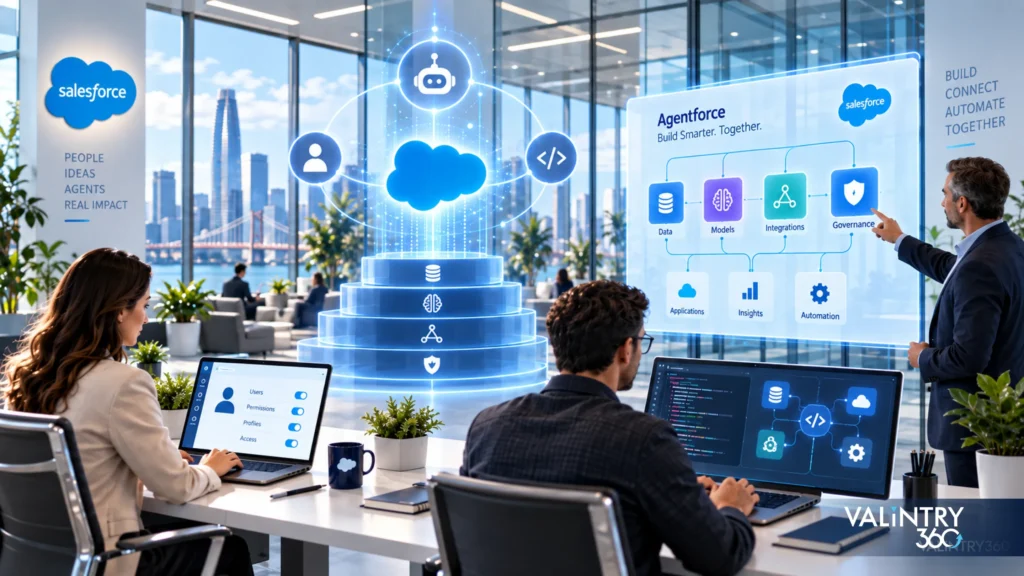
Different roles will take different things from this year’s Dreamforce conference. If you are an admin, developer, or architect, here is what we would put at the top of your list.
For Admins
Agentforce Coworker is available now and lives inside Lightning, so it is the fastest way to give users an agentic experience without retraining them. Because AIforce inherits existing permissions, your permission sets and sharing rules are now the security boundary for Claude, Slack, and every other surface. The Admin Keynote emphasized that the prebuilt agents are configurable by business users, which means admins should expect to be asked for them soon. A permissions and data quality audit is the sensible pre-work.
For Developers
The Headless Toolkit gives you MCP servers, APIs, plugins, skills, and developer tools, with more than 60 MCP tools already exposed through Headless 360. The Salesforce Development plugin for Claude Code ships with 40-plus skills. Slack Code introduces multiplayer coding in Slack. Custom integration work will increasingly shift from building connectors to defining skills and governing what agents may invoke.
For Architects
Three decisions now belong on your roadmap. First, model choice: Koa, Claude, Gemini, and Bedrock models are all available inside Agentforce, so which model handles which workload becomes a governance question with logging and cost implications. Second, data architecture: the Enterprise AI Harness assumes Informatica, Data 360, and Tableau semantics are in place, and zero-copy access to BigQuery and AWS expands this fall. Third, agent governance: Salesforce Guardian’s agent identity capabilities and MuleSoft Agent Fabric are the tools for constraining agents beyond user permissions, and they need to be designed in rather than added later.
Dreamforce 2027: Dates and What to Expect
Dreamforce 2027 is confirmed for September 21 to 23, 2027, in San Francisco and on Salesforce+. Salesforce published the save-the-date on its official Dreamforce site immediately after this year’s event closed.
Based on the trajectory from Salesforce Dreamforce 2025 through 2026, expect the 2027 conversation to center on results. Salesforce spent 2024 introducing agents, 2025 scaling them, and 2026 extending them into every interface. The natural next chapter is measurement: which deployments delivered ROI, how the Koa model performed against the benchmark claims, and whether the Enterprise AI Harness became the single control plane Kumar described. If you plan to attend, registration typically opens in spring, and the official hotel block sold out well before this year’s event.
Missed Dreamforce 2026? How to Catch Up and Plan for Dreamforce 2027
How to Watch Dreamforce 2026 Sessions on Salesforce+
Every keynote and hundreds of sessions from this year’s Salesforce Dreamforce are available to replay at no cost. Here is the quickest way to catch up:
- Go to salesforce.com/plus and create a free Salesforce+ account, or sign in with an existing Trailblazer login.
- Open the Dreamforce 2026 experience page.
- Start with the Main Keynote replay, then the Agentforce keynote “From Fast Start to Real ROI” and the Admin Keynote.
- Use the session catalog filters by role (admin, developer, architect, business leader) and product (Agentforce, Data 360, Slack).
- Watch the “Dreamforce Today” daily recaps if you want the highlights in under an hour.
Turning the Announcements Into a 90-Day Action Plan
Watching the replays is the easy part. The organizations that get real value from a Dreamforce conference are the ones that turn what they saw into a plan within the first quarter. Here is the sequence we recommend:
- Weeks 1 to 2: Audit permission sets and sharing rules, because AIforce will expose them everywhere
- Weeks 2 to 4: Pick one prebuilt agent (Casey, Paige, or Piper are the most common starting points) and define a success metric
- Weeks 3 to 6: Enable Agentforce Coworker for a pilot team inside Lightning
- Weeks 4 to 8: Evaluate Claudeforce or Slackforce for the team that already lives in that tool
- Weeks 6 to 10: Review your data foundation against the Enterprise AI Harness model, especially Data 360 and Tableau semantics
- Weeks 8 to 12: Decide your model governance policy and document which workloads use Koa, Claude, Gemini, or Bedrock models
- Ongoing: Track the ROI measures you defined so Dreamforce 2027 is a progress report, not a restart
Who Should Attend Dreamforce 2027 in Person
Short answer: go if you will be making Salesforce platform decisions in the year ahead. Dreamforce is worth the trip for those people, for teams pursuing certifications who can use the Trailblazer Bootcamp, for partners and ISVs who need face time with customers, and for anyone whose career is built in the Salesforce ecosystem. The announcements themselves are free to watch; the value of being there in person is the hands-on labs, the one-to-one sessions with Salesforce product experts, and conversations with peers who have already deployed what you are considering. It is less essential for individual contributors who mainly need the announcement content, because the keynotes and hundreds of sessions stream free on Salesforce+.
Dreamforce 2027 runs September 21 to 23, 2027, in San Francisco. Registration typically opens in spring, and the official hotel block sold out well before this year’s event, so plan early.
What Dreamforce Costs: 2026 Pricing as a Benchmark for 2027
Salesforce has not published Dreamforce 2027 pricing yet. It typically follows a similar structure each year, with an early-bird window and a group rate, so the 2026 figures below are the best reference for budgeting.
|
Pass type |
Dreamforce 2026 pricing (reference for 2027 budgeting) |
What it includes |
|
Full Conference (early) |
$1,899 through August 20 |
All keynotes, breakouts, hands-on training, Dreamfest |
|
Full Conference (standard) |
$2,299 |
Same as above |
|
Group rate (3+) |
$999 per person |
Same as Full Conference |
|
Trailblazer Bootcamp |
$1,499 |
Three-day pre-conference certification training, held September 12 to 14 in 2026 |
|
Salesforce+ virtual |
Free |
Main keynote, 400+ sessions, virtual hands-on training, Dreamforce Today broadcast |
Dreamfest admission is included with an eligible in-person Full Conference registration and requires a valid ID and age 21 or over. Travel and accommodation are the real cost drivers, since San Francisco hotels fill quickly during the event.
How VALiNTRY360 Helps You Turn Dreamforce 2026 Announcements Into Results
Every year, Salesforce Dreamforce produces a wave of announcements. And every year, the gap between what was announced on stage and what actually ships in your org is where organizations either gain ground or lose momentum. As a certified Salesforce consulting partner, that gap is exactly what our team at VALiNTRY360 exists to close.
From Announcement to Implementation
Our team has spent the days since Dreamforce mapping each of the fourteen announcements above to the client workflows they touch. AIforce and the prebuilt agents are only as good as the data, permissions, and processes underneath them, and that foundation is what we build. Our Salesforce implementation services cover new deployments, and our Salesforce managed services keep those deployments healthy as Salesforce ships the follow-on releases that Dreamforce previewed.
Navigating Licensing, Editions, and the Right Salesforce Package
Because of our certified partner status, we work closely with Salesforce and can act as a trusted intermediary between your organization and the platform. That matters more after Dreamforce 2026 than it did before, because the licensing landscape now spans Agentforce consumption, Claudeforce and Slackforce entitlements, Data 360 capacity, Bedrock and Gemini model access, and the seven prebuilt agents. Choosing the wrong edition or package is expensive in both directions: overbuying wastes budget, and underbuying stalls the roadmap.
We help clients understand what each announcement actually requires, structure the edition and package combination that fits their situation, and shape the roadmap and commercial conversation with Salesforce so the deal reflects what the organization will genuinely use. Our insider knowledge of the ecosystem, our certified expertise, and our focus on right-sized solutions mean clients arrive at a Salesforce agreement built around their needs rather than a generic bundle. Our guide to Salesforce license optimization explains how we approach it.
Where to Start
If you are not sure whether your org is ready for AIforce, the prebuilt agents, or the Enterprise AI Harness, our Agentforce readiness assessment is a structured way to find out. And if you already know what you want to deploy, contact our team and we will build the roadmap with you.
Final Thoughts
So what is the takeaway? Salesforce Dreamforce 2026 was the year the platform stopped asking to be the destination. AIforce, Koa, the prebuilt agents, and the hyperscaler partnerships all point in one direction: Salesforce wants to be present in every interface, powered by models it controls, governed by permissions you already maintain. For organizations that have done the foundational work on data and governance, that is a significant opportunity. For those that haven’t, Dreamforce 2026 is a clear signal about where to start.
Our team is ready to help either way. Whether you need an Agentforce readiness assessment, a full implementation roadmap, or help structuring the right Salesforce package for what you learned this week, reach out to VALiNTRY360 and let’s turn this year’s announcements into next year’s results.
Frequently Asked Questions About Salesforce Dreamforce
What is Dreamforce?
Dreamforce is Salesforce’s annual flagship conference, held each fall in San Francisco, where the company announces its biggest product updates, hosts more than a thousand training sessions, and brings together customers, partners, admins, and developers from around the world. It is the largest event in the Salesforce ecosystem and one of the largest AI-focused business conferences globally.
When was Dreamforce 2026?
Dreamforce 2026 took place September 15 to 17, 2026, at Moscone Center in San Francisco. The Trailblazer Bootcamp ran September 12 to 14, and free streaming on Salesforce+ ran September 15 to 18.
Where is Dreamforce held?
Dreamforce is held in San Francisco, California. The main conference takes place at Moscone Center, keynote conversations are hosted at the Yerba Buena Center for the Arts, and Dreamfest is held at Oracle Park. Dreamforce 2027 returns to San Francisco on September 21 to 23, 2027.
What was announced at Dreamforce 2026?
The major Dreamforce 2026 announcements were AIforce, a live interface layer launching with Claudeforce, Slackforce, and Agentforce Coworker; Koa, Salesforce’s first CRM reasoning model built with NVIDIA; the Enterprise AI Harness; seven prebuilt job-ready agents; Customer 360 updates across nine product areas; expanded partnerships with Google Cloud, AWS, and Siemens; and $27 million in education grants.
Who spoke at Dreamforce 2026?
Marc Benioff delivered the main keynote and hosted conversations with Dario Amodei of Anthropic, Jensen Huang of NVIDIA, Sam Altman of OpenAI, Roland Busch of Siemens, Omar Sultan Al Olama of the UAE, Denis Machuel of Adecco Group, and Travis Kalanick. Salesforce executives Patrick Stokes and Rohan Kumar presented the product announcements.
What is AIforce?
AIforce is Salesforce’s new interface layer, announced at Dreamforce 2026, that brings Salesforce data, workflows, business logic, permissions, and governance into any AI environment. Users can work with Salesforce from Claude, Slack, Lightning, Gemini Enterprise, or Amazon Quick without opening the traditional Salesforce interface.
What is Koa?
Koa is Salesforce’s first CRM reasoning model, developed with NVIDIA by post-training Nemotron 3 Super on a synthetic dataset. Salesforce says no customer data was used in training and that Koa matches or exceeds leading models on CRM tasks with three times fewer errors. It is currently in pilot with customers including Formula 1 and UChicago Medicine.
How much does Dreamforce cost?
A Full Conference pass for Dreamforce 2026 was $1,899 through August 20 and $2,299 afterward, with a $999 per-person rate for groups of three or more. The Trailblazer Bootcamp was $1,499. Virtual attendance through Salesforce+ is free with registration.
Is Dreamforce worth attending?
Dreamforce is worth attending in person if you need to make Salesforce platform decisions, want hands-on training or certification, or benefit from meeting Salesforce product experts and peers who have deployed what you are considering. If you only need the announcements, the free Salesforce+ stream covers the keynotes and more than 400 sessions.
Who performed at Dreamfest 2026?
Usher and Gwen Stefani headlined Dreamfest 2026 at Oracle Park on Wednesday, September 16, 2026. Dreamfest is the official Dreamforce celebration and benefits UCSF Benioff Children’s Hospitals. Admission is included with an in-person Full Conference pass for attendees aged 21 and over.
When is Dreamforce 2027?
Dreamforce 2027 is scheduled for September 21 to 23, 2027, in San Francisco and on Salesforce+. Salesforce published the save-the-date immediately after Dreamforce 2026 closed.
What happened at Dreamforce 2025?
Salesforce Dreamforce 2025 ran October 14 to 16, 2025, at Moscone Center and launched Agentforce 360, renamed Data Cloud to Data 360, expanded partnerships with OpenAI and Anthropic, and announced the Apromore acquisition. More than 40,000 people attended in person, and Metallica and Benson Boone headlined Dreamfest.
Related Posts
- Agentforce
Salesforce Consulting vs Implementation vs Managed Services
A company calls a firm and asks for "Salesforce consulting," expecting the team to configure the platform and go live in 6 weeks. Another buys an implementation and assumes the same people will keep fixing things a year later. A…
- Agentforce
Salesforce Technical Debt: What It Costs and How…
A small field change takes three days because nobody's sure what it'll break downstream. A deployment fails, gets patched, and fails again the next sprint. An old Flow keeps running untouched because nobody documented what it actually does. Somewhere in…
- Agentforce
Agentforce Conversation Cost: What Counts as a Conversation…
Salesforce publishes one number for Agentforce and it looks settled. $2 per Conversation. Your actual Agentforce conversation cost depends on something that price tag never tells you, which is what triggers the charge in the first place.And that changes by…