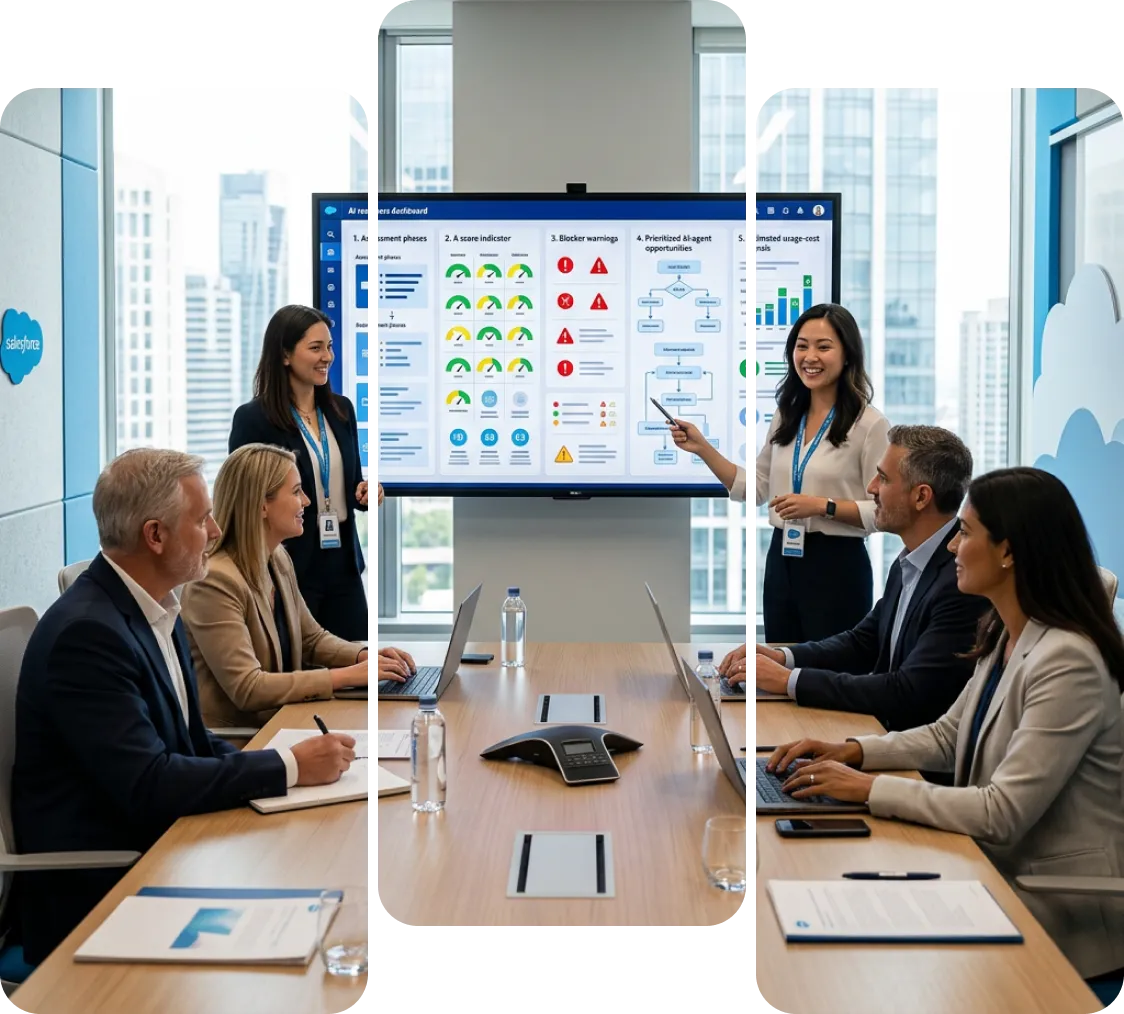
Agentforce Readiness Assessment
Find out whether your Salesforce org is ready for Agentforce before you buy the licenses. This free Salesforce AI readiness assessment scores your org on five dimensions, names the blockers, shortlists your first Agentforce use cases and forecasts their Flex Credit cost.

Take the 2-minute Agentforce readiness self-score

Agentforce-certified

Salesforce Certified Consulting Partner

Read-only

No obligation

What is Agentforce readiness?
Agentforce readiness is the degree to which a Salesforce org’s data, automation, permissions, integrations and governance can support an AI agent acting on real records without wrong answers, unsafe writes or runaway cost. Holding licenses, provisioning Data 360 or picking a use case are prerequisites for the project; the agent’s readiness lives one layer down, in the org itself, which is what an Agentforce assessment measures.
55% of IT leaders are not fully confident they have the guardrails to deploy AI agents (Salesforce research, 2025).
Your Agentforce readiness score: five dimensions, weighted
Every org gets an Agentforce readiness score from 0 to 100, weighted by what breaks Agentforce implementations.
Readiness bands: under 50, not ready · 50–69, foundation work first · 70–84, pilot-ready · 85 and above, ready to scale
Data foundation (30%).Completeness, duplicate density and field consistency on the objects an agent will touch, plus current Knowledge content.
Automation and process clarity (25%). No competing Flows, Workflow Rules or triggers on agent-touched objects; documented stage criteria and ownership for every process an agent enters.
Permissions and security (20%). A least-privilege agent runtime user, scoped integration users, field-level security on sensitive data, Trust Layer and Shield settings.
Integration and Data 360 readiness (15%). Whether the systems an agent must reach are connected and reliable, API headroom, and whether the use case needs Data 360.
Governance and people (10%). A named owner, a human escalation path, KPIs tied to the use case, and post-launch monitoring.
Agentforce readiness checklist: the blockers we find most often
The checks behind the score. Most orgs fail three or four on the first pass; the fixes are rarely expensive once named.

Legacy Workflow Rules and Process Builders still firing beside Flows on Case, Lead or Opportunity

Duplicate Accounts and Contacts above 5% of the object

Required fields on agent-touched objects with fill rates under 80%

No Knowledge articles, or articles last reviewed more than 12 months ago

An agent runtime user inheriting a System Administrator profile

Sensitive fields readable by every profile; nobody owning the agent's KPIs after go-live

What your Agentforce assessment report includes
An Agentforce readiness score from 0 to 100, with a grade per dimension and your trend.
Every blocker ranked by severity, with the fix and effort it takes.
A pre-implementation fix plan: what to clean up before the first agent, what to convert.
Two or three Agentforce use cases matched to your org's strengths, with the data each one needs.
An Agentforce cost forecast in Flex Credits per use case, built on your volumes, sub-flows, and benchmarks.
A Data 360 readiness recommendation: whether your first agent needs it, and for what.
A 45-minute walkthrough with the consultant afterward.
An Agentforce readiness score from 0 to 100, with a grade per dimension and your trend.
Every blocker ranked by severity, with the fix and effort it takes.
A pre-implementation fix plan: what to clean up before the first agent, what to convert.
Two or three Agentforce use cases matched to your org's strengths, with the data each one needs.
An Agentforce cost forecast in Flex Credits per use case, built on your volumes, sub-flows, and benchmarks.
A Data 360 readiness recommendation: whether your first agent needs it, and for what.
A 45-minute walkthrough with the consultant afterward.
Is your org ready for Agentforce? Take the 2-minute self-score
Ten questions from our Agentforce readiness checklist. Answer honestly and you land in one of four bands. It tells you whether to book the assessment now or fix the basics first.
Under 50: fix the foundation first · 50–69: close, but a pilot now would surface gaps in production · 70–84: pilot-ready · 85+: ready to scale
- Do you know every automation that fires when a Case or Lead is saved?
- Are duplicate Accounts and Contacts below 5% of the object?
- Are the fields your agent would rely on at least 80% filled?
- Do you have Knowledge articles that are current and reviewed?
- Is there a dedicated, least-privilege user your agent would run as?
- Is sensitive customer data protected by field-level security?
- Have you named the Agentforce use case you would launch first?
- Do you know the monthly volume of that use case?
- Is there a human handoff for when the agent cannot resolve something?
- Does someone own the agent's KPIs after go-live?
Agentforce cost:why readiness decides your Flex Credit spend
Agentforce pricing is metered. On the Flex Credits model, Salesforce sells credits at $500 per 100,000; a standard agent action consumes 20 credits, about $0.10, and a voice action 30, about $0.15. The alternative is $2 per conversation for customer-facing agents; the two models cannot be mixed in one org. What most teams miss: readiness drives the action count. An agent on clean data and one clear process resolves a case in three actions. On duplicates, missing fields and competing automations it takes six, retries, or hands off to a human, and you pay for every step. Your Agentforce cost forecast uses your volumes and the current rate card.
Flex Credits:
$500 per 100,000
Standard action:
20 credits ≈ $0.10
Voice action:
30 credits ≈ $0.15
$2 per conversation model
Rates verified [date]
How the Agentforce readiness assessment works
Request (Day 0).
Share your edition, user count and the Agentforce use case in a minute.
Read-only access (Day 1).
A scoped integration user, no writes, revoked when we are done.
Assessment (Days 2–5).
Metadata, data, permission and automation analysis, read against your use case by an Agentforce- certified consultant.
Walkthrough (Day 5–6).
Score, blockers, implementation readiness plan, use-case shortlist and cost forecast.

Who needs an Agentforce readiness assessment
Service leaders who want deflection without a wrong-answer incident. Sales and RevOps teams with a lead-qualification or quoting agent on the roadmap. IT and Salesforce admins asked “can we do Agentforce?” who need an evidence-based answer. We run the Salesforce AI readiness assessment for healthcare, financial services, manufacturing and professional services firms, and we will say plainly if your org is not ready yet.
Why VALiNTRY360 for Agentforce implementation
We are a Salesforce Certified Consulting Partner with a U.S.-based team holding 50+ certifications, including Agentforce Specialist and Data 360. We implement and manage Agentforce for clients, so the consultant scoring your org has seen what breaks after go-live.
[X]
Agentforce readiness assessments delivered
[X]
agents in production
[X]%
Of pilot-ready orgs live within 90 days
Book your free Agentforce readiness assessment
Five business days from read-only access to an Agentforce readiness score, fix plan, use-case shortlist and cost forecast. Not evaluating Agentforce yet? Start with the free Salesforce audit.

Agentforce readiness assessment FAQ by VALiNTRY360
A scored, evidence-based review of whether a Salesforce org's data, automation, permissions, integrations and governance can support an AI agent safely and at a predictable cost. You get a readiness score, ranked blockers, a fix plan, a use-case shortlist and a Flex Credit forecast.
Most orgs score 40 to 65 on a first Agentforce assessment: foundation work before a pilot, not a hard no. The self-score gives you a band in two minutes; the full assessment gives you the blockers and the order to fix them.
Not always. Many first agents run on CRM data and Knowledge alone. Data 360 readiness is one of the five dimensions we score, so you know whether your use case needs it before you buy it.
A Salesforce health check scores the org's general condition. An Agentforce readiness assessment scores it against the demands of an AI agent and adds use-case and cost analysis. Not evaluating Agentforce yet? Start with our free Salesforce audit.
Nothing. No invoice, no obligation; you keep the report and the Agentforce cost forecast whether or not you work with us.
The state an org must reach before an Agentforce implementation can go live safely: clean data on agent-touched objects, no competing automation, a least-privilege runtime user, defined escalation and a named owner.
It uses your monthly volumes and a realistic action count per interaction at the current Flex Credits rate card. It is a planning number, not a quote; Salesforce's pricing page remains the source of truth.