

Executive Summary
This guide covers what an Agentforce consultant actually does and why the decisions made before deployment matter more than the technology itself. You’ll find a breakdown of the service use cases with the clearest ROI, a seven-step rollout roadmap, a plain-English explanation of how the platform works, the ROI math your CFO will ask for, and a governance checklist you can run before anything goes live. A 15-question FAQ rounds out the guide for teams at any stage of evaluation.
Quick links
- What Salesforce Agentforce Actually Is
- Where an Agentforce Consultant Will Tell You It Fits, and Where It Doesn't
- The Agentforce Service Use Cases That Actually Pay Off
- A Peek Under the Hood (So the Rest Makes Sense)
- The Agentforce Consultant Rollout Roadmap: How a Real Implementation Goes
- The ROI Math Your CFO Will Ask About
- Governance: The Part That Separates a Tool From a Liability
- Frequently Asked Questions
- The Bottom Line
It’s 11:40pm on a Tuesday. A customer in another time zone is staring at a checkout error, and your support team logged off hours ago. Waiting until morning means a frustrated email and a possible churn. With Agentforce, that same customer types their problem into a chat window. An agent reads the actual order record, sees the failed payment, explains why, offers a fix, processes it, and updates the case. No human touched it. By the time your team logs in, there’s a tidy summary waiting and one fewer fire to fight.
That’s the promise of Salesforce Agentforce, and it’s real. However, here’s what nobody tells you in the demo: the gap between that scenario and a chaotic, expensive mess is almost entirely about the decisions you make before you deploy. Which use cases you pick. Whether your data is clean. How tightly you scope each agent. What guardrails you put around it. That’s the work an Agentforce consultant actually does, and it’s what this guide walks through.
What Salesforce Agentforce Actually Is
The Third Wave of AI
Strip away the marketing and Agentforce is this: a platform for building AI agents that don’t just answer questions, they get things done. Salesforce frames it as the third wave of AI. Wave one was predictive AI, the models that scored your leads and forecasted your pipeline. Next came wave two, the copilot, the assistant sitting in the corner waiting for you to ask it something. Agentforce is the third wave, where the software stops waiting. It can take in a goal, reason about how to reach it, take action across your systems, check the result, and keep going until the job’s done, looping in a human when it should.
How the Atlas Reasoning Engine Works
Powering all of that is the Atlas Reasoning Engine. The most useful way to explain Atlas to a skeptical executive is that it works the way a good employee works on a task. It reads the request, thinks about what’s being asked, does a step, looks at what happened, and adjusts. That loop, reason, act, observe, is what separates an agent from a scripted chatbot. A chatbot follows a branching script and falls apart the moment a customer goes off-script. An agent reasons through the off-script moment, asks a clarifying question if it needs to, and shows its working so an admin can review why it did what it did.
What Makes an Agent
Underneath, every agent is built from a few simple parts. Once you see them, the whole thing demystifies. An agent has a role, a one-line mission like “handle order and return questions.” Inside it live topics, which are the jobs it knows how to do. Each topic carries plain-language instructions (the rules and tone), a set of actions it’s allowed to take (run a Flow, call an Apex method, hit an API, draft from a prompt template), and guardrails that say what it must never do. You assemble all of this in Agent Builder with clicks and natural language, not a six-month code project. Critically, an agent can only ever take the actions you’ve explicitly handed it. Improvising a refund it was never given permission to issue is simply not possible.
Where It Sits in Your Stack
The platform sits directly on the Salesforce instance you already run, grounded in your data through Data Cloud, now called Data 360. That grounding is the part people skip and then regret, so we’ll come back to it more than once.
The 30-second version for your stakeholders: Agentforce builds autonomous AI agents that reason, act across your CRM, and resolve real work, with a human in the loop when it matters. Rather than a smarter chatbot, think of it as a digital coworker you scope, train, and supervise.
Where an Agentforce Consultant Will Tell You It Fits, and Where It Doesn't
The Filter Every Good Agentforce Consultant Applies
Here’s the most useful thing a good Agentforce consultant will tell you, and it’s the opposite of what a sales deck will say: not every problem is an agent problem. Part of the job is talking clients out of bad first ideas. So before getting to the exciting use cases, it helps to set the filter.
Agentforce earns its keep when a task is high-volume, repeatable, reads or writes data you already hold, and follows rules you can write down. Think order-status questions, password resets, appointment scheduling, returns, knowledge-grounded answers, and lead qualification. The pattern is always the same: lots of similar requests, clear logic, and a system of record the agent can stand on.
Where Agentforce Struggles
Agentforce is not the right first move when a task is rare and bespoke, demands human judgment or empathy as the main event, depends on data that’s missing or a mess, or carries a high cost of being wrong with no human checkpoint. A consoling conversation with a grieving customer is not a topic. Approving a seven-figure contract exception is not something you fully hand to an agent on day one.
The Data Dependency You Can't Skip
There’s a hard dependency worth saying plainly: an agent is only as good as the data it stands on. Ask an agent “where’s my order” and the magic isn’t the language. It’s that the agent reads the real order record instead of guessing. When your data is scattered, stale, or locked in systems the agent can’t reach, you don’t have an agent problem. What you have is a data problem wearing an agent costume. That’s why so many Agentforce consultant engagements start with a data foundation conversation. Getting your information unified and reachable through Salesforce Data Cloud is usually step zero, not step five.
The Agentforce Service Use Cases That Actually Pay Off
Customer service is where Agentforce has the clearest, fastest payback, which is why it’s where most organizations start. Rather than listing features, here’s a walk through the use cases that work, with examples.
The Autonomous Service Agent: The Headline Act
This is the customer-facing agent that resolves cases end to end, over chat, email, web, or even voice. Consider a retailer at midnight. A customer asks where their order is. The agent reads the order record, sees it’s stuck in a warehouse hold, explains the delay in plain language, offers expedited shipping, applies it, and emails a confirmation, all grounded in real records to reduce hallucination risk and help ensure responses are based on actual order and shipment data. That same agent handles returns by checking the policy, confirming eligibility, and generating the label. When it hits something it can’t or shouldn’t handle, it gathers the details and hands the customer to a human with full context already attached, so nobody has to repeat themselves.
Agent Assist for Your Human Team
Not every agent faces the customer. Some of the highest-value agents sit beside your reps. While a rep is on a case, an assist agent can summarize a long, messy email thread into three lines, suggest a grounded reply, surface the right knowledge article, and draft the case wrap-up. The rep stays in control and just approves or edits. Teams often start here because it’s lower risk: the human is always the final word, adoption is straightforward, and you build trust in the technology before you ever point an agent at a customer.
Proactive Service: The Part People Forget
Agents don’t have to wait to be spoken to. Because they can be triggered by data changes, a service agent can act the moment a case status flips, a shipment is delayed, or a contract is about to lapse. Consider a customer whose subscription payment just failed: instead of waiting for them to notice and complain, an agent reaches out, explains the issue, and offers to update the card, turning a future support ticket into a quiet resolution.
A Quick Map of Agentforce Service Use Cases
Use Case | What the Agent Does | Why It Pays Off |
Tier-1 resolution | Answers FAQs, order status, account questions, grounded in real records and knowledge | Deflects high-volume, low-complexity cases around the clock |
Returns and exchanges | Checks policy and eligibility, generates labels, processes the return | Removes repetitive work and shortens resolution time |
Case triage and routing | Classifies, prioritizes, and routes cases to the right human or queue | Faster first response, less manual sorting |
Agent assist | Summarizes threads, drafts replies, surfaces knowledge, writes wrap-ups | Cuts handle time while a human stays in control |
Proactive outreach | Acts on status changes, delays, failed payments, renewals | Prevents tickets instead of just answering them |
Field service support | Guides technicians, schedules, surfaces asset history | Keeps skilled staff on skilled work |
A Peek Under the Hood (So the Rest Makes Sense)
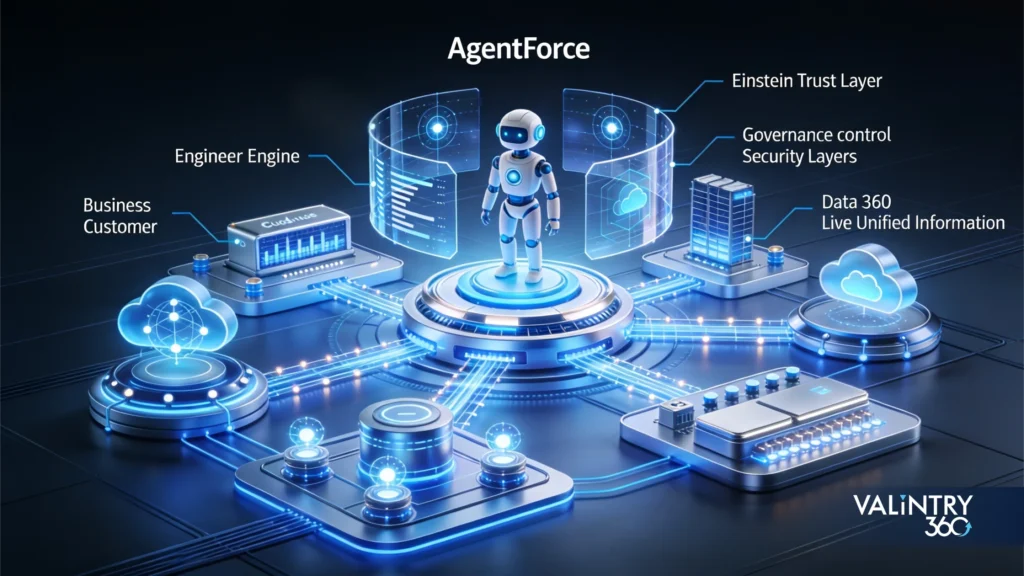
How an Agent Processes a Request
You don’t need to be an architect to sponsor an Agentforce project, but a 60-second mental model helps you ask better questions. When a request comes in, the agent first figures out which topic it belongs to, which narrows the problem and loads the right instructions, actions, and limits. From there, it grounds itself by pulling the relevant facts from your data, increasingly through a zero-copy approach where it reads live data where it lives instead of making yet another copy. It reasons through the steps, takes the allowed actions, checks the results, and either finishes or asks for help.
The Einstein Trust Layer and Data 360
All of that runs through the [Einstein Trust Layer](https://help.salesforce.com/s/articleView?id=ai.generative_ai_trust_arch.htm&language=en_US&type=5), which is the safety envelope around the whole thing. It grounds responses in your data, masks sensitive fields before anything reaches a large language model, runs toxicity and safety checks on the output, and ensures customer prompts and data are not retained by supported model providers for training purposes, while maintaining auditability and governance controls. Every prompt and response is logged for audit. Pair that with a clean, unified data layer in Data 360, and you’ve got the two ingredients every dependable agent needs: trustworthy data going in, and a controlled, auditable boundary around what comes out.
The Agentforce Consultant Rollout Roadmap: How a Real Implementation Goes
Why Most Agentforce Projects Fail
Most failed Agentforce projects didn’t fail because the technology couldn’t do the job. Rather, they failed because someone tried to boil the ocean: a single mega-agent meant to do everything, pointed at messy data, with no way to measure whether it worked. The teams that win do the opposite. Starting narrow, proving value, and then expanding is the consistent pattern among successful deployments. Here’s the roadmap a seasoned Agentforce consultant would walk a client through.
The Seven-Step Implementation Roadmap
- Find and rank the use cases. Map your highest-volume, most repetitive workflows and the cost of each one today. Pick three to five candidates, then choose one to start, the one with clear logic, clean data, and a number you can move. Resist the urge to start with your hardest problem.
- Ground the data first. Before you build the agent, make sure it can reach accurate, live data. This is where Data Cloud earns its place. An agent grounded in bad data just produces confident, wrong answers faster, and every wrong answer is wasted money.
- Design the agent. Write the role, the topics, the instructions, and the exact actions it’s allowed to take. Keep the mission tight. A focused agent that does one job well beats a sprawling one that does ten jobs badly, and it’s far easier to secure and maintain.
- Test before you trust. Use the [Agentforce Testing Center](https://help.salesforce.com/s/articleView?id=ai.agent_testing_center.htm&language=en_US&type=5) to run typical, edge-case, and adversarial scenarios at volume, and a digital-twin environment to rehearse against a copy of your business without touching production. You’re looking for where it breaks, where it over-reaches, and where it should have asked for help.
- Pilot small, with a human nearby. Launch to a limited audience or a single channel, with a clear escalation path and someone watching. Treat week one like a shakedown, not a victory lap.
- Measure, then scale. Watch the metrics that matter (more on those next), fix what the data shows, and only then expand to more topics, more channels, more departments. Earn each expansion with proof.
- Optimize forever. Agents aren’t a launch, they’re a product. Prompts drift, business rules change, edge cases pile up. Plan for ongoing tuning with the observability and optimization tools rather than treating go-live as the finish line.
- The pattern in one line: start with one well-scoped agent on clean data, prove the number, and expand from there. Some companies that do this can see payback in weeks. Organizations that skip straight to a do-everything agent often struggle to demonstrate value because success criteria were never clearly defined.
The ROI Math Your CFO Will Ask About
Sooner or later, someone with a spreadsheet asks the real question: does this pay for itself? Agentforce can deliver excellent returns, but only if you understand how it’s priced and you measure the right things.
How You Pay for Agentforce
[Agentforce pricing](https://www.salesforce.com/agentforce/pricing/) is consumption-based, which is a shift if you’re used to per-seat software. There’s a free tier, Salesforce Foundations, that gives Enterprise Edition customers a starting block of Flex Credits and Data Cloud credits plus the builders, which is plenty for a pilot. Beyond that, the main model is Flex Credits: a block of 100,000 credits runs about $500, and each standard action an agent takes costs roughly 20 credits, or about $0.10 (voice actions cost a bit more). There’s also an older flat model at about $2 per customer conversation, regardless of how many actions happen inside it. You pick one model per org, you can’t mix them, and there’s a per-user license route for employee-facing rollouts.
One cost most buyers miss is Data Cloud. Agentforce needs it to ground agents in your data, and at production volume those Data 360 credits are a separate line item that can rival or exceed the agent licensing itself. Budget for it up front. Use the [Agentforce pricing calculator](https://www.salesforce.com/agentforce/pricing/calculator/) to model your expected volume before you commit.
The Math That Makes It Work
Here’s the framing that lands with finance. Human-assisted service interactions typically cost several times more than AI-assisted interactions once labor, tooling, and overhead are included. A typical Agentforce interaction runs between about $0.10 and $2 depending on the pricing model and how many actions it takes. Even the most action-heavy agent comes in well under the human cost, and the simple, high-volume cases, which are most of them, come in dramatically lower. Savings aren’t hypothetical; they’re arithmetic, and they compound with volume.
The outcomes back this up. Salesforce has publicly reported that Agentforce handles a substantial share of support interactions autonomously within its own support organization, an experiment it calls [Salesforce Customer Zero](https://www.salesforce.com/customer-success-stories/salesforce/), reducing the volume that requires human intervention. A [Forrester Total Economic Impact™ study commissioned by Salesforce](https://www.salesforce.com/agentforce/) modeled a composite organization and found approximately 35% case deflection, significantly reduced handle times, and a projected 396% ROI over three years with payback within the first year. Moreover, in many deployments, order-inquiry agents become one of the earliest and most successful candidates for case deflection because the requests are repetitive, rules-based, and grounded in structured data.
Measure These Five Things
Track them from day one, weekly rather than quarterly, because that’s how you catch a drifting agent before it burns credits or trust:
– Cost per interaction, agent versus human
– Deflection rate, cases the agent kept off a human’s desk
– Autonomous resolution rate, cases fully and correctly closed end to end (not the same as deflection, and the more honest number)
– Time to resolution, and first-response time
– Revenue impact and avoided cost, the upside and the savings, side by side
One expert nudge: don’t treat Agentforce as a pure cost-cutting play. The biggest returns come from pairing service deflection with revenue work, where an agent that resolves a case can also spot and route an upsell, or where a sales agent that responds to a lead in 45 seconds instead of four hours moves your conversion rate. Cost savings get you in the door. Revenue keeps the program funded.
Governance: The Part That Separates a Tool from a Liability

Why Governance Is Non-Negotiable
Here’s where a responsible Agentforce consultant gets a little stern, because this is the section most teams skim and later wish they hadn’t. An autonomous agent acting on your data, in your name, in front of your customers, is a new kind of risk. Salesforce gives you strong built-in controls, which is good news. However, those controls only help if you actually use them. Security is a shared responsibility, and the customer’s half is the half that most often gets neglected.
Start with the [Einstein Trust Layer](https://help.salesforce.com/s/articleView?id=ai.generative_ai_trust_arch.htm&language=en_US&type=5), which handles a lot for free: it grounds responses in your data, masks sensitive fields before they reach any model, screens output for toxicity, ensures customer data is not retained by model providers for training purposes, and logs every interaction for audit. [Salesforce Shield](https://www.salesforce.com/platform/shield/) adds encryption, monitoring, and tighter controls on top. Beyond those built-in tools, the design choices are on you, and they matter more than any single feature.
The Governance Moves That Matter Most
– Keep agents specialized, not monolithic. A narrow agent with a clear mission and a short, locked list of topics and actions is easier to secure, test, and trust. The do-everything agent is the one that surprises you.
– Apply least privilege. An agent should have exactly the data access and actions it needs for its job, and not one permission more. Scope it the way you’d scope a new employee on day one, not a tenured admin.
– Keep a human in the loop for anything irreversible. Refunds above a threshold, contract changes, data deletions, anything you can’t cleanly undo, should pause for human approval. Use [Transaction Security policies](https://help.salesforce.com/s/articleView?id=sf.security_transaction_security.htm&type=5) to block risky actions outright.
– Lock down actions and use RBAC plus ABAC. Agents only do what you explicitly allow. Layer role-based access with attribute-based rules (geography, department, compliance status) so an agent’s authority bends to context.
– Test relentlessly, in a safe place. Run typical, edge, and adversarial scenarios in the [Agentforce Testing Center](https://help.salesforce.com/s/articleView?id=ai.agent_testing_center.htm&language=en_US&type=5) and a digital-twin environment before go-live, and re-run them whenever you change a prompt or a rule.
– Watch it in production. Use the observability and optimization tooling to monitor what agents are actually doing, catch drift, and tune. An unmonitored agent is a rumor, not a system.
– Run it like a product, with an owner. Keep an inventory of every agent, assign a named owner, version your changes, log every prompt and response, and stand up a small cross-functional governance group spanning IT, security, legal, and ops. AI scales fast, so make sure your control does too.
A helpful mindset: treat each agent like a capable new hire. You’d give them a clear job, limited access, a manager, a review process, and a way to escalate when unsure. Following the same logic here takes care of most of the risk.
The Pre-Deployment Governance Checklist
Run this before any agent touches a real customer or a production record. If any item is unchecked, you’re not ready to flip the switch.
Scope and Data
– Agent has a single, written mission and a short list of topics
– Every action the agent can take is explicitly defined and documented
– Data access follows least privilege, reviewed and signed off
– Underlying data is unified, accurate, and reachable (grounded in Data Cloud)
– Sensitive fields are masked through the Einstein Trust Layer
Safety and Control
– Human-in-the-loop approval required for irreversible or high-value actions
– Transaction Security policies block risky actions (bulk exports, unauthorized changes)
– RBAC and ABAC rules configured for the agent’s context
– Clear fallback and escalation path when confidence is low or a case is out of scope
– Prompt and response logging enabled and reviewable for audit
Testing and Launch
– Typical, edge-case, and adversarial scenarios tested in the Testing Center
– Rehearsed in a digital-twin or sandbox environment, not production
– Pilot scoped to a limited audience or channel with monitoring in place
– Success metrics defined and instrumented before go-live
Operate and Govern
– Agent added to a maintained inventory with a named owner
– Version control and change process in place for prompts and actions
– Real-time observability and a tuning cadence established
– Cross-functional governance group (IT, security, legal, ops) reviewing regularly
Want this as a one-page PDF you can hand your team? VALiNTRY360 runs this exact governance checklist as part of every Agentforce consultant engagement. [Request an Agentforce use-case workshop](https://valintry360.com/contact) and we’ll pressure-test your first use case and your guardrails together, before you commit a dollar of credits.
The Bottom Line
Agentforce is one of the most capable things Salesforce has ever shipped, and that’s exactly why the decisions around it matter so much. Deployed against a clean, well-scoped, well-governed use case, it pays for itself quickly and frees your people for the work that actually needs a human. Pointed at messy data and a vague mission with no guardrails, it scales your problems just as efficiently as it would have scaled your wins.
That’s the whole reason to bring in an Agentforce consultant early. VALiNTRY360 works on exactly this: finding the use cases worth doing, grounding the data, designing agents that stay in their lane, and putting the governance in place before anything goes live. For teams starting with service, our Agentforce for Service work is built around getting that first agent right, and it all stands on a clean Data 360 foundation.
Not sure which use case to start with? That’s the perfect first conversation. [Request an Agentforce use-case workshop](https://valintry360.com/contact) and we’ll map your highest-value workflows, sanity-check the data behind them, and leave you with a scoped, governed starting point, not a sales pitch.
Agentforce Consultant Frequently Asked Questions by VALiNTRY360
Agentforce is a platform for building AI agents that reason through a goal and take action across your Salesforce data, not just chat. Think of an agent as a digital coworker you scope, train, and supervise, powered by the Atlas Reasoning Engine and grounded in your CRM data.
A chatbot follows a fixed script and breaks when the conversation goes off it. An agent reasons through the situation, pulls real data, takes allowed actions, checks the outcome, asks for clarification when needed, and hands off to a human cleanly. Essentially, it does work, not just talk.
Effectively, yes, for anything beyond a small pilot. Agents ground their answers in your data, and Data Cloud (Data 360) is how that data gets unified and reachable. The Foundations free tier includes a starting allocation, but production usage requires additional Data 360 credits, a cost to plan for up front.
There’s a free Foundations tier to start. Beyond that, Flex Credits run about $500 per 100,000, with a standard action costing roughly $0.10, or you can use a flat rate near $2 per customer conversation. Data Cloud costs and per-user options add on top. See [Agentforce pricing](https://www.salesforce.com/agentforce/pricing/) for current details.
Start with one narrow, high-volume service use case on data you trust, like order status or returns, run as a monitored pilot with a clear escalation path. Prove the number, then expand. Starting with your hardest problem or a do-everything agent is the most common way to stall.
With the right guardrails, yes. The Einstein Trust Layer grounds, masks, screens, and logs everything, and you control exactly which actions an agent may take. Keep a human in the loop for anything irreversible, scope tightly, and monitor in production. Ultimately, the technology gives you the controls; using them is on you.
Beyond the build, an Agentforce consultant helps you choose the right first use cases, get your data ready, design tightly scoped agents, set up testing and governance, define the metrics, and run a pilot that proves ROI before you scale. Building the agent is the easy part. The strategic judgment around it is the value.
A well-scoped first agent, starting with a single service use case on clean data, can typically move from discovery to a monitored pilot in six to twelve weeks, depending on data readiness and internal approvals. Larger, multi-agent programs scale from there. Generally, the biggest variable is the state of your data before the engagement begins.
Standard Salesforce implementations configure a platform. An Agentforce consultant engagement is more strategic: it involves identifying which workflows are actually worth automating, assessing data quality, defining clear success criteria, designing agents with the right scope and guardrails, and building a governance framework so the program scales without creating new risk. As with the build itself, the strategic layer is the differentiator.
Yes. While customer service delivers the fastest and clearest ROI for most organizations, Agentforce agents can also support sales (lead qualification, follow-up), field service, HR self-service, and internal IT help desks. An experienced Agentforce consultant will help you prioritize which use case delivers the most value first, then sequence the rest from there.
A well-designed agent has a defined escalation path for every out-of-scope scenario. When it can’t confidently resolve something, it collects the relevant context and hands the conversation to a human with everything already documented. As a result, the customer never has to repeat themselves and the rep starts with full context.
Track five metrics weekly: cost per interaction (agent vs. human), deflection rate, autonomous resolution rate, time to resolution, and revenue or cost impact. An Agentforce consultant will help you instrument these before go-live so you’re measuring outcomes from day one, not reverse-engineering results after the fact.
Data readiness is the most common reason implementations stall. Agents are only as reliable as the records they’re grounded in. Before building, an Agentforce consultant will typically assess whether your key data is unified, accurate, and accessible through Data Cloud, and will flag any remediation work that needs to happen first.
The Einstein Trust Layer is the security and governance envelope built into Agentforce. Specifically, it ensures customer data and prompts are not retained by model providers for training purposes, masks sensitive fields before they reach any language model, screens output for toxicity, and logs every prompt and response for audit. Together, these controls are what make enterprise-grade AI governance possible within the Salesforce platform. See [Salesforce Trusted AI principles](https://www.salesforce.com/artificial-intelligence/trusted-ai/) for more.
The best starting point is a use-case workshop. We’ll map your highest-value workflows, assess data readiness, and leave you with a prioritized, scoped starting point, not a sales pitch. [Request a workshop here](https://valintry360.com/contact).
Related Posts
Salesforce Health Cloud vs EHR
IntroductionMost hospitals, health systems, and physician practices already run an EHR. For most of them, the real question is how Salesforce Health Cloud fits around the clinical system they already depend on. Health Cloud sits in a different part of…
Salesforce Partner Transition Checklist
A Salesforce partner change touches more than a vendor name on an invoice. Production access, integrations, source code, sandboxes, deployment tooling, vendor accounts, documentation, and ongoing support all move at the same time, and each one can break quietly if…
Salesforce Release Management Framework
TL;DR Salesforce changes come from everywhere. Admins tweak page layouts and developers ship Apex. Integrations push metadata changes of their own.A handful of other changes stack on top of that every week. Flows get rebuilt mid-quarter, permissions shift as teams…