

- Salesforce Managed Services
Yes, Data Cloud, now called Data 360, must be enabled for Agentforce. Salesforce is explicit that Data 360 has to be provisioned and enabled for all Agentforce use and that features like the Agentforce Data Library and the Einstein Trust Layer do not work without it. But enabled is not the same as implemented, and that distinction is the difference between a two-week agent build and a two-quarter data program.
Agentforce does not become useful because a model can write a fluent answer. It becomes useful when the agent can retrieve trusted Salesforce context, respect permissions, use the right action, and leave enough evidence for the team to explain the result. That is the technical reason the Agentforce Data 360 question matters. The real decision is not whether an agent can generate text. The decision is whether the agent can ground that text in approved CRM records, knowledge content, files, customer signals, and business rules.
Enabling means Data 360 is provisioned and available. Implementing means data sources are connected, mapped, governed, retrieved, tested, and made usable for production agents. Salesforce draws that distinction in the Trailhead Data 360 requirement unit, which is why the question “Is Data Cloud required for Agentforce” needs more than a yes or no answer.
A narrow pilot can often start with enabled Data 360, an Agentforce Data Library, and a controlled set of Knowledge articles or files. A production agent that needs customer 360 context, real-time data, identity resolution, custom retrieval, unstructured data in Data 360, or cross-system action needs a deeper implementation. Data 360 delivery services are relevant because Data 360 for Agentforce is not only a product setup decision. It is a data architecture, RAG Salesforce, governance, and operating model decision.
The Short Answer: Is Data Cloud Required for Agentforce?
Data 360 is required as the Salesforce data foundation behind key Agentforce capabilities. If a team wants Agentforce Data Library, trusted grounding, prompt context, AI guardrails, and audit support, Data 360 has to be enabled. That does not mean every organization must complete a full enterprise Data 360 implementation before starting an Agentforce pilot.
The practical distinction is enabled versus implemented. Enabled Data 360 can support narrow knowledge use cases through an Agentforce Data Library and default RAG components. Implemented Data 360 for Agentforce is needed when agents must reason across structured CRM data, unstructured content, identity-resolved customer profiles, zero-copy sources, data graphs, live signals, and governed action workflows.
The safest path is to scope the agent first, then choose the data depth. Start small when the agent answers from controlled content. Implement more Data 360 when the agent needs broader Agentforce grounding, complex retrieval, sensitive data access, or production responsibility.
|
If you are asking… |
The answer is… |
|
Do I have to buy Data 360 separately before I can turn Agentforce on? |
No. Enabling Agentforce provisions Data 360 in the org. |
|
Does Data 360 have to be enabled for Agentforce to work? |
Yes. Salesforce states it is required for all Agentforce use. |
|
Do I need a full Data 360 implementation project? |
Only if your agent needs unified profiles, multi-source context, unstructured grounding, or real-time signals. |
|
Can my agent read and write CRM records without a Data 360 build? |
Yes. Flow actions, Apex actions and prompt templates with record merge fields cover that. |
|
Will Data 360 consume credits when my agent runs? |
Yes. Agentforce grounding and retrieval consume Data 360 credits, tracked in Salesforce Digital Wallet. |
Why Half the Internet Says Data Cloud Is Not Required
Search this question and you will get contradictory answers from credible-looking sources. Some partners say Data Cloud is not required. Salesforce documentation says it is. Practitioners on Reddit argue both sides. That is unusual, and the reason is mechanical rather than editorial.
The provisioning step is what confuses everyone
When you enable Agentforce, Salesforce provisions Data 360 in the org for you. You will see Data 360 objects, a Data 360 setup node, and Data 360 terminology inside Agent Builder. From an admin seat, that looks like a hard dependency you have already paid for.
Then a partner scopes a Data 360 implementation, the number comes back large, and the project stalls. At that point somebody writes a blog post saying Data Cloud is not required, because they built a working agent without ever running that implementation project. They are describing a real experience. They are just using the word “required” to mean something different from what Salesforce means by it.
Both camps are describing different things
|
What people mean by “required” |
Is it true? |
Why |
|
Data 360 must be active in the org for Agentforce features to work |
True |
Salesforce states Data 360 must be provisioned and enabled for all Agentforce use. The Agentforce Data Library and Einstein Trust Layer do not function without it. |
|
You must buy Data 360 as a separate purchase before starting |
False |
Enabling Agentforce provisions it. Editions and the Foundations tier also include starting credit allocations. |
|
You must complete a Data 360 implementation project before building an agent |
False for many use cases |
An agent that reads and writes standard CRM records needs no Data 360 modelling project at all. |
|
You need Data 360 implemented for unstructured grounding and unified profiles |
True |
There is no supported way to run a production RAG pipeline or identity resolution across systems without it. |
So the accurate sentence is this: Data 360 is required and already provisioned, but a Data 360 implementation is only required for a specific and fairly well-defined set of capabilities. Anyone answering yes or no to this question without separating those two things is giving you half an answer.
The Direct Answer: Yes, But the Depth Changes
|
Data state |
What it means |
Agentforce impact |
Best fit |
|
Data 360 not enabled |
Data 360 is not active in the org |
Core data-dependent Agentforce capabilities are blocked or incomplete |
Not a serious production path |
|
Data 360 enabled |
Data 360 is active, but sources may not be fully modeled or harmonized |
Agentforce Data Library and default RAG components can begin |
Focused pilots and controlled knowledge answers |
|
Data 360 implemented |
Sources are connected, mapped, transformed, governed, and retrievable |
Agents can use customer 360 context, advanced RAG, structured and unstructured data, and richer workflows |
Production service, sales, commerce, and industry agents |
The question “Is Data Cloud required for Agentforce” usually gets answered badly because people collapse these 3 states into one. Agentforce Data Cloud is required as a foundation, but the implementation depth should follow the work the agent is expected to do.
A product FAQ agent that answers from 20 approved articles does not need the same foundation as a service agent that checks entitlement, reads case history, retrieves a policy document, summarizes a transcript, and triggers a return workflow. The first agent needs controlled Agentforce grounding. The second needs a governed data layer. The guide on Data 360 and Agentforce makes the same larger point: agents need context, not just content.
Data Cloud vs Data 360: What Changed and Why You See Both Names
Data Cloud was renamed Data 360 on October 14, 2025. The functionality did not change. Only the name did.
That matters for anyone researching this question in 2026, because both names are still in circulation. Salesforce documentation, the product interface, Trailhead modules, partner blogs and your own internal runbooks may all still say Data Cloud. Salesforce acknowledges this directly, noting that references to Data Cloud remain in the application and documentation during the transition.
So if you are comparing sources and one says Data Cloud while another says Data 360, they are talking about the same platform. There is no new product, no migration, and no separate SKU. Anything written about Data Cloud and Agentforce before October 2025 still applies architecturally, though pricing and credit allocations have moved since.
For clarity, the rest of this guide uses Data 360, and mentions Data Cloud only where the older name is likely to be what you see on screen.
When You Do Not Need a Data 360 Implementation
This is the part most articles skip, and it is the part that saves projects. If everything your agent needs already sits in Salesforce, cleanly, you do not need a Data 360 modelling project to build it.
Agents that read and write CRM records
An agent that answers questions about cases, opportunities, accounts, contacts, orders or Knowledge articles can be grounded directly in those records. Flow actions, Apex actions, and prompt templates with record merge fields cover this pattern. No data streams, no data model mapping, no identity resolution ruleset.
That covers a genuinely large set of valuable use cases: case deflection on documented topics, internal assistants that help reps find account context, service agents answering from existing Knowledge, and drafting help for sales and support staff.
What you actually need instead
The prerequisite for these agents is not Data 360. It is the unglamorous work upstream of it.
- Deduplicated accounts and contacts, so the agent does not retrieve two versions of the same customer.
- Knowledge articles that are current, owned, and written clearly enough to be retrieved usefully.
- A sharing model and field-level security you actually trust, because the agent inherits it.
- Consistent picklists and ownership accuracy, because inconsistent values produce confidently wrong answers.
Skipping that work is what causes agent projects to disappoint. The absence of a Data 360 implementation usually is not.
Where the line sits
You cross into needing an implementation the moment the agent has to answer from unstructured content, or has to treat one customer as one identity across systems that do not share a key. Those two capabilities have no supported workaround. Everything before that line is a data quality problem wearing a data architecture costume.
Why CRM Access Is Not the Same as Agentforce Grounding
A Salesforce user can open a record, scan related lists, understand missing context, and decide what matters. An AI agent cannot rely on that human judgment. It needs retrieval rules, field access rules, prompt context, relevance ranking, and fallback behavior before it produces an answer.
Record visibility is not retrieval permission
A user may have access to an account, case, or opportunity. That does not automatically mean every field should be available to the agent’s prompt. Data 360 integration should define which fields can be retrieved, which are masked, and which should never enter generated output.
Search is not RAG Salesforce architecture
Search helps people find documents. RAG decides what content is chunked, indexed, retrieved, and inserted into the prompt. IBM explains retrieval augmented generation as connecting an AI model to external knowledge bases so responses become more relevant and higher quality through the IBM retrieval augmented generation overview. In Salesforce, that same concept becomes practical through retrievers, data libraries, permissions, and prompts.
A pilot source is not a data strategy
An Agentforce Data Library can be enough for a controlled pilot, but it should not be mistaken for a complete customer data foundation. When the agent needs identity resolution, live account context, multi-source retrieval, or data graphs, Data 360 setup for agents becomes implementation work.
What Does the Agentforce Data Library Actually Do?
The Agentforce Data Library is the fastest way many teams encounter Agentforce grounding. It gives the agent a defined source of knowledge and helps avoid unsupported answers from general model memory. The Salesforce Agentforce Data Library docs describe the library as a grounding mechanism for agents that can index defined data sources.
That matters because a grounded agent has a retrieval path. A model-only answer depends on what the model already learned or guesses. A grounded answer can pull from specific enterprise material. The difference is important for service, sales, commerce, and internal operations because business answers change as policies, products, pricing, cases, and contracts change.
Still, the Agentforce Data Library is not every Data 360 feature in miniature. It is a strong starting point when the sources are limited. It is not a substitute for implementing Data 360 when the agent needs multiple sources, real-time records, harmonized identity, or complex relationships.
Enabled Data 360 Is Enough When the Agent Is Narrow
Enabled Data 360 can support an early Agentforce Data Cloud pilot when the agent has a small job and a controlled data surface. A help-center agent that answers from approved Knowledge articles is different from a customer service agent that decides whether a customer qualifies for a refund.
Good candidates usually share these traits:
- The agent answers from known and approved content.
- The data is low or moderate sensitivity.
- The answer does not require a live customer state.
- The agent is not allowed to make high-impact changes.
- The team can test answer quality against a stable prompt set.
The Trailhead RAG guardrails unit explains that adding a data library can automatically create a RAG-powered setup with components such as a vector data store, search index, and retriever. That is why enabling Data 360 for Agentforce can be a valid first move. It is also why the first use case must stay narrow.
Implemented Data 360 Is Needed When Context Becomes Relational
Implemented Data 360 becomes necessary when the agent needs to understand relationships, not only retrieve text. A service agent may need the customer’s open cases, product entitlements, recent emails, order status, warranty terms, and escalation history. A sales agent may need account hierarchy, contacts, opportunity stage, activity history, product fit, and buying signals.
Those use cases need Salesforce Data 360 and Agentforce to work as a data system. The agent must know which records describe the same customer, which source is current, which content is approved, and which action is permitted. That is not a prompt-writing problem. It is data architecture.
Our own RAG on Salesforce delivery patterns are a useful reference here, because mature retrieval in Salesforce usually combines structured CRM records, unstructured documents, metadata, permissions, prompts, and monitoring. The more sources an agent touches, the more implementation depth matters.
Three Agentforce Data Architecture Paths
Architecture path | Data 360 need | Best fit | Main risk |
Data Library pilot | Data 360 enabled | Knowledge answers, files, simple policy support | Treating a pilot setup like a production foundation |
Custom RAG on Data 360 | Data 360 implemented | Structured plus unstructured grounding, data graphs, source-specific retrieval | More data modeling, testing, and governance work |
Agentic workflow with integrations | Data 360 implemented plus APIs, Flow, MuleSoft, and monitoring | Agents that answer, decide, update, route, or execute | Bad context can trigger bad action |
This is the practical choice. A team should not build a full custom retrieval architecture when an Agentforce Data Library can prove the use case. It also should not let a small library become the foundation for a high-risk production agent.
The architecture path changes when the agent moves from answering questions to taking action. Once the agent creates records, updates status, sends messages, routes cases, or calls external systems, the quality of the data foundation directly affects operational risk.
The Unstructured Data Problem in Data 360

Many Agentforce projects begin with documents because the real business knowledge often sits outside clean Salesforce fields. Policies, manuals, transcripts, PDFs, contracts, service notes, and product sheets all carry useful context. They also carry versioning, sensitivity, duplication, and source-authority problems.
Salesforce documents unstructured data in Data 360 as a way to ground agents, generative AI, analytics, and automation on non-tabular content. That is powerful, but it only works well when the content is organized for retrieval.
A document library is not automatically an AI knowledge base. The team has to decide which version wins, which region a policy applies to, which sections are safe to retrieve, which documents are retired, and which answers need human review. Unstructured data in Data 360 creates value when those decisions are explicit.
This is also the clearest line in the whole debate. If your agent must answer from documents, you need Data 360 implemented. There is no supported way to run a production-grade retrieval pipeline on unstructured content without it.
The 10-Question Test That Settles It
If you want a decision in twenty minutes rather than a workshop series, do this with the right people in the room.
Write down the ten questions you most want the agent to answer. For each one, write down where the answer lives today. Then count.
|
Where the answers live |
What it means |
What to do next |
|
Eight or nine point at Salesforce |
Your agent is a CRM-grounded agent with a couple of exceptions |
Build on Salesforce records and Knowledge. Integrate the exceptions individually. No Data 360 implementation needed for release one. |
|
Most point at documents, policies or PDFs |
Your agent is an unstructured-grounding agent |
You need Data 360 implemented, plus source authority and version control before you index anything. |
|
They scatter across four or five systems |
Your agent needs a unified profile |
This is what Data 360 is for. Identity resolution across sources is genuinely hard to solve any other way. |
|
They depend on what someone is doing right now |
Your agent needs real-time signals |
Data 360 implemented, with real-time ingestion. Batch data cannot do this and integrations will not do it well. |
Two follow-up questions that change the answer
- How fresh does the answer have to be? If it must be accurate to the minute, a nightly sync is not an integration. It is a source of confidently wrong answers. Decide the tolerance before you pick the approach.
- Does the agent take action, or only answer? The moment it writes records, sends messages or calls external systems, your data foundation stops being an accuracy question and becomes an operational risk question.
This test sounds too simple to be useful. In practice it is remarkable how often a team certain they needed a unification programme discovers nine of their ten questions were answerable from data they already had, and how often a team planning a quick build discovers the opposite.
Sequencing matters more than the licensing decision
Even when a full Data 360 implementation is genuinely the right destination, it does not have to be the first step. There is usually a well-scoped agent you can ship now on data already in the org, one that delivers something measurable and teaches the team how these systems behave in production, while the larger data work proceeds on its own timeline.
The failure mode we see most is not picking wrong. It is picking a large architecture first, spending two quarters on it, and never reaching the agent that was supposed to justify it.
15 Scenarios That Decide the Data 360 Choice
1. Approved FAQ agent.
Enabled Data 360 and an Agentforce Data Library may be enough when the agent answers from a small set of reviewed FAQ articles. The work is mainly source quality, test prompts, and fallback behavior.
2. Service knowledge plus case context.
Data 360 for Agentforce becomes more important when the answer depends on both knowledge articles and case data. The agent needs current, permission-aligned customer context, not just a good article.
3. Identity resolution.
Implemented Data 360 is usually needed when one customer appears across several systems, IDs, or emails. Without identity rules, Agentforce Data Cloud integration can retrieve fragments that describe different people.
4. Multiple content repositories.
If the agent uses Salesforce Knowledge, SharePoint, Confluence, PDFs, and web content, retrieval needs authority rules. A broader Data 360 setup can prevent draft, retired, and approved content from competing.
5. Real-time status answers.
Order status, inventory, outage state, subscription status, and entitlement data cannot be treated like static documentation. These use cases need fresher data and stronger retrieval design.
6. Regulated communication.
Regulated outputs need approved sources, audit trails, disclaimers, and human review. The data foundation should identify which information is safe for the agent to retrieve and reuse.
7. Sales account planning.
Sales agents need relationships across accounts, contacts, opportunities, activities, intent, renewals, and product data. This is usually a Data 360 implementation problem, not a small library problem.
8. Commerce support.
Commerce agents need catalog, inventory, order, promotion, returns, payment, and profile context. Static content can answer general questions, but personalized commerce assistance needs implemented data.
9. API actions.
When an agent calls external systems, retrieval design and integration architecture have to move together. The Salesforce integration services architecture matters because the agent’s action is only as safe as the system contract behind it.
10. Record summaries.
If the agent only summarizes records already visible to the user, enabled Data 360 may be enough. The team should still test that summaries do not invent facts or expose hidden fields.
11. Human handoff.
When an agent hands off to a human, the handoff packet should include sources, reasons, and confidence signals. Data 360 setup for agents should preserve the context a person needs to continue.
12. Multi-channel service.
Chat, email, voice, SMS, and portal experiences create different context. A single-channel pilot can stay narrow. An omnichannel service agent usually needs a unified customer view.
13. Measurement and ROI.
Agent value is hard to prove without data about deflection, resolution, escalation, retrieval misses, and user feedback. Implemented Data 360 can support the measurement layer behind the agent.
14. Sensitive fields.
If the agent can retrieve financial, healthcare, employee, contract, or personal information, the data model needs classification, access boundaries, and audit controls before launch.
15. Pilot-to-production movement.
A pilot can be intentionally small. Production needs monitoring, ownership, logging, source maintenance, and release discipline. This is where enabled often becomes implemented.
What Data 360 Actually Costs for Agentforce
Most articles on this question stop before the money, which is unhelpful because the money is what people are actually worried about. Here is the shape of it.
|
Cost element |
How it works |
What to watch |
|
Data 360 provisioning |
Enabling Agentforce provisions Data 360 in the org |
There is no separate purchase gate to get started. This is why the “not required” argument exists. |
|
Included credit allocations |
Salesforce Foundations includes a starter allocation of Data Cloud credits at no cost for customers on Enterprise Edition or above. The Core, Advanced and Max editions include larger Flex Credit allocations. |
Included does not mean unlimited, and unused allocations generally expire rather than roll over. |
|
Data 360 credit consumption |
Grounding, retrieval, indexing, transformation and identity resolution all consume Data 360 credits |
This is the meter most teams discover late. Every feature in the Agentforce grounding path consumes credits. |
|
Ingestion and storage |
Bringing data in, storing it, and keeping it fresh |
Volume-driven. Connecting sources you do not need is a direct, recurring cost, not a free option. |
|
Implementation services |
Data modelling, mapping, identity resolution, retriever design, testing and governance |
Scales with the number of sources and the sensitivity of the data, not with the size of the agent. |
|
Ongoing operations |
Source maintenance, retrieval quality review, permission audits, monitoring |
Continuous. A retrieval layer that nobody owns degrades quietly. |
Track consumption in Salesforce Digital Wallet from day one, broken down by agent, use case and source. The most common budget failure on these projects is not the licence. It is a retriever that queries far more than it needs to, repeatedly, at scale, for months before anyone looks at the number.
For the full pricing picture, including how Agentforce itself is metered across conversations, Flex Credits and pay-per-resolution, see our Salesforce Agentforce pricing guide.
Cost, Scope, and Risk Should Be Priced Together
Data 360 cost discussions become confusing because teams mix platform access, data ingestion, services, and operations. A narrow Agentforce Data Library pilot may be light. A production agent with customer profiles, unstructured data, real-time source access, and cross-system action needs more architecture.
The wrong comparison is “Agentforce with Data 360” versus “Agentforce without Data 360.” The better comparison is a narrow grounded pilot, a production knowledge agent, and a fully integrated workflow agent. Each has different data requirements, different testing needs, and different support costs.
The Gartner agentic AI cancellation forecast is useful here because Gartner tied many future cancellations to cost escalation, unclear value, and inadequate risk controls. Those are exactly the risks created by overbuilding too early or underbuilding for production.
Data Governance Cannot Wait Until After Launch
Agentforce Data Cloud work should start with ownership, permission boundaries, source authority, retention, quality thresholds, and monitoring. AI agents amplify weak data governance because they can turn weak or stale context into confident language.
A governed setup should define:
- Which sources are approved for grounding.
- Which fields can enter prompts.
- Which records are excluded from retrieval.
- Which answers require human review.
- Which actions the agent may take alone.
- Which outputs must be logged.
- Which team owns source updates.
That is why Salesforce data governance services connect directly to Agentforce Data Cloud. Governance determines whether Salesforce AI grounding improves trust or simply exposes old data problems through a new interface.
Testing the Data Foundation Before the Agent
Teams often test the agent after building. Better teams test the data foundation first. They check whether the right content is indexed, whether retrieval returns the right passages, whether permissions hold, and whether the agent knows when it lacks enough evidence.
Test these items before user acceptance testing:
- Source freshness and version control.
- Source authority across conflicting documents.
- Retriever accuracy for representative prompts.
- Permission alignment with user roles.
- Supported-answer traceability.
- Fallback behavior when evidence is weak.
- Action boundaries and escalation logic.
- Feedback and audit capture.
The Agentforce governance framework guide becomes practical here. Governance is not only a steering committee. It is the operating design that controls what the agent can know, say, and do.
Agentforce Data 360 Decision Matrix
|
Question |
If the answer is yes |
Likely requirement |
|
Does the agent answer from approved articles or files only? |
Keep scope tight and test retrieval quality |
Data 360 enabled with Agentforce Data Library |
|
Does the agent only read and write standard CRM records? |
Use Flow actions, Apex actions and prompt templates |
No Data 360 implementation needed |
|
Does the agent need unified customer context? |
Map, harmonize, and govern sources |
Data 360 implemented |
|
Does the agent need real-time or zero-copy data? |
Design source access around freshness and ownership |
Data 360 implemented |
|
Does the agent take business action? |
Pair grounding with permissions and audit |
Data 360 implemented plus workflow governance |
|
Does the agent support regulated workflows? |
Add human review, logs, and source controls |
Data 360 implemented with governance |
|
Is the project still a proof of concept? |
Prove answer quality before expanding data |
Data 360 enabled may be enough |
Use this matrix to keep the project honest. Data 360 for Agentforce should match the job. A small internal assistant should not inherit a large enterprise data program. A customer-facing service agent should not inherit a small internal assistant architecture.
How Trust, Grounding, and Use Case Design Connect
The Einstein Trust Layer helps with secure retrieval, dynamic grounding, zero data retention, toxicity detection, audit, and feedback controls. It is important, but it does not decide which data source is correct, which process should be automated, or whether a specific action should be allowed.
NIST’s AI Risk Management Framework is useful because it treats AI risk management as a lifecycle discipline across design, development, deployment, use, and evaluation. Agentforce grounding needs the same view. The data foundation must be maintained as products, policies, customers, and systems change.
For practical use cases, Salesforce AI solutions framework ties Data360, Generative Einstein, and Agentforce into one operating system. That matters because service, sales, and commerce agents rarely stay inside one feature. They need data, prompts, action logic, monitoring, and governance together.
In service environments, Agentforce for Service implementation depends on governed data access because answer quality is tied to case, customer, knowledge, entitlement, and escalation context. That does not mean every service launch starts with every source connected. It means the data scope must match the promise made to users.
Case Study: When Data 360 Became the Difference Between a Basic Agent and a Trusted Agent
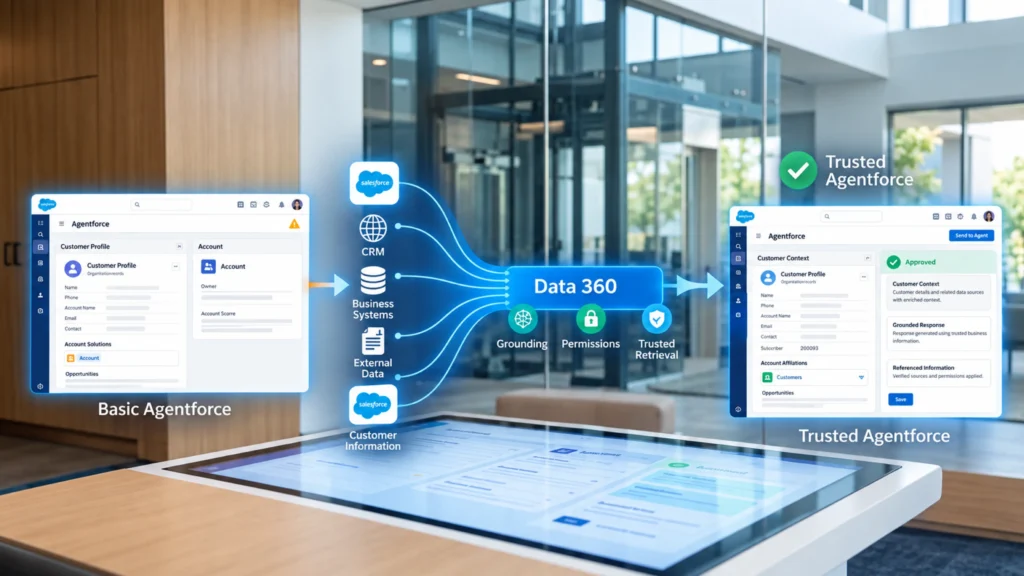
The Challenge: Agentforce Needed More Than Salesforce Data
A company wanted to introduce Agentforce to help employees answer customer questions and take routine actions. Its Salesforce environment already contained useful CRM data, but important information also lived across other systems. The team needed Agentforce to work from a reliable context rather than generate responses from incomplete records.
The question was whether Data Cloud (Data 360) was actually necessary. Instead of treating Data 360 as a mandatory prerequisite for every Agentforce project, the team evaluated where Salesforce data was sufficient and where additional context, grounding, and governance were required.
The Approach: Use Data 360 Where the Agent Needed Deeper Context
The implementation started with the existing Salesforce data and Agentforce capabilities. Where the agent only needed standard CRM context and straightforward actions, Data 360 was not treated as a requirement.
For use cases involving information spread across multiple sources, the architecture introduced Data 360 to provide a broader, more connected context. The Agentforce Data Library also supported grounding so responses could rely on approved business information rather than unsupported assumptions.
The team separated “Data 360 enabled” from “Data 360 implemented.” This helped avoid unnecessary scope while still using Data 360 where the agent’s accuracy, grounding, and multi-source context justified it.
The Outcome
The project showed that the answer was not simply yes or no. Agentforce can operate without a fully implemented Data 360 environment for certain use cases, while more advanced scenarios may benefit substantially from it.
Area | Outcome |
Basic Agentforce use cases | Salesforce data and standard capabilities may be sufficient |
Multi-source context | Data 360 provides a stronger architecture for connected information |
Knowledge grounding | Agentforce Data Library supports more reliable responses |
Governance | Data 360 can support broader data and trust requirements |
Implementation scope | Data 360 should be introduced based on the actual Agentforce use case |
The Key Takeaway
Data 360 should not be added simply because an organization is deploying Agentforce. The better approach is to start with the agent’s required data, actions, grounding, permissions, and context, then determine whether Data 360 is needed. The right question is not “Do we have Agentforce, so do we need Data 360?” but “What does this Agentforce use case require?”
What Not to Do
Do not treat Data 360 as a checkbox. Enabling the platform does not fix duplicate identities, weak source authority, stale articles, broad permissions, or poor retriever behavior.
Do not connect everything immediately. More data can increase retrieval noise, privacy exposure, testing effort, and credit consumption. Add sources because the agent needs them, not because they are available.
Do not assume “not required” means “not needed”. The pages telling you Data Cloud is not required are describing the implementation project, not the platform requirement. Read which one they mean before you build a plan on it.
Do not measure only usage. Track answer acceptance, escalation quality, retrieval misses, unsupported claims, action errors, human overrides, and source gaps. The Wiley Agentforce ROI case study is a useful example because Salesforce reports service outcomes tied to Agentforce and AI, including efficiency gains, 213% ROI, and $230,000 in savings through Wiley’s Service Cloud implementation.
The Practical Implementation Sequence
A clean rollout starts with the agent job, not the platform diagram.
- Define the agent’s job in one sentence.
- List the sources needed for that job.
- Separate required data from nice-to-have data.
- Decide whether an Agentforce Data Library can support release one.
- Identify what would require implementing Data 360.
- Map access, source authority, and review rules.
- Test retrieval before testing conversation quality.
- Launch the smallest useful version.
- Expand sources only when measured failures prove the need.
This keeps Agentforce Data Cloud integration from becoming too broad too early. It also prevents a narrow pilot from being pushed into production before the data foundation is ready.
Working With a Certified Salesforce Partner on Data 360 and Agentforce
We are a certified Salesforce consulting partner, and this particular question is one we get asked before almost every Agentforce engagement. Usually it arrives with a quote attached and a worried look.
The value we add here is mostly subtraction. Sitting between you and Salesforce, we can tell you which parts of a proposed Data 360 scope your agent genuinely needs and which parts are being sold ahead of the requirement. That conversation is easier to have with a partner than with a vendor, and it is easier to have before the order form than after it.
We can also tell you what your retrieval layer will actually consume, because we have run it. Credit consumption on a badly designed retriever is the most common unpleasant surprise on these projects, and it is entirely predictable if someone models it first.
What we bring to the table
- A scoped requirement. The ten-question test run properly, with your actual data sources mapped, so the Data 360 decision is made on evidence rather than on a slide.
- Architecture that matches the agent. Data Library pilot, custom RAG, or full implementation, chosen against the job the agent has to do and the risk it carries.
- Retrieval design that respects the meter. Source selection, chunking, indexing and retriever tuning that keeps credit consumption proportionate to the value delivered.
- Governance built in from the start. Source authority, field-level access, audit capture and human review designed before launch, not retrofitted after an incident.
- Testing the foundation before the conversation. Retrieval accuracy, permission alignment and fallback behaviour validated before anyone judges the agent on how it sounds.
We are not the cheapest route to an Agentforce agent and we do not position ourselves that way. We are the route that gets the data layer right the first time, because retrofitting grounding and governance into a live agent is considerably more expensive than designing them in. If you want that conversation, our Salesforce consulting team can review your sources and give you a scoped answer before you commit budget.
See How We Have Solved This for Other Salesforce Teams
The framework in this guide came out of real engagements across service, sales, healthcare, manufacturing and financial services, not out of a whiteboard.
The same pattern repeats. A team arrives convinced they need a full data programme before they can build anything. We map where the answers actually live. Sometimes the programme is justified and we say so. More often, there is a useful agent that can ship in six weeks on data already sitting in the org, and the larger data work gets a concrete consumer pulling it forward instead of being a project everyone loses patience with.
If you want to see how those decisions played out, including what got built first and what got deferred, our case studies are worth twenty minutes. Read them at https://valintry360.com/case-studies
The Honest Answer: Do You Need Data Cloud for Agentforce
Yes. Data Cloud, now Data 360, is required for key Agentforce capabilities. Salesforce’s own materials are clear that Data 360 must be provisioned and enabled for all Agentforce use, and that features such as the Agentforce Data Library and the Einstein Trust Layer do not work without it. That answers the literal question.
The better answer is that a Data 360 implementation depends on the use case. A controlled knowledge agent can start with enabled Data 360 and a narrow data library. An agent that reads and writes standard CRM records needs no modelling project at all. A production agent that needs unified customer context, unstructured data in Data 360, real-time signals, advanced RAG Salesforce patterns, or governed action needs implemented Data 360.
If you take one sentence from this guide, take this one: Data 360 is required and already provisioned, but a Data 360 implementation is only required for a specific and well-defined set of capabilities. Work out which of those capabilities your agent actually needs, and the budget question answers itself.
Agentforce and Data 360 FAQs
- Is Data Cloud required for Agentforce?
Yes. Data Cloud, now Data 360, must be enabled for key Agentforce capabilities such as the Agentforce Data Library and trust-layer controls. A narrow pilot may only need enabled Data 360, while a production agent often needs full implementation.
- What is the difference between Data Cloud and Data 360?
Data 360 is Salesforce’s current positioning for the data layer formerly called Data Cloud. In Agentforce planning, both terms point to the foundation that supports governed context, retrieval, unstructured data, customer profiles, and AI-ready data use.
- What does Data 360 enabled mean?
Data 360 enabled means the capability has been provisioned and turned on in the org. It does not necessarily mean sources are connected, data is mapped, identity is harmonized, or custom retrievers are designed.
- What does Data 360 implemented mean?
Data 360 implemented means data sources are connected, modeled, governed, retrieved, and tested for production use. It can include data streams, mappings, identity rules, data graphs, retrievers, transformations, and access controls.
- What is the Agentforce Data Library?
The Agentforce Data Library is a Salesforce mechanism for grounding agents in approved sources such as Knowledge, files, web content, or custom retrievers. It gives agents a defined knowledge base for more reliable responses.
- Does the Agentforce Data Library require Data 360?
Yes. Agentforce Data Libraries rely on Data 360. That is why enabled Data 360 is usually the first requirement for teams building grounded Agentforce agents.
- What is Agentforce grounding?
Agentforce grounding means giving the agent approved business context before it answers or acts. Grounding can use CRM records, knowledge articles, files, unstructured content, retrievers, or data graphs.
- What is RAG Salesforce?
RAG Salesforce refers to retrieval augmented generation patterns inside the Salesforce ecosystem. It combines retrieval, grounding, permissions, prompts, and generated responses so agents answer from trusted enterprise context.
- When is enabled Data 360 enough?
Enabled Data 360 may be enough for a narrow agent that answers from approved articles, files, or a small custom retriever source. It works best when the data surface is controlled and the agent does not take high-risk action.
- When do I need implemented Data 360?
Implemented Data 360 is usually needed when the agent needs multiple systems, unified profiles, real-time data, zero-copy access, data graphs, regulated workflows, or cross-system actions.
- Can Agentforce use unstructured data?
Yes. Unstructured data in Data 360 can support grounding from documents, files, transcripts, policies, and other non-tabular business content. The content still needs source authority, version control, and retrieval testing.
- What is an Agentforce retriever?
An Agentforce retriever determines which indexed content is returned for a prompt or task. Retriever quality strongly affects answer quality because the agent can only use the context it receives.
- Can Data 360 reduce hallucination?
Data 360 can reduce hallucination risk by grounding agents in approved and retrievable context. It does not eliminate risk. Teams still need testing, monitoring, feedback, fallback rules, and human review for sensitive work.
- What should teams test before launch?
Teams should test source freshness, retriever accuracy, permission alignment, answer traceability, fallback behavior, action boundaries, audit logging, feedback capture, and escalation paths.
- What is the honest answer for buyers?
Agentforce Data Cloud is required as a foundation, but the level of Data 360 implementation should match the agent’s job. Start with a narrow grounded use case, then expand Data 360 when production needs prove it.
Related Posts
- Salesforce Managed Services
What Is an Agentic Enterprise in Salesforce, and…
An agentic enterprise is an organization where AI agents complete governed work end to end, across data, systems and workflows, instead of only surfacing answers for a person to act on. In the Salesforce context, that means Agentforce 360 agents…
- Salesforce Managed Services
What Is Agentforce? 30 Key Terms Every Salesforce…
Agentforce is Salesforce’s platform for building and running AI agents that reason over trusted business data and take action inside the Salesforce ecosystem. Unlike a chatbot, an Agentforce agent can classify intent, retrieve approved context, call an action such as…
- Salesforce Managed Services
10 Salesforce Data Migration Tools You Should Know…
Every Salesforce project eventually hits the same wall. The org is configured, the users are trained, and then someone asks how 400,000 records from the old CRM, 3 spreadsheets, and an ERP are going to get in there without breaking…