
- Salesforce Managed Services
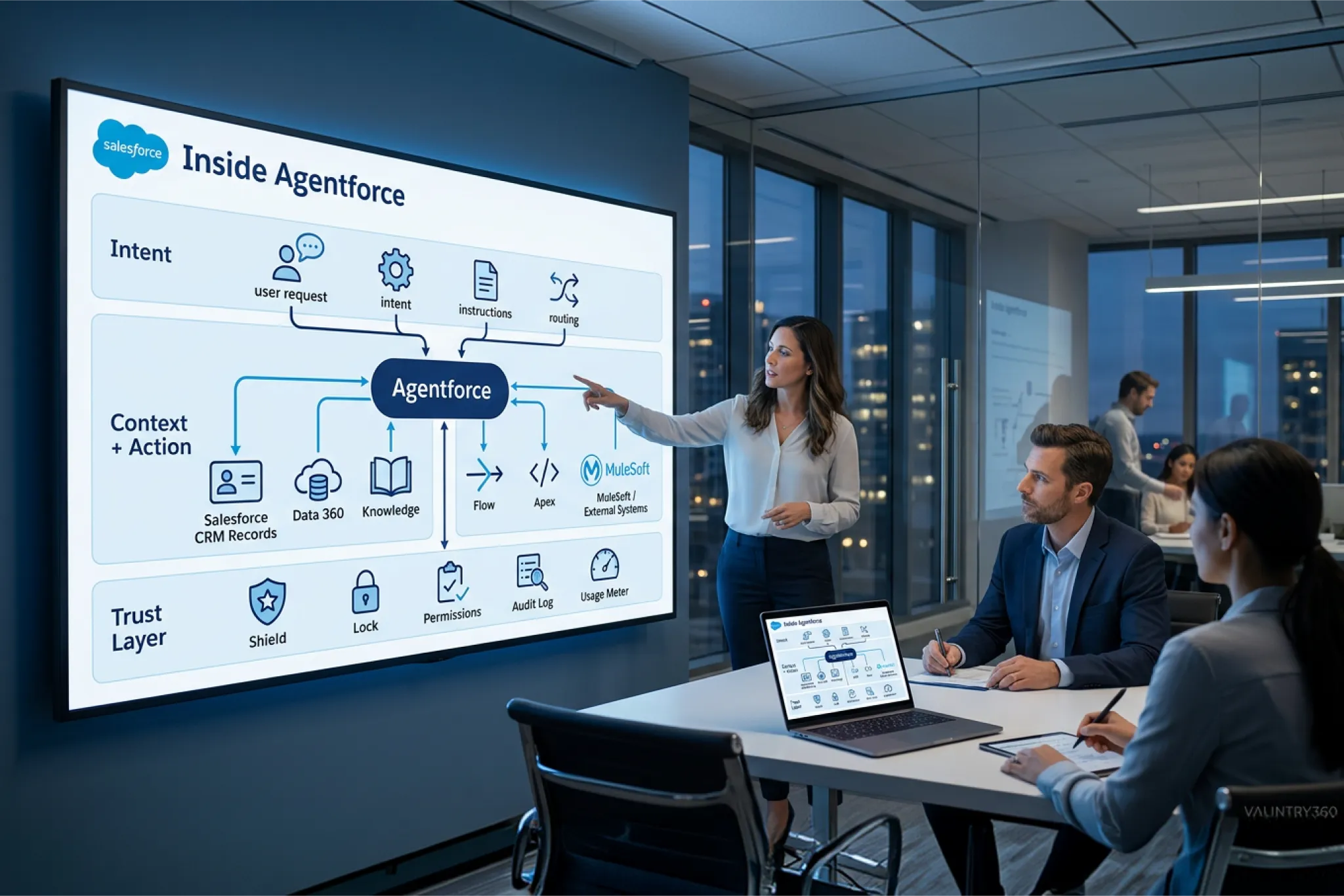
Agentforce is Salesforce’s platform for building and running AI agents that reason over trusted business data and take action inside the Salesforce ecosystem. Unlike a chatbot, an Agentforce agent can classify intent, retrieve approved context, call an action such as updating a record or launching a flow, and hand off to a human when the decision needs one.
That is the short version. The longer version is why this guide exists, because Agentforce meaning starts inside the runtime, not inside the marketing headline. A buyer hears “AI agent” and imagines a chatbot with a better answer style. A Salesforce architect hears a different stack: user intent, subagent routing, instructions, actions, data retrieval, grounding, trust controls, permissions, logs, pricing meters, and operational ownership. That is why Agentforce terminology matters before a demo. The words describe how the agent thinks, what it can touch, how it takes action, and where a Salesforce team can be exposed if the setup is too loose.
The short definition leaves out the buyer questions that decide cost and risk. Does the agent only answer from knowledge? Does it write back to CRM records? Does it need Data 360 for Agentforce? Does it call a Flow, Apex class, MuleSoft API, or external system? Does the Salesforce Trust Layer protect the prompt path? Does the commercial model use Flex Credits, conversations, pay-per-resolution, or per-user licensing?
A useful Agentforce glossary should make those questions visible. Salesforce maintains an official glossary of terms, but buyers still need a plain-English layer that connects Agentforce terminology to implementation decisions. The goal of this guide is to define the 30 terms that come up most often when a business evaluates Agentforce AI consulting, estimates scope, compares partners, and decides whether the agentic AI platform is ready for production.
What Is Agentforce? The Short Definition
Agentforce is Salesforce’s agentic AI platform. It lets organizations build AI agents that work inside Salesforce, using Salesforce data, permissions, and automation to complete defined jobs rather than simply answer questions.
|
Question |
Answer |
|
What does Agentforce do? |
Interprets a request, retrieves approved business context, decides on a path, calls actions such as updating records or launching Flows, and escalates to a human where required. |
|
Is it a chatbot? |
No. A chatbot converses. An Agentforce agent can act on Salesforce systems, under Salesforce permissions, with an audit trail. |
|
What powers the reasoning? |
The Atlas Reasoning Engine, which breaks a request into steps and orchestrates the actions needed to complete it. |
|
Where does its knowledge come from? |
Grounding, through CRM records, Salesforce Knowledge, files, an Agentforce Data Library, or Data 360. |
|
Who builds it? |
Admins and architects, mostly in Agentforce Builder, with Agent Script available where deterministic control is needed. |
|
How is it priced? |
Consumption through Flex Credits or conversations, outcome-based through pay-per-resolution, or per user through add-ons and bundled editions. |
If you take one line from this guide, take this one. Agentforce is not a smarter answer box. It is a way to let software do defined work under governance, which is why the vocabulary around it is mostly vocabulary about control.
Agentforce Meaning in Plain English
Agentforce meaning is not just “Salesforce AI agent.” For buyers, the phrase covers an operating model where Salesforce AI agents classify intent, select the right subagent, retrieve approved context, run actions, respect security, and produce an answer or workflow outcome that can be reviewed. The Agentforce glossary matters because every word points to a control point.
The terms that change the buying decision are not the broad ones. Agentforce 360, Agentforce Builder, Atlas Reasoning Engine, Agentforce topics and actions, Data 360 for Agentforce, Salesforce Trust Layer, RAG Salesforce, and Flex Credits decide how expensive, safe, and production-ready the program becomes. A team that understands those terms can ask better questions before the first sprint.
The honest answer is that Agentforce terminology should be read as architecture language. A glossary is useful only when it separates product names from runtime behavior, data requirements, governance duties, and pricing exposure. That is how a buyer avoids treating a small demo agent like a production service system.
A Buyer Map of Agentforce Terminology
Term family | What it describes | Buyer question it answers | Typical risk if misunderstood |
Agent runtime | Agent, subagent, instructions, actions, channels | What job can the agent actually do? | Broad scope, weak routing, wrong action selection |
Reasoning layer | Atlas Reasoning Engine, hybrid reasoning, Agent Script | How does the agent decide what happens next? | Black-box behavior without enough deterministic control |
Data and context | Data 360, grounding, retrievers, RAG, Data Library | What source does the agent trust? | Hallucinated or outdated answers |
Trust and governance | Salesforce Trust Layer, guardrails, audit, human review | How is risk controlled? | Sensitive data exposure, weak approvals, poor traceability |
Commercial model | Flex Credits, conversations, add-ons, editions | How will usage turn into cost? | Pilot economics that break at production volume |
This table is the fastest way to read an Agentforce glossary. The terms do not sit in one bucket. Some define the agent’s job, some define the data foundation, some define the security boundary, and some define the bill. A technical team can know Agentforce Builder well and still miss the cost logic behind Flex Credits. A business sponsor can understand the Agentic Enterprise message and still miss why an action needs an approval path.
For that reason, a glossary page should not stop at definitions. It should explain which term changes the architecture, which term changes governance, and which term changes procurement. A strong Salesforce AI solutions strategy keeps those layers connected rather than treating Agentforce as one feature to switch on.
Why Agentforce Terminology Confuses Buyers
Term family | What it describes | Buyer question it answers | Typical risk if misunderstood |
Agent runtime | Agent, subagent, instructions, actions, channels | What job can the agent actually do? | Broad scope, weak routing, wrong action selection |
Reasoning layer | Atlas Reasoning Engine, hybrid reasoning, Agent Script | How does the agent decide what happens next? | Black-box behavior without enough deterministic control |
Data and context | Data 360, grounding, retrievers, RAG, Data Library | What source does the agent trust? | Hallucinated or outdated answers |
Trust and governance | Salesforce Trust Layer, guardrails, audit, human review | How is risk controlled? | Sensitive data exposure, weak approvals, poor traceability |
Commercial model | Flex Credits, conversations, add-ons, editions | How will usage turn into cost? | Pilot economics that break at production volume |
This table is the fastest way to read an Agentforce glossary. The terms do not sit in one bucket. Some define the agent’s job, some define the data foundation, some define the security boundary, and some define the bill. A technical team can know Agentforce Builder well and still miss the cost logic behind Flex Credits. A business sponsor can understand the Agentic Enterprise message and still miss why an action needs an approval path.
For that reason, a glossary page should not stop at definitions. It should explain which term changes the architecture, which term changes governance, and which term changes procurement. A strong Salesforce AI solutions strategy keeps those layers connected rather than treating Agentforce as one feature to switch on.
Why Agentforce Terminology Confuses Buyers
Product names and architecture names overlap
Salesforce uses Agentforce to describe a product family, a runtime experience, and a business direction. Agentforce 360 then widens the frame to include agents, apps, humans, and data. A buyer can hear both terms in one sales conversation and assume they mean the same thing. They do not. Agentforce is the agent capability. Agentforce 360 is the broader connected platform story.
Old terminology still appears in active conversations
Agentforce topics and actions remain common language, while Salesforce documentation has also moved toward subagents in newer contexts. That transition matters because an implementation team may discuss a “topic” while a new Builder screen uses “subagent.” The idea is similar, but the buyer should ask what the unit of routing and responsibility is called in the actual org being built.
Demos hide the data work
A demo can show an agent answering smoothly. A real org has duplicate contacts, stale knowledge, old automation, connected apps, hidden permissions, and different versions of the truth. Agentforce meaning changes when the agent moves from demonstration content to live customer data. That is where Data 360 for Agentforce, grounding, RAG Salesforce, and the Salesforce Trust Layer become practical terms instead of vocabulary.
Pricing words sound smaller than usage risk
Flex Credits, conversations, and per-user licensing look like commercial terms. They are also architectural terms. An agent that performs 2 simple actions per interaction may price differently from one that calls multiple tools, retrieves documents, and runs a voice workflow. Understanding Agentforce terminology early prevents pricing from becoming a surprise after launch.
Agentforce vs Einstein: What Actually Changed
This is the comparison buyers ask for most, usually because they already paid for Einstein and want to know what is genuinely new.
Einstein is Salesforce’s embedded AI layer. It predicts, classifies, summarises, drafts and recommends. It assists a human who then decides. Agentforce adds a reasoning and action layer on top, so the software can plan a sequence of steps and execute them rather than only suggesting them.
|
|
Einstein |
Agentforce |
|
What it is |
Embedded predictive and generative AI inside Salesforce |
Agentic AI platform for building and running AI agents |
|
What it does |
Predicts, scores, classifies, summarises, drafts |
Reasons through a request, plans steps, calls actions, evaluates results |
|
Who acts |
A human acts on the suggestion |
The agent can act, within defined permissions and guardrails |
|
Core engine |
Predictive models and prompt templates |
Atlas Reasoning Engine |
|
Typical output |
A recommendation, a score, a draft |
A completed task, an updated record, a resolved case, or an escalation |
|
Risk profile |
Low. A human filters everything |
Higher. Actions have operational consequences, so guardrails matter |
A related question is whether Agentforce is simply Einstein Copilot renamed. Partly. Einstein Copilot was folded into Agentforce, so the name did change. But the architecture also changed, because Copilot was assistive and Agentforce introduces planning and execution. If a vendor tells you it is only a rebrand, ask them to explain the Atlas Reasoning Engine and what the agent is permitted to execute without a human.
Agentforce Agent Types Explained
Salesforce ships preconfigured agent types alongside the ability to build your own. Knowing the names saves time in a demo, because each one carries a different scope, risk profile and pricing pattern.
Service Agent
A customer-facing support agent. Answers common questions, retrieves knowledge, triages and routes cases, and escalates to a human rep. Usually the first production agent a company deploys, and the one where deflection rate is the headline metric.
Agentforce Help Agent
A specific service agent type billed on outcomes rather than activity. You pay when it resolves the inquiry. It is the agent behind the pay-per-resolution pricing model, which makes it the lowest-risk starting point for teams that cannot predict their deflection rate.
Sales Development Representative (SDR) Agent
Engages inbound leads, answers product questions, handles objections and books meetings using CRM context. Risk sits in tone, accuracy and escalation timing rather than in system actions.
Sales Coach
An internal agent that guides reps on next-best action, deal risk and performance based on pipeline stage and activity history. Employee-facing, so it usually sits under per-user pricing rather than consumption.
Agentforce Coworker
An employee-facing agent that works alongside staff across Salesforce and Slack. It is bundled unmetered into some of the higher editions, which changes its cost logic entirely compared with a customer-facing agent.
Agentforce Voice
An agent that handles spoken conversation for inbound calls, bookings and routine service. Priced differently because a voice action consumes more Flex Credits than a standard action, so voice workflows should always be modelled separately.
Personal Shopper and Campaign Agents
Commerce and marketing agent types. A personal shopper guides product discovery and purchase. A campaign agent builds audiences, personalises messaging and triggers outbound communication. Both depend heavily on the quality of the data foundation underneath.
Preconfigured does not mean plug and play. Each type arrives with a defined scope and built-in escalation paths, but the goals, guardrails and data sources still have to be set before production. Teams that succeed treat these as a starting layer, deploy internally first, and expand once the behaviour is understood.
Quick-Reference: All 30 Terms at a Glance
The full definitions follow. This table is for scanning, or for pasting into a project brief.
|
Term |
One-line meaning |
|
Action |
A callable task the agent can perform, such as updating a record or launching a Flow. |
|
Agent |
The AI worker that receives a request, interprets it, and responds or acts. |
|
Agent Script |
A way to define agent behaviour explicitly, for deterministic control. |
|
Agentforce |
Salesforce’s platform for building and running AI agents. |
|
Agentforce 360 |
The broader platform story connecting agents, apps, humans and data. |
|
Agentforce Builder |
The workspace for defining, testing and managing agents. |
|
Agentforce Data Library |
A defined source layer for grounding agents in approved content. |
|
Agentforce topics and actions |
The operating model: what kind of work, and what the agent may do. |
|
Agentic Enterprise |
Salesforce’s term for humans and agents working together across the business. |
|
Agentic loop |
The repeating cycle of interpret, retrieve, act, evaluate, continue. |
|
Atlas Reasoning Engine |
The reasoning system that plans steps and orchestrates actions. |
|
Conversation pricing |
Charging per interaction unit rather than per action or per seat. |
|
Data 360 |
Salesforce’s data foundation, formerly Data Cloud, that supplies trusted context. |
|
Data Cloud |
The former name for Data 360. Renamed October 14, 2025. |
|
Digital labor |
The business phrase for AI agents performing work humans used to do. |
|
Flex Credits |
Consumption-based pricing, $500 per 100,000 credits, roughly $0.10 per standard action. |
|
Grounding |
Supplying the agent with trusted context before it generates or acts. |
|
Guardrails |
The controls that keep an agent inside approved boundaries. |
|
Human in the loop |
A person reviews, approves or takes over at defined points. |
|
Hybrid reasoning |
Combining flexible AI reasoning with deterministic control. |
|
Instructions |
The rules that tell an agent how to behave inside a subagent or task. |
|
Intelligent Context |
Extracting usable meaning from complex and unstructured business content. |
|
Prompt template |
A reusable instruction pattern with placeholders filled by business data. |
|
RAG Salesforce |
Retrieval augmented generation patterns applied inside Salesforce. |
|
Reasoning instructions |
Guidance for how the agent chooses between possible paths. |
|
Retriever |
The mechanism that decides which content is returned for a prompt. |
|
Salesforce AI agents |
Configured digital workers handling defined jobs inside Salesforce. |
|
Salesforce Trust Layer |
The security and trust architecture around generative AI and Agentforce. |
|
Subagent |
The work-specific unit handling a defined type of task. Formerly called a topic. |
|
Vector index |
A store that supports semantic retrieval by meaning rather than keyword. |
The Agentforce Glossary: 30 Terms Explained
1. Agentforce
Agentforce is Salesforce’s platform layer for building and running autonomous or semi-autonomous AI agents inside the Salesforce ecosystem. In buyer terms, Agentforce meaning is not simply “chatbot.” It is a way to combine Salesforce AI agents, data access, business rules, actions, channels, and governance so work can move from request to outcome.
2. Agentforce 360
Agentforce 360 is Salesforce’s broader platform direction that connects humans, applications, agents, and data into one operating model. Salesforce’s Agentforce 360 announcements describe features such as Agentforce Builder, Agent Script, Agentforce Voice, and Intelligent Context. Buyers should read Agentforce 360 as the umbrella story, not as one single feature.
3. Salesforce AI agents
Salesforce AI agents are software workers configured to handle defined jobs inside sales, service, marketing, commerce, IT, and operations. They can answer questions, summarize records, draft content, retrieve context, and trigger actions. The important point is scope. Salesforce AI agents should have clear jobs, data boundaries, and escalation rules before they meet real users.
4. Agent
An agent is the user-facing or system-facing AI worker. It receives a request, interprets intent, retrieves context, and either responds or takes action. A buyer should ask what the agent is allowed to do without human review. Reading Agentforce terminology this way keeps the agent’s job separate from the product label.
5. Subagent
A subagent is the work-specific unit that handles a defined type of task. In older language, many buyers still hear this described as a topic. Subagents matter because routing quality depends on boundaries. A refund subagent, a warranty subagent, and a pricing subagent may need different sources, instructions, and actions.
6. Agentforce topics and actions
Agentforce topics and actions is a useful phrase because it captures the practical operating model. A topic or subagent defines the kind of work. An action defines what the agent can do. Together, they decide whether the agent only talks or can actually execute. This is one of the most important Agentforce glossary ideas for buyers.
7. Action
An action is a callable task the agent can use to get something done, such as creating a case, updating a field, drafting an email, launching a Flow, or calling an API. Actions deserve scrutiny because they create operational consequences. The more actions an agent has, the more the team needs permissions, testing, rollback logic, and monitoring.
8. Instructions
Instructions tell the agent how to behave inside a subagent or task. They can define tone, sequence, limitations, data use, and decision rules. Weak instructions create vague behavior. Overloaded instructions create brittle behavior. The buying question is whether instructions are precise enough to govern common cases without hiding exceptions.
9. Reasoning instructions
Reasoning instructions guide how the agent decides between possible paths. They matter when a request could fit more than one subagent or action. In a service workflow, for example, the agent may need to classify whether a customer wants order status, refund help, technical troubleshooting, or escalation. Poor reasoning instructions cause misrouting.
10. Atlas Reasoning Engine
The Atlas Reasoning Engine is the reasoning system behind Agentforce. Salesforce describes it as the brain of Agentforce, responsible for interpreting requests, planning steps, and orchestrating action. For buyers, Atlas Reasoning Engine is the term to inspect when a vendor explains how the agent chooses what to do next.
11. Agentic loop
An agentic loop is the recurring pattern where the agent interprets the request, retrieves context, selects a path, takes an action, evaluates the result, and continues if the job is not finished. This term matters because multi-step work creates more failure points than one answer. Buyer governance should follow the loop, not only the final response.
12. Agentforce Builder
Agentforce Builder is the workspace used to define, test, and manage agents. It helps teams assemble subagents, instructions, actions, and testing flows. A focused Agentforce Quickstart usually starts here with a narrow, measurable use case.
13. Agent Script
Agent Script gives builders explicit control over how an agent behaves, step by step, rather than relying on the reasoning engine to choose a path. It is useful when a team needs determinism, not only probabilistic reasoning. Buyers should ask where free-form reasoning is acceptable and where Agent Script or structured logic is needed. That distinction matters in regulated, financial, service, and revenue workflows.
14. Hybrid reasoning
Hybrid reasoning combines flexible AI reasoning with more deterministic control. It matters because enterprise teams rarely want pure autonomy everywhere. A policy answer may need a grounded response. A refund approval may need a hard workflow. Hybrid reasoning is the language for deciding which parts can flex and which parts must be scripted.
15. Data 360 for Agentforce
Data 360 for Agentforce is the data foundation that gives agents trusted business context. It can support unified profiles, metadata context, unstructured information, and governed retrieval. It has to be enabled for Agentforce to work at all, though a full implementation is only needed for specific capabilities. Our Data 360 services exist because the data layer, more than the model, determines whether the agent answers with company-specific truth or with generic fluency.
16. Data Cloud
Data Cloud is the former name for Data 360. Salesforce renamed it on October 14, 2025, and the functionality did not change. In practice, buyers will hear both names for some time yet, because documentation, the product interface and internal runbooks are all still catching up. The safer phrase in a mixed room is “Data Cloud, now Data 360”.
17. Grounding
Grounding means supplying the agent with trusted context before it generates or acts. That context can come from CRM records, Knowledge, files, Data 360, a retriever, or an approved external source. Grounding is central to Salesforce Agentforce meaning because it separates an enterprise agent from a general-purpose language model answering from memory.
18. RAG Salesforce
RAG Salesforce refers to retrieval augmented generation patterns inside the Salesforce ecosystem. IBM defines retrieval augmented generation as connecting an AI model to external knowledge bases so responses can be based on relevant outside information. In Salesforce, RAG includes data access, permissions, retrievers, prompt context, and response generation.
19. Retriever
A retriever decides which pieces of content or data should be returned for a prompt. Good retrievers improve relevance. Poor retrievers feed the agent the wrong evidence, and they also cost more, because every retrieval consumes credits. In an Agentforce glossary, retriever belongs next to grounding and RAG Salesforce because it is one of the mechanisms that controls what the model actually sees.
20. Vector index
A vector index stores content in a form that supports semantic retrieval. Instead of matching only exact keywords, it helps find passages that are similar in meaning. Buyers do not need to become vector database specialists, but they should understand that document quality, chunking, metadata, and source control all affect vector search quality.
21. Agentforce Data Library
An Agentforce Data Library is a defined source layer for grounding agents in approved business content. It can help a narrow agent answer from a controlled knowledge base or file set. It should not be mistaken for a full enterprise data strategy. A library can prove usefulness, while Data 360 for Agentforce can support a broader production context.
22. Intelligent Context
Intelligent Context refers to extracting usable meaning from complex business content, including unstructured material. It matters when policies, PDFs, product sheets, diagrams, and support documents contain the knowledge an agent needs. Buyers should ask which content types are truly supported, how they are indexed, and how retired documents are excluded.
23. Salesforce Trust Layer
The Salesforce Trust Layer is the security and trust architecture that helps protect data and users when generative AI and Agentforce features operate. It covers secure data retrieval, grounding, masking, policies, audit, and feedback. The Salesforce Trust Layer does not remove the need for business governance, but it gives the architecture a safer foundation. It also requires Data 360 to be enabled, which is one reason the data requirement is not optional.
24. Guardrails
Guardrails are the controls that keep the agent inside approved boundaries. They can include instructions, permission rules, human review, content restrictions, topic boundaries, policy checks, and escalation paths. The Agentforce governance framework is where guardrails become operating design rather than a paragraph in a policy document.
25. Human in the loop
Human in the loop means a person reviews, approves, or takes over at specific points. This is not a sign that Agentforce failed. It is often the correct design for sensitive, high-value, or ambiguous work. The glossary term helps buyers separate automation from autonomy. Some decisions should remain supervised.
26. Prompt template
A prompt template is a reusable instruction pattern that can include placeholders filled with business data. It helps standardize generated responses, summaries, or recommendations. Prompt templates matter because they connect language generation to approved context. Buyers should ask who owns templates, how they are tested, and how changes are approved.
27. Digital labor
Digital labor is the business phrase for AI agents performing work that previously required human effort. The term can be useful, but it can also become too broad. A buyer should translate digital labor into specific tasks, such as qualify a lead, summarize a case, draft a reply, update a record, or escalate a workflow.
28. Flex Credits
Flex Credits are Salesforce’s consumption-based pricing unit for Agentforce. They are sold at $500 per 100,000 credits, which works out to about $0.005 per credit. A standard Agentforce action uses 20 credits, roughly $0.10, and an Agentforce Voice action uses 30 credits, roughly $0.15. Buyers should treat Flex Credits as both a finance term and a design term, because action volume is what drives spend. Our Agentforce pricing guide works through the full cost math.
29. Conversation pricing
Conversation pricing charges around an interaction unit rather than every individual seat or action, at $2 per conversation. It can be simpler to model for some customer-facing agents, but it still requires volume assumptions. A buyer should model normal, peak, and failure scenarios. A third option now exists: pay-per-resolution, where the Help Agent is billed $2 only when it actually resolves the inquiry.
30. Agentic Enterprise
Agentic Enterprise is Salesforce’s strategic phrase for a company where humans and AI agents work together across data, apps, and workflows. It is useful as a vision term, but buyers should connect it back to implementation. Agentic Enterprise only becomes real when data, governance, users, processes, and measurable outcomes are ready.
Agentforce Terms That Changed in 2026
Terminology on this platform moves fast enough that a glossary written eighteen months ago is now actively misleading. These are the changes worth knowing before your next vendor conversation.
|
You may still hear |
Current term |
What changed |
|
Data Cloud |
Data 360 |
Renamed October 14, 2025. Functionality unchanged, both names still in circulation. |
|
Topic |
Subagent |
Newer Builder contexts use subagent. The routing concept is the same. |
|
Einstein Copilot |
Agentforce |
Copilot was folded into Agentforce. The architecture also changed, not just the label. |
|
Agentforce 1 Edition |
Max edition |
Renamed in the September 2026 edition restructure. Same $550 per user per month, larger credit allocation. |
|
Enterprise Edition |
Core edition |
Replaced September 2026. Price moved to $195 per user per month with bundled Flex Credits. |
|
Unlimited Edition |
Advanced edition |
Replaced September 2026, at $395 per user per month with bundled credits. |
|
Agentforce 2.0 |
Agentforce 360 |
The version framing gave way to the broader platform framing. |
Newer terms worth adding to your vocabulary
- Agentforce Coworker. An employee-facing agent that works alongside staff across Salesforce and Slack, bundled unmetered into some higher editions.
- Agentforce Vibes. Salesforce’s agentic development tooling, aimed at building rather than at end-user workflows.
- Headless 360. Agent capability consumed outside the Salesforce UI, through APIs and other surfaces.
- Pay-per-resolution. Outcome-based billing for the Help Agent, $2 per resolved inquiry, with no charge when the customer escalates to a human.
- Testing Center. The environment for building, testing and versioning agent behaviour before release.
- Salesforce Digital Wallet. The consumption dashboard where Flex Credit and Data 360 credit usage is tracked.
If a proposal or a partner deck uses the left-hand column above without acknowledging the right, it was probably written some time ago. That is not automatically a problem, but it is worth asking when the approach was last reviewed.
Similar Terms That Should Not Be Used Interchangeably
|
Common mix-up |
How to separate them |
Why the difference matters |
|
Agent vs subagent |
The agent is the broader worker. The subagent handles a defined job inside that worker. |
Weak subagent boundaries cause misrouting and poor ownership. |
|
Action vs automation |
An action is what the agent can call. Automation is the broader process logic around that action. |
Calling a Flow is not the same as governing the full workflow. |
|
Grounding vs search |
Search finds content. Grounding feeds approved context into the agent’s response or decision path. |
Search success does not guarantee answer quality. |
|
Salesforce Trust Layer vs governance |
The Trust Layer provides platform protections. Governance assigns ownership, policy, review, and audit. |
Technical controls still need business accountability. |
|
Flex Credits vs conversations |
Flex Credits track usage by action or feature type. Conversations price a broader interaction unit. |
The right commercial model depends on agent design and volume. |
|
Agentforce Builder vs Agent Script |
Builder supports visual and conversational agent creation. Agent Script adds explicit behavioral control. |
Regulated workflows often need more deterministic design. |
|
Enabled vs implemented (Data 360) |
Enabled means provisioned. Implemented means sources connected, mapped and governed. |
One is a switch. The other is a project with a budget attached. |
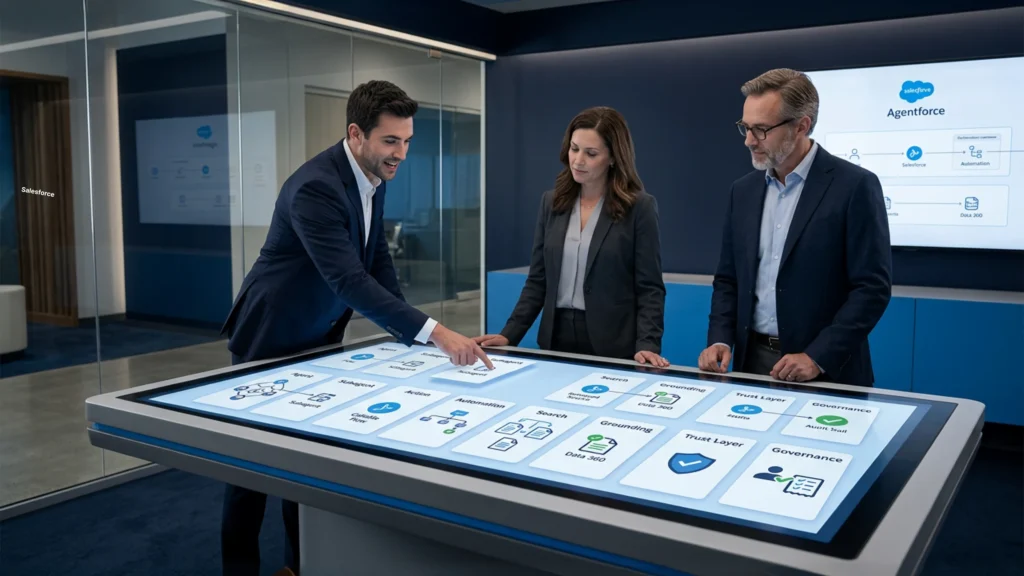
These pairs are where many buying conversations become unclear. A vendor may say the agent is grounded, but the buyer should ask grounded in what source, through which retriever, under which permissions, and with what fallback when evidence is weak. A team may say it has governance, but the buyer should ask who approves actions, who reviews logs, and who owns the agent after go-live.
The same issue appears in partner selection. A firm can know Salesforce configuration and still be thin on RAG Salesforce, Data 360 for Agentforce, or agent operations. The human partner still matters because architecture, data quality, risk control, and adoption do not disappear when Agentforce Builder becomes easier to use.
15 Agentforce Terms That Change the Buying Decision
1. Agentforce meaning
Agentforce meaning changes the buying decision because it sets the scope of the conversation. If the buyer thinks Agentforce is only a chatbot, the project may be under-scoped. If the buyer understands it as an agentic AI platform, the discussion naturally includes data, actions, governance, cost, and support.
2. Agentforce glossary
An Agentforce glossary creates shared language between executives, Salesforce admins, architects, security teams, and procurement. Without it, the same word can carry different expectations across the room. A shared glossary reduces ambiguity before statements of work, demos, and pricing models become hard to unwind.
3. Salesforce Agentforce meaning
Salesforce Agentforce meaning should be tied to the Salesforce platform context. The agent is not floating outside the CRM. It sits near CRM records, metadata, automations, channels, and permissions. That makes Salesforce architecture knowledge part of the buying decision, not a nice addition.
4. Agentforce 360 explained
Agentforce 360 explained properly helps buyers avoid confusing the vision with the deployment. The vision is humans, data, apps, and AI agents working together. The deployment is a sequence of scoped use cases, data readiness, permission design, testing, and operational ownership.
5. Flex Credits
Flex Credits change procurement because usage can scale with behavior, not only headcount. A pilot with limited actions may look inexpensive. A production service agent with retrieval, voice, multiple actions, and repeated retries may look different. Buyers should model usage before celebrating a low entry point.
6. Atlas Reasoning Engine
Atlas Reasoning Engine changes risk because it explains how the agent reasons through a request. A buyer should ask when Atlas can reason freely, when Agent Script constrains the path, and how the team tests routing, action choice, and fallback behavior.
7. Agentic Enterprise
Agentic Enterprise changes leadership expectations. It is not a synonym for installing Agentforce. It points to a future operating model where human teams and AI agents share work. That requires governance, data quality, skills, adoption, and business measurement.
8. Agentforce terminology
Agentforce terminology matters because the product is evolving quickly. Terms such as topics, subagents, Builder, Agent Script, Data 360, and Intelligent Context can shift across releases. Buyers should confirm which terms appear in their org, their contract, and their implementation documentation.
9. Salesforce AI agents
Salesforce AI agents change the operating model when they move beyond answering to acting. A summary agent has one risk profile. An agent that updates accounts, changes case status, or triggers an order workflow has another. Buyers should define write permissions before launch.
10. Agentforce topics and actions
Agentforce topics and actions decide the shape of the agent’s work. Too few subagents create broad, confused routing. Too many create maintenance overhead. Too many actions create risk. The buying decision should include a design review of action boundaries.
11. Agentforce Builder
Agentforce Builder lowers the barrier to agent creation, which is useful and risky at the same time. More people can build. More people can also create inconsistent patterns if governance is weak. The buyer should ask who may create, approve, test, and publish agents.
12. Data 360 for Agentforce
Data 360 for Agentforce changes the answer quality. Without a trusted data foundation, the agent may produce confident responses from incomplete context. Buyers should ask which data sources are needed for release one and which sources belong in later phases.
13. Salesforce Trust Layer
Salesforce Trust Layer changes the security conversation. It helps reduce risk through platform protections, but it does not replace access design, source approval, or incident response. Buyers should treat Trust Layer as part of the control stack, not the whole control stack.
14. Agentic AI platform
Agentic AI platform is a useful category term when comparing Agentforce with other systems. But inside a Salesforce decision, the platform category matters less than the use case. The buyer should ask which existing CRM, Service Cloud, Data 360, integration, and workflow assets the platform can use.
15. RAG Salesforce
RAG Salesforce changes implementation effort because retrieval quality has to be designed. It is not enough to upload documents. The team has to manage source authority, chunking, permissions, metadata, testing, and answer traceability.
Where the Glossary Becomes Implementation Risk
The glossary turns into implementation risk when definitions are used without boundaries. Agentforce meaning should tell the team what an agent is allowed to know, say, and do. Agentforce glossary work should also reveal what remains unknown: which data sources are clean, which actions need approval, which users can see which fields, and which logs will prove what happened.
Gartner predicted that over 40% of agentic AI projects will be canceled by the end of 2027, citing escalating costs, unclear business value, and inadequate risk controls. That warning is directly relevant to Agentforce terminology. If a buyer cannot define Flex Credits, guardrails, grounding, actions, and ownership, the project may already contain the causes Gartner named.
NIST’s AI Risk Management Framework is also useful here because it treats AI risk across design, development, use, and evaluation. In Agentforce terms, that means the glossary should not be a training artifact only. It should become a checklist for what gets governed, measured, and managed across the agent lifecycle.
A Practical Agentforce Glossary Checklist
- Define the business job before naming the agent.
- Separate Agentforce, Agentforce 360, and Agentic Enterprise in stakeholder conversations.
- Confirm whether the build uses topics, subagents, or both terms in documentation.
- List every action the agent may call and the system it affects.
- Identify every data source used for grounding.
- Decide where Data 360 for Agentforce is required now and where it can wait.
- Confirm which Salesforce Trust Layer controls apply to the use case.
- Model Flex Credits or conversation pricing against likely production volume.
- Define the human-in-the-loop path for sensitive decisions.
- Assign post-go-live ownership for tuning, testing, permissions, and source freshness.
This checklist is intentionally plain. Buyers often lose clarity when Agentforce terminology becomes too product-heavy too early. A glossary works best when each term ends in a decision. Who owns it? What does it affect? What must be tested? What could break if the term is misunderstood?
The skills requirement is real. The World Economic Forum’s Future of Jobs Report 2025 found that 63% of employers identify skills gaps as a major barrier to business transformation. Agentforce terminology is part of that gap because teams need shared language for data, actions, trust, and cost.
Term-to-Decision Matrix for Buyers
Term | Decision it should trigger | Owner to involve |
Agentforce meaning | What business job is being automated or assisted? | Executive sponsor, product owner |
Agentforce Builder | Who can build, test, and publish agents? | Salesforce admin, platform owner |
Data 360 for Agentforce | Which sources are required for trusted context? | Data architect, CRM owner |
RAG Salesforce | How will evidence be retrieved and validated? | AI architect, knowledge owner |
Salesforce Trust Layer | What data protections, masking, and audit controls apply? | Security, compliance, Salesforce architect |
Flex Credits | What usage pattern will drive cost? | Procurement, finance, delivery lead |
Agentforce topics and actions | What can the agent classify and execute? | Solution architect, business process owner |
Human in the loop | Which decisions require review before action? | Risk owner, operations lead |
Use this matrix during early discovery. Every term should push the buyer toward a design, control, or cost decision. That is the real value of a buyer-focused Agentforce glossary.
Case Study: Turning Agentforce Terminology Into an Implementation Plan
The Challenge: A Promising Agentforce Use Case With Too Many Open Questions
A Salesforce customer wanted to launch an AI agent for customer service, but the initial project scope was simply described as “build an Agentforce chatbot.” That definition left several important questions unanswered: What could the agent actually do? Which Salesforce data could it use? Which actions could it execute? Would responses require grounding? What controls would apply? And how would production usage affect cost?
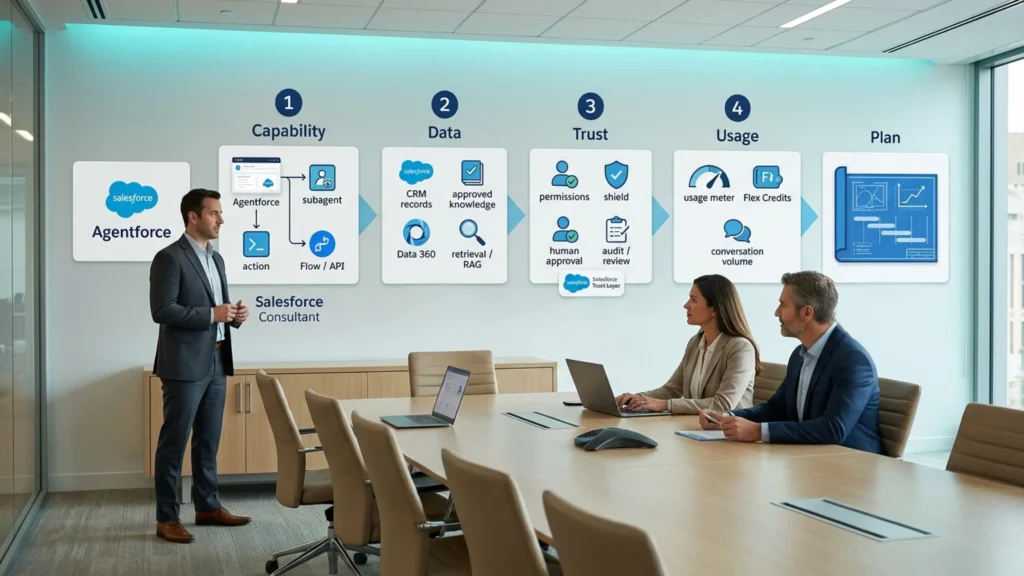
Before development began, the team translated the key Agentforce terms into specific architecture, governance, and commercial decisions. This prevented the project from treating Agentforce as a single feature rather than an operating system for AI-driven work.
The Approach: Turn Each Term Into a Buyer Decision
The team mapped the agent’s requirements across its runtime, data, trust, and pricing layers. Agentforce Builder defined the development environment, while subagents and actions established what work the agent could handle and what systems it could affect.
For knowledge-based responses, the team identified approved sources for grounding and evaluated whether Data 360 for Agentforce or an Agentforce Data Library was needed. RAG and retriever requirements were considered separately from general search so the team could understand exactly how business evidence would reach the agent.
Security and governance were then added through permissions, guardrails, the Salesforce Trust Layer, and human-in-the-loop controls. Finally, Flex Credits and conversation pricing were evaluated against expected usage instead of relying only on pilot volumes.
Buyer Decision Map
Agentforce Term | Decision Made | Why It Mattered |
Agent / Subagent | Defined specific service jobs | Reduced routing confusion |
Actions | Limited approved CRM and workflow actions | Controlled operational risk |
Grounding / RAG | Identified trusted knowledge sources | Improved response reliability |
Data 360 | Used only where broader context required it | Avoided unnecessary scope |
Trust Layer / Guardrails | Defined security and review controls | Strengthened governance |
Flex Credits | Modeled expected production usage | Improved cost visibility |
Human in the loop | Reserved review for sensitive decisions | Balanced automation with oversight |
The Outcome
Instead of buying or building Agentforce around a vague “AI chatbot” definition, the team created a clear implementation model tied to specific jobs, data sources, actions, controls, and costs. The glossary became more than a reference document—it became a discovery checklist for architecture, procurement, security, and implementation.
The Key Takeaway
The value of an Agentforce glossary is not knowing 30 definitions by memory. It is understanding what each term changes in a real Salesforce project. When terms such as Agentforce Builder, subagents, actions, grounding, Data 360, Salesforce Trust Layer, and Flex Credits are connected to actual decisions, buyers can scope Agentforce more accurately and avoid surprises after implementation.
Working With a Certified Salesforce Partner on Agentforce
We are a certified Salesforce consulting partner, and a surprising amount of what we do early in an Agentforce engagement is vocabulary work. Not because clients need a lesson, but because a shared definition is what makes a scoping conversation productive rather than circular.
Sitting between you and Salesforce, we can tell you which terms in a proposal describe capability you will actually use and which describe capability that is being sold ahead of your requirement. That is a more useful conversation to have with a partner than with a vendor, and much more useful before the statement of work than after it.
We can also tell you what the terminology implies operationally. Every term in this glossary carries an owner, a test, and a cost. A proposal that names Data 360, Flex Credits and guardrails without saying who owns each one is describing a product, not a plan.
What we bring to the table
- A scoped definition of the agent’s job, written in one sentence, before anything gets built.
- Architecture decisions mapped to the terms that drive them: subagent boundaries, action permissions, grounding sources and retrieval design.
- A commercial model tested against real usage, not pilot volumes, across Flex Credits, conversations, pay-per-resolution and per-user options.
- Governance designed in from the start: Trust Layer controls, guardrails, human-in-the-loop paths and audit capture.
- Post-launch ownership, because tuning, permissions, source freshness and testing do not maintain themselves.
We are not the cheapest way to get an Agentforce agent live and we do not present ourselves that way. We are the route that gets the scope, the data layer and the governance right the first time, because unwinding a vague scope after go-live costs considerably more than defining it properly. If you want that conversation, our Salesforce consulting team can review your use case and give you a scoped answer before you commit budget.
See How We Have Done This for Other Salesforce Teams
The framework in this guide came out of real engagements across service, sales, healthcare, manufacturing and financial services.
The pattern repeats. A project starts as “we want an AI agent.” We turn that into a defined job, a data source list, an action inventory, a control model and a cost forecast. What gets built afterwards is smaller than what was originally imagined, ships sooner, and survives contact with production.
If you want to see how those decisions played out on real projects, including what got built first and what got deferred, our case studies are worth twenty minutes. Read them at https://valintry360.com/case-studies
The Honest Answer for Buyers
Agentforce meaning is simple only at the surface. The deeper meaning is architectural. Salesforce AI agents work when they have a clear job, trusted data, precise instructions, safe actions, good reasoning, cost visibility, and accountable ownership. A shared Agentforce glossary helps buyers see what each term changes before demos, proposals, and production commitments make vague scope harder to correct.
Agentforce Meaning FAQs
1. What is Agentforce?
Agentforce is Salesforce’s platform for building and running AI agents that reason over trusted business data and take action inside the Salesforce ecosystem. An agent can interpret a request, retrieve approved context, call actions such as updating a record or launching a Flow, and escalate to a human when needed.
2. What is Agentforce in simple terms?
It is software that does defined work inside Salesforce instead of just suggesting what a person should do. You give it a job, the data it can use, the actions it can take, and the rules it must follow, and it completes the work under those boundaries.
3. Is Agentforce just a chatbot?
No. A chatbot focuses on conversation. Agentforce can use Salesforce data, route work through subagents, call actions, trigger workflows, and operate under Salesforce permissions and trust controls.
4. What is the difference between Agentforce and Einstein?
Einstein predicts, scores, summarises and drafts, and a human then acts on the suggestion. Agentforce adds reasoning and execution, so the agent can plan a sequence of steps and carry them out within defined permissions. Einstein assists. Agentforce acts.
5. Is Agentforce just Einstein Copilot rebranded?
Partly. Einstein Copilot was folded into Agentforce, so the name did change. But the architecture changed too, because Copilot was assistive while Agentforce introduces planning and execution through the Atlas Reasoning Engine.
6. What is the basic Agentforce meaning?
Agentforce meaning refers to Salesforce’s agentic AI capability for creating AI agents that reason over business context and take defined actions. For buyers, it includes design, grounding, permissions, actions, trust controls, and cost.
7. What is an Agentforce glossary?
An Agentforce glossary defines terms such as Agentforce Builder, Atlas Reasoning Engine, Flex Credits, Data 360 for Agentforce, subagents, actions, grounding, and Salesforce Trust Layer, then connects them to buying decisions.
8. What is a subagent in Agentforce?
A subagent is the work-specific unit that handles a defined type of task, such as refunds or warranty questions. Older documentation calls the same idea a topic. Subagent boundaries determine routing quality, so vague boundaries produce misrouted requests.
9. What are Agentforce actions?
An action is a callable task the agent can perform, such as creating a case, updating a field, drafting an email, launching a Flow, or calling an API. Actions are where operational risk lives, so each one needs permissions, testing and monitoring.
10. What is the Atlas Reasoning Engine?
The Atlas Reasoning Engine is the reasoning system behind Agentforce. It helps classify requests, plan steps, retrieve context, choose actions, and generate responses.
11. What types of Agentforce agents are there?
Salesforce ships preconfigured types including Service Agent, Help Agent, SDR Agent, Sales Coach, Agentforce Coworker, Agentforce Voice, Personal Shopper and Campaign Agent. Each carries a different scope, risk profile and pricing pattern, and each still needs its goals and guardrails defined before production.
12. What is the Agentforce Help Agent?
The Help Agent is a customer-facing service agent billed on outcomes rather than activity. It is charged $2 per resolved inquiry, with no charge when the customer escalates to a human, which makes it a low-risk starting point when the deflection rate is unproven.
13. What is Agentforce Builder?
Agentforce Builder is the Salesforce workspace for creating and configuring agents. It helps teams define subagents, actions, instructions, and test behavior.
14. What is Agent Script?
Agent Script lets builders define agent behaviour explicitly, step by step, rather than relying on the reasoning engine to choose a path. It matters in regulated, financial and revenue workflows where the same input must always produce the same outcome.
15. What are Flex Credits in Agentforce?
Flex Credits are Salesforce’s consumption-based pricing unit, sold at $500 per 100,000 credits. A standard Agentforce action uses 20 credits, roughly $0.10, and a voice action uses 30 credits, roughly $0.15. Action volume, not headcount, is what drives the bill.
Related Posts
- Salesforce Managed Services
What Is an Agentic Enterprise in Salesforce, and…
An agentic enterprise is an organization where AI agents complete governed work end to end, across data, systems and workflows, instead of only surfacing answers for a person to act on. In the Salesforce context, that means Agentforce 360 agents…
- Salesforce Managed Services
Is Data Cloud Required for Agentforce? Data 360…
Yes, Data Cloud, now called Data 360, must be enabled for Agentforce. Salesforce is explicit that Data 360 has to be provisioned and enabled for all Agentforce use and that features like the Agentforce Data Library and the Einstein Trust…
- Salesforce Managed Services
10 Salesforce Data Migration Tools You Should Know…
Every Salesforce project eventually hits the same wall. The org is configured, the users are trained, and then someone asks how 400,000 records from the old CRM, 3 spreadsheets, and an ERP are going to get in there without breaking…