
- Salesforce Managed Services
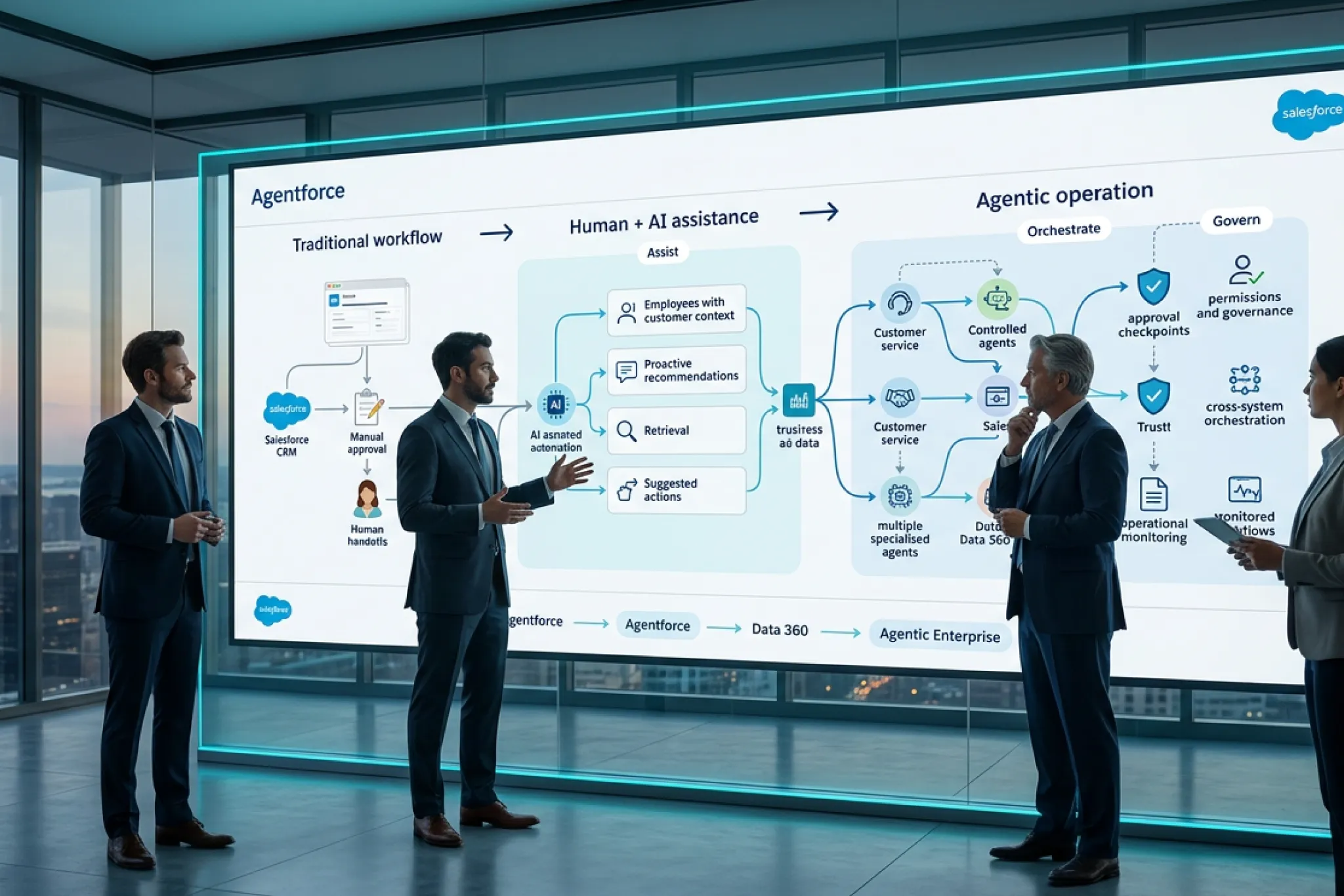
An agentic enterprise is an organization where AI agents complete governed work end to end, across data, systems and workflows, instead of only surfacing answers for a person to act on. In the Salesforce context, that means Agentforce 360 agents that retrieve trusted context, take approved actions inside CRM, and escalate to a human when the risk boundary changes.
A Salesforce org becomes agentic only when work can move across data, logic, permissions, actions, and human review without forcing every decision back into a manual queue. That is the technical difference between a company that has AI features and a company trying to become an Agentic Enterprise. A prompt window can summarize a case. An AI copilot can draft a reply. But digital labor inside Salesforce has to retrieve the right customer context, choose the right tool, respect the same access model a human user would face, write back to the system of record, and escalate when the risk boundary changes.
Salesforce uses the Agentic Enterprise idea to describe a business where humans, enterprise AI agents, apps, and data operate on one trusted platform. In its Dreamforce 2025 announcement, Salesforce positioned Agentforce 360 as the platform layer for that shift, bringing together agents, Data 360, Customer 360 apps, Slack, voice, hybrid reasoning, and governance capabilities. That definition matters because the Salesforce Agentic Enterprise is not meant to be a chatbot layer sitting beside CRM. It is a platform claim about how work gets executed inside sales, service, marketing, commerce, revenue, and operations workflows.
The honest answer is that the Agentic Enterprise is real in narrow, governed workflows and still aspirational as a full enterprise operating model. Agentic AI adoption is moving fast, but production maturity is uneven. The companies getting value are not simply buying autonomous AI agents. They are redesigning data access, approval rules, exception handling, monitoring, and human and AI agent collaboration so digital labor can be trusted in the flow of work. A broader Salesforce AI solutions framework is useful because Agentforce 360 only becomes meaningful when AI strategy, Data 360, governance, and workflow design move together.
What Is an Agentic Enterprise?
An agentic enterprise is an operating model, not a product you can buy. The defining test is whether a decision can travel all the way to a completed action without a person having to carry it between systems.
Question | Answer |
What makes an enterprise agentic? | AI agents can complete defined units of work end to end, under governance, rather than only recommending what a person should do next. |
Is it the same as using AI tools? | No. A company can have a dozen AI assistants and still route every decision through a manual queue. The structural change is in how work moves, not how many tools are installed. |
Where does Salesforce fit? | Agentforce 360 is Salesforce’s platform layer for it, connecting agents, Data 360, Customer 360 apps, Slack, permissions and governance. |
Is it real yet? | Real in bounded workflows. Aspirational as a full enterprise operating model for most organisations. |
What decides whether it works? | Data quality, action boundaries, measurement, and clear ownership. Very little of it is about the model. |
Where should you start? | One frequent, measurable, bounded work unit where you can compare before and after honestly. |
The phrase is also used outside Salesforce. ERP and operations vendors describe the same operating-model shift in manufacturing, distribution and healthcare contexts. The mechanics are consistent wherever it appears: agents reason across connected systems, act under governance, and complete work rather than handing it back.
The Short Answer
What Salesforce means. The Agentic Enterprise is Salesforce’s name for an operating model where humans and AI agents work inside the same Salesforce-centered environment, using Agentforce 360, Data 360, Customer 360 apps, Slack, business metadata, permissions, and workflow automation. In plain English, the promise is digital labor that can do more than answer questions. It can reason, retrieve context, take approved actions, and collaborate with people.
What is real today. Real agentic AI adoption is strongest in defined workflows such as service deflection, sales follow-up, knowledge retrieval, internal support, case summarization, and guided operational tasks. Market data supports the direction: McKinsey’s 2025 global AI survey found that 62% of respondents said their organizations were at least experimenting with AI agents, but only 23% were scaling an agentic AI system somewhere in the enterprise, and no individual function crossed 10% scaling. That gap explains why the Agentic Enterprise is visible but not yet universal.
What buyers should verify. A company is not an Agentic Enterprise because it launches one agent. The real test is whether the agent has governed data, scoped actions, measurable outcomes, fallback rules, audit trails, and a clear human owner. Agentforce 360 can support that model, but it does not remove the need for an enterprise AI operating model, AI agent governance, change management, and careful process design.
The Direct Answer: The Idea Is Real, The Enterprise-Wide Version Is Not Automatic
Layer of maturity | What it looks like | Reality check | Buyer implication |
AI feature adoption | Teams use generative AI for drafts, summaries, search, and recommendations | Real and common | Useful, but not yet an Agentic Enterprise |
Agentic workflow | An agent follows a goal, retrieves context, uses tools, and completes a bounded task | Real in narrow workflows | Needs testing, permissions, source control, and escalation |
Digital labor model | AI agents own recurring work units across sales, service, IT, or operations | Emerging | Requires process redesign and measurable governance |
Agentic Enterprise | Humans, agents, data, apps, and controls operate as one system of work | Aspirational for most companies | Requires architecture, operating model, ownership, and portfolio management |
The Agentic Enterprise is useful when it forces leaders to ask how work actually moves. It becomes weak when used as a branding label for any AI pilot. An agent that answers from a knowledge article is not the same as an agent that checks entitlement, reviews order history, updates a case, and logs the action. Only the second begins to look like digital labor.
That is why the reality question has to be answered by use case. A customer service agent that resolves simple requests can be real. A sales agent that drafts outreach from account signals can be real. A headless agent that monitors events and triggers back-office action can be real. A fully agentic enterprise where digital labor coordinates across every function with consistent governance, shared data, and reliable ROI is still a work in progress for most organizations.
The Five Characteristics of an Agentic Enterprise
Strip away the vendor language and the same five capabilities keep appearing. Use them as a checklist rather than a description, because most organisations have two or three and are missing the rest.
1. Autonomous action within boundaries
Agents can decide the next step and execute it without waiting for a prompt at every stage. The word that matters is boundaries. Autonomy without a defined action scope is not maturity, it is exposure.
2. Goal-driven rather than trigger-driven
Traditional automation reacts to a trigger: a field changes, so a task is created. An agent receives an objective and works out the steps. That shift is the single biggest change in how you design the work.
3. Adaptability across situations
The same request does not always mean the same thing. An agent should read context, handle an unexpected input, and adjust rather than failing or forcing a handoff. This is where most pilots break, because demo data is tidy and production data is not.
4. Multi-agent coordination
Value comes from agents working together rather than from any single agent. A service agent that can hand context to a scheduling agent, which can hand work to a billing process, is doing something a collection of separate bots cannot. Coordination is also where observability gets hard, so it should be designed early.
5. Human in the loop by design
Not every decision should be automated. Sensitive, ambiguous or high-value work needs a clear escalation path, a human owner, and enough context passed across that the person does not restart from zero. Human oversight is a design feature of a mature agentic enterprise, not an admission that the agent failed.
A useful way to read this list: the first three are about capability, and the last two are about operating model. Most companies can buy the first three. The last two have to be built.
Agentic AI vs AI Agents: The Distinction That Matters
These two phrases get used interchangeably and they are not the same thing. The confusion causes real scoping problems, because a company can buy plenty of AI agents and still have nothing agentic.
An AI agent is a component. It handles a bounded task. Agentic AI is the operating model that plans, coordinates and follows work through across several agents and systems.
AI agents | Agentic AI |
The building blocks | The operating model |
Execute a specific, bounded task | Plans and coordinates work across many tasks |
Work within a single step or system | Coordinates agents across systems and functions |
Useful in isolation, but limited | Carries a decision through end to end |
“Summarise this case” | “Detect the issue, decide the response, and execute it” |
The practical implication for a Salesforce buyer is that you need good agents to build agentic AI, but a collection of agents is not an agentic enterprise until they coordinate toward a shared business outcome. If a vendor demo shows six impressive agents that never talk to each other, you are looking at the building blocks, not the operating model.
Salesforce Automation vs Agentic AI: Flow, Apex and Agents
Salesforce teams have automated work for years using Flow and Apex. It is worth being precise about what actually changes with agents, because “we already automate this” is a reasonable objection and it is sometimes correct.
Traditional automation (Flow, Apex) | Agentforce AI agents |
Runs on if-then rules with no contextual awareness | Reasons over context before choosing a path |
Fails or stalls on unexpected input | Can adapt to inputs the designer did not anticipate |
Requires a developer or admin to handle a new variation | Handles variation within its defined scope |
Produces the same response for every record | Personalises the response to the situation |
Deterministic and auditable by design | Probabilistic by default, which is why guardrails and logging matter more |
Ideal for structured, predictable processes | Ideal for judgment-heavy or highly variable processes |
Read that table in both directions. Agents are not an upgrade to Flow. They are a different tool for a different class of problem. A well-designed, predictable process should usually stay in Flow, because deterministic automation is cheaper, faster and easier to audit. Moving stable rule-based work onto an agent adds cost and variability for no gain.
The right question is not “can an agent do this?” It is “does this work require judgment that a rule cannot encode?” If the answer is no, keep it in Flow.
Why the Agentic Enterprise Is More Than an AI Label
It changes the unit of automation
Traditional CRM automation usually starts with a trigger: when a field changes, creates a task, sends an email, updates a status, or routes a record. The Agentic Enterprise changes the unit from trigger to goal. An AI agent receives an objective, reads context, plans the next step, selects tools, acts within permissions, and decides whether it needs a human. That is why enterprise AI agents need a richer control layer than old workflow rules.
It pushes AI into systems of record
A standalone assistant can sit outside the business process. It can help a person write, search, or summarize. Digital labor is different because the action touches systems of record. In Salesforce, that means accounts, contacts, opportunities, cases, orders, entitlements, quotes, knowledge, consent, and service history. Agentforce 360 matters because the agentic claim depends on the same data and metadata that operational teams already use.
It makes governance operational
AI agent governance cannot remain a policy PDF. It has to define what an agent may know, what it may say, what it may change, when it must ask for approval, and who owns exceptions. Gartner’s 2025 forecast that more than 40% of agentic AI projects will be canceled by the end of 2027 due to cost escalation, unclear value, or inadequate risk controls is a useful warning through the Gartner agentic AI cancellation forecast. The failure mode is not that agents never work. It is that organizations skip the operating model needed to make them reliable.
It changes the unit of automation
Traditional CRM automation usually starts with a trigger: when a field changes, creates a task, sends an email, updates a status, or routes a record. The Agentic Enterprise changes the unit from trigger to goal. An AI agent receives an objective, reads context, plans the next step, selects tools, acts within permissions, and decides whether it needs a human. That is why enterprise AI agents need a richer control layer than old workflow rules.
It pushes AI into systems of record
A standalone assistant can sit outside the business process. It can help a person write, search, or summarize. Digital labor is different because the action touches systems of record. In Salesforce, that means accounts, contacts, opportunities, cases, orders, entitlements, quotes, knowledge, consent, and service history. Agentforce 360 matters because the agentic claim depends on the same data and metadata that operational teams already use.
It makes governance operational
AI agent governance cannot remain a policy PDF. It has to define what an agent may know, what it may say, what it may change, when it must ask for approval, and who owns exceptions. Gartner’s 2025 forecast that more than 40% of agentic AI projects will be canceled by the end of 2027 due to cost escalation, unclear value, or inadequate risk controls is a useful warning through the Gartner agentic AI cancellation forecast. The failure mode is not that agents never work. It is that organizations skip the operating model needed to make them reliable.
How Agentforce 360 Fits the Agentic Enterprise
Agentforce 360 is the Salesforce platform expression of the Agentic Enterprise. It sits between the business promise and the technical reality. The business promise is that humans and AI agents can work together with more capacity, speed, and precision. The technical reality is that agents need data, identity, metadata, actions, prompts, channels, testing, governance, and observability.
Agentic AI transformation requires more than a model. An Agentforce platform deployment has to connect language to workflow, policy, security, APIs, Data 360, CRM records, and customer-facing channels. That is why an Agentforce quickstart can be a sensible first step when the use case is narrow, but it should not be confused with a complete enterprise AI operating model.
Read Agentforce 360 through 4 practical questions:
- What data can the agent see? Data 360, CRM records, Knowledge, files, unstructured sources, and connected systems shape what the agent can know.
- What tools can the agent use? Flows, APIs, MuleSoft, Slack actions, custom actions, and app-specific features shape what the agent can do.
- What decisions can the agent make alone? Guardrails, approvals, risk bands, and handoff rules define the boundary of autonomy.
- How will performance be measured? Resolution, deflection, cycle time, cost per interaction, error rate, human override, and business outcome metrics decide whether digital labor is improving work or just adding another layer.
How Agentic AI Actually Works
Underneath the platform language, an agent runs on five mechanics. Knowing them makes vendor demos much easier to interrogate, because you can ask which mechanic is doing the work in any impressive moment.
Planning
The agent breaks a goal into a sequence of executable steps. Ask how the plan is constrained. An agent that can plan freely across every available tool is more expensive and riskier than one working from a defined action menu.
Reasoning
The agent evaluates the situation, interprets the request, and selects the right tool or path. This is where misrouting happens. In Salesforce this is the Atlas Reasoning Engine’s job, and it is the layer to inspect when a vendor explains how the agent decides what to do next.
Integrations and tool use
The agent connects to systems through Flows, Apex, APIs, MuleSoft or Slack actions. Every integration is both a capability and a liability, because the agent’s action is only as safe as the contract behind it.
Memory
Short-term memory holds context within a task. Longer-term context carries across a multi-step workflow. Ask what is retained, for how long, and under what data-retention rules, because memory and privacy policy intersect here.
Reflection
The agent compares the result against the goal and adjusts if the outcome missed. Reflection is what separates a multi-step agent from a long script, and it is also the hardest part to test, because the behaviour can change as prompts, data and integrations change.
When you watch a demo, work out which of these five is being shown. A polished answer usually demonstrates reasoning and retrieval. It rarely demonstrates reflection, and almost never demonstrates what happens when a tool call fails.
Where the Agentic Enterprise Is Already Real
A realistic view starts with bounded workflows. The Agentic Enterprise is real when an agent can take a defined category of work, complete it reliably, and make the human team more effective without hiding risk. In service, that may mean answering routine questions, summarizing history, recommending next steps, or resolving low-risk cases. In sales, it may mean preparing account briefings, identifying follow-up gaps, qualifying inbound interest, or updating pipeline fields. In internal operations, it may mean routing requests, drafting knowledge updates, or coordinating approvals.
The broader AI market supports this staged view. Stanford’s 2025 AI Index reports that 78% of organizations used AI in 2024, up from 55% in 2023, while generative AI use in at least one business function more than doubled to 71%. The same report notes that financial gains are often still modest, with many reported cost savings below 10%, which is exactly why agentic AI adoption has to be tied to specific work units through the Stanford AI Index 2025 economy data.
Where the Claim Gets Ahead of Reality
The phrase Agentic Enterprise can sound like a company-wide AI workforce will appear as soon as licenses are turned on. That is the wrong mental model. Most companies are still learning how to translate autonomous AI agents into safe, measurable business workflows.
Deloitte’s research on agentic AI warns that usage is scaling faster than governance, with only 21% of surveyed leaders saying their organizations have a mature governance model in place for agentic AI. That finding fits the Salesforce context because Agentforce 360 increases the number of places where AI can act, while governance has to keep up across sales, service, data, security, change management, and executive ownership through the Deloitte agentic AI governance findings.
There are 5 places where the Agentic Enterprise usually gets ahead of reality:
- The data is not ready. Agents retrieve stale, duplicated, incomplete, or conflicting information.
- The workflow is not explicit. The business cannot describe which actions are allowed and which require human review.
- The value case is vague. Leaders fund experimentation but do not define baseline cost, cycle time, quality, or revenue impact.
- The risk boundary is missing. Sensitive data, regulated decisions, and customer-facing outputs are not separated from low-risk tasks.
- Ownership is unclear. IT configures the agent, business teams expect results, legal worries about risk, and no one owns lifecycle performance.
These are not reasons to avoid the Salesforce Agentic Enterprise. They are reasons to treat it as an operating-model program rather than a software feature.
How to Evaluate an Agentic Enterprise Partner
Most organisations bring in help for at least part of this, and the market for that help is crowded. Rather than ranking firms, here is what separates the ones who can deliver an agentic programme from the ones who can deliver a demo.
Partner archetype | Best suited to | What to test them on |
Salesforce-native implementation partner | Organisations where Salesforce is the system of record for revenue, service and customer work | Depth in Agentforce 360, Data 360, integrations, testing and managed support after launch. Ask what they own on day 91. |
Global systems integrator | Multi-business-unit programmes touching risk, HR, legal, finance and several platforms | Whether the strategy work connects to specific Salesforce workflows, or floats above them. Ask for the named architect, not the pitch team. |
Risk and assurance firm | Regulated decisions, financial controls, healthcare data, external customer commitments | Whether they can produce control evidence and audit trails for agent actions, not just a governance framework document. |
Boutique advisory and delivery firm | Pilot design, stakeholder alignment, workflow redesign, adoption support | Whether the pilot is built with enough architecture discipline to scale past the first agent, or is a proof of concept that will be rebuilt. |
Offshore or hybrid delivery partner | Capacity for data engineering, testing, prompt design, monitoring and support | Workstream ownership and direct access to senior Salesforce and AI architecture leads, not just throughput. |
The questions that actually separate partners are the same regardless of archetype. Can they name a production agent they built and tell you what it cost to run? Can they describe a use case they advised a client not to build? Can they show you what their monitoring looks like six months after go-live?
A firm that only has demos and case-study slides has not yet operated an agent in production. That is worth knowing before you sign.
The Digital Labor Capability Ladder
Capability | What the agent can do | What must be in place | Enterprise readiness signal |
Answer | Retrieve and respond from approved knowledge | Source authority, retriever testing, fallback rules | Low-risk support and internal help use cases work consistently |
Recommend | Suggest a next best action or message | Data quality, prompt context, human review | Users accept recommendations and override reasons are tracked |
Act | Update records, trigger workflows, or call APIs | Permissions, action scopes, audit logs, approval rules | Actions are reliable, reversible, and measured |
Coordinate | Orchestrate across people, apps, agents, and systems | Integration contracts, monitoring, exception queues | Work moves across teams with clear accountability |
Optimize | Improve workflow performance over time | KPI baseline, feedback loop, governance cadence | Digital labor is managed as an operating asset |
Digital labor becomes enterprise-grade when the organization can move up this ladder without losing control. Many teams can build an answering agent. Fewer can build an action-taking agent that respects data classification, approvals, business rules, and exception handling. Fewer still can coordinate AI agents in business workflows across several systems while preserving a clear record of what happened and why.
This is where Data 360 delivery matters. The Agentic Enterprise needs more than a CRM record. It needs a governed context layer that can serve customer, product, contract, entitlement, interaction, and operational data to the right agent at the right moment. Without that layer, enterprise AI agents either operate with too little context or retrieve too much noise.
Why Human and AI Agent Collaboration Is the Real Operating Model
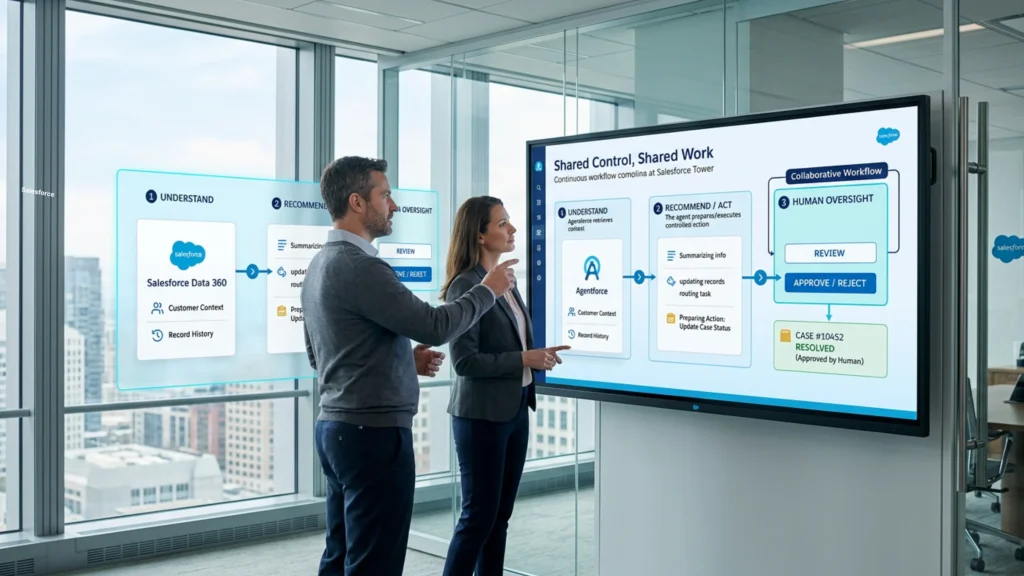
Human and AI agent collaboration is the practical center of the Agentic Enterprise. Salesforce’s language about digital labor should not be read as a full replacement story. The stronger model is work redesign: agents take repeatable, data-heavy, low-to-medium-risk tasks, while people handle judgment, empathy, negotiation, exceptions, accountability, and process improvement.
In service, Agentforce for Service implementation can make this concrete. An agent can collect context, answer common questions, summarize prior interactions, recommend a resolution, or complete a low-risk update. A human service representative should still handle sensitive complaints, unclear policy exceptions, legal exposure, and high-value customer relationships. The Agentic Enterprise is not the absence of people. It is a clearer division of labor.
In sales, digital labor can research an account, surface risk, draft a follow-up, check CRM completeness, and trigger a next step. A person still owns negotiation, relationship interpretation, discount judgment, and strategic account planning. In operations, autonomous AI agents can monitor exceptions, assemble context, and route work. A person still owns policy design, prioritization, and escalation decisions.
The better question is which work units inside a role can be delegated safely. That framing makes agentic AI adoption more measurable and reduces the risk of over-promising before the operating model is ready.
The Architecture Question Buyers Should Not Skip
Agentforce 360 is strongest when architecture is explicit. A Salesforce Agentic Enterprise needs a design for agent identity, data access, prompt context, action permissions, API contracts, event triggers, observability, and human handoff. The architecture should show how a request moves from user intent to retrieval, reasoning, action, logging, feedback, and escalation.
NIST’s AI Risk Management Framework is useful here because it treats trustworthy AI as a lifecycle issue across design, development, deployment, use, and evaluation. For autonomous AI agents, that matters because behavior can change as prompts, data, integrations, and business rules change. Risk management cannot be a one-time launch gate through the NIST AI Risk Management Framework.
Agentforce Headless Agents raise the architecture bar further because they may run outside a visible user interface. A headless agent might monitor a data event, call an API, trigger a workflow, or coordinate with another system in the background. That can be powerful, but it also means logging, rate limits, permission boundaries, and exception queues become non-negotiable.
What to Measure Before Calling Your Enterprise Agentic
A company can have Agentforce 360 live and still lack a meaningful Agentic Enterprise. The label should be earned through operating evidence.
Use these measures before declaring success:
- Work coverage: Which work units are handled by AI agents, and what percentage of total demand do they represent?
- Resolution quality: How often does the agent complete the intended task without human rework?
- Escalation quality: When the agent hands off, does the human receive enough context to continue without starting over?
- Cost per outcome: What is the true cost after licenses, credits, data work, monitoring, and human review?
- Cycle-time change: Did the workflow become faster from request to completed outcome, not just from prompt to response?
- Risk control: Are sensitive actions gated, logged, reviewed, and reversible where needed?
- User trust: Are employees using the agent because it helps, or bypassing it because it creates cleanup work?
- Portfolio discipline: Are leaders retiring weak agent use cases and reinvesting in stronger ones?
IBM’s research on AI agents shows why measurement needs to focus on operating outcomes rather than excitement. In one IBM Institute for Business Value study, 83% of respondents expected AI agents to improve process efficiency and output by 2026, while 71% believed agents would autonomously adapt to changing workflows. Those expectations are meaningful, but they require the business to track process performance, agent behavior, and human oversight through the IBM AI agents study.
Governance Rules That Separate Agentic From Reckless
AI agent governance should be designed before deployment, not after the first mistake. The larger the digital labor footprint, the more governance has to become part of daily operations.
A credible Salesforce Agentic Enterprise should have rules for:
- Agent ownership. Every agent needs a named business owner, technical owner, and risk reviewer.
- Data boundaries. Each agent needs a documented list of sources, fields, records, and restricted data classes.
- Action limits. Each action should have a risk band, approval rule, rollback path, and audit requirement.
- Prompt and topic change control. Prompt edits can change behavior and should be governed like workflow changes.
- Testing evidence. Agents need test cases for normal requests, edge cases, permission checks, and policy conflicts.
- Monitoring cadence. Performance, hallucination, escalation, complaint, and override data should be reviewed regularly.
- Lifecycle retirement. Agents that do not produce measurable value should be changed, merged, or retired.
The Agentforce governance framework becomes important because governance in an Agentforce platform environment is not only about admin permissions. It is about behavior. An AI agent can recommend, draft, update, route, and act. That means governance has to cover decisions, outputs, actions, and outcomes.
The Skills Problem Underneath The Agentic Enterprise
The Agentic Enterprise requires skills that many organizations do not yet have in one place. Teams need Salesforce architecture, Data 360, integration, security, AI product ownership, prompt design, test design, process mapping, change management, and analytics. That mix explains why agentic AI adoption is often easier to announce than to scale.
The World Economic Forum’s Future of Jobs Report 2025 found that 63% of employers cited skill gaps as a major barrier to business transformation and that nearly 40% of job skills are expected to change by 2030. AI and big data, networks and cybersecurity, and technological literacy are among the fastest-growing skill areas, while leadership and collaboration remain critical human skills through the WEF Future of Jobs 2025 findings.
This fits the Salesforce Agentic Enterprise perfectly. Autonomous AI agents may handle more tasks, but people still need to design the work, govern the data, evaluate the outputs, handle exceptions, and improve the operating model. The AI workforce does not remove the skills problem. It changes it.
Case Study: From AI Pilot to a More Realistic Agentic Enterprise
The Starting Point
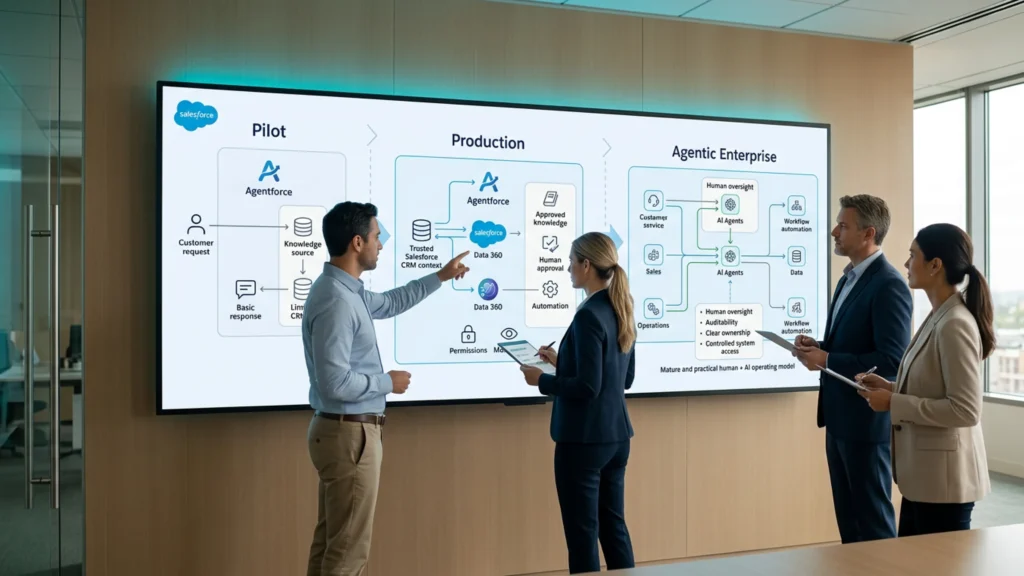
A Salesforce organization had already introduced generative AI for tasks such as case summaries, knowledge retrieval, and response drafting. The technology was useful, but these isolated AI features did not make the organization an Agentic Enterprise. The bigger question was whether AI agents could move from assisting employees to completing defined work across data, workflows, and Salesforce systems.
The Reality Check
The organization evaluated one bounded service workflow rather than attempting enterprise-wide autonomy. The agent was given access to approved customer context and defined actions, while permissions, escalation rules, and human review remained part of the workflow.
The implementation focused on five areas:
- Data: Confirmed which customer and knowledge sources the agent could access.
- Actions: Limited the agent to specific, approved workflow and CRM actions.
- Human oversight: Required escalation for sensitive or ambiguous situations.
- Measurement: Tracked resolution quality, cycle time, rework, and human overrides.
- Governance: Assigned ownership for agent behavior, testing, monitoring, and changes.
What Changed
The result was not a claim that the entire company had suddenly become agentic. Instead, one measurable work unit could move from request to resolution with the AI agent handling defined steps and people taking over where judgment or risk required it.
That distinction matters. A company can have Agentforce 360, AI assistants, and multiple pilots while still operating primarily through traditional processes. The stronger signal is whether digital labor can reliably perform governed work inside the business process.
Maturity Signal | What This Case Demonstrated |
AI assistance | AI could summarize and retrieve information |
Agentic workflow | The agent could complete a defined service task |
Human + AI collaboration | People handled exceptions and higher-risk decisions |
Governance | Actions, permissions, testing, and ownership were defined |
Business measurement | Performance was evaluated through workflow outcomes |
Enterprise readiness | Expansion depended on evidence from the first use case |
The Lesson
The Agentic Enterprise is real in bounded workflows, but not automatic at enterprise scale. The practical path is to prove digital labor in specific, measurable processes and expand only when data quality, governance, integration, human oversight, and business results support the next step.
That is the difference between having AI agents and actually changing how the enterprise works.
A Reality Test For The Agentic Enterprise
Question | If the answer is yes | What it proves |
Can the agent explain which sources supported its answer? | The retrieval layer is traceable | The agent is grounded, not guessing |
Can the agent act only within scoped permissions? | Action control is designed | Digital labor has boundaries |
Can humans override, review, or reverse risky actions? | Human and AI agent collaboration is operational | Governance exists in the workflow |
Can leaders compare baseline and post-agent outcomes? | Measurement is connected to business value | The program is more than experimentation |
Can the team monitor failures by source, prompt, action, and user segment? | Observability is mature | The enterprise AI operating model can improve |
Can weak use cases be retired quickly? | Portfolio discipline exists | The company is managing agentic AI adoption economically |
Use the table as a practical filter. A company can have AI agents in business workflows without being fully agentic. It becomes more agentic when those workflows can be explained, measured, governed, and improved. That is the difference between tool adoption and operating-model change.
The Agentforce testing guide fits this stage because testing is where the promise meets reality. Agents should be tested against expected answers, unsupported requests, sensitive records, bad data, ambiguous intent, conflicting instructions, and action failure. A demo tests possibility. A validation programme tests trust.
Working With a Certified Salesforce Partner
We are a certified Salesforce consulting partner, and most of our Agentic Enterprise conversations start by making a programme smaller rather than bigger.
That is not modesty. It is what the evidence supports. The organisations getting value are running bounded, measurable workflows with clear ownership, and expanding on proof. The ones stuck in pilots usually started with an architecture programme and never reached the agent that was meant to justify it.
Sitting between you and Salesforce, we can be candid about which parts of the vision are deliverable in your org this quarter and which parts need a data or process programme first. A platform vendor cannot really have that conversation with you. A partner can, and it is more useful before the statement of work than after it.
What we bring to the table
- A defined first work unit, chosen because it is frequent, measurable and bounded, not because it demos well.
- An honest readiness assessment across data quality, permissions, knowledge sources, process clarity and ownership.
- Architecture that matches the risk: action scopes, escalation paths, audit capture and rollback designed before launch.
- Measurement that a CFO will accept: baseline cost per outcome, cycle time, rework rate and human override, tracked before and after.
- Operating support after go-live, because agent behaviour drifts as prompts, data, integrations and business rules change.
We are not the fastest route to announcing an agentic programme and we do not position ourselves that way. We are the route to one that still looks good in month nine. If you want that conversation, our Salesforce consulting team can review your workflows and tell you honestly what is ready and what is not.
See How We Have Done This for Other Salesforce Teams
The framework in this guide came out of real engagements across service, sales, healthcare, manufacturing and financial services, not out of a strategy deck.
The pattern repeats. A programme arrives framed as enterprise transformation. We narrow it to one work unit, measure the baseline honestly, ship something that works, and expand on the evidence. What gets built first is almost always smaller than what was originally imagined, and it is the reason the second and third agents get funded.
If you want to see how those decisions played out, including what got deferred and why, our case studies are worth twenty minutes. Read them at https://valintry360.com/case-studies
The Honest Answer: Is the Agentic Enterprise Real?
The Agentic Enterprise is real as a direction and real in bounded use cases. It is not yet real as a default enterprise state. Salesforce is correct that Agentforce 360 gives organizations a practical platform for humans, agents, apps, and data to work together. The market data also shows that companies are experimenting heavily, investing heavily, and beginning to scale agentic AI in selected functions.
Caution is equally important. Most organizations are still early. The enterprise-wide version depends on data quality, AI agent governance, role design, measurement, integration, cybersecurity, change management, and the willingness to redesign work rather than decorate old processes with AI. When those foundations are weak, digital labor becomes another automation layer that creates monitoring burden and rework.
A better answer is this: the Salesforce Agentic Enterprise is credible when it starts with narrow, measurable workflows and expands through evidence. It becomes hype when leaders treat autonomous AI agents as a shortcut around process design. Agentforce 360 can support agentic AI transformation, but the enterprise becomes agentic only when the operating model is built to manage the AI workforce responsibly.
Agentic Enterprise FAQs
- What is the Agentic Enterprise?
The Agentic Enterprise is an operating model where humans and AI agents work across connected apps, data, workflows, and governance systems. In the Salesforce context, it refers to using Agentforce 360, Data 360, Customer 360 apps, Slack, and trusted AI controls so digital labor can support real business work.
- What does Salesforce mean by Agentic Enterprise?
Salesforce uses the term to describe companies that integrate humans, enterprise AI agents, applications, and data on a trusted platform. The idea is not only AI assistance. It is AI agents that can reason, retrieve context, take approved actions, and collaborate with people inside Salesforce-centered workflows.
- Is the Agentic Enterprise real yet?
It is real in bounded workflows such as service deflection, sales follow-up, knowledge support, internal helpdesk, workflow routing, and case summarization. It is not yet real as a mature enterprise-wide operating model for most companies. Most organizations are still piloting or scaling selected agentic AI use cases.
- How does Agentforce 360 relate to the Agentic Enterprise?
Agentforce 360 is Salesforce’s platform layer for building, deploying, and governing AI agents. It connects agents, data, apps, metadata, and collaboration tools so AI agents can operate inside Salesforce workflows rather than outside the business system.
- What is digital labor?
Digital labor refers to AI agents or software systems that perform work units traditionally handled by people. In an Agentic Enterprise, digital labor may retrieve information, summarize cases, update records, route requests, trigger workflows, and assist employees while staying inside defined rules and controls.
- Is digital labor the same as automation?
No. Traditional automation follows fixed rules and triggers. Digital labor uses AI agents that can interpret goals, retrieve context, choose tools, and act within boundaries. It still needs governance, testing, monitoring, and human oversight, especially when actions affect customers or regulated data.
- What is agentic AI adoption?
Agentic AI adoption means deploying AI systems that can plan and execute multi-step tasks with some autonomy. Adoption can range from small pilots to scaled production workflows. A mature program measures outcomes, manages risk, and defines how humans and AI agents collaborate.
- What are enterprise AI agents?
Enterprise AI agents are AI systems designed to operate inside business environments. They use enterprise data, tools, permissions, and workflows to complete tasks. In Salesforce, enterprise AI agents may interact with CRM records, Data 360, Service Cloud, Sales Cloud, Slack, APIs, and approved automation.
- What is the biggest risk in becoming an Agentic Enterprise?
The biggest risk is giving AI agents too much autonomy without enough data quality, governance, testing, and human oversight. Poorly governed agents can produce unsupported answers, expose sensitive data, trigger incorrect actions, or create accountability gaps.
- What makes an Agentic Enterprise different from a company using AI tools?
A company using AI tools may have isolated assistants for writing, summarizing, or search. An Agentic Enterprise redesigns work so agents can perform governed tasks across connected systems, with clear ownership, measurement, escalation, and operating discipline.
- Why does Data 360 matter for the Agentic Enterprise?
Data 360 matters because AI agents need reliable context. Without clean, governed, connected data, Agentforce agents may retrieve incomplete or conflicting information. Data 360 helps create the trusted data foundation required for more advanced Agentforce 360 workflows.
- What role do humans play in an Agentic Enterprise?
Humans set goals, design workflows, approve sensitive actions, handle exceptions, manage customer relationships, review performance, and improve the operating model. Human and AI agent collaboration is the practical model. The goal is not removing people from work but assigning work more intelligently.
- How should companies measure digital labor?
Companies should measure resolution quality, deflection, cycle time, cost per outcome, error rate, escalation quality, human override, user trust, and business impact. Measuring prompt usage alone is not enough. The question is whether the agent improved the work.
- Do companies need a consulting partner to become an Agentic Enterprise?
Not always. Some organizations have the Salesforce, data, AI, integration, and governance skills internally. Many companies use partners when they need help with architecture, Data 360, Agentforce platform setup, testing, governance, change management, or managed support after launch.
- What is the practical starting point?
Start with one work unit that is frequent, measurable, bounded, and valuable. Define the data sources, allowed actions, human review points, success metrics, and risk controls before implementation. Then expand only when the first agent proves value and trust.
Related Posts
- Salesforce Managed Services
How Much Agentforce Cost? Full TCO With Data…
Agentforce costs $500 per 100,000 Flex Credits, which prices a standard agent action at $0.10 and a Voice action at $0.15. That's the meter. The bill is bigger, because your edition licences, Data 360 processing, implementation and running costs all…
- Salesforce Managed Services
How Agentforce Flex Credits Work: Cost Per Action…
Salesforce Agentforce Flex Credits are consumption credits that pay for the metered work an AI agent performs. One standard Agentforce action consumes 20 Flex Credits, credits sell at $500 per 100,000, and that makes a standard action about $0.10 at…
- Salesforce Managed Services
Salesforce Agentforce Pricing 2026: How Much Does Agentforce…
Salesforce Agentforce pricing in 2026 runs from $0 on the free Salesforce Foundations tier to $550 per user per month on the Max edition, with usage priced at $2 per conversation, roughly $0.10 per standard action through Flex Credits, or…