
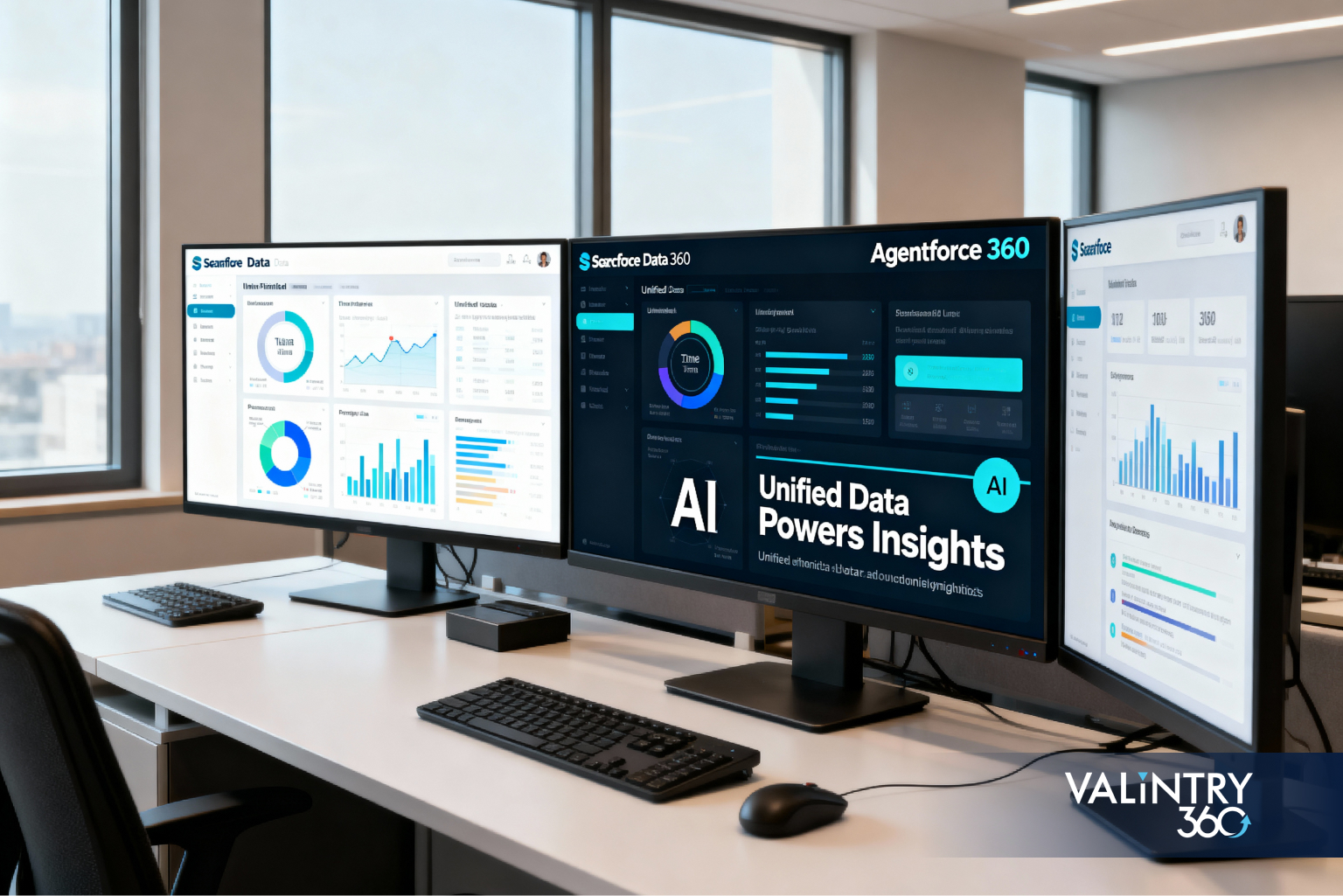
Nearly 80% of enterprise data remains unstructured, and many organizations still find it difficult to access, organize, and extract useful insights from it. This ongoing challenge is exactly what Data 360 is built to solve through its latest phase of growth.
Salesforce Data Cloud has moved into a new chapter, now called Salesforce Data 360, aligning with the company’s complete 360 ecosystem. Earlier versions appeared under names such as Customer 360 Audiences and Salesforce Genie, marking continuous development over time. Now in its sixth version, this update represents more than just a rebrand; it reflects a focused strategy to strengthen the data foundation that fuels Einstein AI and Agentforce 360 with structured intelligence and context-driven accuracy.
This article explains how Data 360 progressed from being a simple data management platform to becoming a smart data engine that powers meaningful outcomes. It highlights the platform’s main improvements, its vital role in supporting Agentforce 360, and the wider impact it creates for businesses aiming to use their data more efficiently.
Overview
From Data Cloud to Data 360: What Changed
The move from Salesforce Data Cloud to Data 360 represents the sixth version of Salesforce’s data platform. Over the years, it has appeared under several names, such as Customer 360 Audiences, Salesforce CDP, Marketing Cloud Customer Data Platform, and Salesforce Genie. However, this latest update goes far beyond a visual refresh or a title change.
Why Salesforce Rebranded to Data 360
Salesforce introduced the Data 360 identity to reflect its vision of making the platform more unified, accessible, and flexible. During Dreamforce 2025, the company presented this move as a strategic upgrade that strengthens the link between Data 360 and Agentforce 360. According to David Schmaier, President and Chief Product Officer at Salesforce, “We did a pivot earlier this year, saying we want to be all-in on AI and data.” This statement outlines Salesforce’s clear intent to place data at the center of intelligent enterprise systems rather than keeping it as a background utility.
How Data 360 Fits into the 360 Ecosystem
Within Salesforce’s wider framework, Data 360 is now positioned as a core part of the Agentforce 360 suite. It operates as the unified data layer that provides every AI agent inside Agentforce with the context needed to perform accurately. In addition, Data 360 integrates naturally with the rest of the Salesforce environment including Einstein, Tableau, Slack, and MuleSoft. Together, these platforms create a complete ecosystem where information moves smoothly and remains consistent across departments. This setup makes Data 360 the backbone of Customer 360 for CRM, keeping data and intelligence aligned at every step.
The Shift from Data Storage to Intelligent Data Engine
Over time, Data 360 has advanced from a simple data repository into a high-performance data engine that fuels AI agents and process automation throughout Salesforce.
Some of its standout improvements include:
- Intelligent Context: Extracts and structures insights from unstructured files such as PDFs, tables, and diagrams.
- Tableau Semantics: Converts datasets into clear business language using the Customer 360 Semantic Data Model, improving metric consistency.
- AI-Ready Architecture: Functions as a large-scale data engine that supports the full Salesforce ecosystem with reliable performance.
Unlike earlier Customer Data Platforms that focused mainly on marketing use cases, Data 360 now operates as a cloud-native, metadata-driven system capable of bringing together disconnected data across the enterprise. Because it connects directly with the Salesforce metadata framework, teams across departments, not only IT, can now work faster with data using low-code tools and pre-built models. This shift turns complex data management into a more accessible, efficient process across the organization.
Core Enhancements in Salesforce Data 360

Salesforce Data 360 introduces deep structural upgrades that move it far beyond a typical database. It now functions as an intelligent data engine built for precision, speed, and adaptability across enterprise environments.
Real-Time Data Ingestion and Processing
At its foundation, Data 360 manages multiple integration approaches in real-time, batch, API, and zero-copy, each designed for different operational needs. It allows continuous data ingestion from CRMs, websites, mobile applications, and IoT systems while maintaining minimal delay.
Key highlights:
- Supports continuous data streaming for personalized, up-to-the-moment insights
- Incorporates Top-k Parameter logic to collect only the most relevant data segments
- Reduces latency through optimized compute handling
- Balances performance and cost for large-scale streaming scenarios
Through these optimizations, the platform removes long-standing bottlenecks and creates a responsive, event-driven architecture suitable for modern enterprises.
Cross-Cloud Data Unification
Data harmonization stands as the central strength of Data 360, converting information from varied systems into a unified format that serves as a single, reliable data source.
Key highlights:
- Uses advanced identity resolution to match and reconcile records across clouds
- Generates unique identifiers for individuals, assets, or activities
- Connects directly with Snowflake and Databricks using zero-copy methods
- Removes the need for complex ETL setups while keeping data instantly accessible
This unified profile model is dynamic and ready for real-time activation, bridging the gap between storage and usable intelligence.
AI-Ready Data Architecture
Data 360 converts unstructured enterprise data into organized, insight-ready intelligence. It handles media-rich workloads efficiently through specialized compute design and GPU acceleration.
Key highlights:
- Processes complex content such as images, audio, and video inside the Spark framework
- Uses vector search to find patterns and relationships within massive datasets
- Employs a unified document schema to standardize outputs from multiple input formats
- Enables fast interpretation of diverse data sources without external preprocessing
As a result, organizations gain near-real-time intelligence that strengthens predictive models and AI-based automation.
Improved Data Governance and Compliance
Governance within Data 360 is built directly into the platform, offering automated trust controls and regulatory alignment. The framework maintains strong visibility while keeping each data set securely isolated.
Key highlights:
- Applies policy-driven tagging and metadata classification automatically
- Uses data spaces to create logical boundaries for internal multitenancy
- Maintains clear visibility for administrators across all environments
- Meets top compliance benchmarks including SOC 2 Type II, ISO/IEC 27001, GDPR, and HIPAA
Through these governance layers, Data 360 ensures responsible data usage without restricting agility or performance.
How Data 360 Powers Agentforce 360
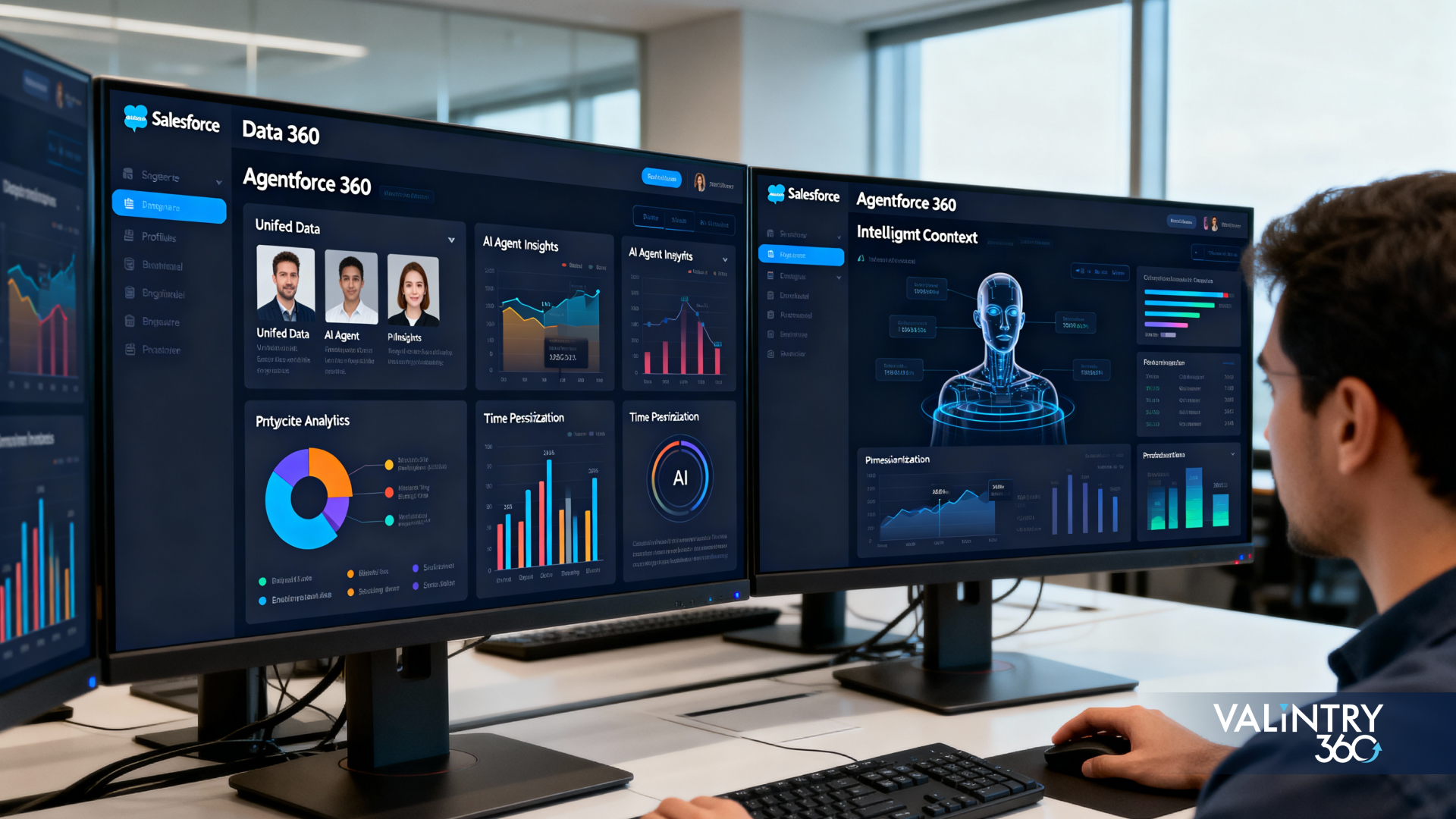
At the center of Agentforce 360 is Data 360, the smart foundation that converts scattered information into organized, practical insights. Every AI agent inside the platform depends on this layer to act with precision and purpose. Without clear data context, AI systems would process information blindly. With Data 360, each agent receives a steady flow of well-structured, meaningful data that drives confident and consistent results.
Feeding AI Agents with Contextual Data
Data 360 connects structured and unstructured information to form a complete, unified understanding. Through Intelligent Context, the platform reads unstructured materials such as PDFs, reports, and diagrams to assist agents in solving detailed or multi-step tasks. This allows AI components to interpret business data in a way that mirrors logical human reasoning. At the same time, Tableau Semantics plays a vital role in converting raw figures into plain business language. This feature, powered by the Customer 360 Semantic Data Model, keeps information clear and consistent across all systems.
- Intelligent Context allows agents to access and analyze unstructured data.
- Tableau Semantics simplifies technical details for business understanding.
- The unified semantic model maintains one clear version of the data.
Together, these elements make AI agents more aware of context, allowing them to make decisions that align closely with actual business needs.
Enabling Predictive Insights for Sales and Service
When Data 360 and Einstein AI work together, the outcome is predictive accuracy that reshapes how sales and service teams operate. Sales departments can now focus on prospects most likely to move forward, which helps shorten deal timelines. In service operations, customer issues are assigned to the right agent instantly, improving efficiency.
The combination delivers visible improvements:
- Faster sales cycles with fewer lost opportunities
- Stronger win rates through smarter targeting
- Quicker service resolutions guided by AI-based recommendations
- Better customer satisfaction built on timely, informed responses
These outcomes show how Data 360 supports real-world productivity, not just digital analysis.
Personalizing Customer Experiences in Real Time
Data 360 supports instant personalization by adjusting every customer interaction based on live behavior. Each action, preference, or recent purchase influences the next response within milliseconds. This continuous feedback loop allows brands to connect with customers naturally, without delay or repetition.
The personalization extends across all communication points, including web, mobile, email, and in-app interactions. As each update occurs, the system automatically refreshes the context, keeping messages and offers relevant at every touchpoint. This ongoing adaptability helps businesses maintain consistent engagement that feels personal, not mechanical.
Automating Workflows with Intelligent Triggers
With Data 360 as its base, Agentforce 360 simplifies automation by allowing actions to trigger automatically as conditions change. The platform links seamlessly with MuleSoft APIs, connecting external and internal systems without added complexity.
Some examples include:
- A sudden increase in demand can start an inventory update instantly.
- A drop in satisfaction levels can alert a support team right away.
- Using Einstein for Flow, automation can be built with simple language prompts.
These responsive processes replace repetitive work with real-time, automated actions that keep operations efficient and proactive.
Business Impact and Future of Data 360
Organizations adopting Data 360 are observing measurable improvements across multiple areas of operation. The results highlight how this platform extends far beyond the limits of standard data management tools, driving real business performance and operational clarity.
Smarter Decision-Making with Real-Time Analytics
By using the real-time capabilities of Data 360, enterprises are now able to make decisions faster and with greater accuracy. Internal use within Salesforce uncovered over USD 25 million in potential value simply through AI-assisted notifications in Slack. This approach helped sales teams strengthen lead management, resulting in a 40% rise in pipeline value per lead and a 60% jump in marketing lead revenue. In addition, campaigns powered by Data 360 produced an impressive fivefold return on advertising spend.
Such results show how continuous insight and quick data access can transform the decision-making process across departments.
Scalable and Secure Data Infrastructure
The underlying design of Data 360 automatically applies consent, access, and regional data policies, helping businesses maintain compliance while managing data at scale. Its built-in controls provide consistent governance without adding manual steps or additional tools.
Some of the strongest aspects include:
- Automated enforcement of consent and residency requirements
- Secure data handling with built-in policy controls
- Seamless access to information from nearly any source
- A unified business view without complex custom pipelines
This structure allows organizations to expand safely while maintaining data integrity across global environments.
Preparing for Advanced AI Model Integration
Data 360 is now capable of supporting several AI systems in parallel, including Google Gemini, OpenAI, and Anthropic. This flexibility ensures that enterprises can select the best AI model for specific business needs while maintaining consistent data standards.
Through collaboration with Databricks, dbt Labs, and Snowflake, the platform also enables standardized semantics that remain uniform across diverse ecosystems. As a result, companies can develop AI-driven strategies with a clear, consistent foundation rather than isolated, incompatible datasets.
What’s Next for Agentforce and Data 360
In the upcoming phase, Data 360 is expected to strengthen its hybrid reasoning layer, blending the creativity of large language models with precise business rules. This balance will allow organizations to build AI-driven systems that think creatively yet act responsibly.
With the planned Informatica acquisition, Data 360 will gain deeper cataloging features, making it easier to convert enterprise data into searchable, well-organized collections. Moving forward, the platform will continue developing as an intelligent data environment that connects insight, automation, and decision-making into one cohesive system.
Summing Up the Insights
Salesforce Data 360 marks a clear turning point in how modern enterprises use their data. Once known as Salesforce Data Cloud, it has grown far beyond a storage platform into a powerful, context-driven data system that fuels AI across the Salesforce environment. This strategic update reflects Salesforce’s vision of simplicity, unity, and open accessibility, making data the true foundation of intelligent business systems.
The platform’s new capabilities distinguish it from standard data tools. With real-time processing, organizations can now act immediately on customer behavior. Cross-cloud connections remove silos and create a complete, shared view of business activity. Its AI-ready framework also converts nearly 80% of previously unstructured data into meaningful insights that directly strengthen Agentforce 360.
Within this ecosystem, Data 360 functions as the central intelligence layer for every agent. It supplies the precise context required for accurate actions and predictions. As a result, sales teams reach qualified leads faster, service operations handle cases with greater accuracy, and marketing teams deliver instant, personalized experiences across all channels. The outcomes are measurable. Businesses using Data 360 report stronger pipelines, higher marketing efficiency, and better operational visibility. In addition, its built-in compliance structure reduces risk and supports data from multiple sources without adding technical complexity.
Looking forward, Data 360 will continue refining its hybrid reasoning abilities and expand its connections with advanced AI systems. The planned Informatica integration will also strengthen its data cataloging and discovery features. In short, Data 360 now stands as the intelligent foundation that enables context-aware, reliable AI across the entire Salesforce landscape.
Related Posts
Salesforce Health Cloud vs EHR
IntroductionMost hospitals, health systems, and physician practices already run an EHR. For most of them, the real question is how Salesforce Health Cloud fits around the clinical system they already depend on. Health Cloud sits in a different part of…
Salesforce Partner Transition Checklist
A Salesforce partner change touches more than a vendor name on an invoice. Production access, integrations, source code, sandboxes, deployment tooling, vendor accounts, documentation, and ongoing support all move at the same time, and each one can break quietly if…
Salesforce Release Management Framework
TL;DR Salesforce changes come from everywhere. Admins tweak page layouts and developers ship Apex. Integrations push metadata changes of their own.A handful of other changes stack on top of that every week. Flows get rebuilt mid-quarter, permissions shift as teams…