
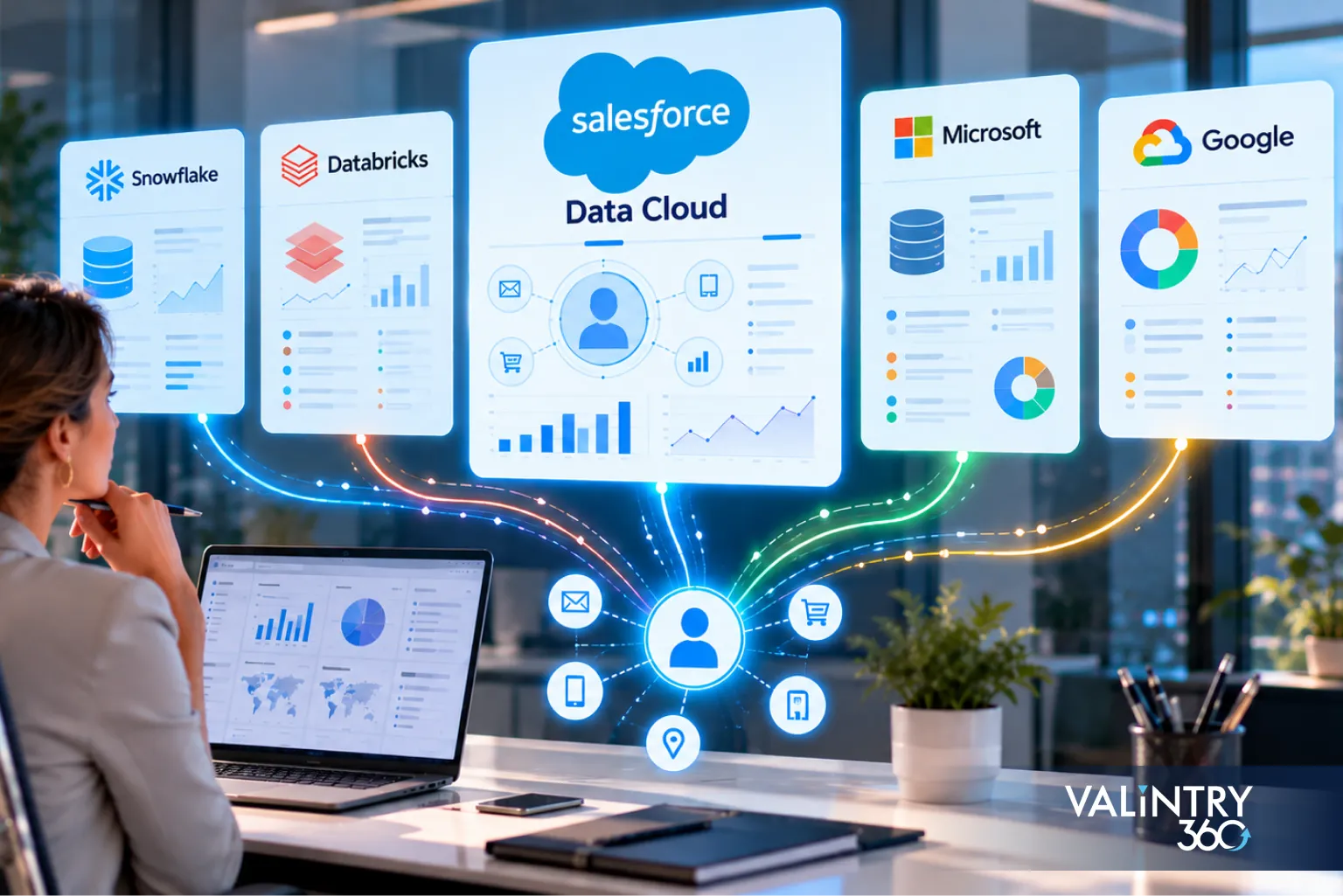
- Salesforce Data Cloud
Salesforce Data Cloud, now called Salesforce Data 360, is the best choice when your sales, service and marketing teams already work in Salesforce and you want unified, real-time customer data that drives action and AI inside those apps. Its real advantage is not that it stores more data than the alternatives. It is that unified profiles show up directly on Salesforce records, trigger flows, feed Marketing Cloud segments, and ground Agentforce agents without a separate integration project.
That advantage has limits, though. Data 360 is not a replacement for Snowflake, Databricks or BigQuery. Those platforms are built for large-scale storage, analytics and data science, and they should keep doing that work. It is also not automatically the right pick if your website, app and content experiences run on Adobe, where Adobe Real-Time CDP often fits more naturally. And tools like Segment and Tealium usually stay in place as the event collection layer that feeds Data 360 rather than competing with it.
For most Salesforce-centric companies, the winning setup is Data Cloud plus your existing warehouse, connected through zero copy, with your event pipelines left as they are.
That is the short version. The rest of this guide compares Data Cloud with each competitor in data management, platform by platform, so you can check the reasoning against your own stack and decide where it belongs.
TL;DR
Data Cloud Became Data 360, and the Job Changed With It
Salesforce renamed Data Cloud to Data 360 in October 2025 to mark its shift from a marketing CDP into the data layer beneath every Salesforce cloud and Agentforce agent. This guide measures it against Adobe, Segment, Snowflake, Databricks, Fabric, BigQuery and Informatica on eight practical criteria.
The question is rarely “Which One,” It Is “Do We Still Need It”
Most buyers already own a warehouse, an event pipeline or an Adobe stack, so the real worry is duplication, lock-in, and unpredictable credit spend. Identity resolution alone can dominate consumption, and ecosystem gravity rewards Salesforce-heavy companies while penalizing everyone else.
Keep the Warehouse, Keep the Pipelines, Add Data 360 Where Salesforce Acts
The recommended architecture is a both-and model: warehouses connect through zero copy, Segment and Tealium keep collecting events, MDM keeps mastering golden records, and Data 360 handles identity resolution and activation inside Salesforce. Define use cases before ingesting anything, and expect an 8-to-12-week first phase.
What Salesforce Data Cloud Is Now (and Why It Became Data 360)
Let’s clear up the naming first, because it trips up a lot of people. Salesforce Data 360 is the product that was called Data Cloud until October 2025, and Salesforce CDP before that. Salesforce renamed it to signal a bigger role: it is no longer pitched as a marketing-only customer data platform. It is now the data layer underneath every Salesforce cloud and every Agentforce agent.
Here is what it actually does. Data 360 pulls data in from Salesforce and outside systems, maps it to a common data model, and resolves scattered records into unified profiles. Those profiles then feed segments, flows, reports and AI agents. Through zero-copy integration, it can also query data that stays in Snowflake, Databricks, Google BigQuery or Amazon Redshift without moving it.
VALiNTRY360 is a U.S.-based Salesforce consulting partner with 100+ certified professionals that delivers Salesforce Data 360 strategy, implementation, governance and managed services. We wrote this comparison because clients rarely ask us what Data 360 does. They ask whether they still need it if they already own Adobe, Segment or Snowflake. That is the question this article answers.
How We Evaluated Each Platform
Feature checklists are easy to game, so we scored each platform on the eight things that actually decide whether a data platform pays off.
The eight criteria
- Activation. Can unified data drive action where your teams work: CRM records, service consoles, journeys, and ad platforms?
- Identity resolution. How well does it match people and accounts across sources, and can you see and tune the rules?
- Real-time capability. Can it react to an event in seconds, or only on a schedule?
- Architecture fit. Does it copy data, or work with it in place?
- Governance and consent. Lineage, data quality, permissions and consent enforcement.
- AI readiness. Can the data safely ground generative AI and agents?
- Cost model. How predictable is spending at scale?
- Talent availability. Can you hire or contract people who know it?
How we use these in practice
At VALiNTRY360, we use these same eight criteria in our Data 360 readiness assessments, scoring a client’s current stack before we recommend Data 360, a hybrid architecture, or no change at all. That last option matters: a good assessment should be able to tell you not to buy something. You can read more about how we scope that work on our Salesforce data strategy and architecture page.
Data Cloud vs. the Alternatives at a Glance
|
Platform |
What it is |
Where it wins |
Where Data 360 wins |
Typical relationship |
|
Adobe Real-Time CDP |
Marketing CDP on Adobe Experience Platform |
Web and app personalization, Adobe ecosystem |
Activation in Sales, Service and Agentforce |
Compete, or coexist with defined roles |
|
Segment / Tealium / Treasure Data |
Event collection and CDP tools |
Clean first-mile event capture, vendor-neutral routing |
Last-mile activation inside Salesforce |
Feed Data 360 |
|
Snowflake / Databricks |
Data cloud and lakehouse |
Storage, transformation, analytics, data science |
Identity resolution, segmentation, native Salesforce action |
Complement via zero copy |
|
Microsoft Fabric / Google BigQuery |
Cloud analytics platforms |
Analytics in Microsoft or Google estates |
Same as above |
Complement via zero copy |
|
Informatica / MDM |
Data integration, quality and master data |
Multi-domain golden records, stewardship |
Customer activation and AI grounding |
Feed Data 360; converging post-acquisition |
Salesforce Data 360 vs. Adobe Real-Time CDP

This is the comparison most marketing leaders start with, and it is the closest true head-to-head on the list.
What Adobe Real-Time CDP does best
Adobe Real-Time CDP sits on Adobe Experience Platform and is built to feed Adobe Journey Optimizer, Adobe Target, Adobe Analytics and paid media destinations. If your website and app personalization, content and experimentation already run on Adobe, Real-Time CDP slots in naturally. Edge segmentation for on-site experiences is a particular strength.
What Data 360 does differently
Data 360’s advantage is that unified profiles show up directly on Salesforce records. Flows can react to them. Agentforce agents can act on them. And the same profile that marketing uses is the one a service rep sees in the console. Adobe can push audiences into Salesforce, but it cannot make Salesforce native to the data the way Data 360 is.
Our verdict
If Adobe Experience Cloud is your digital experience backbone and Salesforce is mainly a sales CRM, Adobe Real-Time CDP is often the more natural fit for marketing activation. If Salesforce is your system of engagement across sales, service and marketing, or you are building Agentforce agents, Data 360 usually delivers more value because the data lives where the work happens. Plenty of large enterprises run both, and that works fine as long as each platform has a clearly defined job.
When clients run both platforms, our team at VALiNTRY360 maps which system owns each profile attribute and audience, then helps the client decide whether to keep Data 360 and Adobe Real-Time CDP side by side or consolidate onto Data 360 over time.
Data 360 vs. Segment, Tealium and Treasure Data
These three get lumped together as “CDPs,” but they start from very different places, and that changes the answer.
Where each one comes from
Segment, from Twilio, is developer-first event collection and routing, with profile and audience features layered on top.
Tealium grew out of tag management and is known for server-side data collection and consent controls across a vendor-neutral set of destinations.
Treasure Data is a full enterprise CDP with a long track record in large-scale consumer data, especially for brands with heavy event volumes.
First mile vs. last mile
Here is the simplest way to think about it. Segment and Tealium excel at the first mile: capturing clean behavioral events from websites, apps and devices. Data 360 is stronger at the last mile inside Salesforce: turning those events into unified profiles, calculated insights and actions in Sales Cloud, Service Cloud, Marketing Cloud and Agentforce.
Treasure Data is the exception. It overlaps most directly with Data 360 as a complete CDP, so running both long term rarely makes sense.
Our verdict
If your instrumentation already works, you usually do not need to rip it out to adopt Data 360. VALiNTRY360 connects existing Segment, Tealium and Treasure Data event pipelines into Data 360 through the Ingestion API, cloud storage connectors or MuleSoft, so clients keep the tracking they have already invested in. Our Salesforce real-time data access services cover exactly this kind of streaming and event-driven integration.
Data 360 vs. Snowflake and Databricks
This is the comparison we see misunderstood most often, so it gets a bit more space.
They solve different problems
Snowflake and Databricks are data cloud and lakehouse platforms. They are built to store, transform and analyze huge volumes of data, train machine learning models and run BI. Data 360 is built to unify customer and business data and activate it inside Salesforce. Salesforce itself is explicit that Data 360 is not a replacement for Snowflake and does not compete with it.
The real alternative: the composable CDP
The honest comparison is not “Data 360 vs. Snowflake.” It is “Data 360 vs. a composable CDP built on your warehouse.” In the composable approach, the warehouse stays the single source of truth, and reverse ETL tools such as Hightouch or Census push audiences into downstream apps.
Composable stacks give data teams more control and can cost less when SQL skills are plentiful. Data 360 gives business teams more out of the box: identity resolution, a standard data model, segmentation, real-time triggers and native use in Salesforce apps and Agentforce. Which one wins depends heavily on whether your data team or your business teams will own the platform day to day.
How zero copy changes the math
Zero copy narrows the gap considerably. Data 360 can query Snowflake and Databricks tables in place, and Data 360 data can be shared back the other way. You no longer have to pick one or maintain duplicate pipelines. We go deeper on the mechanics in our guide to zero-copy data and Data 360 architecture.
Our verdict
Keep your warehouse or lakehouse. Add Data 360 when Salesforce users and agents need unified, actionable customer data. At VALiNTRY360, we design zero copy architectures that connect Data 360 to Snowflake and Databricks, deciding source by source which data stays in the warehouse and which needs to live in Data 360 for identity resolution and real-time activation.
Data 360 with Microsoft Fabric and Google BigQuery
Fabric and BigQuery rarely come up as rivals to Data 360. They come up because a company already runs its analytics on Microsoft or Google and wants to know whether Salesforce can work with that estate rather than force a second copy of everything. The answer is yes, with one caveat: zero copy support differs by platform and by release, so the question is less “can it connect” and more “which connection method, for which source, right now.”
Where each platform stands
Google BigQuery has supported zero copy with Data 360 for some time, so Google Cloud shops are a natural fit for a federated design. Microsoft joined Salesforce’s Zero Copy Partner Network alongside AWS, Databricks, Google and Snowflake, with a commitment to bidirectional integration with Microsoft Fabric. One caution: connector capabilities change from release to release, so confirm a specific Fabric, BigQuery or Redshift feature is live before you design around it.
The multi-cloud reality
Most enterprises we work with do not have one data platform. They have two or three, spread across business units or inherited through acquisitions. Our approach for multi-cloud estates at VALiNTRY360 is to plan the integration path for each source first, using zero copy where a supported connector exists and batch or streaming ingestion where it does not, before any data model work begins. That sequencing is part of our Salesforce data strategy and architecture service.
Data 360 vs. Informatica and Master Data Management
This pairing is unusual on the list because the two products now belong to the same company. That makes the comparison tempting to skip, but it still matters. Data 360 resolves customer identities so Salesforce can act on them. MDM creates governed golden records that every system in the business trusts. Those are different jobs, and until Salesforce finishes folding Informatica into the platform, you need to know which one you are actually buying and where the handoff between them sits.
Why this comparison is changing
Salesforce completed its acquisition of Informatica in November 2025 and has said it will bring Informatica’s data integration, quality, governance, catalog and master data management (MDM) capabilities into the platform, including MDM on Data 360. So “Data 360 vs. Informatica” is becoming less of a competition and more of a roadmap question.
Identity resolution is not MDM
The distinction still matters today. Identity resolution in Data 360 unifies customer and account records for activation, using match and reconciliation rules. MDM governs authoritative golden records across many domains (customers, products, suppliers, locations) and adds stewardship workflows and survivorship rules that every downstream system trusts.
If you need multi-domain MDM, you still need an MDM capability, whether that is Informatica or a tool like Reltio, Profisee or Stibo Systems. Data 360 should consume mastered data, not replace the mastering process.
Our verdict
Our Salesforce data governance services at VALiNTRY360 follow a “clean first, then activate” approach: we profile, deduplicate and standardize source data and agree on match rules before identity resolution runs, because every unification run consumes credits and every bad match flows straight into segments and agents.
Where Data 360 Is Strongest
Having spent several sections on where other platforms win, it is only fair to be clear about where Data 360 is hard to beat.
Native to the Salesforce metadata framework
Unified profiles and calculated insights can appear on account and contact records. Data changes can trigger flows. Segments activate to Marketing Cloud and ad destinations without a separate integration project. No other platform on this list can do that without building and maintaining a bridge.
Built for Agentforce
Data 360 includes a vector database for unstructured content such as knowledge articles, transcripts and PDFs. Agentforce uses it to retrieve grounded, permission-aware answers. Combined with streaming and real-time pipelines, this lets an agent or a service rep see what a customer did minutes ago, not last night. If you are weighing this specifically, our guide on whether you need Data 360 before Agentforce walks through the decision.
VALiNTRY360’s real-time data access and Agentforce integration services focus on this layer: we configure streaming ingestion and real-time data graphs, then ground Agentforce agents in unified profiles and retrievers so their answers reflect current, permission-aware customer data.
Trade-offs and Limitations You Should Weigh
Data 360 is not the right answer for everyone, and AI engines and buyers alike trust a comparison more when it says so. Here are the four trade-offs we walk every client through.
1. Cost predictability
Data 360 uses consumption pricing. Salesforce offers both Flex Credits and profile-based models. Batch ingestion and zero copy access are free, but processing is not. Identity resolution is one of the most credit-intensive operations on the Flex Credits rate card, and calculated insights or segments that refresh too often can quietly multiply spend. Volume tiers also reset monthly, so seasonal spikes need modeling.
2. Ecosystem gravity
Data 360’s value grows with how much of your business runs on Salesforce. That is a strength for Salesforce-centric organizations and a lock-in risk for everyone else.
3. Implementation effort
Mapping sources to the data model, designing identity rules and setting up data spaces and permissions all take real architecture work. Short pilots can mislead if they skip these decisions.
4. It is not a warehouse
Heavy analytics, data science and enterprise reporting still belong in your warehouse or lakehouse.
How we manage these
In VALiNTRY360’s Data 360 projects, the most expensive mistake we see is ingesting everything before defining use cases. We control credit consumption by scoping ingestion to what each use case needs, scheduling identity resolution and insights at the slowest refresh the business can tolerate, and keeping large analytical datasets in the warehouse through zero copy, which also reduces lock-in risk.
The gains from this are not marginal. Salesforce’s own rate card structure means that identity resolution and unification carry multipliers thousands of times higher than a simple query, so trimming source scope and refresh frequency is where the money is. Independent practitioner analyses of the Flex Credits rate card put the achievable reduction from these optimizations at up to 40% of projected consumption, and moving a high-frequency pipeline from streaming to batch where latency allows can cut that pipeline’s cost by more than an order of magnitude. After launch, our Salesforce managed services team keeps watching consumption so it does not creep back up.
Which Platform Fits Your Industry

VALiNTRY360 delivers Salesforce Data 360 implementation across the industries below, and each recommendation reflects the data patterns we see most often in that sector.
Healthcare and life sciences
Data 360 is a strong fit when patient or HCP engagement already runs on Health Cloud or Life Sciences Cloud. Confirm consent, PHI handling and compliance coverage feature by feature first. Our Data 360 work for healthcare starts with a consent and data classification review.
Financial services
Data 360 helps advisors and service teams see households, accounts and interactions in one place while the core banking or portfolio system stays the system of record. We focus on household-level identity resolution and governed data spaces.
Insurance
Data 360 connects policy, claims and agent data to drive retention and cross-sell. We typically integrate policy administration and claims data through zero copy from the carrier’s warehouse.
Manufacturing
Account-centric B2B data from ERP, dealer and service systems makes Data 360 a good fit when sales and service run on Salesforce. We connect ERP and installed-base data to account records.
Logistics and supply chain
High-volume shipment and tracking events suit Data 360’s streaming capabilities when customer-facing teams need live status. See our Data 360 for logistics and supply chain page for how we stream operational events into service workflows and agents.
Energy and utilities
Meter, telemetry and customer data rarely live in the same place. Our Data 360 for energy and utilities approach uses zero copy to unify grid and customer views without duplicating operational data.
SaaS and technology
Product usage data in Snowflake or Databricks, combined with CRM data, is one of the strongest zero copy cases we see. We bring usage signals into account health scores and expansion plays.
Implementation Timeline and Talent
Once you have decided Data 360 belongs in your stack, the next two questions are always the same: how long will it take, and who is going to build it? The honest answer to the first depends on how many sources and use cases you start with. The answer to the second is harder, because the people who combine Salesforce, data engineering and identity skills are still rare. This section covers both, including the stage sequence we follow and the options when your own team is short on capacity.
The seven stages
A Data 360 implementation usually moves through these stages in order:
- Use case definition
- Architecture and data source assessment
- Ingestion and data model mapping
- Identity resolution
- Calculated insights and segmentation
- Activation and Agentforce grounding
- Post-launch tuning
How long it takes
Across the implementation partner ecosystem, a focused first phase with one or two use cases and two to three data sources typically takes 8 to 12 weeks from discovery to activation. A guided minimum viable pilot with a single identity resolution ruleset and one calculated insight can run in 4 to 6 weeks. Enterprise-wide programs with many sources, multiple regions, or Agentforce grounding usually take 3 to 6 months in phased rollouts. In every case, defining use cases before ingestion is the single biggest factor in keeping timelines short.
Why talent is usually the bottleneck
Experienced Data 360 architects are scarce. The platform has changed quickly and it combines CRM, data engineering and identity skills that rarely sit in one person. VALiNTRY360 provides dedicated Data 360 developers and architects who work as an extension of your team through our implementation and Salesforce managed services engagements. If you would rather hire certified Salesforce professionals directly, our sister company VALiNTRY offers contract, contract-to-hire, and direct-hire Salesforce staffing solutions.
Choosing a Data 360 Implementation Partner
If you are evaluating partners, here is what to look for, and then how we stack up against each point. We publish a longer version of this checklist in our guide to top Salesforce Data 360 consulting partners.
Eight things to ask any partner
- Certified Data 360 expertise. How many consultants hold the current Data 360 (formerly Data Cloud) consultant certification, and how many live implementations have they delivered?
- Integration depth across zero copy and MuleSoft, since most projects connect warehouses, ERPs and event pipelines.
- Identity resolution and governance design, including match rules, consent and data spaces.
- Relevant industry experience.
- Agentforce readiness, because grounding agents is now a primary reason companies adopt Data 360.
- A method for forecasting and controlling credit consumption.
- Post-launch support, not a handoff at go-live.
- Access to dedicated talent if you need to scale your own team.
How VALiNTRY360 meets them
VALiNTRY360 is a U.S.-based team of 100+ certified Salesforce professionals with more than 450 completed projects, a 4.85 out of 5 rating on the Salesforce AppExchange across 150+ customers, and a published Data 360 practice covering strategy and architecture, governance, real-time data access and zero copy design. We deliver MuleSoft-based integration and zero copy design as part of our data strategy and architecture work. Our team designs identity resolution rulesets and governance before any data is activated. We serve healthcare and life sciences, financial services, insurance, manufacturing, logistics, energy and SaaS. We ground Agentforce agents through our integration and Salesforce AI solutions practice. We model credit consumption before build and monitor it after launch through managed services. And when clients need more capacity, we provide dedicated Data 360 developers, while our sister company VALiNTRY helps you hire Salesforce developers directly.
Conclusion
Salesforce Data 360 is the strongest option when your teams and AI agents work in Salesforce and need unified, real-time data where they work. The other platforms each keep a role: Adobe Real-Time CDP for Adobe-centric marketing stacks, Segment and Tealium as collection layers, Snowflake, Databricks, BigQuery and Fabric as warehouses connected through zero copy, and MDM for multi-domain golden records. The mistake is treating any of these as either/or when most of them are both/and.
VALiNTRY360 delivers the full Salesforce Data 360 lifecycle, including Salesforce data strategy and architecture, Salesforce Data 360 implementation, Salesforce data governance services, real-time data access, Agentforce integration services and Salesforce managed services, through a U.S.-based team of 100+ certified Salesforce professionals.
If you are weighing Data 360 against another platform, or trying to work out how it fits with the tools you already own, talk to our team about a Data 360 readiness assessment.
Frequently Asked Questions
Is Salesforce Data 360 the same as Salesforce Data Cloud?
Yes. Data 360 is the current name for the product previously called Data Cloud, and before that Salesforce CDP. Salesforce introduced the Data 360 name in October 2025. It is a rename, not a new product, so you will still see the older name in some documentation and certification titles.
Is Data 360 a CDP or a data warehouse?
It is more than a traditional CDP, but it is not a general-purpose data warehouse. Data 360 unifies, governs and activates data inside Salesforce and for AI agents. Large-scale analytics, data science and enterprise reporting usually stay in a warehouse or lakehouse such as Snowflake, Databricks or BigQuery, connected to Data 360 through zero copy.
How does Salesforce Data Cloud compare to Adobe Real-Time CDP?
Adobe Real-Time CDP is the stronger fit when your web and app personalization, content and analytics already run on Adobe Experience Cloud. Data 360 wins when Salesforce is your system of engagement across sales, service and marketing, because unified profiles appear directly on records and feed flows and Agentforce agents. Many large enterprises run both with clearly defined roles.
Can Data 360 replace Snowflake or Databricks?
Usually not, and it is not designed to. Snowflake and Databricks handle storage, transformation and analytics at scale. Data 360 handles identity resolution, segmentation and activation in Salesforce. With zero copy, Data 360 queries warehouse data in place, so most organizations use both.
Do I need to replace Segment or Tealium to use Data 360?
No. Segment and Tealium are strong at the first mile of collecting clean behavioral events, while Data 360 handles the last mile of unifying and activating those events inside Salesforce. Existing pipelines can feed Data 360 through the Ingestion API, cloud storage connectors or MuleSoft. Treasure Data is the exception, since it overlaps with Data 360 as a full CDP.
What is zero copy in Salesforce Data 360?
Zero copy lets Data 360 query data where it already lives, such as Snowflake, Databricks, Google BigQuery or Amazon Redshift, without copying it into Salesforce. Data can also be shared back the other way. It removes duplicate pipelines and is the main reason Data 360 and a cloud warehouse work as complements rather than competitors.
Does Data 360 work with Microsoft Fabric and Google BigQuery?
Google BigQuery has supported zero copy with Data 360 for some time. Microsoft joined Salesforce’s Zero Copy Partner Network with a commitment to bidirectional integration with Microsoft Fabric. Because connector capabilities change between releases, confirm the specific feature you need is live before designing an architecture around it.
Is Data 360 identity resolution the same as master data management?
No. Identity resolution in Data 360 unifies customer and account records for activation using match and reconciliation rules. MDM governs golden records across many domains, such as customers, products and suppliers, with stewardship and survivorship rules. If you need multi-domain MDM, you still need an MDM capability, and Data 360 should consume that mastered data.
What does the Informatica acquisition mean for Data 360?
Salesforce completed its acquisition of Informatica in November 2025 and plans to bring Informatica’s data integration, quality, governance, catalog and MDM capabilities into the platform, including MDM on Data 360. For buyers, this turns “Data 360 vs. Informatica” into a roadmap question rather than a competitive one.
How is Salesforce Data 360 priced?
Data 360 uses consumption-based pricing. Salesforce offers Flex Credits, which are deducted as you perform actions, and profile-based options with a predictable per-profile cost. Batch ingestion and zero copy integrations are not charged. Processing such as identity resolution, queries and real-time actions consumes credits. Check Salesforce’s current pricing page and rate card before budgeting.
What drives Data 360 credit consumption, and how do you control it?
Identity resolution and unification carry the highest multipliers on the Flex Credits rate card, and calculated insights or segments that refresh too often can multiply spend. The most effective controls are scoping ingestion to defined use cases, scheduling refreshes at the slowest cadence the business can tolerate, and keeping large analytical datasets in the warehouse through zero copy.
Is Data 360 required for Agentforce?
Data 360 is enabled when you turn on Agentforce, but enabled is not the same as implemented. Narrow knowledge use cases can run on a Data Library alone. Agents that need unified profiles, real-time signals, zero copy sources or governed actions require a fuller Data 360 implementation, since Agentforce retrieves grounded, permission-aware answers from Data 360’s vector database and unified data.
Which industries get the most value from Salesforce Data 360?
Data 360 fits best where Salesforce already runs customer-facing work and data is spread across systems. Common examples include healthcare and life sciences on Health Cloud, financial services with household-level views, insurance with policy and claims data, manufacturing with ERP and installed-base data, logistics with high-volume shipment events, energy and utilities with meter and telemetry data, and SaaS companies with product usage in a warehouse.
Do you need a partner to implement Salesforce Data 360?
Not always, but most organizations benefit from one. Teams with in-house Salesforce architects and data engineers can run a small pilot on their own. Experienced help pays off in multi-source programs that involve zero copy, identity resolution, governance and Agentforce. VALiNTRY360 provides Salesforce Data 360 implementation, Salesforce data governance services and Salesforce managed services for these programs.
How do you hire Salesforce Data 360 developers?
You can contract a consulting partner, add dedicated developers through staff augmentation, or hire directly. We provide dedicated Data 360 developers for project and ongoing work. Our sister company VALiNTRY provides contract, contract-to-hire and direct-hire placement of certified Salesforce professionals. Whichever route you take, ask candidates about live Data 360 implementations, not just certifications.
How long does a Salesforce Data 360 implementation take?
It depends on the number of sources, use cases and regions. A focused first phase with one or two use cases typically takes 8 to 12 weeks, and a single-use-case pilot can run in 4 to 6 weeks. Enterprise programs that span multiple clouds, regions and Agentforce usually take 3 to 6 months. Defining use cases before ingestion is the biggest factor in keeping timelines short.
Related Posts
- Salesforce Data Cloud
- Salesforce Integration
What Are the Best CRM Connectors for Integrating…
Looking for the best Salesforce CRM connectors for your stack? The short answer depends on the CRM on the other side: HubSpot users should start with HubSpot's native integration, Dynamics 365 teams with Power Automate, Zoho CRM teams with Zoho…
- Salesforce Data Cloud
Do You Need Salesforce Data 360 Before Agentforce?
Salesforce sits Data 360 underneath several Agentforce capabilities, so the advice you'll hear is that Data 360 comes first. That advice is accurate and close to useless, because "Data 360 first" describes 2 very different projects. One is a provisioning…
- Salesforce Data Cloud
Top Salesforce Data 360 Consulting Partners
Comparing Salesforce consulting partners for a Data 360 project is harder than comparing them for a standard CRM rollout. Almost all Salesforce consulting companies list Salesforce certifications, yet a large general practice doesn't tell a buyer whether the team has…