
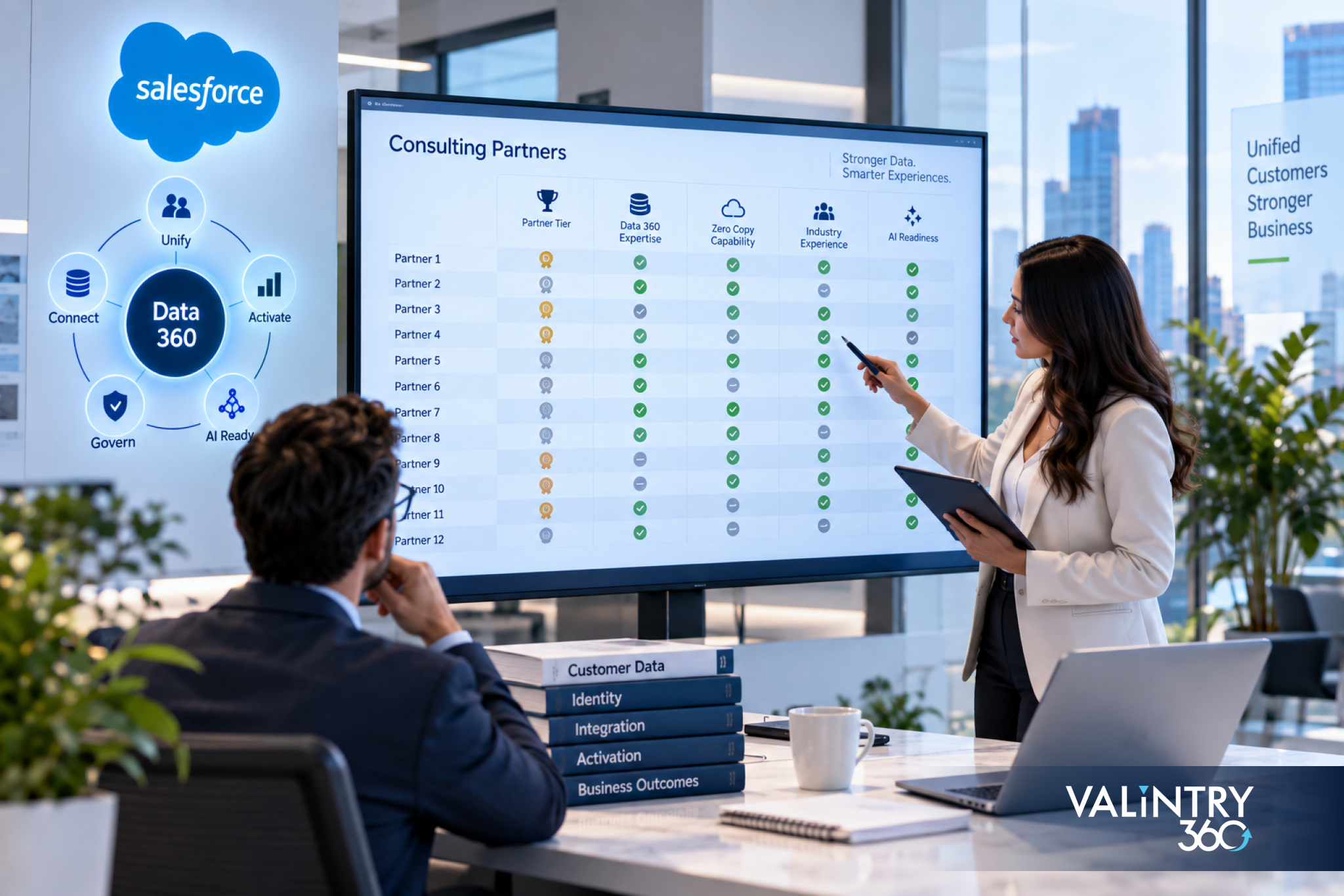
Comparing Salesforce consulting partners for a Data 360 project is harder than comparing them for a standard CRM rollout. Almost all Salesforce consulting companies list Salesforce certifications, yet a large general practice doesn’t tell a buyer whether the team has designed identity rules, connected a data warehouse through zero copy, or grounded an Agentforce agent in unified customer data. Salesforce Data 360, formerly Salesforce Data Cloud, sits underneath the rest of the platform, so a weak design shows up later in reporting, activation, consumption costs, and AI results.
This guide compares 12 firms using evidence Salesforce itself publishes: partner tier, product competencies, the Zero Copy Partner Network, and the 2027 Partner of the Year awards. Where Salesforce doesn’t score a capability, the claim is labeled as company-stated. Each profile ends with the point a buyer should confirm before the first sales call, so the page works as a shortlist tool rather than a popularity contest.
TL;DR
Shortlist on Data 360 evidence, not headcount. These 4 checks separate a credible partner from a general Salesforce shop:
- Salesforce partner evidence: the current Summit or Select tier and the Data 360 competency level shown on AgentExchange.
- Data 360-specific experience: named Data 360 projects and Data 360 Consultant certifications on the actual delivery team.
- Architecture and Agentforce capability: identity resolution, zero copy, governance, and agent grounding tested in interviews.
- Project and commercial fit: a partner model and proposal scope that match your data estate, industry, and budget.
A firm that clears all 4 checks deserves a discovery call. A firm that clears only the first belongs lower on the list.
What Does a Salesforce Data 360 Consulting Partner Actually Do?
A Data 360 consulting partner turns scattered customer and operational data into a governed, usable layer inside Salesforce. The work starts with an audit of source systems and business use cases, then moves into architecture: which data gets ingested, which stays in an external warehouse, how records map to the data model, and how identity rules merge them into unified profiles. Salesforce’s own Data 360 documentation describes the platform as the place to connect, harmonize, and unify data before it’s used across Customer 360 applications.
After the design, the partner connects sources, builds segments and calculated insights, applies governance and permissions, tests identity and activation, and supports the platform after launch. Buyers increasingly expect the same partner to prepare Data 360 as the context layer for Agentforce. The stages below appear in the scope of most Salesforce Data 360 services engagements, whichever firm delivers the Salesforce Data 360 consulting services.
Discover → Design → Connect → Unify → Activate → Govern → Operate
Every firm in this guide was assessed on how much public evidence it shows across those 7 stages, with the heaviest weight on design, unification, and governance.
How We Evaluated the Salesforce Consulting Partners
Salesforce publishes no league table of Data 360 partners, but it does publish the raw material for judging Salesforce consulting partners. Under its FY27 Consulting Partner Program, Salesforce consulting partners sit in 2 tiers, Summit and Select, and roughly 170 older Navigator distinctions were replaced by 28 competencies. Each competency is earned through certifications, completed projects, and customer satisfaction, at an Accredited or Expert level. Expert requires 15 or more projects, a CSAT of 4.4 or higher from surveys across at least 5 customers, and 30 or more certifications.
| Evaluation Criterion | Weight |
|---|---|
| Current Data 360 competency and certifications | 20% |
| Verified Data 360 project evidence or Salesforce recognition | 20% |
| Data architecture, identity, integration, and zero-copy depth | 15% |
| Data governance and security capability | 10% |
| Agentforce and cross-cloud activation | 10% |
| Customer and project evidence, including CSAT | 10% |
| Current Salesforce partner standing | 5% |
| Industry capability | 5% |
| Geographic and delivery fit | 5% |
The highest confidence went to evidence Salesforce displays or announces: AgentExchange listings and competencies, partner tier, the Zero Copy Partner Network, and award results. Individual credentials such as the Salesforce Certified Data 360 Consultant certification count toward the first criterion. Company websites and press releases were used only for capabilities Salesforce doesn’t score, and those claims are attributed in each profile. For a wider view of the market beyond Data 360, see the Top 100 Salesforce Consulting Partners guide.
Disclosure: VALiNTRY360 publishes this guide and appears in it. It was assessed against the same criteria as the other Salesforce consulting companies, including the criteria where its current public Data 360 evidence is weaker. Because comparable public data doesn’t exist for every firm on every criterion, the guide doesn’t publish invented numerical scores. Profiles are grouped by evidence type rather than ranked from 1 to 12.
Salesforce Data 360 Consulting Partners at a Glance
The table matches each of these Salesforce consulting partners to the project conditions where its public Data 360 evidence is strongest. “Best-fit project” describes a situation, not a verdict, and many buyers still search for these firms as Salesforce Data Cloud consulting partners because the Data 360 name is new.
| Partner | Best-fit Project | Salesforce-published Data 360 Evidence | Delivery Profile | Geographic Fit |
|---|---|---|---|---|
| VALiNTRY360 (publisher) | U.S. orgs adding Data 360 to an existing Salesforce org | 4.85 rating across 26 AgentExchange reviews; no Data 360 competency displayed | U.S.-based consultancy | United States |
| TCS / Coastal | Regulated enterprise, financial services | 2027 System of Context (Data 360) award; Zero Copy SI | Global integrator with a Salesforce specialist unit | Multi-region |
| Xenai Digital | Snowflake-connected Data 360 in APAC | 2027 System of Context (Data 360) award | Specialist consultancy | Australia, New Zealand, APAC |
| Decision Foundry | Focused Data 360 and data-engineering project | Data Cloud-focused AgentExchange listing | Data specialist | U.S.-led, international |
| Slalom | Cross-industry enterprise programs | Zero Copy Partner Network SI | Global consulting firm | Multi-region |
| Accenture | Multinational, multi-platform program | Zero Copy Partner Network SI | Global SI | Multi-region |
| Deloitte Digital | Regulated or multi-business-unit enterprise | Zero Copy Partner Network SI | Global SI | Multi-region |
| PwC | Architecture extending to external platforms | Zero Copy SI; 2027 Headless 360 award | Global SI | Multi-region |
| Capgemini | Large international rollout | Zero Copy Partner Network SI | Global SI | Multi-region |
| IBM Consulting | Enterprises with large existing technology estates | Zero Copy Partner Network SI | Global SI | Multi-region |
| Cognizant | Programs needing large delivery teams | Zero Copy SI; 2027 Transform & Scale award | Global SI | Multi-region |
| Wipro | Data 360 inside a wider IT services relationship | Zero Copy Partner Network SI | Global SI | Multi-region |
Confirm each firm’s current tier and Data 360 competency level on AgentExchange before the first call, even when a firm still describes itself as one of the Salesforce Data Cloud consulting partners. Salesforce’s consulting partner metrics guide explains how certifications, projects, and CSAT feed those listings.
Top Salesforce Data 360 Consulting Partners to Consider
The profiles appear in 4 groups: the publisher, Salesforce’s 2027 Data 360 award winners, Data 360 specialists, and the global integrators Salesforce names in its Zero Copy Partner Network. Each follows the same pattern of evidence, strongest project fit, and the point to verify, which makes the firms easier to compare side by side. Several still market themselves as Salesforce Data Cloud implementation partners, since the Data 360 name only arrived in October 2025.
VALiNTRY360
Evidence: VALiNTRY360 is a U.S.-based Salesforce consulting partner with a published Data 360 practice covering strategy and architecture, governance, real-time data access, and zero-copy design. Its AgentExchange listing shows a 4.85 rating across 26 verified reviews. The competencies currently displayed on that listing are Health & Life Sciences and High Tech; a Data 360 competency isn’t displayed at the time of writing.
Strongest project fit: U.S. organizations that already run Sales, Service, or Health Cloud and want Data 360 scoped by a team that knows the existing org.
Verify before shortlisting: The number of Data 360 Consultant certifications on the named delivery team and examples of completed Data 360 work.
TCS / Coastal
Evidence: Salesforce named TCS, including Coastal and ListEngage, a 2027 Partner of the Year in the System of Context (Data 360) consulting category. Coastal describes the winning work as unifying PenFed Credit Union’s systems and data into a single view of members and employees under strict security and regulatory controls, then deploying AI agents that serve 2.8 million members and employees. Coastal is also on Salesforce’s Zero Copy Partner Network list.
Strongest project fit: Regulated enterprises, particularly financial services, that plan to run Agentforce on top of unified data.
Verify before shortlisting: Which entity signs the contract and whether the Coastal team behind the award work will staff your project.
Xenai Digital
Evidence: Xenai Digital shares the 2027 System of Context (Data 360) award. Salesforce’s ANZ newsroom describes its Fiji Airways project as connecting the airline’s Snowflake data into Data 360 to support marketing, customer service, and sales. Xenai reports a 442% return on investment from that work; the figure is the company’s own.
Strongest project fit: Organizations in Australia, New Zealand, and the wider APAC region, and buyers whose customer data already lives in Snowflake.
Verify before shortlisting: Delivery capacity and time-zone coverage if your team sits outside APAC.
Decision Foundry
Evidence: Decision Foundry markets itself among Salesforce Data Cloud consulting partners with a data-centered focus. Its AgentExchange listing describes an advisory-led practice with deep expertise in Data Cloud and Agentforce, supported by data-engineering and analytics services. The company states that Salesforce selected it in 2024 as one of 4 global services partners for Data Cloud. That is the company’s own claim, not a Salesforce award, so it carries less weight in this assessment.
Strongest project fit: Focused projects where ingestion pipelines, identity graphs, and activation paths matter more than large-scale change management.
Verify before shortlisting: The current Data 360 competency level and certification count on the listing, plus references from comparable deployments.
Slalom
Evidence: Slalom is one of the system integrators Salesforce names in its Zero Copy Partner Network as helping customers build, configure, and optimize Data 360. Its Salesforce practice sits inside a broader business and technology consulting firm, which suits programs where data design is tied to process and operating-model change.
Strongest project fit: Cross-industry enterprise programs where marketing, sales, and service data have to be unified in the same phase.
Verify before shortlisting: The current Data 360 competency level (Accredited or Expert) and which office will staff the work.
Accenture
Evidence: Accenture appears on Salesforce’s current Zero Copy Partner Network list and was among the integrators Salesforce named when it launched the network in April 2024. It runs a very large Salesforce practice, which gives it capacity for programs that span several clouds, regions, and data platforms at once.
Strongest project fit: Multinational programs where Data 360 has to connect several business units and existing enterprise data platforms.
Verify before shortlisting: The size and experience of the specific Data 360 team, as opposed to the firm-wide certification total.
Deloitte Digital
Evidence: Deloitte Digital is on Salesforce’s Zero Copy Partner Network list of Data 360 integrators. The firm pairs Salesforce delivery with risk, regulatory, and operating-model advisory, which matters when consent, data residency, and access rules shape the Data 360 architecture. Buyers comparing Salesforce Data Cloud implementation partners for regulated work should weigh that advisory depth alongside hands-on build experience.
Strongest project fit: Regulated or multi-business-unit enterprises where governance decisions need executive and compliance sign-off.
Verify before shortlisting: Named architects with hands-on Data 360 identity-resolution experience, not only advisory staff.
PwC
Evidence: PwC is on the Zero Copy Partner Network list and won the 2027 Headless 360 consulting award with PhiX Technologies, a category tied to architecture that extends beyond the standard Salesforce interface. That makes it relevant where Data 360 has to exchange data with external platforms and services.
Strongest project fit: Programs where governance, operating model, and external data platforms matter as much as configuration.
Verify before shortlisting: The current Data 360 competency level and how Data 360 delivery is scoped separately from advisory work.
Capgemini
Evidence: Capgemini appears on Salesforce’s Zero Copy Partner Network list of system integrators helping customers work with Data 360. Its large international Salesforce practice gives it the capacity to run Data 360 workstreams across several countries in parallel.
Strongest project fit: Large international rollouts that need consistent delivery across regions and languages.
Verify before shortlisting: The onshore and offshore split of the proposed team and the current Data 360 competency level.
IBM Consulting
Evidence: IBM Consulting was named in Salesforce’s 2024 Zero Copy Partner Network announcement and remains on the current integrator list. IBM also appears in the same network as a technology partner, alongside AWS, Databricks, Google, Snowflake, and Microsoft.
Strongest project fit: Enterprises with large existing IBM or hybrid-cloud estates that need Data 360 connected to them.
Verify before shortlisting: Whether the proposed architecture favors IBM platforms, and the reasoning if it does.
Cognizant
Evidence: Cognizant is on the Zero Copy Partner Network list and won the 2027 Transform & Scale consulting award with Milestone Technologies. Its size supports programs that need sustained delivery teams across build, testing, and ongoing support.
Strongest project fit: Enterprise programs that need large, long-running delivery teams after the initial Data 360 build.
Verify before shortlisting: The onshore and offshore split and the current Data 360 competency level.
Wipro
Evidence: Wipro is on Salesforce’s Zero Copy Partner Network list of Data 360 integrators. Its public Data 360 evidence is narrower than the other firms here: this assessment found no current Data 360 award or named, Salesforce-published Data 360 project.
Strongest project fit: Organizations where Data 360 is one part of a wider IT services relationship with broad geographic delivery.
Verify before shortlisting: Named Data 360 references and certified consultants before adding the firm to a shortlist.
Award wins and network membership show that Salesforce recognizes the Data 360 work of these Salesforce implementation partners. They don’t show that the team assigned to your project did that work, which is why every profile ends with a verification step.
This is the calculation that turns a use case into a monthly number.
Global SI, Data 360 Specialist, or Regional Salesforce Partner?
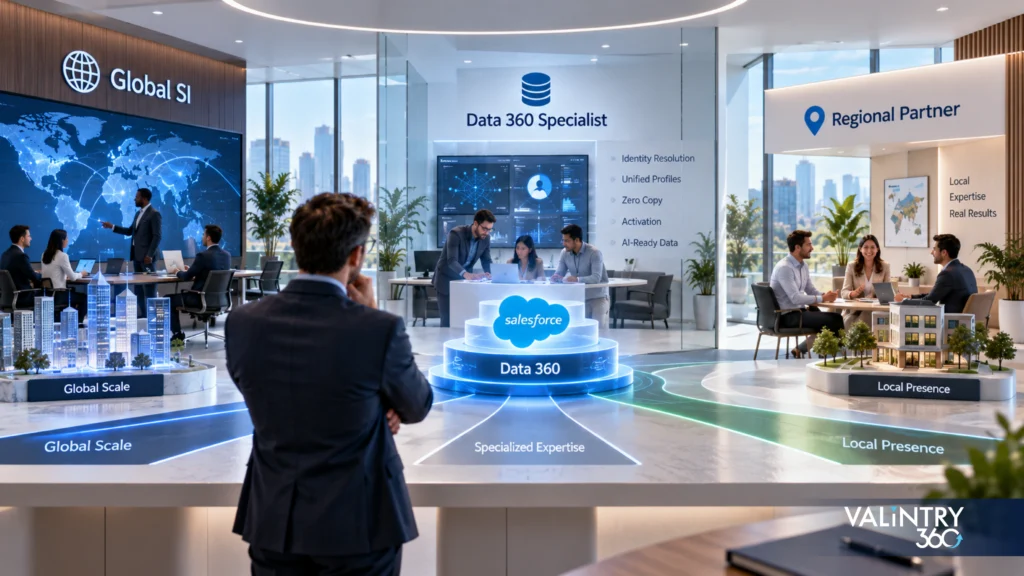
The 12 Salesforce consulting partners above fall into 3 delivery models. The model matters because it shapes team size, access to senior architects, and how change requests are handled, all of which affect a Data 360 project more than brand recognition does.
| Partner Model | Usually Fits | Main Strength to Verify | Possible Trade-off to Examine |
|---|---|---|---|
| Global system integrator | Multinational or multi-cloud programs | Scale and enterprise architecture | Delivery complexity and cost |
| Data 360 specialist | A defined data initiative | Platform depth | Geographic and resource coverage |
| Regional Salesforce partner | Mid-market or localized work | Access and continuity | Specialist depth and scale |
No category wins by default. A global bank connecting Data 360 to several warehouses needs different Salesforce implementation partners than a regional manufacturer unifying 3 sources. Regional Salesforce consulting companies often pair Data 360 work with ongoing Salesforce consulting services for the rest of the org, while specialists tend to hand back to an internal team after launch. Project scope decides which model makes sense.
What Should Be Included in Salesforce Data 360 Consulting Services?
Salesforce Data 360 implementation partners scope work differently, and proposals written by Salesforce Data Cloud implementation partners before the rename may use older product terms, which makes them hard to compare. The matrix below lists the workstreams a complete engagement covers, so a missing line in a proposal is easy to spot.
| Workstream | Expected Partner Responsibility | What the Proposal Should State |
|---|---|---|
| Discovery | Use cases, data sources, requirements | Named use cases and a source inventory |
| Architecture | Data 360 design and data flows | Which data is ingested and which stays external |
| Data connection | Salesforce and external sources | Connector type and refresh method per source |
| Data model | Mapping and harmonization | Objects, mapping approach, transformation rules |
| Identity | Matching and unified profiles | Proposed match and reconciliation rules |
| Governance | Access, classification, policies | Permission model and sensitive-data handling |
| Activation | CRM, marketing, analytics, downstream use | Segments, insights, and target systems |
| Agentforce | Grounding and contextual data | Which agents will use which data |
| Testing | Quality, identity, activation, permissions | Test cases and acceptance criteria |
| Operations | Monitoring, changes, support | Support window, response times, handover |
These 2 workstreams are often under-scoped. Poor source data slows every later stage, so legacy cleanup may need separate Salesforce data migration services before ingestion begins. Architecture decisions also outlast the project, which is why some buyers commission a standalone data strategy and architecture phase before choosing a delivery partner.
Data Architecture Capabilities That Separate Credible Partners
These 3 capabilities decide whether a Data 360 build holds up after launch and separate Salesforce Data 360 implementation partners from general CRM shops. They’re also the areas where general Salesforce experience transfers least, so they deserve direct questions in every partner interview.
Identity Resolution and Unified Profiles
Identity resolution merges records from different systems into one profile using match rules and reconciliation rules. Rules that are too loose merge different people; rules that are too strict leave duplicates, and both errors flow into segments, reports, and agent responses. A credible partner can explain how it would test merge accuracy on your data before go-live, not just which rules the platform offers.
Zero Copy and External Enterprise Data
Many companies don’t want every dataset physically moved into Salesforce. Salesforce’s Zero Copy Partner Network covers integrations with Snowflake, Databricks, Google, AWS, and Microsoft, so Data 360 can work with data where it already lives. Ask partners when they would recommend zero copy over ingestion, how that choice affects performance and consumption, and whether their team has built zero-copy Data 360 architecture or real-time data access on your warehouse platform.
Governance and Data Access
Unified data is more useful and more sensitive than the scattered records it replaced. Evaluate how each partner handles tagging, classification, permissions, policy enforcement, lineage, and sensitive-data controls across both ingested and zero-copy data. Firms with a defined Salesforce data governance approach can show a permission model at the design stage rather than retrofitting one after users complain.
Why Data 360 Experience Now Matters for Agentforce Projects
Salesforce positions Data 360 as the layer that gives agents trusted business context, which is why Agentforce plans now shape Salesforce Data 360 consulting services, drawing on structured records and unstructured content such as documents and call logs. Its Data 360 guide describes the platform as the activation engine behind Agentforce. Some Agentforce features only need Data 360 enabled, but agents grounded in wider enterprise data generally need it implemented, with connected sources, mapped data models, and identity resolution in place.
Source systems → Data 360 → Unified and retrieved context → Agentforce → Business action
The partner-selection question follows directly: can the firm design Data 360 for the immediate use case and for the agents you expect to run on it next year? Background on how Data Cloud evolved into Data 360 explains why the two are now planned together, and buyers comparing agent specialists can use the Top 20 Agentforce consulting partners guide. Agents also need tuning after launch, so ask whether the partner offers Agentforce managed services or expects your team to take that on.
Checklist for Choosing a Salesforce Data 360 Consulting Partner
Use the checklist below when shortlisting Salesforce consulting partners. The warning-sign column matters as much as the evidence column, because weak answers usually show up there first.
| Check | Evidence to Request | Warning Sign |
|---|---|---|
| Partner status and tier | Current Summit or Select tier on AgentExchange | Retired labels such as Crest or Platinum used as current |
| Data 360 competency | Accredited or Expert level on the listing | Competency claimed on the website but not shown on the listing |
| Data 360 certifications | Data 360 Consultant count on your delivery team | Only firm-wide certification totals offered |
| Completed Data 360 work | Named projects or referenceable customers | Case studies that describe CRM work, not Data 360 |
| Industry experience | Projects in your sector | Generic industry pages with no examples |
| Identity resolution | Sample match and reconciliation approach | No plan for testing merge accuracy |
| Zero-copy capability | Experience on your warehouse platform | Every dataset proposed for full ingestion by default |
| Integration capability | Connectors and patterns for your systems | Integration left as a customer responsibility |
| Governance | Permission and classification model | Governance deferred to a later phase |
| Agentforce experience | Agent use cases built on Data 360 | Agents treated as separate from data design |
| Consumption planning | A written consumption estimate | No estimate, or one that excludes identity and insights |
| Post-launch support | Support terms and response times | Support mentioned without scope or duration |
A partner doesn’t need a perfect score on every row, but 2 or more warning signs in the architecture rows is a strong reason to keep looking.
Questions to Ask Before Signing With a Data 360 Partner
The checklist above collects documents and listings; these questions test the people at Salesforce Data 360 implementation partners. They work best in a technical interview with the consultants who will actually deliver the project, and each one comes with the kind of answer that signals real experience.
Which Data 360 implementations can you discuss in detail?
A strong answer includes: Named projects, the sources involved, and what went wrong along the way.
How many current Data 360 Consultant certifications does the proposed team hold?
A strong answer includes: A number for the named team, not the whole firm.
Who will actually work on our project?
A strong answer includes: Names, roles, and the percentage of time each person is allocated.
Which data-platform skills does the delivery team have?
A strong answer includes: Specific experience with your warehouse, lake, and integration tools.
How will you design and test identity rules?
A strong answer includes: A match-and-reconcile approach plus a merge-accuracy test plan.
When would you recommend zero copy over ingestion?
A strong answer includes: Trade-offs covering performance, freshness, governance, and consumption.
How do you estimate Data 360 consumption?
A strong answer includes: A method tied to profiles, operations, and refresh frequency.
How will you handle governance and permissions?
A strong answer includes: A permission model defined during design.
How will our Agentforce plans affect the architecture?
A strong answer includes: Specific data requirements for the agents on your roadmap.
What work is excluded from this proposal?
A strong answer includes: A written list of exclusions and customer responsibilities.
Vague or deferred answers to the identity, zero-copy, and consumption questions usually mean the firm hasn’t delivered those parts before, and they’re the parts that are hardest to fix later.
What Does Salesforce Data 360 Implementation Cost?
A Data 360 program has 2 separate costs: the Salesforce subscription and the work of Salesforce implementation partners. Proposals sometimes blur them, so price each one on its own.
Salesforce Data 360 cost
These figures come from Salesforce’s Data 360 pricing page, which notes that prices are subject to change and final terms depend on the contract. Ask each partner which planned operations, such as identity resolution and calculated insights, will drive the largest share of consumption.
Consulting implementation cost
No reliable public average exists for the fees Salesforce consulting companies charge for Data 360 work, so treat any single figure with caution. Fees move with the number of source systems, source data quality, identity complexity, zero-copy architecture, integrations, governance requirements, activation use cases, Agentforce scope, and the length of post-launch support. Comparing quotes against the same scope is more useful than comparing day rates.
How to Narrow the Shortlist to the Right Partner

With 3 or 4 Salesforce consulting partners left, narrow the list in the order that eliminates the most risk first.
Architecture complexity → Industry requirements → Data 360 proof → Team model → Commercial fit
Start with the firms whose architecture experience matches your data estate, then remove any without relevant industry work or verifiable Data 360 evidence. Compare the named teams next, and leave commercial terms for last, once the remaining proposals cover the same scope.
Some teams find the shortlist of Salesforce Data 360 consulting partners stalls because the requirements themselves are unclear. In that case, an AI readiness assessment of data sources, quality, and governance before the RFP gives every partner the same starting point, which makes the resulting proposals far easier to compare on equal terms.
Case Studies on Data Quality and Account Mapping
A Data 360 program succeeds or fails on data discipline: how records are confirmed, matched to accounts, governed, and kept current. The 5 projects below are published in full in the VALiNTRY360 case studies library, and each one solves a problem a Data 360 build also has to solve. Read them as worked examples of the scorecard rows above.
1. AdventHealth University: A Full 360 View of Every Alumnus
AdventHealth University held 25 years of alumni records spread across disconnected systems that could store information without making it usable. Contact details, giving history, and continuing education activity couldn’t be acted on across the 4 functions that needed them: alumni relations, fundraising, continuing education, and accreditation reporting. VALiNTRY360 ran a full ETL migration of the 25-year record set and rebuilt it around relationship management, producing a single 360 view of each alumnus after graduation.
Key takeaway: This is the identity resolution and unified profile row on the scorecard, done at scale. Ask a partner how they’d assemble one entity from sources that were never designed to agree, and ask what their merge accuracy testing looked like.
Read the full case study: AdventHealth University Salesforce Implementation
2. BIC Graphic: Handle Time Down 7 Minutes Across 4 Teams
BIC Graphic sold promotional products at scale with no CRM, which left field sales, inside sales, quoting, and customer service working from siloed data and handing customers between them. VALiNTRY360 deployed Sales Cloud and Service Cloud with a Sales Performance System and a full connection to the existing ERP, giving all 4 teams one customer record. Average handle time fell by 7 minutes and new pipeline opportunities increased by more than 27%.
Key takeaway: This is the connection capability row. A partner who treats reaching an external system as the customer’s responsibility will leave the same silos in place that the Data 360 build was meant to close.
Read the full case study: BIC Graphic Salesforce Sales Cloud Case Study
3. Real California Milk: 500 Annual Data Hours Cut to 4
Real California Milk was running on SugarCRM with staff manually updating and reconciling account and contact records, reports that took days to produce, and stakeholders who had stopped trusting the numbers. VALiNTRY360 migrated the organization to Sales Cloud with an ETL layer built for quarterly imports and reconciliation, alongside MailChimp and Zoom connections for activity capture. Annual labor hours spent manually updating data fell from 500 to 4.
Key takeaway: Data quality work has its own return, separate from anything built on top of it. A proposal that skips remediation and goes straight to ingestion is carrying the reconciliation problem forward into a larger platform.
Read the full case study: Real California Milk Salesforce Migration
4. AthenaPsych: Compliance Errors Down 75% on Regulated Records
AthenaPsych, a New York State mental health provider, faced rising demand against an outdated EMR that capped operational capacity. VALiNTRY360 replaced the EMR outright with a custom Health Cloud platform carrying Salesforce Scheduler, Shield, Experience Cloud, and connections to Vonage and Change Healthcare. In the first 6 months, 80% of patients were scheduled on the first call, 68% completed intake within 7 days, CPT coding errors fell 69%, and clinical compliance errors fell 75%.
Key takeaway: This is the governance row, with a number attached. Ask a partner in a regulated sector what their permission and classification model looks like, and ask them to show you an error rate before and after.
Read the full case study: AthenaPsych Salesforce Health Cloud Implementation
5. Ravago: $500K in New Revenue in 3 Months
Ravago wanted a direct-to-consumer channel, and its Marketing Cloud instance had been built for B2B distribution. The segmentation and the content personalization the new channel needed were missing, so every campaign went out as one broadcast to a single undifferentiated list. VALiNTRY360 reengineered the data architecture and automations, reordered the existing customer journey, added anniversary and abandoned cart journeys, and built landing pages, a loyalty program, and SMS, and the new channel recorded $500K in revenue in its first 3 months.
Key takeaway: Most Data 360 engagements land on an existing estate rather than an empty org. Ask a partner what they’d do with the architecture already in place before they propose replacing it.
Read the full case study: Ravago Salesforce Marketing Cloud Optimization
Each project was scoped around the questions this guide recommends putting to a Data 360 partner: what counts as a confirmed record, how records map to accounts, who owns access, and how the data stays usable after the engagement closes.
Frequently Asked Questions About Salesforce Data 360 Consulting Partners
What does a Salesforce Data 360 consulting partner do?
Salesforce Data 360 consulting services cover the full data layer, and a partner designs and delivers it: source assessment, architecture, ingestion, data modeling, identity resolution, governance, segmentation, activation, and Agentforce grounding. Most engagements also include testing and post-launch support as new sources and use cases are added.
How do I choose a Salesforce Data 360 consulting partner?
Start with evidence Salesforce displays for Salesforce consulting partners: the current tier, the Data 360 competency level, and certified Data 360 consultants on the delivery team. Then test architecture skills in interviews and compare proposals on scope, exclusions, and consumption estimates rather than day rates alone.
What is the difference between Salesforce Data Cloud and Data 360?
They are the same product. Salesforce rebranded Data Cloud as Data 360 on October 14, 2025, and says the functionality is unchanged. Older documentation, proposals, and some interface labels still use the Data Cloud name, so many Salesforce Data Cloud consulting partners now offer the same services under the Data 360 label.
What should I look for in Salesforce consulting partners?
For a Data 360 project, look past the firm-wide certification totals most Salesforce consulting companies publish. Check the Data 360 competency, named project work, identity-resolution and zero-copy experience, the governance approach, and who will actually staff the engagement.
Does a consulting partner need Salesforce Data 360 certification?
Salesforce doesn’t require it to hire a partner, but the Salesforce Certified Data 360 Consultant credential is the clearest individual signal of platform knowledge, and certifications count toward competencies. Ask how many certified consultants sit on your delivery team, not across the whole firm.
What does a Salesforce Data 360 implementation include?
Salesforce Data Cloud implementation partners and Data 360 specialists usually scope the same stages. A typical implementation covers discovery, architecture, source connections, mapping and harmonization, identity resolution, governance, segmentation and activation, testing, and support. Agentforce grounding is added when agents will use the unified data.
How long does a Salesforce Data 360 implementation take?
Salesforce Data 360 implementation partners scope duration around the number and condition of sources, identity complexity, governance needs, and activation scope, so a single-source pilot and a multi-region rollout are very different projects. Ask each partner to break its timeline into phases with named dependencies.
How much does Salesforce Data 360 cost?
Salesforce lists Flex Credits at $500 per 100,000 credits, Profiles at $240 per 1,000 profiles per year, and Enterprise Profiles at $420 per 1,000 profiles per year. Actual cost depends on the pricing model, contract terms, and consumption.
How much do Salesforce Data 360 consulting services cost?
No reliable public average exists. Fees from Salesforce Data 360 implementation partners depend on source count, data quality, identity rules, zero-copy design, integrations, governance, activation, Agentforce work, and support, so compare quotes line by line against the same scope.
Can Salesforce Data 360 work with Snowflake and other external data platforms?
Yes, and experienced Salesforce Data Cloud implementation partners have built this pattern before. Salesforce’s Zero Copy Partner Network includes Snowflake, Databricks, Google, AWS, and Microsoft, which lets Data 360 work with data held in those platforms without copying every dataset into Salesforce.
What is zero copy in Salesforce Data 360?
Zero copy lets Data 360 access data where it already lives, such as a warehouse or lakehouse, instead of duplicating it. It reduces data movement but still requires architecture, security, and consumption planning.
How does Salesforce Data 360 support Agentforce?
Data 360 gives agents unified, governed context drawn from structured and unstructured sources. Agents grounded in wider enterprise data generally need Data 360 implemented with connected sources and identity resolution, not just enabled.
Can Salesforce consulting partners handle identity resolution and unified profiles?
Experienced Salesforce implementation partners can, and it’s often the most important design decision in the project. Ask them to explain the match and reconciliation rules they would propose for your data and how they will test merge accuracy.
Should I choose a global system integrator or a specialist Salesforce partner?
Neither type of Salesforce consulting partners is better by default. Global integrators suit multinational, multi-cloud programs, while specialists suit a defined data problem that needs deep platform focus. Decide based on scope, your data estate, and the team each firm will assign.
How can I verify a Salesforce partner’s Data 360 experience?
Whether a firm calls itself one of the Salesforce Data Cloud consulting partners or a Data 360 specialist, check its AgentExchange listing for its tier, Data 360 competency level, and CSAT, and confirm award claims on Salesforce’s own announcements. Then ask for Data 360 references and the named certified consultants who will work on your project.
Related Posts
Salesforce Health Cloud vs EHR
IntroductionMost hospitals, health systems, and physician practices already run an EHR. For most of them, the real question is how Salesforce Health Cloud fits around the clinical system they already depend on. Health Cloud sits in a different part of…
Salesforce Partner Transition Checklist
A Salesforce partner change touches more than a vendor name on an invoice. Production access, integrations, source code, sandboxes, deployment tooling, vendor accounts, documentation, and ongoing support all move at the same time, and each one can break quietly if…
Salesforce Release Management Framework
TL;DR Salesforce changes come from everywhere. Admins tweak page layouts and developers ship Apex. Integrations push metadata changes of their own.A handful of other changes stack on top of that every week. Flows get rebuilt mid-quarter, permissions shift as teams…