
- Salesforce Partner
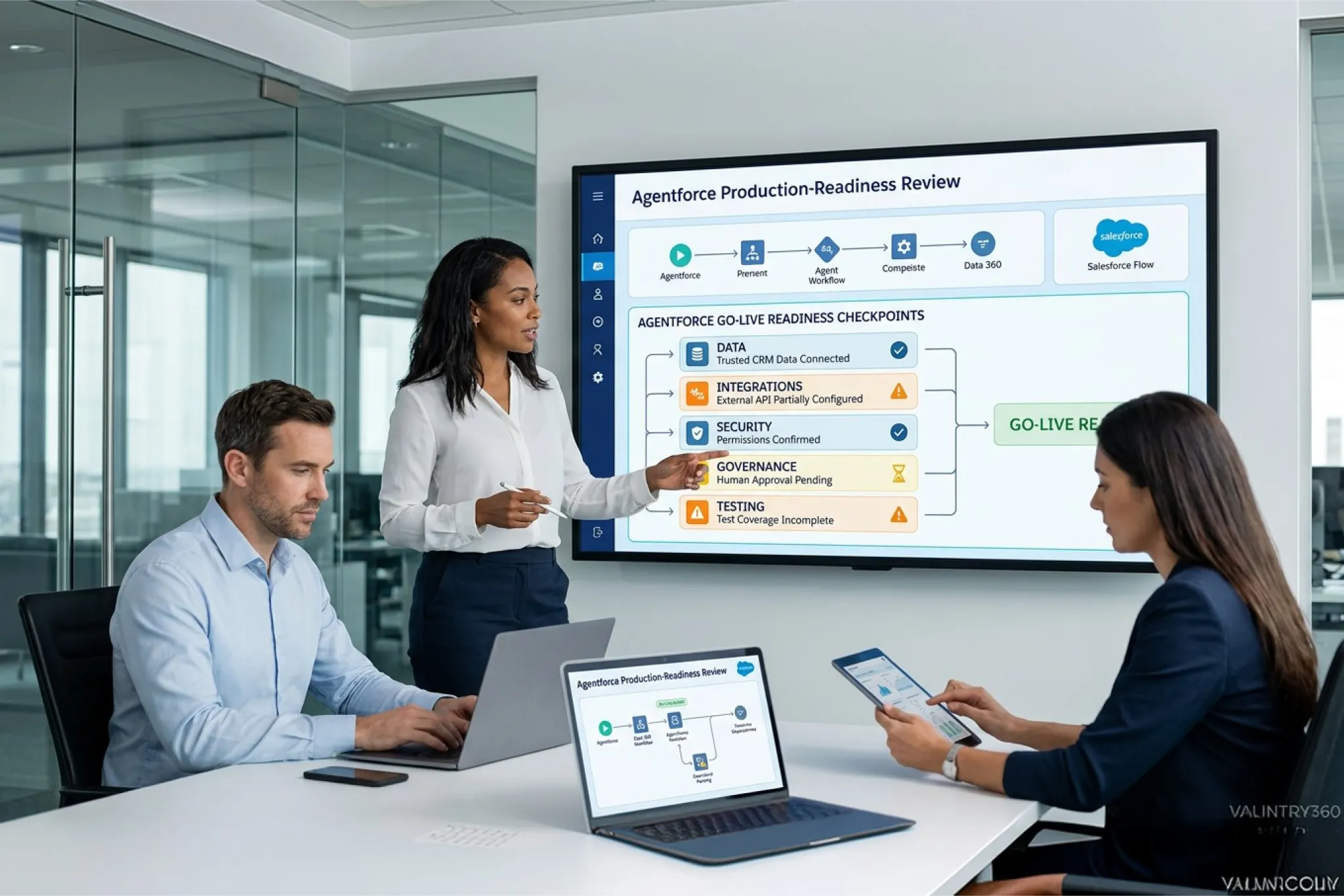
For most organizations, yes. Salesforce reports that its partner ecosystem leads roughly 70% of Agentforce implementations, and the company has spent the past eighteen months building its own thousand-person team of forward-deployed engineers specifically because customers were signing up for Agentforce and then failing to deploy it.
That’s the single most persuasive piece of evidence on this question, and it comes from Salesforce rather than from any Agentforce implementation partner. If the platform vendor concluded that customers need embedded engineers sitting alongside them to get agents live, the tooling being easier in 2026 doesn’t settle the argument the way the marketing suggests.
There is an honest exception, and this guide covers it properly rather than pretending it doesn’t exist. But the exception is narrower than most teams assume, and the cost of misjudging it lands on your production org rather than on a slide.
What, Why and How: Understanding Agentforce Consulting Partners
Most people picture an Agentforce consulting partner as someone who configures Agent Builder for you. That part got genuinely easy this year. The work that actually decides whether your agent survives production sits either side of the build, and that’s worth understanding before you hire anyone.
What an Agentforce Consulting Partner Actually Does
The job is not configuring Agent Builder. That part got genuinely easier this year, and any Agentforce consultant whose value rests on clicking through a builder is selling you something you no longer need.
What an Agentforce implementation partner actually handles is the work either side of the build. Assessing whether a use case is viable at all. Auditing data quality and structure before anything is grounded on it. Designing subagent boundaries that don’t overlap and misroute. Writing action descriptions the reasoning engine can match on. Placing deterministic gates around anything with financial, legal or compliance weight. Reviewing the permission model an agent will run under. Designing handoff and escalation paths. Testing against the messy inputs real users produce. And defining who owns the agent once it’s live. Roughly one line of that list involves building an agent. The rest is architecture, data and judgment.
Why the Question Comes Up in 2026 Specifically
Four things genuinely changed, and they’re worth acknowledging rather than dismissing.
Setup with Agentforce reached general availability on 26 May 2026, giving admins an in-setup assistant for user access troubleshooting, permission review, custom object and field creation, report types, formulas and identity configuration, per Salesforce’s documentation. Setup actions are non-billable, so admins can experiment freely.
Agentforce Builder made agent construction conversational. Standard actions covered more ground than expected, so a meaningful set of agents need no code at all. And Agent Script made behavior controllable through deterministic rules rather than prompt engineering intuition.
All four are real improvements. All four affected the build, which was never the bottleneck.
That deserves unpacking, because it’s the crux of the whole question. Agentforce Builder made agents easier to construct without making them easier to scope, and scoping is where misclassification comes from. Agent Script made behaviour controllable without telling you which behaviours need controlling, which is domain judgment rather than tooling. Standard actions removed the need for code without removing the need to describe those actions in language a reasoning engine can match on.
And none of it touched the data. Data remediation was the longest phase before these releases and remains the longest phase after them. The 2026 improvements moved the parts that were already the easiest.
This is why the partner question didn’t resolve itself the way the tooling headlines implied. If building agents had been the hard part, easier building would have settled it. The hard parts were always data readiness, architectural judgment and permission design, and none of those got a release note.
How to Decide, in One Paragraph
Judge four things: how clean and well-understood your org is, whether the agent writes data or only reads it, whether it faces customers or colleagues, and whether anyone has genuine capacity to own it after launch. Strong on all four, and you may not need an Agentforce consultant. Weak on any one and outside help usually costs less than the remediation would.
The Evidence: Why Salesforce Built a Thousand-Person Hand-Holding Team
This is the part of the argument most content on Agentforce consulting partners misses entirely, and it’s the strongest evidence available.
Forward Deployed Engineers, Explained
Salesforce launched its Forward Deployed Engineering team in April 2025 and committed to building it to a thousand people. The role originated at Palantir, and Salesforce describes an FDE in its own blog on the role as part personal tech guru, part business consultant, and part hand-holder, adding that they can make or break an AI agent launch.
Read that job description again with the do-it-yourself question in mind. The vendor that built the platform, which has every commercial reason to describe it as easy, staffed a thousand engineers to sit inside customer organizations because the platform alone wasn’t producing deployments.
The Failure They Exist to Prevent
Salesforce has been unusually candid about this. FDE director Sarah Khalid has described the risk the role exists to prevent as thousands of customers stuck in pilot purgatory: signed up but never successfully deployed.
That phrase is worth sitting with. More than 29,000 Agentforce deals had closed as of recent reporting, but not all of those represent production deployments. Many are exploratory pilots, and with over 150,000 Salesforce customers worldwide, there’s considerable room between signing and shipping. Industry reporting on the FDE programme makes the same point: the challenge is moving customers dipping a toe into agentic AI toward full deployment. Salesforce cites IDC FutureScape research predicting that more than a third of organizations will remain stuck in the experimental, point-solution phase of AI. Gartner separately predicts that over 40% of agentic AI projects will be cancelled by the end of 2027, citing escalating costs, unclear business value and inadequate risk controls.
A Real Example Salesforce Published
The detail in Salesforce’s own account is instructive. A reservation booking platform launched its first Agentforce agent and hit problems. The agent struggled to answer because something was wrong with the Agentforce data library, and knowledge article updates weren’t syncing with Data 360. Note what that failure was and wasn’t. It wasn’t a badly built agent. It was a data plumbing problem between two systems, exactly the class of issue that a builder-focused approach never surfaces and that only appears once real traffic hits. Salesforce sent a team of FDEs, who escalated to the product team and got it back on track.
Most organizations don’t get a team of Salesforce engineers dispatched to them. That’s what an Agentforce consulting partner is for.
Salesforce Then Extended It to Partners
The strongest confirmation came in 2026, when Salesforce launched the Forward Deployed Engineering Partner Network, embedding Salesforce-trained engineers directly into partner delivery teams. Launch members included Accenture and Deloitte, alongside Capgemini, Cognizant, IBM Consulting, KPMG, PwC, Slalom and Tata Consultancy Services, plus regional specialists and more than twenty additional firms.
Salesforce states that member firms have driven one-third of all successful Agentforce implementations to date and describes the network as prioritizing technical rigor and production outcomes over firm size or tenure.
The strategic read is straightforward. Salesforce couldn’t scale hand-holding through its own headcount, so it extended the model through partners. That is a vendor telling you, through its actions rather than its marketing, that Agentforce deployments need embedded expertise.
What This Means for Your Decision
Three conclusions follow, and they’re more useful than the headline.
First, the gap between buying Agentforce and running it in production is real, documented and acknowledged by the vendor. Anyone telling you the platform is now self-service is contradicting Salesforce’s own hiring and partner strategy.
Second, the failures the FDE program exists to fix are integration and data failures rather than build failures. The published booking platform example was a data library and sync problem, not a badly constructed agent. That tells you where to focus your evaluation of any Agentforce consultant: ask about their data and integration work, not their builder skills.
Third, and most usefully, this gives you a benchmark for what good looks like. An embedded engineer working alongside your team for a defined period, with a direct escalation line into Salesforce, is the standard the vendor itself set. When you assess an Agentforce implementation partner, that’s the shape of engagement worth comparing against.
The Failure Modes: Eight Ways Agentforce Projects Go Wrong Without Expert Help
Understanding what actually breaks is more useful than a list of partner benefits, so here’s what goes wrong and why it’s hard to catch internally the first time.
1. Subagent Misclassification Sends Requests to the Wrong Toolset
The reasoning engine decides which subagent a request belongs to before doing anything else, and that decision determines which actions are even available. Pick wrong and the agent works from the wrong instructions with the wrong tools, and no amount of good reasoning afterwards rescues it.
The cause is almost always overlapping subagent definitions with fuzzy boundaries. It’s invisible in testing because your test cases were written by people who know how the subagents are scoped.
2. Actions Sit Unused Because Descriptions Were Written for Humans
Atlas selects actions by reading their descriptions. Something labelled “Account helper” gives it nothing to match against, so the action never fires and the agent improvises around it.
The symptom is confusing: an agent that appears to ignore a capability you know exists. Teams usually rebuild the action when the fix is rewriting one sentence.
3. Prompt Instructions Get Treated as Guarantees
Writing an instruction telling the model to always verify identity before a change is a suggestion, not a rule. It may hold across a hundred tests and fail on the hundred and first when a conversation goes somewhere unusual.
This is the most consequential failure on the list because it typically surfaces only after something has already gone wrong in production.
4. The Sandbox Passes and Production Fails
A well-documented pattern involving Agent User permission errors. The agent runs perfectly in a sandbox where permissions are looser, then fails at runtime against production’s actual access model.
Some Data Library retrievers even show as ready to use and pass in the Retriever Playground before failing live. Sandbox parity on permissions, not just data, is the fix.
5. Data Quality Turns Into Confident Wrong Answers
An agent grounded in inconsistent records doesn’t fail loudly. It answers confidently and incorrectly, and people act on the answer. Three versions of a returns policy means the agent cites whichever one it retrieves.
This is worse than no agent, because a broken agent gets switched off while a confidently wrong one keeps running.
6. Reasoning Loops Quietly Multiply Run Cost
A poorly scoped agent that calls five actions to answer a one-action question pays that penalty on every conversation, permanently. On consumption pricing the effect compounds silently until someone reviews the bill.
7. Handoff Creates a Dead End
Handoff is a designed outcome, not a failure state. Configured badly, particularly around business hours and escalation availability, it drops customers into nothing at all.
That’s a worse experience than never deploying an agent, and it’s one of the most common launch problems we encounter.
8. Nobody Owns It After Launch
Agents degrade as data, products and phrasing change. Without a named owner with real time allocated, containment rates slide for months before anyone notices.
Every one of these eight is preventable at design time and expensive to diagnose afterwards. That asymmetry is the honest commercial case for expert involvement, and it’s why Salesforce staffed its own team rather than publishing better documentation.
The Guide: Seven Things a Good Agentforce Implementation Partner Handles
If you’re evaluating Agentforce consultants, this is the scope of work that separates real capability from a rebranded configuration service.
1. Use Case Selection Based on Volume, Not Appeal
The agent that demos well to leadership is rarely the one that matters. A good partner pulls your actual case and conversation volume and points you at the high-frequency work already consuming human hours, even when it’s less impressive in a steering committee.
2. Data Readiness Assessment Before Anything Is Built
Data remediation is typically the longest phase of an Agentforce project and the most variable cost. It’s also the line most often discovered after signature rather than before.
A partner worth engaging assesses this first and tells you honestly if the answer is that you’re not ready. That conversation costs them revenue in the short term and saves you a failed deployment. What the assessment should actually cover: duplicate records that would confuse identity resolution, knowledge content with contradictory versions, fields assumed to be populated that aren’t, and whether unstructured content needs indexing before an agent can retrieve from it.
3. Subagent Architecture That Doesn’t Misroute
Salesforce’s own guidance names choosing the wrong topic and choosing the wrong action as the two most common production failures. Both trace back to how the subagents were scoped, which is design work rather than build work.
The test a good Agentforce consultant applies: read the subagent descriptions to someone who doesn’t know the build. If they hesitate about which one a request belongs to, the classifier will too. Salesforce also recommends no more than 15 actions per topic, which constrains how you group work. We’ve covered the mechanics in our guide to how Agentforce works if you want to understand what your partner should be doing here.
4. Placing the Deterministic Boundary
Salesforce’s architect guidance calls the boundary between deterministic execution and model reasoning the most consequential decision in a production build. Anything with financial, legal or compliance weight belongs in code the model cannot override. A prompt instruction telling an agent to always verify identity is a suggestion, and the failure mode only surfaces after something has already gone wrong.
5. Permission Model and Sandbox Parity Review
A recurring and genuinely confusing failure: an agent works perfectly in a sandbox and then fails at runtime with permission errors, because the sandbox granted access production doesn’t. Testing needs to mirror production permissions, not just production data. This one catches experienced internal teams regularly.
6. Integration Architecture Beyond Salesforce
The moment an agent needs an ERP, a billing platform or a legacy database, you’re doing integration work. MCP made connection easier without making architecture easier, and this is where self-build projects most often stall. It’s the territory Agentforce integration services exist for.
The questions that matter: what happens when the external system is slow or down, how are credentials governed, does the agent get read access or write access, and who owns the connection when something changes upstream.
7. Post-Launch Ownership and Tuning
Agents degrade quietly as data, products and phrasing change. Ongoing admin capacity is a permanent operating cost, and an agent nobody owns slides for months before anyone notices the containment rate dropping.
Ask any prospective partner whether post-launch support is scoped or assumed. The answer is revealing, and a vague one usually means it’s assumed to be your problem.
Good handover includes documented subagent boundaries, the reasoning behind each deterministic gate, the test suite, the escalation configuration, and a named owner on your side who was involved throughout rather than briefed at the end.
Two Worked Scenarios: Where the Line Actually Falls
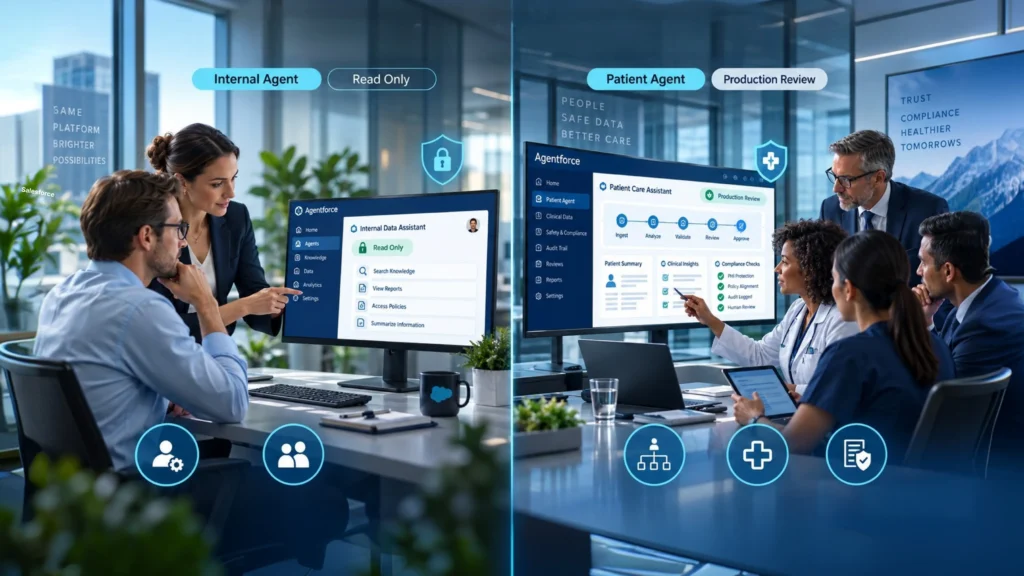
Abstract criteria only go so far. Here are two organizations at opposite ends, with the reasoning laid out.
Scenario One: No Partner Needed
A 200-person B2B software company. Salesforce was implemented four years ago, lightly customised since, with an admin who has been there three years and knows the org well. They want an internal agent that summarises account history and pulls aggregate pipeline figures for their sales team.
Every criterion points the same way. Internal, so a poor answer inconveniences a colleague. Read-only, so nothing can be written incorrectly. Standard actions only, so no code. Data is reasonably clean because the org is young and the implementation was deliberate. And the admin has genuine capacity because leadership treated this as a priority rather than an addition.
They should build it themselves. A partner would deliver faster, but the speed gain doesn’t justify the cost, and the learning has real value for whatever they build second.
Scenario Two: Partner Strongly Advised
A regional healthcare provider. Salesforce running eleven years, three partners over that time, Health Cloud plus a custom scheduling integration and Flows nobody has fully mapped. They want a patient-facing agent that answers appointment questions and reschedules bookings.
Every risk factor is present simultaneously. Patient-facing rather than internal. It writes data, since rescheduling changes records. It touches identity verification and regulated health information. It depends on an integration whose behaviour isn’t documented. And the data model carries eleven years of decisions nobody can fully explain.
Building this in-house isn’t impossible, but the failure modes are severe and diagnosis costs are high. An architecture and permission review alone would likely pay for itself before an agent gets built, because it surfaces problems that would otherwise appear in production with patients involved.
What Separates Them Isn’t Size
Notice that the company size barely features. The healthcare provider isn’t harder because it’s larger. It’s harder because of accumulated complexity, regulatory exposure and a write-heavy customer-facing use case.
A large organization with a clean recent implementation and a low-risk internal use case sits closer to scenario one. Judge the specific agent and the specific org, not the headcount. Size is the shortcut most vendors use and it’s a poor predictor.
The Comparison: Four Ways to Resource an Agentforce Build
The choice is usually framed as “hire a partner” or “don’t,” which is a false binary. Four models sit on the spectrum.
Model | What it looks like | Best suited to |
Full self-build | Your admin scopes, builds, tests and owns everything | Internal read-only agent, clean org, admin with real capacity |
Advisory engagement | Partner reviews architecture, data readiness and risk; your team builds | You have capacity but not agent-specific experience |
Co-delivery | Partner leads the first agent with your team embedded throughout | You want capability transfer alongside delivery |
Partner-led with handover | Partner builds, then trains your team to own it | Speed matters and internal capacity is limited |
Co-delivery is the model we recommend most often, and it’s worth being clear that it generates less recurring revenue than a fully managed arrangement. Your team ends up able to build the second agent alone, which is what most organizations actually want. Delivery that leaves you dependent isn’t a good outcome, however comfortable it is commercially. If you’re weighing specific firms rather than models, our comparison of the top Agentforce consulting partners scores 20 firms on production deployments, Agentforce competencies, Forward Deployed Engineering status, Data 360 work and post-launch ownership.
The Main Highlights of Dreamforce 2026
If you only have a minute, these are the ten moments that defined this year’s Salesforce Dreamforce:
- Benioff declared “AI replaces the UI” and launched AIforce as a live interface layer above Data 360, Customer 360, and Agentforce.
- Claudeforce entered open beta, with the Sales Cloud in Claude skill available at no additional cost.
- Slackforce introduced Slack Surfaces, turning Slackbot into a generator of live Salesforce interfaces.
- Koa became Salesforce’s first CRM reasoning model, built with NVIDIA and trained on synthetic data only.
- Seven named, job-ready agents shifted Agentforce from “build it yourself” to “turn it on.”
- The Enterprise AI Harness explained how Informatica, Data 360, Tableau, Salesforce Guardian, MuleSoft, and Agentforce Studio fit together.
- Google Cloud and AWS partnerships arrived on the same day, both built on MCP.
- Siemens showed Agentforce answering engineering questions inside sales and service workflows.
- Huang, Amodei, and Altman gave the Dreamforce conference a genuine AI policy debate.
- Usher and Gwen Stefani headlined Dreamfest at Oracle Park in support of UCSF Benioff Children’s Hospitals.
The Honest Exception: When You Don't Need an Agentforce Partner
We’re an Agentforce implementation partner, so treat this section as the one we had the least commercial reason to write. It’s here because a recommendation you can’t trust isn’t worth reading.
You can reasonably build without help when all of the following hold at once:
- The agent is internal, so a poor answer inconveniences a colleague rather than a customer
- It only reads data, so nothing can be written incorrectly and propagated by downstream automation
- It uses standard actions only, meaning Query Records, Summarize Record, Get Record Details or similar, with no Apex or Flow
- Your data is genuinely clean, not assumed to be clean
- Your org is well understood, with no significant undocumented automation
- An admin has real capacity, not theoretical availability around an existing full workload
That combination is a genuinely good first build, and doing it yourself teaches your team more than watching someone else would. Our catalog of 40 Agentforce tasks flags which ones fit this profile.
One more case where you should decline help outright: if anyone quotes you for migrating between Agentforce versions or onto Agentforce 360, there is nothing to migrate. We explain why in our guide to Agentforce 360 versus Agentforce 3.
The Middle Case Most Teams Actually Sit In
In practice, few organisations fall cleanly into either camp. The common position is strong on some criteria and weak on one or two, usually data quality or admin capacity.
That’s the case for an advisory engagement rather than a full build. A partner reviews architecture, data readiness and the permission model, flags the specific risks, and your team builds. You keep ownership and pay for judgment rather than hours. It’s also the least-sold engagement model in the market, for obvious reasons. It’s worth asking for explicitly, because a firm that only offers full delivery will quote you full delivery.
The Checklist: 12 Questions to Ask Any Agentforce Consultant
Since the partner you choose shapes the outcome more than the platform does, these are the questions that separate genuine capability from a polished deck.
On Their Approach
- What would you tell us not to build? A consultant with no answer hasn’t thought about your business.
- How do you test for topic misclassification before go-live rather than after customers notice?
- Where would you place the deterministic boundary for our specific use case, and why?
- How do you handle the sandbox-to-production permission gap? If the question doesn’t land, they haven’t hit it yet.
On Evidence
- How many agents have you taken to production, not pilot?
- Can you show delivery evidence on the underlying work, not just agent demos?
- Do you hold current Agentforce competencies, and are you in the Forward Deployed Engineering Partner Network?
- Which industries have you deployed in that resemble ours?
On What Happens After
- Who tunes the agent after launch, and is that scoped or assumed?
- Will our team be able to build the next agent without you?
- How do you model consumption cost, and what happens if it exceeds the estimate?
- What does your handover documentation actually contain?
The second-to-last question in that list is the one we’d most want a prospective client to ask us, and it’s the one asked least often.
How to Read the Answers
Specificity is the signal. A consultant who answers the deterministic boundary question with a general principle hasn’t thought about your use case. One who asks what your refund thresholds are before answering has.
Watch for the reverse too. Any Agentforce consultant who answers every question with yes, and never pushes back on a use case you describe, is selling capacity rather than judgment. The best answer to some of your ideas is that they’re not worth building yet.
And weight production over pilots throughout. Pilot counts are easy to accumulate and tell you little. A firm that has taken six agents to production and kept them healthy for a year knows things a firm with thirty pilots doesn’t.
The Costings: What Agentforce Consulting Actually Costs in 2026
Published 2026 benchmarks put Agentforce implementation projects between roughly $40,000 and $900,000, with services typically running two to five times first-year platform spend. Sit with that multiple. A business case built on license cost alone is wrong by a factor of two to five, and that holds whether you engage a partner or not, because the work still has to happen.
Day Rates by Delivery Model
Delivery model | Indicative 2026 day rate | What you typically get |
Offshore | $400 to $800 | Execution capacity, needs tight specs and strong internal direction |
Nearshore | $700 to $1,300 | Overlapping hours with better context retention |
Onshore boutique | $1,200 to $2,200 | Senior people close to the work, usually the whole team on your project |
Large SI or Salesforce Professional Services | $2,000 to $3,500 | Scale, formal methodology, deep bench for complex programmes |
A point that cuts against our own interest: rate matters considerably less than scope discipline. A well-scoped project at a higher rate routinely costs less in total than a poorly scoped one at half the rate, because rework is the expensive part.
Timeline Expectations
For a first production agent in a mature org, sixteen to thirty weeks is a realistic benchmark, with data remediation as the longest phase rather than the build. Anyone promising a first enterprise agent in two weeks is describing a pilot, not a deployment.
The Line Nobody Budgets
Ongoing admin capacity is a permanent operating expense. Budget it explicitly or it comes out of your existing team’s slack, which in most organisations is already zero.
A Cost You Might Avoid
Data 360 is only strictly required for unstructured grounding or cross-system identity resolution. Plenty of internal use cases don’t need it, which removes a large cost line. A good Agentforce consulting partner tells you that before quoting you for a data platform you may not need yet. Full pricing detail sits in our guide to Agentforce 360 and its editions.
The Consumption Dimension
On credit-based pricing, reasoning loops cost money on every conversation, permanently. Salesforce’s Q2 FY27 results reported 3.2 billion Agentic Work Units in a single quarter, growing 97% quarter over quarter. At that trajectory, a poorly scoped agent’s inefficiency stops being a rounding error. Scoping quality has a direct line to run cost.
How a Certified Salesforce Partner Works as Your Intermediary
This is the part of the partner relationship least understood by buyers, and it’s where a certified Agentforce consulting partner earns its place beyond delivery hours.
We Sit Between You and Salesforce
VALiNTRY360 is a certified Salesforce partner and a Salesforce-branded services partner for Agentforce commercial deployments. Practically, that means we operate on your side of the table during conversations that would otherwise be a vendor selling directly to you.
When a quote arrives, we can read it the way it was constructed rather than the way it was presented. Which line is the edition-level capability you already hold? Which is a separately billed dependency that hasn’t been made obvious. Where the consumption assumptions are optimistic. Whether the edition being proposed matches your projected usage or your best-case usage.
We See the Roadmap Before It Reaches You
Partner status means visibility into what’s coming through the release pipeline rather than only what has shipped. That changed our advice on agent scoping months before most teams had heard of Agent Script, and it means you don’t build something in one quarter that the next quarter makes redundant.
We Have a Direct Line When Something Breaks
The FDE example earlier is the template. When a data library issue or a sync failure between systems stops an agent from working, the difference between a two-day resolution and a two-month one is usually an escalation path rather than technical skill.
Partner relationships carry escalation routes into Salesforce product and support that individual customers don’t have. That’s not a small advantage when an agent is live in front of customers.
What This Looks Like on an Actual Quote
A concrete example makes the intermediary role clearer than the description does.
A quote arrives with an Agentforce line, a Data 360 line, and an implementation estimate. Read cold; it looks like three costs to approve or negotiate. Read with partner context; several questions surface immediately.
Does this use case actually need Data 360, or is it internal and structured enough to run without it? Is the edition proposed matched to projected usage or best-case usage? Are the consumption assumptions based on a scoped agent or an unscoped one? Does the implementation estimate include data remediation, or is that a change order waiting to happen? And is anything on this quote capability you already hold under an existing edition?
Those questions routinely change the shape of a deal and occasionally remove a line entirely. That’s the practical value of an intermediary who reads quotes for a living rather than approving one every few years.
We Advocate on Standards, Not on Discounts
Worth being precise here, because this is where partner marketing usually overreaches. The value of an intermediary is not that we get you a cheaper number. It’s that we make sure what you’re buying matches what you actually need, at the quality standard the deployment requires.
That means arguing for the right edition rather than the biggest one, the right sequencing rather than the fastest, and the right scope rather than the broadest. Sometimes that increases what you spend, because underspending on a data foundation is how deployments fail. An Agentforce deployment that works costs more than one that doesn’t, right up until the one that doesn’t gets switched off and the whole investment is written off.
We Tell You What Not to Do
The most useful thing a partner offers is often a recommendation against something. Don’t build on a data model you know is inconsistent. Don’t automate a process nobody has documented. Don’t scope twelve use cases when three would prove the case. Don’t pay anyone to migrate you between Agentforce versions.
The Evidence to Ask For: What Delivery Proof Should Look Like
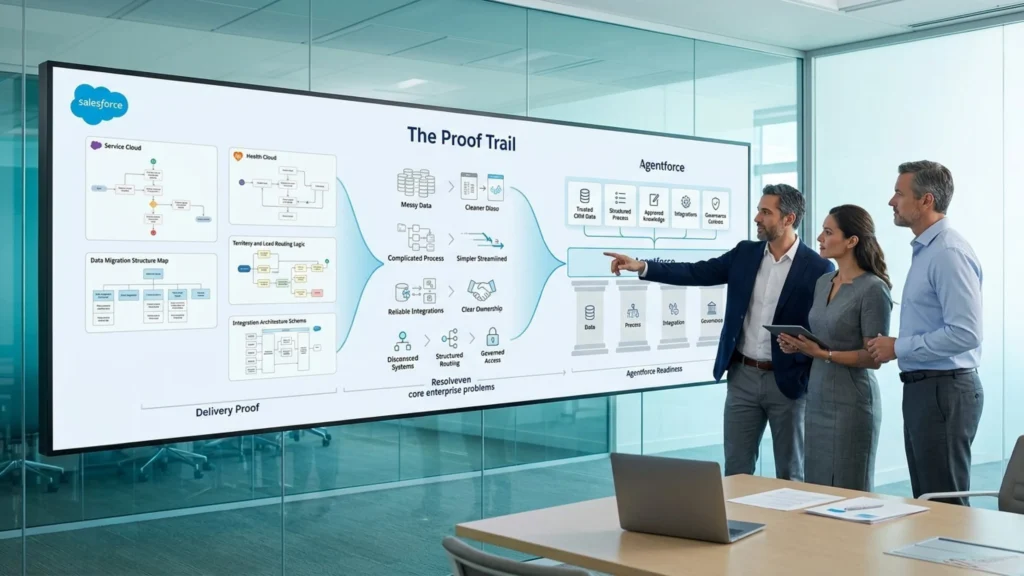
Agent demos are easy to produce and tell you very little. The work that determines whether an Agentforce project succeeds happened before anyone built an agent.
Our Salesforce case studies cover exactly that layer: Sales Cloud and Service Cloud implementations, Health Cloud rollouts, data migrations, territory management and marketing automation across healthcare, financial services, education and B2B.
Three worth reading through an agent-readiness lens. The Service Cloud work where average handle time dropped by minutes rather than seconds, because the data a rep needed was structured properly first, which is the same structuring an agent reasons over. The Health Cloud implementation where scheduling and coding accuracy improved together, is exactly the kind of clean, well-defined process an agent automates reliably. And the territory management and lead routing builds, which are the foundation any sales agent works from.
None were sold as Agentforce projects. All of them are the work that makes an Agentforce project viable. There’s a broader point here that cuts against how most Agentforce consultants currently market themselves. Agentforce is young enough that essentially nobody has a decade of experience with it, so anyone claiming deep Agentforce heritage is claiming something that didn’t exist to have heritage in. What separates partners in practice is whether they understand the Salesforce estate an agent has to operate inside, and that record does go back years.
When you review any firm’s case studies, including ours, look past the technology names. Was the data model cleaned up or worked around? Did a metric improve because a process got simpler or because someone worked harder? Were integrations built to be extended or built to be finished? Those answers predict agent success far better than a badge does.
If you want to see how we structure the work itself, our Agentforce consulting and implementation page sets out the delivery model, and our write-up on Agentforce consulting for measurable ROI covers how we tie agent work to business outcomes rather than feature counts.
If you’d like a straight read on whether your org is ready, and whether you need us at all, talk to our team.
Key Takeaways
Salesforce reports its partner ecosystem leads roughly 70% of Agentforce implementations, and built a thousand-person forward deployed engineering team because customers were getting stuck between signing and shipping.
- Salesforce extended that model through the FDE Partner Network in 2026, whose member firms have driven a third of successful Agentforce implementations.
- The 2026 tooling improvements made agents easier to build. Building was never the bottleneck; data, scoping and permissions were.
- Services typically run two to five times first-year platform spend, so a licence-only business case is wrong by that multiple.
- Data remediation is usually the longest phase and the most variable cost, whoever does the work.
- You genuinely don’t need a partner for an internal, read-only agent on clean data in a well-understood org.
- Scope discipline matters more than day rate, because rework is where budgets actually go.
- Ask any prospective partner whether your team will be able to build the next agent alone.
The useful version of this question isn’t whether Agentforce consulting partners still matter. Salesforce answered that by hiring a thousand of its own. It’s whether your data, your org and your team are ready for the specific agent you have in mind and how much of that gap you want to close yourself.
FAQs
Is VALiNTRY360 a certified Salesforce partner?
Yes. VALiNTRY360 is a certified Salesforce partner and a Salesforce-Branded Services Partner for Agentforce commercial deployments, which is a designation only select consulting firms hold for this product area.
What is the difference between an Agentforce consultant and a Salesforce admin?
An admin configures and maintains your org day to day. An Agentforce consultant brings deployment-specific judgment: subagent architecture, deterministic gate placement, grounding design and production testing patterns across multiple builds.
Can a partner help if we already started building and it isn’t working?
Yes, and this is common. A targeted remediation engagement usually costs less than a full build, since the discovery work is partly done and the failure symptoms narrow where to look.
Do Agentforce partners work with existing Salesforce implementations?
Almost always. More than half of Agentforce bookings come from existing Salesforce customers, so partners are usually adding agents to years of accumulated fields, Flows, integrations and admin decisions.
What is the Forward Deployed Engineering Partner Network?
A Salesforce programme embedding Salesforce-trained engineers into partner delivery teams. Members receive direct lines to Salesforce product teams, and Salesforce says they have driven a third of successful Agentforce implementations.
How many Agentforce agents should we start with?
One, scoped narrowly. Expanding to a second only after the first is genuinely stable produces better outcomes than launching several together, because you can attribute problems to a specific change.
Does a partner take over our Salesforce org?
No. A good engagement leaves ownership with you. Ask directly whether your team will be able to build the next agent alone, and treat a vague answer as a warning.
What industries does Agentforce consulting typically cover?
All of them, though risk profiles differ sharply. Healthcare, financial services and other regulated sectors need deterministic gates and audit trails designed upfront rather than retrofitted after deployment.
Should we choose a partner based on AppExchange ratings?
Only partly. Ratings reflect past Salesforce work broadly, not Agentforce production experience specifically. Ask how many agents they have taken to production rather than pilot.
Can we hire a partner for advisory only, without a build?
Yes, and it is the least-sold model in the market. A firm offering only full delivery will quote full delivery, so request advisory explicitly if that is what you need.
What happens to our agent when Salesforce ships a new release?
Capability arrives through the seasonal release cycle automatically. A partner with roadmap visibility can flag whether an upcoming release changes something you built, before it lands.
Is offshore Agentforce consulting a false economy?
Not inherently. Offshore delivery works well with tight specifications and strong internal direction. Scope discipline affects total cost far more than day rate does, because rework is the expensive part.
How do we measure whether a partner delivered value?
Containment or deflection rate, resolution accuracy, handoff rate, and consumption per conversation. Agree the baseline before work starts, otherwise the comparison after launch is guesswork.
Do partners handle Data 360 setup as well as Agentforce?
Capable ones do, because grounding quality determines agent quality. A partner who treats Data 360 as somebody else’s problem is scoping around the hardest part of the project.
What should be in a partner handover document?
Documented subagent boundaries, the reasoning behind each deterministic gate, the test suite, escalation configuration, and a named owner on your side who was involved throughout rather than briefed at the end.
Related Posts
- Salesforce Partner
Salesforce Partner Transition Checklist
A Salesforce partner change touches more than a vendor name on an invoice. Production access, integrations, source code, sandboxes, deployment tooling, vendor accounts, documentation, and ongoing support all move at the same time, and each one can break quietly if…
- Salesforce Partner
Best Salesforce Service Cloud Consulting Partners 2026
Most companies searching for a Salesforce Service Cloud consulting partner aren't choosing between an obviously good firm and an obviously bad one. They're staring at 10 websites that all say roughly the same thing: certified, experienced, customer-obsessed.This guide skips the…
- Salesforce Partner
Salesforce Partner Transition Checklist
A Salesforce partner change touches more than a vendor name on an invoice. Production access, integrations, source code, sandboxes, deployment tooling, vendor accounts, documentation, and ongoing support all move at the same time, and each one can break quietly if…