

- Salesforce Consulting Services
Salesforce’s own marketing makes the pitch aggressively simple: Agentforce is already built into the platform, can reuse existing Salesforce workflows and APIs, and gives admins a conversational builder for creating agents. No complex data integration, no custom automation build.
At the same time, Salesforce’s own 2026 Connectivity Benchmark found that 96% of organizations still face barriers to using data for AI, and 41% of IT leaders cite a lack of internal AI and agent-design expertise as a top challenge. Those two facts come from the same company, describing the same product, in the same year.
That’s the paradox this article sits inside. Salesforce is telling you the building part got easy while its own research shows the trust part didn’t. And it’s leaning harder into its consulting ecosystem than it has in years, restructuring the entire partner program in March 2026 to sort out who’s actually qualified to help with this. If Agentforce were as self-sufficient as the pitch suggests, that restructuring wouldn’t be necessary.
So, do you still need a human partner in 2026? The answer now depends on the work you’re asking the agent to do, the systems and data it can reach, and the consequences when something’s wrong. Those factors have changed what a Salesforce consulting partner is actually being hired for.
TL;DR
Some Agentforce projects can reasonably stay in-house. Others still justify specialist help. The dividing line comes from the work itself, especially the agent’s autonomy, reach, consequence, and the expertise already available internally. If you’re building one well-scoped agent, on clean data, doing read-only or low-stakes actions, inside a Salesforce org an existing admin already understands, you can very reasonably do this yourself with Salesforce’s low-code Agentforce Builder. If you’re touching multiple systems, giving an agent write access or customer-facing autonomy, working with regulated or duplicated data, or orchestrating several agents together, the work that decides whether that goes well isn’t configuration anymore. It’s judgment, and judgment is exactly what didn’t get automated. The interface got easier. The decisions behind it didn’t, and that’s where a human partner earns its cost.
Agentforce Has Changed What "Salesforce Consulting" Means
For most of Salesforce’s history, hiring a consultant meant hiring someone who knew where the buttons were. Object models, page layouts, flow logic, validation rules, the accumulated tribal knowledge of a platform that rewards people who’ve configured it a hundred times before. That was the job. A good consultant saved you from the six ways a new admin could misconfigure a sharing rule, and the value was almost entirely procedural.
Agentforce has genuinely reduced that procedural work. As of the week of July 13, 2026, Salesforce moved new agent creation out of the legacy Setup-based builder entirely, into a new app called Agentforce Studio, accessed from the App Launcher, built around a low-code builder that now supports Agent Script for teams that want deterministic control. You still don’t need Apex or a developer to get a basic agent running: confirm the org has the right licensing and agent-building access, open Agentforce Studio, pick a template, name your agent, and start defining what it should handle.
That’s a real shift, not marketing spin layered over a still-complicated product. The procedural, where’s-the-button work has genuinely gotten easier, and for a real slice of Agentforce projects, that was most of what a consultant used to be hired for.
What’s left isn’t a smaller job. It’s judgment work: deciding on business process, data trust, permissions, risk, and accountability, none of which shows up as a checkbox in the builder.
What Agentforce Can Now Handle Without Much Consulting
Give the technology its due, because a fair comparison starts here. A real, growing list of Agentforce work is now genuinely self-service for a competent Salesforce admin, not “technically possible with heroic effort,” but built to be done without outside help.
Agentforce Builder itself is the clearest example. Creating a subagent, what Salesforce called a Topic until an April 2026 rename, is a guided, natural-language process. You describe the scope of what it should handle, and Salesforce’s own tooling helps translate that into a working configuration. Connecting actions, what the subagent actually does once it’s triggered, works largely through existing Flows and prompt templates, which most established Salesforce orgs already have some experience building.
Templates do real work too. For a standard service agent handling inbound queries, case deflection, and escalation routing, Salesforce ships a starting template rather than a blank canvas. Testing has gotten a layer of assistance as well, with simulated preview sessions and trace files that let you inspect how an agent routed and acted before it ever reaches a real customer, catching some of the obvious misfires without needing a QA consultant to design test scripts from scratch.
And the timeline reflects it. Salesforce’s own planning guidance says a working prototype can come together in a day or even a week. That’s genuinely fast, and it’s not a consultant’s timeline. But Salesforce is just as clear that a working prototype and a production-ready agent are different things, with real gaps in provisioning, testing, deployment, and ongoing observability between them. That gap, between “it works in a demo” and “it’s ready for production,” is where the harder questions in this article begin.
Put plainly: if your project is one clearly scoped agent, built on data you already trust, doing something close to what the template was designed for, you are looking at genuinely low-consulting work. That’s the honest baseline, and any partner pitch that skips past it is selling more than the platform actually requires.
The Work That Doesn't Disappear When Building Gets Easier
Here’s the part that stays, and it stays whole, because none of it was ever really about the builder interface.
Use-case selection doesn’t get easier just because building got easier. Deciding which of your business’s actual problems is worth pointing an autonomous agent at, and which ones would just automate a broken process faster, is a judgment call about your operation, not about Salesforce configuration. Business process design sits right behind it. A subagent needs to be scoped to a real workflow, and if that workflow was never clearly defined in the first place, no amount of low-code tooling fixes that upstream.
Data is the one everyone repeats and almost nobody explains. Salesforce made Data 360, the product most people still know as Data Cloud before its late-2025 rename, a foundational requirement for Agentforce, not a nice-to-have. If your CRM carries duplicate accounts, conflicting values, or records nobody fully trusts, grounding an agent on that data doesn’t just create bad data sitting in a report. It creates confident answers and actions built on the wrong context, and the more autonomy the agent has, the harder that kind of problem is to catch before it reaches someone. It’s part of why 86% of IT leaders in Salesforce’s own 2026 research worry that agents introduce more complexity than value without the integration and data work to support them.
Integrations, access, and security follow the same pattern. Deciding which systems a subagent can reach, what it’s allowed to read versus write, and where the boundary of its authority sits are architecture decisions with real consequences if they’re wrong. Testing standards matter here differently than they do for a proof-of-concept. Simulated previews catch obvious problems; deciding what “good enough to go live” actually means for a customer-facing agent making autonomous decisions is a business risk call.
Then there’s the part almost nobody puts a number on: human handoff, adoption, and ROI. Deciding when an agent should stop and hand off to a person, getting your team to actually trust and use what got built, and being honest about whether the thing delivered value, none of that lives in the builder. It lives in the operating model around it.
All of it is judgment work, applied to your specific business, your specific data, and your specific risk tolerance, exactly the kind of work a low-code interface was never built to automate, no matter how good it gets.
The Autonomy, Reach, and Consequence Test
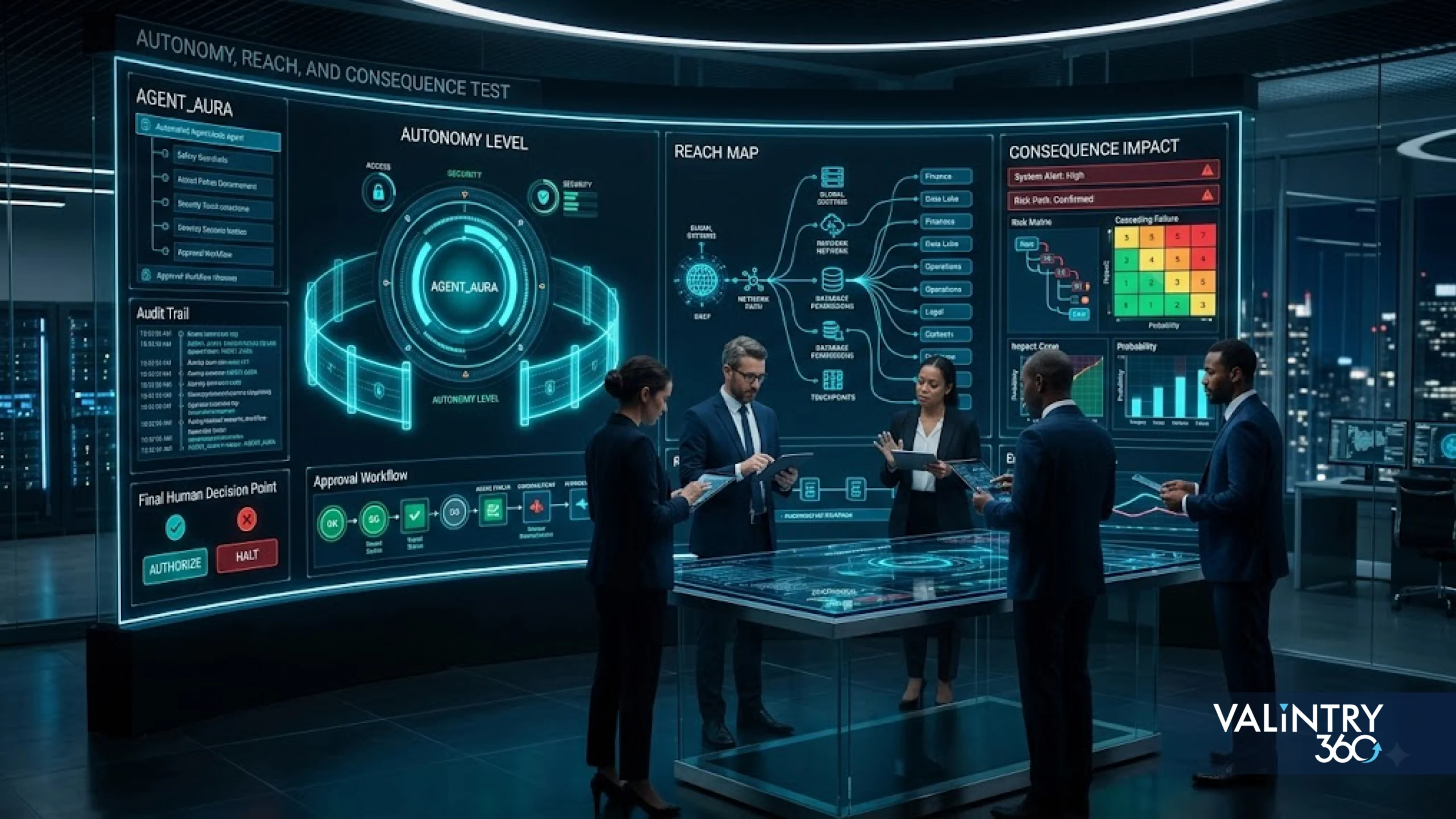
Here’s a simple way to sort any Agentforce project into “probably self-serve” or “probably needs a partner,” without relying on vague words like complexity.
Ask three questions about the specific agent you’re building.
Autonomy: how much does it decide on its own? An agent that retrieves information and drafts a suggestion for a human to approve is low autonomy. An agent that takes action, updates a record, sends a message, or triggers a workflow without a human in the loop is highly autonomous. The higher the autonomy, the more the judgment questions from the previous section matter, because there’s no human checkpoint left to catch a bad call.
Reach: How many systems and how much of your data does it touch? A subagent scoped to one object in one cloud, working from data you already trust, has narrow reach. An agent pulling from multiple clouds, external systems, or data you haven’t fully audited has wide reach, and wide reach multiplies the number of places something can go wrong silently.
Consequence: What happens when it’s wrong? A wrong answer in an internal, low-stakes context is an inconvenience. A wrong answer in a customer-facing conversation, a regulated industry, or anywhere it touches money, health information, or a legal commitment is a real event with real cost.
Score your project low across all three, low autonomy, narrow reach, and low consequence, and you’re squarely in self-serve territory. Score high on even one, especially consequence, and the judgment work from the last section stops being optional homework and starts being the actual project. This is the test worth running before you decide whether to build in Agentforce Studio yourself or bring in outside help, and it’s the test behind the table below.
What Agentforce Can Do vs What a Human Still Has to Decide
Part of the work | What Agentforce and Salesforce tooling can help with | What still needs human judgment |
Choosing the use case | Templates suggest common starting points (service agent, sales coach) | Deciding which business problem is actually worth automating, and which would just break faster |
Building the agent | Low-code Agentforce Builder in Agentforce Studio, natural-language subagent creation, guided setup | Scoping subagents so the agent’s classification logic matches how the business actually works |
Connecting actions | Flows, prompt templates, and standard APIs plug in through existing tools | Deciding what an agent should be allowed to do, and where write access crosses into real risk |
Data the agent relies on | Data 360 unifies and grounds the agent’s data sources | Judging whether that data is actually trustworthy enough to act on, not just technically connected |
Testing before launch | Simulated preview sessions and trace files catch obvious conversational misfires | Deciding what “ready for production” means for a specific, consequential use case |
Guardrails and control | Agent Script lets builders write deterministic rules and conditions that run the same way every time, instead of being reinterpreted by the model on every turn | Deciding where those deterministic rules are required, and where the agent can be left to reason on its own |
Going live | Deployment channels (Experience Cloud, embedded messaging) are configuration steps | Deciding the handoff rules: when the agent stops and a person takes over |
After launch | Salesforce reports on usage, resolution rates, and agent performance | Interpreting whether the numbers mean the agent is actually helping, and what to change if it isn’t |
Read down the right column and a pattern shows up fast. None of it is about knowing where a setting lives. All of it is about deciding something specific to your business that no template can decide for you. That’s the whole argument of this article in one table: Agentforce automated the left column. It left the right column exactly where it was, sitting on your desk.
When You Can Reasonably Implement Without an External Partner
Run the autonomy, reach, and consequence test on a real example. A 40-person SaaS company wants an internal agent that summarizes support tickets for the on-call engineer at the start of each shift. It reads from one object, in one cloud, using data the team already trusts because they’ve been working out of the same clean Salesforce org for two years. It doesn’t take action, doesn’t touch a customer, and doesn’t write anything back. If it gets a summary wrong, an engineer reads the ticket themselves and moves on.
Low autonomy. Narrow reach. Low consequence. That’s a genuinely reasonable project for an internal admin to build in Agentforce Studio, using the standard service template, over the course of a week or two. There’s real judgment involved, deciding what the summary should include, testing it against a range of real tickets, but it’s judgment an admin who already understands the support workflow is equipped to make. Hiring a partner here doesn’t buy you much you don’t already have, and it adds a cost and a timeline for work your team was capable of doing itself.
What you gain by self-serving this: speed, and ownership. The person who built it is the person who can adjust it next month without a change request.
What you pay for it: the risk that your admin doesn’t have bandwidth for edge cases, and a slower ramp if this is genuinely their first agent build.
What would change the answer: if that same agent started drafting replies sent to customers automatically, instead of just summarizing for a human to read. The consequence score jumps the moment a customer is on the receiving end, and the calculus changes even though nothing else about the project changed.
The pattern generalizes past this one example. A 15-person nonprofit building an agent to triage donor inquiries into categories for staff review is in the same territory, provided the agent only sorts and suggests rather than replying on its own. So is a 300-person manufacturing division building an internal agent that summarizes open service cases for a Monday operations meeting, as long as it reads from one clean object and never writes back to the record. Size of the company barely matters here. What matters is autonomy, reach, and consequence, the same three questions, run honestly against the specific agent in front of you.
When a Human Partner Starts Earning Its Cost
Change one variable in that same scenario and watch the answer flip. Same 40-person company, but now the agent needs to pull order status from a separate billing platform, check inventory in a third system, and respond directly to the customer without a human reviewing the message first. That’s multi-system, customer-facing, and high-autonomy now, three of the hardest conditions to get right on a first attempt, stacked on top of each other.
This is where the judgment questions from earlier in this article stop being background reading and become the actual project. Which system is the source of truth when the CRM and the billing platform disagree about an order’s status. What happens when the integration between them fails silently for a day. What the agent is allowed to promise a customer, and what it should never be allowed to say without a human checking first. Every one of those is a business risk question wearing a technical costume, and getting it wrong doesn’t show up as an error message. It shows up as a customer getting confidently wrong information, at scale, with your company’s name on it.
Now swap the industry instead of the system count. A regional healthcare provider with 25 locations wants an agent that can answer patient scheduling questions and, eventually, reschedule appointments directly. A healthcare scheduling agent like this may handle protected health information, and HIPAA doesn’t prohibit that outright, providers can use PHI for scheduling and reminders as part of treatment. What it does is change the requirements around how that information is accessed, used, disclosed, logged, and secured, and who’s allowed to see or act on it. Getting those requirements right, on top of getting the platform right, needs someone who understands both the Salesforce architecture and the regulatory exposure, and that pairing is rarely sitting inside a 25-location provider’s existing IT team.
A few conditions reliably tip a project into this territory, and they’re worth naming plainly rather than hiding behind the word “complexity.”
Cross-system work. Any agent that has to reconcile data across Salesforce and an ERP, a billing platform, or another system of record needs someone who’s actually done that reconciliation before, because the failure mode is invisible until it isn’t. Picture a 200-person distribution company whose Salesforce org handles the sales relationship while inventory and fulfillment status live in a separate ERP. An agent answering “when will my order ship” has to trust one of two systems when they disagree, and deciding which one, and what the agent says while it waits for a sync, is not a setting you toggle in Agentforce Studio.
Regulated or sensitive data. Healthcare, financial services, anything touching PII at scale, the cost of an agent confidently acting on bad data isn’t inconvenience. It’s a compliance event.
High autonomy with write access. The moment an agent can update a record, send a message, or trigger a downstream process without a human checkpoint, every judgment call about scope and guardrails carries real weight.
Multi-agent orchestration. Coordinating several agents across sales, service, and other functions, the way Salesforce’s newer orchestration capabilities allow, multiplies the number of places a scoping mistake can hide, because now agents are handing work to each other, not just to a human.
Customer-facing deployment. Internal tools fail quietly. Customer-facing agents fail in public, and the reputational cost of an agent that drifts or gives inconsistent answers to the same question is exactly the problem Agent Script’s deterministic rules were built to control.
Weak internal Salesforce skill. If there’s no admin in-house who’s ever configured a Flow or thought carefully about sharing rules, the low-code interface doesn’t remove the judgment gap. It just means nobody in the building is positioned to close it.
When several of these conditions stack together, the case for specialist help gets much stronger, unless that expertise already exists internally. A company with an experienced Salesforce architect, a security team, and real Agentforce depth on staff may reasonably handle more of this than the list above suggests. The conditions describe risk, not a rule that overrides what your own team can already do.
Agentforce Doesn't Remove Human Oversight From the Operating Model
It’s worth separating two different things that get conflated constantly: building an agent, and operating one.
Everything so far has been about the build decision, self-serve or partner, for a specific project. But even a well-built, properly scoped agent needs ongoing human oversight and an operating model once it’s live , and that model still runs through people, not through the agent itself. Someone has to own what happens when an agent hits a case it wasn’t scoped for. Someone has to review whether the handoff rules are still right after three months of real usage instead of the preview-session simulations it launched with. Someone has to notice when resolution rates quietly drift and decide whether that’s a data problem, a scoping problem, or just normal variation.
This is the part “human-in-the-loop” gets treated as a one-time build decision when it’s actually an ongoing operational commitment. An agent that had a human checkpoint at launch doesn’t automatically keep that checkpoint meaningful six months later if nobody’s watching whether it’s still catching the right things. A checkpoint that made sense when an agent handled 50 conversations a week can quietly stop making sense once usage triples and the person reviewing it can no longer read every case. Agentforce moved oversight from “someone configures this once” to “someone owns this continuously,” a different kind of responsibility than most low-code guides account for, and usually the first thing that gets skipped when a project is scoped as a one-time build instead of an operating commitment.
What the Salesforce Partner Role Looks Like in 2026

Salesforce’s own actions as an Agentforce implementation partner ecosystem say more about this than any marketing copy could. In March 2026, the company dismantled its old four-tier partner hierarchy, Base, Ridge, Crest, and Summit, along with roughly 170 individual certification badges built up over years, and replaced them with two tiers, Select Partner and Summit Partner, organized around 28 focused competencies weighted toward Agentforce and Data 360 delivery capability.
Think about what that restructure actually signals. A company that believed its platform had become fully self-service wouldn’t spend the effort to rebuild its entire partner-qualification system around AI-specific competencies. It would let the partner program quietly shrink. Instead, Salesforce did the opposite, and said so directly:its network of Salesforce Partner and Agentforce implementation partner firms already leads 70% of Agentforce implementations, and the restructure is built to reward the partners doing that work well. The reshuffle was Salesforce publicly narrowing the definition of who’s qualified to do the judgment work this article has been describing, right as it leaned harder into an ecosystem it says is already doing most of this work.
That has a practical implication if you’re evaluating a partner in 2026 rather than deciding whether you need one at all. A partner list, badge, or case study that predates March 2026 is describing a partner structure that no longer exists in its old form. The old badges told you a firm had done implementation work. The new competencies are trying to tell you whether a firm has done the specific, newer kind of judgment work this article is about, particularly around Agentforce and Data 360. That’s a meaningfully different signal, and it’s worth knowing which one you’re actually looking at.
Where VALiNTRY360 Fits
Everything in this article points to the same conclusion: the easy part of Agentforce got easier, and the hard part didn’t move. That’s the part we work on.
We don’t start an Agentforce engagement by opening the builder. We start by running roughly the same test this article laid out, what’s the actual use case, what’s the condition of the data it depends on, how much autonomy and reach does it actually need, and what happens if it’s wrong. That assessment is what our AI readiness work is built around.
For teams weighing whether an Agentforce project needs outside help at all, our Salesforce consulting services and Agentforce delivery work start with exactly that judgment layer rather than jumping straight to configuration. And if the honest answer to your specific project is “you’re not sure your foundation can support this yet,” our Salesforce health check is built to answer that question directly before anyone commits to a build.
The Bottom Line
Do you still need a human partner in the Agentforce era? For a real share of projects, no, and this article means that honestly rather than as a hedge. A well-scoped, low-autonomy, low-consequence agent on data you already trust is genuinely something a competent admin can build with the tools Salesforce now ships for free.
The work shifted almost entirely into judgment instead: what to build, what data to trust, how much autonomy to allow, where the guardrails sit, and who owns the thing once it’s live. Agentforce automated the configuration. It left every one of those decisions exactly where they were, and Salesforce’s own restructuring of its partner program in 2026, and its own claim that its ecosystem already leads 70% of Agentforce implementations, is the company publicly agreeing with that.
Run your project through autonomy, reach, and consequence before you decide anything else. The answer it gives you will be a better guide than anyone’s opinion, including this article’s.
Frequently Asked Questions
1. What is included in Agentforce consulting services?
Agentforce consulting services can include discovery, use-case planning, solution design, data and integration assessment, agent configuration, testing, deployment planning, documentation, training, and post-launch support. The final scope should reflect your Salesforce environment, internal skills, risk level, and business goals.
2. How much does an Agentforce consulting project cost?
Agentforce consulting cost depends on project scope, number of agents, connected systems, data preparation, security requirements, testing effort, and support needs. Salesforce usage charges are separate from consulting fees, so both implementation cost and ongoing consumption should be budgeted.
3. How long does a typical Agentforce implementation take?
Implementation time varies with scope, data readiness, integrations, approval cycles, testing, and deployment requirements. A focused pilot may take far less time than a production program involving several departments, customer channels, external systems, governance reviews, and formal change management.
4. What should we prepare before an Agentforce consulting engagement starts?
Prepare your business goals, candidate use cases, Salesforce org details, data sources, integration inventory, security requirements, user groups, existing automation, and expected success measures. Having business owners and technical stakeholders available during discovery also helps reduce assumptions and rework.
5. Can an Agentforce consultant work with our existing Salesforce implementation?
Yes. A consulting engagement can begin with an existing Salesforce org rather than a new implementation. The consultant should review current data, automation, permissions, integrations, custom code, and release practices before introducing agents that depend on those existing components.
6. Can we hire an Agentforce consultant only for strategy or architecture review?
Yes. Some companies need independent guidance before committing to implementation. A limited engagement can review use cases, architecture, data readiness, risk, licensing assumptions, and deployment plans, then leave the internal team with recommendations they can implement themselves.
7. Can an Agentforce partner rescue a stalled or unsuccessful implementation?
Yes, provided the engagement begins by finding why the project stalled. The review may examine unclear use cases, unreliable data, permission problems, integration failures, testing gaps, weak ownership, or unrealistic expectations before deciding which parts should be repaired or rebuilt.
8. Will an Agentforce consultant work alongside our internal Salesforce team?
Yes. A partner can work with internal admins, developers, architects, security teams, and business owners instead of replacing them. The engagement should define decision rights, responsibilities, handoff points, and knowledge transfer so the internal team can support the solution afterward.
9. What deliverables should we expect from an Agentforce consulting engagement?
Deliverables vary by scope, but they may include use-case definitions, architecture decisions, agent specifications, integration requirements, test plans, deployment steps, governance rules, operating procedures, training material, and documentation. Ask for these outputs to be named in the statement of work.
10. Does Agentforce consulting include training for admins and business users?
Training can be included for both technical owners and business users. Admins may need guidance on agent configuration, testing, monitoring, and changes, while business users need practical instructions on when to use the agent, review its output, and report problems.
11. What post-launch support should an Agentforce partner provide?
Post-launch support can cover defects, usage monitoring, configuration changes, test updates, new use cases, integration issues, and user questions. Before go-live, agree on the support period, response expectations, escalation process, ownership boundaries, and how future changes will be requested.
12. Are Salesforce Agentforce licensing and usage fees included in consulting costs?
Usually, Salesforce licensing and Agentforce usage charges are separate from partner consulting fees. Salesforce currently supports several Agentforce purchasing models, so the project budget should distinguish software consumption, required Salesforce products, third-party services, implementation work, and ongoing support.
13. What happens if Agentforce requirements change during the project?
Requirements can change as testing and stakeholder feedback reveal new needs. The engagement should include a change-control process covering impact assessment, revised effort, cost, timeline, approval responsibility, and whether the request belongs in the current phase or a later release.
14. How should we compare proposals from different Agentforce consulting partners?
Compare more than hourly rates or implementation estimates. Review each partner’s proposed discovery process, responsibilities, assumptions, testing approach, handover plan, support model, relevant project experience, and how clearly the proposal separates Salesforce licensing, partner fees, third-party costs, and ongoing ownership.
15. What should be included in an Agentforce consulting statement of work?
A useful statement of work should define scope, use cases, deliverables, responsibilities, assumptions, dependencies, environments, integrations, testing, acceptance criteria, deployment activities, training, documentation, support, exclusions, and change-control terms. It should also state which costs sit outside the consulting engagement.
Related Posts
- Salesforce Consulting Services
Salesforce Architecture for SaaS Companies From $10M to…
Experience Cloud, CPQ, and a clean Sales Cloud data model can carry a SaaS company a long way. But the setup that worked when your team was smaller starts to strain once pricing models expand, renewals pile up, product usage…
- Salesforce Consulting Services
Why Salesforce Integrations Fail – and How to…
Introduction: When an Integration Stays Online but the Business Process Breaks A Salesforce integration can pass every technical check and still fail the business that depends on it. The connection authenticates and the API returns success, while records still arrive…
- Salesforce Consulting Services
Why Salesforce Reports Can’t Be Trusted
A VP of Sales opens the pipeline dashboard on Monday and sees $4.2M. RevOps runs the saved pipeline report an hour later and gets $3.8M. Finance walks into the forecast meeting carrying $3.1M.All 3 numbers came out of the same…