
- Salesforce Consulting Services
Ask 2 Salesforce firms to quote the same project and you can get 2 very different prices back. One assumed a lighter data migration. Another built in more testing, more training, or a longer support period.
Neither one lied. They filled in gaps the buyer never specified.
That gap is what makes Salesforce proposals hard to compare. A Salesforce RFP closes it by giving every bidder the same starting information and asking for the same kind of answer back, so a buying team can judge scope and price side by side instead of guessing at what each number actually includes.
The buyer usually feels this gap first at the review meeting, not at the proposal deadline. 3 proposals land, the totals sit far apart, and nobody in the room can say with confidence why.
Some of that gap is real differentiation. Most of it is unstated scope.
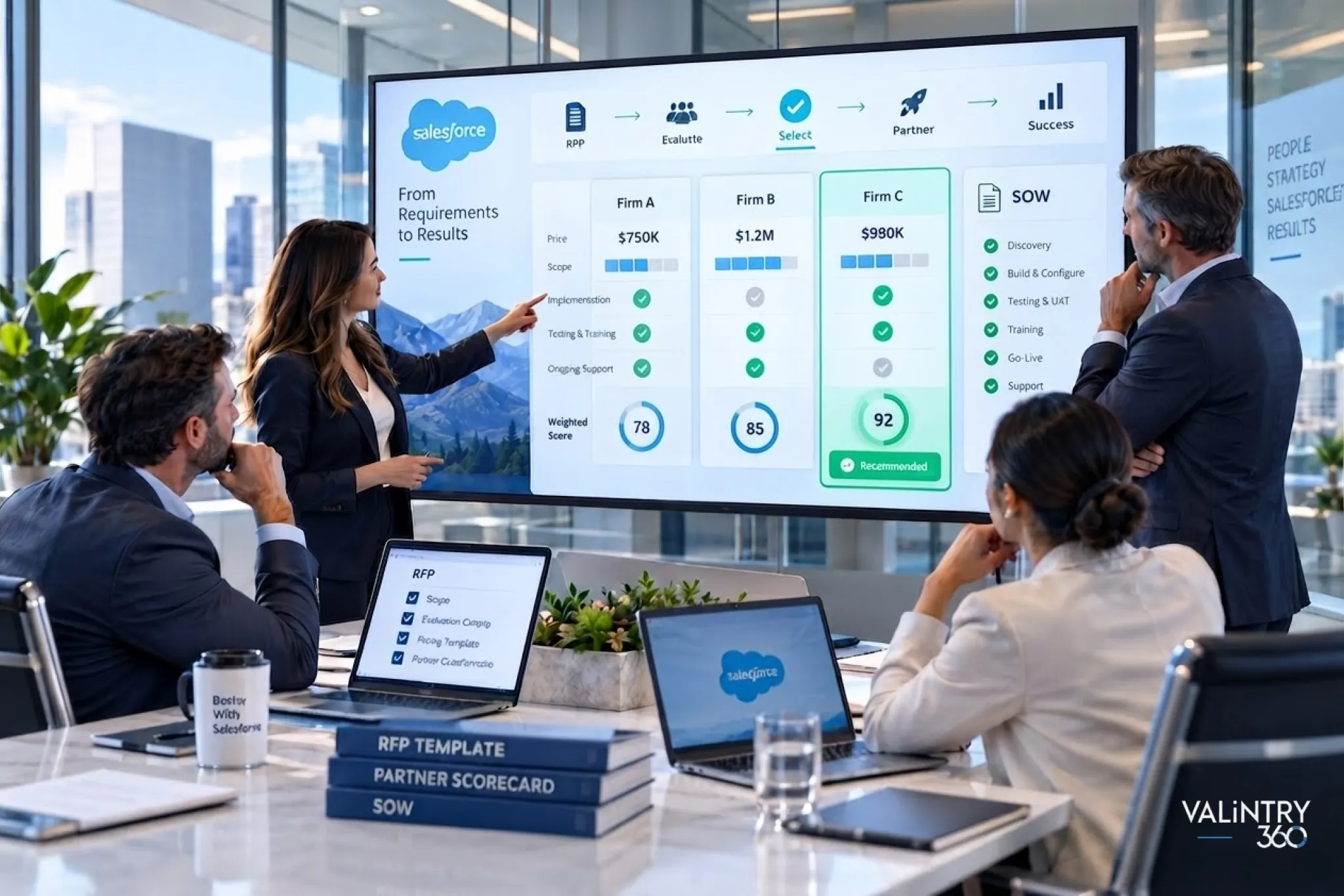
This guide works as a Salesforce Consulting RFP Template you can build from directly. It covers 12 sections a bidder should answer, the technical and security questions worth adding, a weighted Salesforce Partner Scorecard for comparing responses, and the steps that turn a winning proposal into a signed SOW. VALiNTRY360 built it around the same questions buying teams ask us before a Salesforce project goes out to bid.
By the end of the guide, you should have:
- A Salesforce consulting RFP framework
- A bidder-response checklist
- A weighted Salesforce Partner Scorecard
- A final-selection and SOW handoff process
Every section below builds toward one of those 4 outcomes, and the case studies near the end give you a real-project gut check before you send anything out.
What a Salesforce Consulting RFP Needs to Accomplish
A Salesforce consulting RFP is the document you send bidders before a new implementation, a data migration, an integration project, a multi-cloud rollout, Agentforce or other AI work, or ongoing managed support that requires a formal selection process. It’s the same buying decision behind most requests we see for Salesforce consulting services, just formalized into a document bidders can respond to consistently.
It has 2 jobs. First, it gives every bidder enough information to price the same project instead of 3 different versions of it. Second, it requires every bidder to return information a buying team can actually compare, going well past a headline number and a sales deck.
A good Salesforce RFP makes these points clear before a single proposal comes back:
- What is being bought
- What Salesforce environment exists today
- Who owns each part of delivery
- What evidence the bidder must provide
- How responses will be scored
One naming note worth settling early: Salesforce runs its own internal scorecard to track partner progress inside its partner program. That’s a different thing from the Salesforce Partner Scorecard this guide builds, which is the buyer’s own evaluation matrix for comparing consulting firms on a specific project.
Treat the RFP as a working document rather than a formality to clear before the “real” conversation starts. Bidders answer the questions you actually ask. A vague RFP produces vague proposals, and a vague proposal is nearly impossible to score fairly against a competitor’s equally vague one.
When to Use an RFP, RFI, Discovery Engagement, or Direct Selection
Not every Salesforce buying decision needs a full RFP. Some need less process. Some need more groundwork first.
Approach | Best fit | Main output | Buyer needs beforehand |
|---|---|---|---|
RFI | Market or solution options still need investigation | Capability information | Business problem and broad requirements |
Salesforce RFP | Buyer can define the project well enough for comparable proposals | Technical and commercial proposals | Scope, requirements, evaluation method |
Paid discovery | Important requirements remain uncertain | Requirements, architecture, backlog, estimate | Business goals and access to stakeholders |
Direct partner selection | Buyer has a narrow requirement or an established procurement route | Proposal or SOW | Clear scope and evidence supporting the selection |
A formal Salesforce RFP is the right call once you can explain, in plain terms:
- Business outcomes
- Current platform state
- Required workstreams
- Main constraints
- Evaluation criteria
- Procurement timeline
If you can’t answer most of those yet, a short discovery engagement or an RFI will produce a better RFP later than rushing one out now.
An RFI works best as a filter, not a full evaluation. Use it to narrow a long list of possible Salesforce partners down to a shortlist worth a real RFP, or to test whether the market has a mature answer to an unusual requirement before you commit budget to discovery. Skipping straight to an RFP when the real gap is understanding, not comparison, tends to produce proposals nobody can actually judge against each other.
Prepare the Buying Team and Evaluation Rules Before Issuing the RFP
The evaluation rules need to exist before proposals start shaping anyone’s opinion, not after.
Define Project Ownership
Pull the right people in before you write a single requirement:
- Executive sponsor
- Salesforce or IT owner
- Business process owners
- Procurement and finance
- Security, privacy, legal, or compliance contacts where required
- Salesforce administrator or platform team
Skipping any of these roles up front usually means revisiting the RFP after it’s already gone out.
Record the Outcomes Being Purchased
Name the actual business outcome driving the Salesforce activity, since the activity alone rarely explains why it matters. Examples worth writing down:
- Replace a legacy CRM
- Consolidate Salesforce orgs
- Migrate records from another system
- Connect Salesforce with ERP or service systems
- Improve service operations
- Introduce Agentforce
- Reduce manual administration
Every outcome on that list should trace back to something the business actually asked for, not a Salesforce feature someone wanted an excuse to use.
Set Evaluation Rules
Decide these before the RFP goes out the door, not while proposals are sitting in your inbox:
- Mandatory requirements
- Scorecard criteria
- Criterion weights
- Proposal deadline
- Clarification process
- Interview stage
- Reference-check stage
- Final decision authority
Salesforce’s own Implementation Partner Selection Assessment Tool is a useful reference here. It walks buyers through picking evaluation criteria, weighting each one from 1 to 5, then rating partners High, Medium, or Low before multiplying rating by weight to get a ranked score.
That tool’s sample criteria run wider than most buyers expect, covering track record, technical skills, industry and solution expertise, company knowledge, local or global presence, culture fit, business transformation capability, training capability, delivery model, resource availability, and what the partner expects from the customer in return. Not every criterion needs to survive into your own scorecard, but reading the full list before you write your own is worth the 10 minutes it takes.
Assign an owner to each evaluation stage before the RFP goes out. Someone runs the clarification process, someone schedules finalist sessions, and someone owns the final recommendation. Splitting these roles after proposals arrive tends to slow the whole process down right when speed matters most.
Salesforce Consulting RFP Template: Sections Every Bidder Should Answer
This is the core of the Salesforce Consulting RFP Template. Copy the structure directly into your own document and adjust the detail to your project.
1. Organization and Project Background
Buyer provides: company context, current Salesforce use, the reason for the project, and the business groups involved.
Bidder provides: their interpretation of the project and the assumptions behind it.
2. Business Goals and Success Measures
Buyer provides: expected outcomes, known KPIs, and adoption or operational goals.
Bidder provides: how the proposed work connects to those specific outcomes.
3. Current Salesforce Environment
Cover the products in use, org structure, major customizations, existing integrations, data volumes, and any known technical constraints. Bidders can’t price around unknowns you haven’t disclosed.
4. Project Scope and Exclusions
Spell out included work, excluded work, customer-owned tasks, and partner-owned tasks. This single section prevents more pricing disputes than any other part of the document.
5. Functional Requirements
Group requirements by business process rather than dumping every feature into one long list. A sales-process requirement reads differently to a bidder than a service-process requirement, and grouping them keeps proposals organized the same way. Note which requirements are mandatory and which are preferred, since bidders price those 2 categories very differently once they know the difference matters.
6. Architecture and Technical Requirements
Request the bidder’s architecture approach, custom-code policy, automation approach, environment strategy, and documentation expectations. A bidder who can explain why they’d build something a certain way, beyond simply confirming they can build it, is usually the one who catches problems before they reach production.
7. Data Migration
Ask for source systems, data volume, mapping approach, deduplication method, validation plan, and cutover and reconciliation steps. Include how the bidder handles data that fails validation, since that answer says more about their process than a clean sample-data walkthrough ever will. Our own Salesforce data migration checklist covers the phases worth asking a bidder to walk through in their response.
8. Integrations
List the systems involved, existing middleware, API constraints, integration ownership, and monitoring expectations. Note which side owns the interface long-term, since a bidder who builds an integration but hands off monitoring to no one is setting up a gap someone else will discover the hard way.
9. Security, Privacy, Compliance, and AI
Cover access controls, data handling, development access, subcontractor involvement, and AI-specific requirements where the project includes Agentforce or similar work. Ask for this in writing rather than as a verbal assurance during the sales call, since a written answer is the one you can hold a bidder to later.
10. Delivery Team and Project Method
Request named roles, allocation, work location, relevant credentials, responsibilities, and the substitution policy if a named person changes mid-project. This is the section bidders most often answer in general terms, so push for names and percentages rather than accepting “a dedicated team” as a complete response.
11. Testing, Training, Deployment, and Support
Require bidders to state exactly what testing, training, deployment, and support they’re including, and what they expect the customer to handle instead. Ask specifically how many training sessions are included and for how many roles, since “training included” on its own tells you almost nothing about what actually gets delivered.
12. Commercial Response and Submission Instructions
Require the price model, assumptions, exclusions, dependencies, a rate card where relevant, the payment schedule, and how long the proposal stays valid. A proposal that goes quiet on any one of these items is telling you where the eventual change order is going to come from.
Different bidders bring different strengths to these 12 sections. A firm built around Salesforce implementation services answers sections 3 through 6 well. A firm known for Salesforce development services usually has more to say in section 6.
Reading both against the same template is what makes the comparison fair.
Write Salesforce Requirements That Produce Comparable Proposals
A requirement like “implement Sales Cloud” can mean 10 different things to 10 different bidders. This section goes one level deeper than the template above so that doesn’t happen.
Workstream | Buyer should specify | Bidder should return |
|---|---|---|
Salesforce products | Products, users, regions, major processes | Proposed product scope and dependencies |
Configuration | Objects, automation, security model | Configuration approach and assumptions |
Custom development | Known custom needs | Apex/LWC approach and technical reasoning |
Data migration | Sources, volumes, history, quality issues | Migration method, tools, validation plan |
Integration | Systems, interfaces, middleware | Integration pattern, responsibilities, monitoring |
Testing | Customer testing capacity and standards | Included test stages and responsibilities |
Deployment | Release constraints and environments | Cutover and rollback method |
Training | User groups and internal training capacity | Training deliverables and format |
Documentation | Required technical and user documentation | Documents included in scope |
Support | Required post-launch period | Coverage, response terms, handoff |
Every requirement that actually matters to the project should identify a required outcome, a known constraint, the party responsible for it, and the response you expect back. Requirements that skip any of those 4 pieces are the ones bidders interpret differently.
Write requirements as outcomes, not tasks, wherever you can. “Reduce duplicate lead creation across web and phone intake” gives a bidder room to propose their own approach and tells you whether they understood the problem. “Build a duplicate rule” tells you nothing except that they can follow an instruction.
This matters most where the work touches multiple systems. A project running through Salesforce integration services or Salesforce data migration services needs those constraints written down precisely, because “integration” and “migration” are 2 of the workstreams bidders price the most differently when the RFP leaves them vague.
The same applies to cloud-specific scope. If the project touches Salesforce Sales Cloud consulting work alongside Salesforce Service Cloud implementation, say so explicitly rather than writing “Salesforce” and letting each bidder guess at the split.
Portal and marketing scope need the same treatment. A Salesforce Experience Cloud portal is a different build than a Salesforce Marketing Cloud journey setup, and a bidder who reads “customer portal and email marketing” as one combined line item will price it very differently than one who reads it as 2 separate workstreams.
Require Evidence About the Consulting Firm and the People Who Will Do the Work
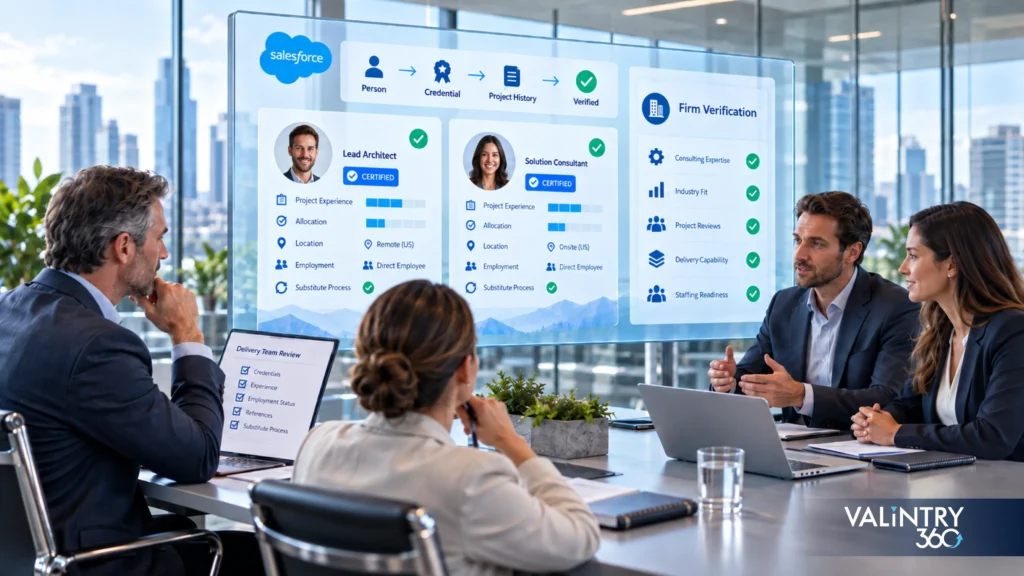
Firm-wide statistics don’t tell you who shows up to your project. This section fixes that.
Evidence requested | What the buyer should check |
|---|---|
Salesforce partner status | Current listing and program information |
Product or industry experience | Relevance to the proposed project |
Proposed team | Names, roles, location, availability |
Salesforce credentials | Credentials relevant to assigned responsibilities |
Comparable projects | Similarity in scope and complexity |
Customer references | Projects involving comparable work |
Subcontractors | Role, access, ownership, supervision |
Resource replacement | How substitutions will be approved |
Verification is easier than it used to be, and it’s worth doing at intake rather than waiting for the finalist stage covered later in this guide. Salesforce’s AppExchange consultant directory lists more than 1,500 consultants, filterable by expertise, industry, and location, with certifications and Verified Project Reviews viewable on each profile. Individual credentials can be checked separately through Salesforce’s own credential verification tool.
None of this replaces a reference call, but it does catch the easy problems early. A named architect whose listed credentials don’t match what the proposal claims, or a firm whose AppExchange presence looks thin next to the scale of work being proposed, is worth a direct question before the finalist stage, not after the contract is signed. It’s the same verification step VALiNTRY360 runs before naming anyone to a proposed delivery team, since a credential claim only holds up if it can survive a buyer checking it directly.
For every key role on the proposed team, require the bidder to disclose:
- Name
- Role
- Relevant credential
- Relevant project experience
- Expected allocation
- Work location
- Employment or subcontractor status
- Proposed substitute process
That level of detail is what section 10 of the template above should actually produce once a bidder fills it in, structured as evidence you can score rather than a paragraph you have to interpret.
This is where the difference between a Salesforce Consulting Partner and a Salesforce Implementation Partner starts to matter in practice. Some firms lead with strategy and ongoing advisory work. Others are built for hands-on implementation delivery.
The RFP should tell you which one you’re actually evaluating, project by project, rather than treating every response as interchangeable. Say so directly in section 1 of the template above, since a bidder who knows which role you’re hiring for tailors the whole proposal around it.
Compare Salesforce Consulting Costs on the Same Scope
Universal Salesforce implementation price claims don’t hold up once you look closely at what each number assumes. This section is about comparing proposals correctly, not publishing a single price everyone can quote.
Model | Suitable condition | What to request |
|---|---|---|
Fixed fee | Scope and acceptance conditions are well developed | Price by deliverable, assumptions, exclusions, change terms |
Time and materials | Requirements still contain uncertainty | Role rates, expected hours, estimate, approval controls |
Milestone pricing | Work can be accepted in defined stages | Price and acceptance rule for each milestone |
Managed support | Work continues after launch | Included capacity, service period, overage rules |
Mixed commercial model | Different workstreams carry different levels of certainty | Pricing basis for each workstream |
Normalize Proposal Costs
Build a buyer worksheet that separates:
- Consulting fees
- Salesforce license assumptions
- Third-party tools
- Data work
- Integration work
- Travel
- Training
- Post-launch support
- Customer staffing assumptions
- Change-request rates
- Optional services
Proposal totals only become comparable once you’ve checked that each one assumes the same scope. A bidder who quietly assumed your team would handle all data cleansing looks cheaper right up until that assumption surfaces mid-project. Where support continues past launch, compare that line against your own Salesforce managed services expectations so the ongoing cost doesn’t get buried inside a one-time implementation number.
Ask every bidder to price optional or “nice to have” scope separately from the core deliverable. Bundled pricing hides which parts of the total are actually required and which parts a bidder added to round the number up. A rate card broken out by role also helps later, since a change request priced against a named rate card is far easier to approve than one priced against an unexplained blended average.
Ask for the assumptions that would change the price if they turned out to be wrong. A bidder who assumed 3 rounds of UAT, a fixed data volume, or a specific number of integration endpoints should say so in writing. That single request surfaces more pricing risk than almost anything else in the commercial section, and it costs the bidder nothing to answer honestly.
Build a Salesforce Partner Scorecard With Weights and Evidence Rules
This is the second core piece of the page: a working Salesforce Partner Scorecard you can adapt to your own project.
Criterion | Weight |
|---|---|
Solution and architecture fit | 18% |
Proposed delivery team | 15% |
Data and integration approach | 12% |
Salesforce and industry experience | 10% |
Security and compliance approach | 10% |
Delivery, testing, training, and adoption | 10% |
Comparable projects and references | 10% |
Commercial clarity and ownership cost | 10% |
Post-launch support and handoff | 5% |
Total | 100% |
Treat these weights as a starting point. Set your own before the RFP goes out, based on which parts of the project carry the most risk.
A heavy data migration project should probably push more weight onto data and integration approach. A project where the org already works fine and the risk sits entirely in adoption should push more weight onto delivery, testing, training, and adoption instead. The point of building the scorecard before proposals arrive is that nobody can quietly shift a weight later to favor whichever bidder they liked best in the room.
Use a 0 to 5 Scoring Scale
Score | Meaning |
|---|---|
0 | Requirement unanswered or failed |
1 | Major gaps and weak evidence |
2 | Partial fit with material concerns |
3 | Meets the stated requirement |
4 | Strong fit backed by relevant evidence |
5 | Strong fit plus a specific benefit tied to the stated requirement |
Apply the same scale to every criterion so a 3 means the same thing on the security row as it does on the pricing row.
Calculate the Weighted Score
Weighted score = (score ÷ 5) × criterion weight
A bidder who scores a 4 on “proposed delivery team” (weight 15%) earns 4 ÷ 5 × 15%, or 12 weighted points on that line. Run every criterion through the same formula and add the results for a total ranking score per bidder.
Separate Mandatory Gates
Some requirements shouldn’t sit inside a 0 to 5 scale at all. Score everything else only after a bidder clears these:
- Required Salesforce partner status
- Mandatory legal terms
- Security requirements
- Insurance requirements
- Data-location conditions
- Conflict disclosures
Your working spreadsheet should carry a column for the criterion, its weight, the raw score, the weighted score, supporting evidence, an evaluator note, and the consensus score once the evaluation team meets. That evidence column matters more than it looks. A 4 with a name, a project, and a reference attached beats a 4 with nothing behind it, even when the number on the page is identical.
Require each evaluator to fill the evidence column before the consensus meeting, not during it. Scores backed by evidence written down in advance hold up under discussion. Scores backed by a gut feeling tend to move the moment someone else in the room pushes back, which defeats the purpose of scoring independently in the first place.
What Recent Public Salesforce Procurements Ask Bidders to Prove
Public-sector procurement documents are a useful, underused source here, since the requirements inside them are real and the stakes make them precise. A few patterns turn up repeatedly.
Procurement pattern found | Why the buyer should consider it |
|---|---|
Technical and commercial responses separated | Reduces early price anchoring |
Staff qualifications requested | Tests the actual proposed team |
References required | Checks delivery history |
Defined technical response format | Makes comparison easier |
SOW controls documented | Connects procurement with delivery |
Acceptance process defined | Clarifies when work is complete |
Change-request process included | Sets rules for scope changes |
Support expectations recorded | Reduces uncertainty after launch |
A 2026 New Hampshire Department of Information Technology RFP for Salesforce professional services split its evaluation between technical criteria and price, with technical categories carrying roughly 3 times the weight of the price score. A separate New York State Salesforce implementation enterprise agreement bundles its main RFP with a distinct attachments package and a separate appendices package, keeping requirements, terms, and reference material apart rather than folding everything into a single document.
Neither example needs copying line for line. What’s worth borrowing is the discipline: separate technical merit from price, request named staff, and keep SOW-relevant material distinct from the core requirements.
Private-sector RFPs rarely publish this level of structure, which is part of why they’re harder to compare. A smaller company doesn’t need a 61-page state RFP like New Hampshire’s to get the same benefit. Borrowing 3 or 4 of these habits, a separated technical and price score, named staff requirements, and a clear SOW handoff step, gets most of the value without the bureaucracy.
Verify Shortlisted Salesforce Partners and Score the Finalists

Once the shortlist is set, verification and scoring run together rather than as 2 separate stages.
Check the evidence. Confirm each finalist’s AppExchange listing, current Salesforce partner program information, and relevant Competencies. Salesforce’s FY27 partner program consolidated its previous 4-tier structure into 2 tiers, Select and Summit, and replaced its 170 Navigator distinctions with 28 Competencies, so verify against that current terminology rather than older tier names you might find in older content. Check verified reviews where available, named-person credentials, references, team availability, and subcontractor details.
Score independently first. Have each evaluator score the written proposal on their own before any group discussion happens. Scores formed in a group tend to converge around whoever speaks first.
Send the same clarification questions. Where fairness requires it, send identical follow-up questions to every finalist rather than tailoring them per bidder.
Run a finalist session. Cover architecture, data migration, integration, the delivery plan, the proposed team, and the assumptions behind the price.
Check references with consistent questions. Ask every reference the same set of questions so the answers are comparable across bidders.
Reach a consensus score. When evaluator scores diverge, record why in the meeting notes. That record is worth more later than the final number alone.
Keep the finalist stage short. A process that drags past a couple of weeks tends to lose the strongest candidates, who have other work lined up and limited patience for an open-ended evaluation.
Check Proposal Red Flags and Move the Selected Response Into the SOW
This is the last step before a signature, and it’s where a strong proposal on paper can still turn into a weak contract if nobody checks the gap between them.
Proposal warning sign | Contract/SOW item to settle |
|---|---|
Senior experts named only in sales material | Named roles and substitution rules |
Large fixed price with weak assumptions | Scope, assumptions, exclusions |
Migration described in one line | Migration deliverables and validation |
Testing ownership unclear | Test stages and responsibilities |
Integration responsibilities split vaguely | System ownership and interface duties |
Customer workload unspecified | Customer dependencies |
Support deferred | Support period and service terms |
Deliverables described broadly | Acceptance criteria |
Change process absent | Change-request procedure |
Handover unclear | Documentation and knowledge-transfer requirements |
Before signing, confirm the SOW captures scope, deliverables, staffing, schedule, acceptance rules, commercial terms, customer dependencies, change control, handover, and support. Every item on that list traces back to a section of the RFP template above, which is exactly the point: nothing in the contract should be a surprise to either side.
VALiNTRY360 Case Studies Worth Reviewing Before You Finalize a Shortlist
Everything above is about the process. These 5 real projects show exactly what a well-scoped Salesforce engagement actually delivers once an RFP turns into signed work.
Real California Milk: SugarCRM to Salesforce Migration. A data migration project that cut manual data work from 500 hours a year to 4.
All American Solar: Sales Cloud Quick Start Implementation. A fast, defined-scope Sales Cloud rollout that drove 16% quarterly growth.
BIC Graphic: Sales and Service Cloud Implementation. A dual-cloud implementation that cut average handle time by 7 minutes.
Ravago: Salesforce Marketing Cloud Optimization. A Marketing Cloud optimization project that generated $500,000 in new revenue in 3 months.
AthenaPsych: Salesforce Health Cloud EMR Replacement. An EMR replacement built on Health Cloud that got 80% of patients scheduled on the first call.
Reading a project’s real scope alongside its outcome is a useful gut check before you finalize the RFP and scorecard you send out.
FAQs About Salesforce Consulting RFPs and Partner Scorecards
What should a Salesforce consulting RFP include?
Project background, scope, functional and technical requirements, staffing evidence, data migration and integration detail, security requirements, a commercial response, and the evaluation method you’ll use to score it. Leaving out the evaluation method is the most common gap.
When should a company issue a Salesforce RFP?
Once requirements are developed enough that different bidders would price roughly the same project. If scope, systems, and success measures are still unclear, a discovery engagement or an RFI will produce a better RFP than issuing one too early.
Should an RFI come before a Salesforce RFP?
Yes, when the market or solution approach still needs investigation. Skip it when the buyer already knows the systems, scope, and general approach well enough to write comparable requirements directly into the RFP, since a redundant RFI just adds a delay with no new information.
How many Salesforce consulting partners should receive an RFP?
It depends on procurement policy, project size, and how many responses the evaluation team can realistically score in depth. A smaller, well-matched shortlist usually produces a better evaluation than a wide, generic distribution, since each additional bidder adds real evaluation hours somebody has to spend.
What is a Salesforce Partner Scorecard?
The buyer’s own evaluation matrix for comparing consulting firms, built from weighted criteria, a 0 to 5 scoring scale, and evidence requirements for every score. It’s a different thing from Salesforce’s internal scorecard for tracking partner program progress, so don’t confuse the 2 when researching the term online.
How should you weight price in a Salesforce Partner Scorecard?
There’s no single correct number. Weight it against project risk, technical complexity, and your own procurement policy, and set that weight before proposals arrive rather than after. A price weight set after the totals are known tends to favor whichever bidder already looks cheapest, which defeats the purpose of scoring at all.
Which Salesforce partner credentials should buyers verify?
Current partner status, relevant Competencies, individual certifications tied to the proposed roles, and evidence from comparable projects. Verify all of it directly through Salesforce’s own AppExchange directory and credential-verification tool rather than taking a proposal’s claims at face value.
How can buyers compare Salesforce proposals with different scopes?
Normalize scope, assumptions, exclusions, staffing, and support terms across every proposal before comparing totals. A lower price built on lighter assumptions isn’t automatically the better deal, so ask each bidder to itemize what’s included before you rank anyone on price alone.
Should the proposed delivery team have a separate score?
Yes. Firm-wide credentials don’t guarantee the individuals assigned to your project have the same depth, so named-resource evidence deserves its own line on the scorecard rather than sitting folded into a general company-experience criterion where it’s easy to overlook.
What should buyers ask Salesforce customer references?
Ask about scope similarity, staffing consistency, communication during the project, how the team handled change requests, delivery quality, and what post-launch support actually looked like. Ask directly whether the same named individuals stayed on the project through to completion.
How should you score data migration experience?
Score it against data volume, complexity, deduplication approach, mapping method, validation steps, and reconciliation process, weighted toward projects genuinely comparable to yours. A bidder who’s only migrated clean, small datasets isn’t automatically ready for a large, messy one.
What security requirements belong in a Salesforce consulting RFP?
Access controls, credential handling, customer data policy, development and release controls, subcontractor access, incident response, and AI-specific requirements where Agentforce or similar tools are part of the scope. Ask for each of these in writing, not as a verbal assurance during the sales process.
How do fixed-fee and time-and-materials Salesforce proposals differ?
Fixed fee sets one price for a defined scope with change control for anything outside it. Time and materials bills actual hours against a rate card, trading price certainty for flexibility. Milestone and mixed models split the difference by pricing the known scope firm and estimating the rest.
What warning signs should buyers watch for in Salesforce RFP responses?
Vague assumptions, senior experts named only in marketing material, missing exclusions, unsupported estimates, unclear testing ownership, and an undefined handover process. Any of these on its own is worth a follow-up question before you score the section.
What should move from the winning Salesforce proposal into the SOW?
Agreed scope, deliverables, named roles, pricing, acceptance conditions, customer dependencies, change-request rules, documentation requirements, handover terms, and the support arrangement. If a term mattered enough to compare during evaluation, it belongs in the signed document too.
Related Posts
- Salesforce Consulting Services
Is Salesforce Consulting Becoming a Business Strategy Function…
Salesforce used to fit neatly inside the IT conversation. A company bought the CRM, an implementation team configured it, developers handled custom requirements, and IT kept the system running after go-live.That boundary is much harder to draw now. Salesforce sits…
- Salesforce Consulting Services
Why Salesforce Consulting Is Moving From Customization to…
Salesforce keeps getting better at building things itself. Flow can now handle branching logic and callouts that used to require Apex. AppExchange has thousands of pre-built solutions for problems companies used to solve from scratch. Agentforce can reason through open-ended…
- Salesforce Consulting Services
Salesforce Consulting in the Agentforce Era: Do You…
Salesforce's own marketing makes the pitch aggressively simple: Agentforce is already built into the platform, can reuse existing Salesforce workflows and APIs, and gives admins a conversational builder for creating agents. No complex data integration, no custom automation build.At the…