
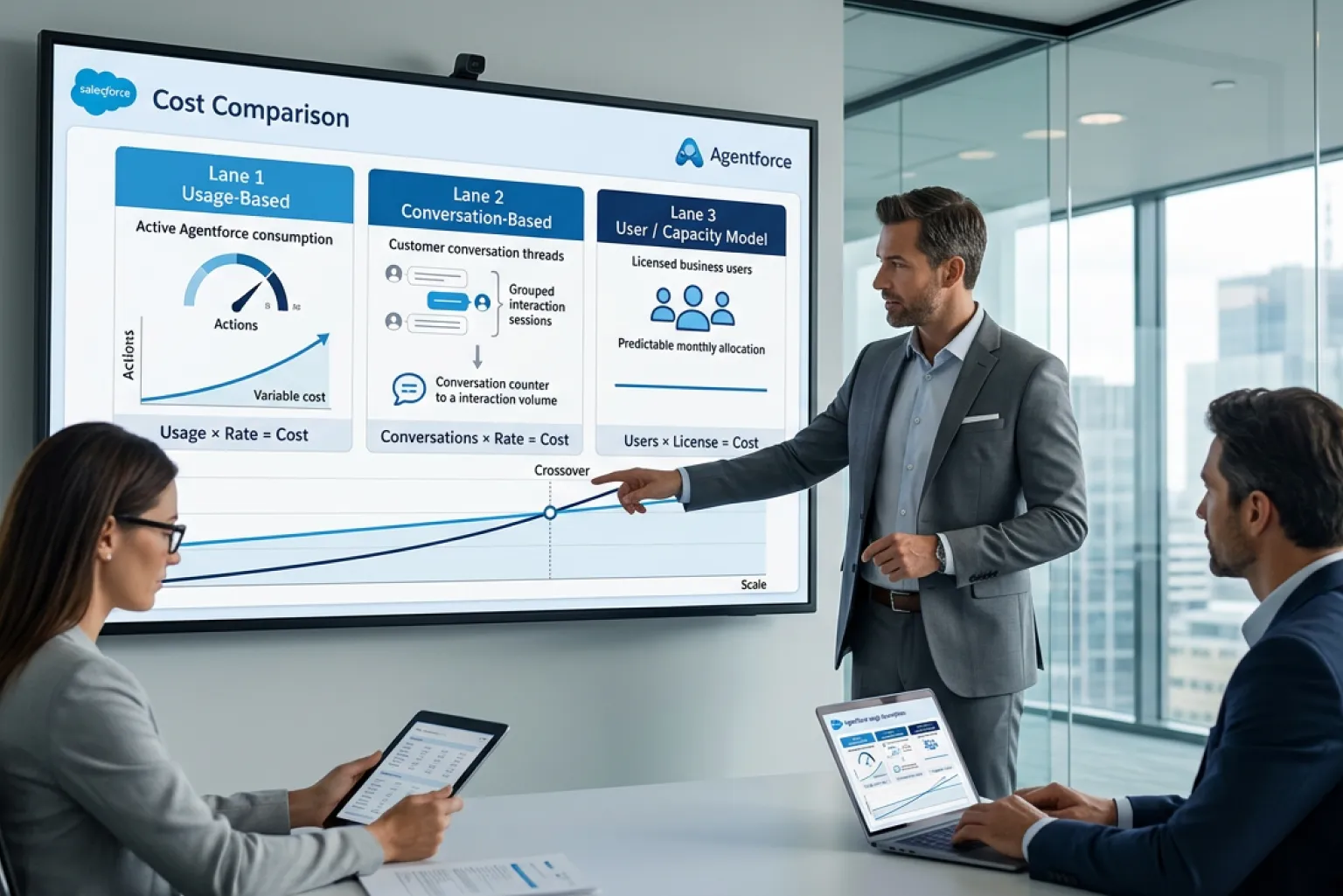
- Salesforce Managed Services
Salesforce Agentforce pricing in 2026 runs from $0 on the free Salesforce Foundations tier to $550 per user per month on the Max edition, with usage priced at $2 per conversation, roughly $0.10 per standard action through Flex Credits, or $2 per resolved case under the outcome-based model. Which of those numbers you actually pay depends on how much work happens inside each interaction.
The cost is created by the metering architecture behind the agent: how many conversations begin, how many actions each conversation needs, whether the agent uses voice, whether employee access is priced per user, and whether the data layer has to retrieve, ground, or synchronize information before the agent can act. That is why Agentforce cost should be modeled like unit economics, not like a conventional CRM add-on.
The public Salesforce Agentforce pricing page now presents several buying paths, not three: Salesforce Foundations, Conversations, Flex Credits, pay-per-resolution, per-user licensing, and the bundled editions. The same page lists Conversations at $2 per conversation, Flex Credits at $500 per 100,000 credits, a $5 user/month Agentforce User Licence that requires Flex Credits, and a Flat Fee Access option shown at $125 user/month. The full price list is in the table below. Those numbers matter, but the better question is how a real workflow consumes them.
A buyer comparing Agentforce pricing models has to estimate the work behind each interaction. One customer conversation may use two actions: authenticate the customer and retrieve an order. Another may use twenty-eight actions across identity, case history, policy retrieval, refund eligibility, workflow update, and escalation. The Salesforce implementation cost and pricing guide makes the broader point that AI costs do not sit alone. They compound with licenses, data readiness, integrations, testing, support, and governance.
This guide compares every Agentforce pricing model available in 2026 with real math. It explains Agentforce $2 per conversation, Agentforce Flex Credits, Agentforce pay-per-resolution, Agentforce per-user pricing, Agentforce cost per action, the new Core, Advanced and Max editions, and the break-even point where conversation pricing and Flex Credits cross over. The practical answer is not that one model is always cheaper. The answer is that Salesforce Agentforce pricing becomes predictable only when the buyer models action depth, user behavior, data requirements, and support effort together.
Salesforce Agentforce Pricing At A Glance (2026)
Here is every publicly listed Agentforce price in one table. Salesforce notes that prices are subject to change and that final pricing comes from a sales representative, so treat this as the list-price starting point for a negotiation and not a quote.
Buying Option | Public List Price | What It Covers |
Salesforce Foundations | $0 | Free entry tier for customers on Enterprise Edition or above. Includes a starter allocation of Flex Credits and Data Cloud credits, plus Agent Builder and Prompt Builder. |
Flex Credits | $500 per 100,000 credits | About $0.005 per credit. A standard Agentforce action uses 20 credits, so roughly $0.10 per action. An Agentforce Voice action uses 30 credits, about $0.15. |
Conversations | $2 per conversation | Flat per-conversation charge for customer-facing agents. Cannot be combined with Flex Credits in the same org. |
Pay-per-resolution (Help Agent) | $2 per resolution, or 400 Flex Credits | Outcome-based. Billed only when the agent resolves the issue. No separate metering for actions or Data 360 queries inside that session. |
Agentforce User Licence | $5 per user per month | Company-wide employee access. Still requires Flex Credits on top, so this is an access layer and not an all-in price. |
Agentforce add-on (Sales, Service, Field Service) | $125 per user per month | Unmetered Agentforce usage for that licensed employee, plus the full AI suite and Prompt Builder. |
Agentforce Industries add-on | $150 per user per month | Same as above with industry-specific AI for Industry Cloud customers. |
Core edition | $195 per user per month | Replaced Enterprise edition in September 2026. Includes 500,000 Flex Credits per year, Slack Business+ and Tableau Next. |
Advanced edition | $395 per user per month | Replaced Unlimited edition. Includes 1 million Flex Credits, the Premier Success Plan, and additional security and data protection. |
Max edition | $550 per user per month | Replaced Agentforce 1. Includes 2.75 million Flex Credits, up from 1 million, at the same price. |
Public sector / FedRAMP High | Approx. $650 per user per month | Reported figure for government tiers. Verify directly with Salesforce. |
Two rules in the fine print matter more than any headline number. You cannot run Flex Credits and Conversations in the same org, and unused Flex Credits do not roll over past their term. Both change the real cost more than a five percent discount ever will.
The Short Version For Buyers
Buyer Question | Pricing Answer | Math To Remember |
Which model is easiest to understand? | Agentforce cost per conversation is a flat $2, so the unit is a conversation rather than each action. | $2 stays predictable when a conversation includes many steps. |
Which model is usually cheapest for small workflows? | Agentforce Flex Credits usually win when an agent performs fewer than about 20 standard actions per conversation. | 20 credits per standard action x $0.005 per credit = $0.10 per action. |
Where is the break-even point? | The standard Agentforce break-even cost math is $2 divided by $0.10. | Conversation pricing and Flex Credits meet at about 20 standard actions. |
When does pay-per-resolution win? | When your resolution rate is below 100 percent, because unresolved sessions are not billed at all. | Effective cost per session = $2 x resolution rate. |
When does per-user pricing matter? | Agentforce per-user pricing matters most for employee-facing agents with recurring usage by named users. | $5/user/month may be an access layer that still requires Flex Credits; $125 and $150/user/month buy unmetered employee usage. |
What can make the model wrong? | Data 360, implementation, support, governance, testing, and seasonal spikes can change the real Agentforce cost. | Model the full outcome cost, not only the public unit price. |
What You Actually Pay For: The Full Agentforce Cost Stack
Agentforce pricing looks like a product decision, but the invoice often behaves like an operating decision. A Salesforce buyer usually pays for a stack of cost layers, and the Agentforce cost line only tells part of the story. The model is clearer when each layer is separated before the team compares Agentforce pricing models.
- Base Salesforce access. Sales Cloud, Service Cloud, Experience Cloud, Slack, Data 360, or industry clouds may already be in the environment, and those licenses shape which agents can be useful.
- Agentforce conversation pricing. Agentforce conversation pricing charges for a completed conversation unit, so the buyer models conversation volume and average case complexity rather than every action.
- Agentforce Flex Credits. Agentforce Flex Credits create a usage pool that charges per action, prompt, translation, and voice action, depending on the relevant rate card and feature.
- Agentforce per-user pricing. Agentforce per-user pricing matters when employees need recurring access to agents, not just occasional customer-facing automation. In practice that means one of three SKUs: the $5 per user per month Agentforce User Licence, which still consumes Flex Credits; the $125 per user per month add-on for Sales, Service or Field Service, which is unmetered for that employee; or the $150 per user per month Industries add-on.
- Bundled editions. Core, Advanced and Max now include Flex Credit allocations of 500,000, 1 million and 2.75 million per org per year. If your usage sits inside the allocation, the edition is your Agentforce price.
- Data and grounding. Production agents often need governed customer, product, policy, case, order, or entitlement data. Data 360 services become relevant when pricing depends on trusted context, not only the agent runtime.
- Implementation and operations. Discovery, build, data cleanup, integration, prompt design, testing, monitoring, and managed support can exceed the first month of usage spend when the workflow is complex.
The first planning mistake is comparing Salesforce AI pricing only on listed consumption units. The better method is to build a cost model around the complete outcome: what the agent resolves, how many actions that resolution requires, which people still review the result, and which systems are touched.
All Agentforce Pricing Models Compared (2026)
The current public pricing language makes the model set clear enough for planning. The published Salesforce pricing page lists consumption-based pricing through Flex Credits or Conversations, an outcome-based option for the Help Agent, plus per-user licensing and bundled editions for employee-facing use. The table below keeps the comparison practical for buyers.
Model | How The Meter Works | Best Fit | Main Cost Risk |
Conversations | Agentforce $2 per conversation charges a flat conversation unit. The number of internal steps matters less than the number of priced conversations. | Customer-facing service, help, or sales interactions where each conversation may include several actions. | Cheap for complex conversations, expensive when most conversations need only one or two actions. |
Flex Credits | Agentforce Flex Credits are consumed by action types. At $500 per 100,000 credits, a standard 20-credit action costs about $0.10. | Variable workflows, pilots, internal assistants, or processes where action counts can be measured and kept tight. | Costs rise quickly when agents overuse tools, retrieve repeatedly, or execute long multi-step flows. |
Pay-per-resolution | Billed at $2, or 400 Flex Credits, only when the Agentforce Help Agent successfully resolves the inquiry. Actions inside the session are not metered separately. | Customer support deflection where the resolution rate is unproven and you do not want to pay for failed sessions. | A very high resolution rate makes it behave almost identically to flat conversation pricing. |
Per-user licensing | Agentforce per-user pricing appears as employee-facing access: $5/user/month requiring Flex Credits, $125/user/month unmetered for Sales, Service or Field Service, $150/user/month for Industries. | Named employees using agents frequently inside Salesforce, Slack, service, sales, or operational workflows. | A seat price can look predictable but still need usage, data, support, and contract assumptions behind it. |
Bundled editions | Core, Advanced and Max include a fixed annual Flex Credit allocation inside the seat price. | Organisations with predictable, established agent usage that fits inside the allocation. | Unused credits expire, and heavy usage still forces a top-up purchase. |
This is why Agentforce pricing models should not be chosen from the price card alone. A high-volume support bot with two actions per question behaves very differently from a low-volume claims agent that makes twenty-five system calls before deciding whether a human must approve the result.
Agentforce Pay-Per-Resolution Pricing: The Outcome-Based Model
In mid-2026 Salesforce added a fourth way to pay. Instead of billing per conversation or per action, the Agentforce Help Agent can be billed per resolution. You pay when the agent actually solves the problem, and you do not pay when it does not. The price is $2 per billable resolution, or 400 Flex Credits if you are drawing from a credit pool. Inside that session there is no separate charge for the number of actions the agent performs or the number of Data 360 queries it runs. Everything the agent does inside the resolution is included.
That is a meaningful change for anyone nervous about action depth, because it removes the single variable that makes Flex Credit forecasting hard.
When Is A Conversation Counted As A Resolution?
Salesforce uses a deterministic three-part test. A session is billable as a resolution when all of the following are true:
- The session has at least two turns of messages between the user and the agent, so an abandoned chat does not count.
- The final feedback received from the user is not explicitly negative.
- The session either concludes without the user escalating to a human, or the final feedback is explicitly positive.
There is one more path to a billable resolution. If the conversation runs past two turns, the user gives no feedback and does not ask for an escalation, and the session exceeds the maximum duration, it is treated as resolved and billed at $2. Session duration is two hours for messaging channels and ten minutes for voice. If the customer escalates and a human representative picks up the case, Salesforce does not bill for the Help Agent at all, even when the agent did useful work first. That is the part buyers should model carefully, because it means a low resolution rate is genuinely cheaper rather than simply less effective.
What Happens If You Disagree With A Billed Resolution
Salesforce says the deterministic rule set exists specifically to reduce disputes, and that if one arises it can provide a full report showing session counts, resolution metrics and turn-by-turn transcripts so you can verify the rules were applied correctly. Ask for that reporting capability to be named in your order form rather than assuming it.
When Pay-Per-Resolution Beats The Other Models
Your Situation | Best Model | Reason |
Deflection rate is unproven and you are nervous about paying for failures | Pay-per-resolution | You only pay for outcomes, so a weak pilot costs very little. |
Resolution rate is already high and conversations are shallow | Flex Credits | At two actions per conversation you pay $0.20 rather than $2. |
Conversations are deep and the resolution rate is high | Pay-per-resolution or Conversations | Both cap the cost of a complex session. Compare them on expected resolution percentage. |
Employee-facing agents used daily by named staff | Add-on or bundled edition | Unmetered usage removes the forecasting problem entirely. |
The break-even question changes shape under this model. It stops being actions per conversation and becomes resolution rate. If your agent resolves 60 percent of sessions, your effective cost per session is $1.20, which beats the flat $2 conversation model. If it resolves 95 percent, you are paying $1.90 per session, the flat model is close to identical, and the deciding factor swings back to action depth.
What Changed In September 2026: The Core, Advanced And Max Editions
On September 4, 2026 Salesforce restructured the top three editions of Agentforce Sales and Agentforce Service, a year after those products were renamed from Sales Cloud and Service Cloud. If you priced Agentforce before that date, your model is out of date.
Old Edition | New Edition | Price Change | Flex Credits Included |
Enterprise ($175/user/mo) | Core | Up to $195/user/mo | 500,000 per org per year |
Unlimited ($350/user/mo) | Advanced | Up to $395/user/mo | 1 million per org per year |
Agentforce 1 ($550/user/mo) | Max | No change, $550/user/mo | 2.75 million per org per year, up from 1 million |
Starter and Pro Suite | Unchanged | No change | Agentforce not included |
What is now bundled that used to be a separate purchase:
- Core for Sales adds Momentum, Slack Business+ and Tableau Next. Core for Service adds case management, a self-service Help Center, Slack Business+ and Slackbot.
- Advanced for Sales adds Sales Programs, the Premier Success Plan, and extra security and data protection. Advanced for Service adds the Agentforce Help Agent, Premier Success, a full sandbox, Backup and Recover, and Data Detect.
- Max for Sales adds Agentforce for Sales, Agentforce Coworker, Salesforce Spiff, Sales Planning, Sales Programs, Salesforce Maps, Slack Enterprise+ and additional Tableau Next capabilities. Max for Service adds Service Rep Assistant, Workforce Engagement, Quality Management, IT Service and unmetered Agentforce Coworker access.
- Existing Agentforce 1 customers can move to Max at no additional cost.
Why More Bundled Credits Is Not Automatically A Better Deal
Salesforce says the new editions deliver 50 to 70 percent more value than the ones they replace. Analysts have been more cautious, and their caution is worth pricing in.
The first concern is visibility. Bundling AI, analytics, Slack, security and support into a single subscription removes the line-item detail finance teams were using to judge value. Once you cannot see what each component costs, comparing Salesforce against a competing product gets much harder.
The second concern is that bundled value only counts if it gets used. A package can carry 60 percent more theoretical value and deliver none of it if the extra functionality sits idle and the included Flex Credits expire unspent.
The third concern runs the other way. As agent usage grows, teams can burn through their included credits faster than expected and end up buying more anyway. Salesforce itself reported that the average number of active agents per customer rose from five in February 2025 to thirteen by April 2026, with agent actions per account growing at a 31 percent compound monthly rate. At that growth rate, an allocation that looks generous in month one can be gone by month eight.
So the honest read is this. The new editions are a better deal when your usage is predictable and your credit consumption sits inside the allocation. They are a worse deal when you are still experimenting, because you are paying a higher seat price for credits you may never touch.
Agentforce Break-Even Math: Conversations vs Flex Credits
The most useful number in any Agentforce pricing model comparison is the conversation-versus-action crossover. Flex Credits cost $500 per 100,000 credits, which means one credit costs $0.005. Salesforce lists a standard Agentforce action at 20 Flex Credits and an Agentforce Voice action at 30 Flex Credits on the current pricing page. The Flex Credits rate card is the source buyers should check before final budgeting, because rate-card details can change by product and contract.
Agentforce Standard Action Cost Math
A standard action uses 20 credits. At $0.005 per credit, that action costs $0.10.
$2.00 per conversation ÷ $0.10 per standard action = 20 actions
That is the clean Agentforce break-even cost math: below 20 standard actions, Flex Credits are cheaper; at 20, the two models are roughly equal; above 20, conversation pricing becomes cheaper for that interaction.
Agentforce Voice Action Cost Math
Agentforce Voice pricing is metered at 30 Flex Credits per voice action, so the unit cost is about $0.15 per voice action.
$2.00 per conversation ÷ $0.15 per voice action = 13.3 voice actions
That does not mean every voice workflow should use conversation pricing. It means voice-heavy flows need a separate model because Agentforce cost per action changes when the action type changes.
Why Is The 20-Action Number Useful?
The 20-action crossover is not a contract guarantee. It is a planning rule that helps finance, IT, service, and operations discuss Agentforce costs in the same language. Once the team knows average actions per outcome, it can decide whether Agentforce conversation pricing, Agentforce Flex Credits, or Agentforce per-user pricing should be evaluated first.
What The Agentforce Flex Credits Rate Card Does Not Tell You
The Flex Credits rate card is a unit-price reference, not an operating budget. It shows how usage types consume credits, but the AI agent pricing model still needs assumptions about conversation volume, action count, data access, fallback behavior, and human review.
Use the Flex Credits rate card as the floor, then build an AI agent pricing model around actual workflow outcomes. That model should include Agentforce break-even cost math, not only expected credit spend. Without that step, Agentforce ROI calculator work can understate variability.
The rate card should be reviewed again after launch because real prompts and real cases may trigger different usage patterns. A mature AI agent pricing model compares expected actions with actual actions and updates the break-even math every month.
Agentforce Cost Examples: 5 Worked Scenarios
The following examples use public list-price signals for simple comparison. They exclude tax, discounts, data credits, base licenses, implementation services, and contract-specific terms. They are useful because they show how Agentforce cost changes when the same volume has different action depth.
Scenario | Assumption | Flex Credit Math | Likely Better Model |
Order-status self-service | 20,000 conversations/month, 2 standard actions each | 40,000 actions x $0.10 = $4,000. Conversation model = $40,000. | Flex Credits |
Routine service case help | 10,000 conversations/month, 8 standard actions each | 80,000 actions x $0.10 = $8,000. Conversation model = $20,000. | Flex Credits |
Complex claim or policy workflow | 10,000 conversations/month, 28 standard actions each | 280,000 actions x $0.10 = $28,000. Conversation model = $20,000. | Conversations |
Internal case assistant | 100 users, 3 cases/day, 20 days/month, 3 actions each | 18,000 actions x $0.10 = $1,800, plus per-user access assumptions. | Flex Credits with user access |
Heavy employee agent | 75 users, 80 actions/day, 20 days/month | 120,000 actions x $0.10 = $12,000 before access pricing. | Evaluate per-user flat access |
The table shows why Agentforce cost per action is the central planning unit. If the average conversation is shallow, Flex Credits can be dramatically cheaper. If the average conversation is deep, Agentforce $2 per conversation can cap cost. If employee usage is constant, Agentforce per-user pricing may become easier to budget, but only after the buyer confirms which usage is included and which usage remains metered.
Agentforce Implementation Cost: The Numbers Nobody Puts On The Pricing Page
The section above prices the meter. This one prices everything around it, because the meter is rarely the biggest line on a first-year invoice.
Cost Layer | Typical Range | What Drives It |
Base Salesforce edition | $195 to $550 per user per month | Agentforce requires Core edition or above. Starter and Pro Suite do not include it. |
Quickstart agent build | Approx. $2,000 to $6,000 per agent | Industry-reported range for one agent with a small set of predefined topics, typically two to five weeks. |
Full production implementation | Varies widely by scope | Discovery, architecture, integration, prompt design, testing, governance and change management. Scales with the number of systems the agent touches. |
Data 360 and data readiness | Separate consumption line | Ingestion, identity resolution, zero-copy access and unstructured document handling. Production agents almost always need this. |
Success Plan | Standard included. Premier priced as a percentage of net license fees | Premier is bundled into Advanced and Max. At lower editions it is a percentage uplift. |
Sandboxes | Percentage of net spend | Full copy sandboxes are priced as a percentage rather than a flat fee at lower editions. |
Ongoing managed support | Monthly retainer | Prompt updates, topic changes, regression testing, failed-action analysis and release checks. |
One inconsistency is worth knowing before you negotiate. Salesforce documentation has described the top edition as including 1 million Flex Credits in one place and 2.5 million in another, and the September 2026 update moved it to 2.75 million. Do not infer your entitlement from a web page. Get the credit allocation written into the order form.
External Benchmarks That Change The Pricing Conversation
Pricing cannot be separated from adoption risk. McKinsey found that 62% of survey respondents said their organizations were at least experimenting with AI agents, while only 23% were scaling an agentic AI system somewhere in the enterprise through the McKinsey State of AI 2025 survey. That gap matters for Salesforce Agentforce Pricing because a pilot budget and a scaled operating budget are not the same model.
The ROI bar is also higher than AI enthusiasm suggests. Stanford HAI reported that many organizations see financial impact from AI, but the most common cost-savings level is still modest; service operations, supply chain, and software engineering often report savings below 10% through the Stanford AI Index 2025 economy data. That makes Agentforce ROI calculator work important. A buyer should estimate baseline labor, current rework, cycle time, escalation rate, and cost per outcome before choosing a model.
Cost risk is not theoretical. Gartner predicted that more than 40% of agentic AI projects will be canceled by the end of 2027 because of escalating costs, unclear value, or inadequate risk controls through the Gartner agentic AI project forecast. That finding is directly relevant to Agentforce pricing models. The wrong model can make a good use case look expensive, while weak governance can make a cheap pilot hard to scale.
15 Agentforce Pricing Scenarios Buyers Should Model Before Choosing A Plan

1. High-volume, low-action self-service
This is the easiest place for Agentforce Flex Credits to win. A customer asks for order status, warranty date, store hours, or password guidance, and the agent only needs one or two actions. In this pattern, Agentforce cost per action stays low and Agentforce $2 per conversation can look expensive. Model the top ten customer intents by volume, then estimate actions per outcome rather than assuming all conversations are equal.
2. Complex service resolution
A more advanced service agent may authenticate the customer, read case history, retrieve an entitlement, check policy, summarize prior notes, update the case, and send a follow-up. The Agentforce Service implementation context matters here because service use cases often look cheap in a demo and expensive in production when every resolution requires several retrieval and action steps. Conversation pricing may become stronger once the average outcome approaches or exceeds 20 standard actions.
3. Voice-heavy customer support
Agentforce Voice pricing is metered at 30 Flex Credits per voice action, so voice should be modeled separately. A short voice interaction may still be economical under Flex Credits, but a reservation, claims, healthcare intake, or appointment workflow can stack up quickly. Agentforce break-even cost math should include the voice-action crossover, not only the standard 20-action rule.
4. Employee case assistant
Employee-facing agents often mix Agentforce per-user pricing with usage. A service representative who asks the agent to summarize, classify, retrieve, and draft responses every day is different from a manager who uses an agent a few times per month. Agentforce per-user pricing should be compared against monthly actions per named user, not the total number of employees in the org.
5. Sales follow-up and account research
Sales agents can research accounts, prepare summaries, draft outreach, update fields, and recommend next steps. The cost math depends on whether those steps happen once per week, once per opportunity stage, or several times per active account. A buyer should not treat Salesforce AI pricing as a flat sales productivity fee. It should model account volume, cadence, action count, and downstream revenue value.
6. Seasonal digital engagement spikes
Retail, travel, insurance, education, and healthcare teams often have uneven interaction volume. A model that looks affordable in an average month can fail during open enrollment, peak sales, renewals, or holiday demand. The 2026 Salesforce trends guide is useful context because consumption pricing is now a budget issue, not just a product feature. Forecast normal, peak, and stress-month scenarios before committing.
7. Data 360-heavy personalization
A personalized agent often needs data from CRM, web behavior, cases, orders, product usage, consent, and account hierarchy. The agent runtime may be only one part of the budget. Data ingestion, identity resolution, zero-copy access, unstructured documents, and governance can create separate cost lines. That is why Agentforce cost should be modeled with data architecture when the agent must know the customer, not just answer from a knowledge article.
8. Knowledge and RAG-heavy agents
RAG-style agents can reduce unsupported answers, but they add source maintenance and retrieval testing. If the agent queries too many documents or retrieves the wrong material, the issue is not only answer quality. The team may spend more on testing, cleanup, and monitoring. Agentforce Flex Credits can still be efficient, but only if the knowledge base is organized enough that the agent uses the right retrieval path quickly.
9. Multi-system integration workflows
A workflow that touches ERP, billing, inventory, identity, scheduling, or external APIs is priced by more than the agent action. Integration design, error handling, logging, and support ownership become part of the total Agentforce cost. The Agentforce consultant roadmap and governance checklist is relevant because the first estimate should include systems touched, actions allowed, and rollback paths, not just expected conversations.
10. Regulated workflows with human review
Healthcare, finance, insurance, public sector, and HR workflows usually need human review for sensitive decisions. That review can improve trust but also changes cost per outcome. A workflow may appear cheaper under Agentforce $2 per conversation, but if every resolution still needs a human reviewer, the business case depends on how much agent work reduces review time, error rate, or rework.
11. Always-on internal agents
Some internal agents may become daily work tools. If hundreds of employees ask dozens of questions or trigger dozens of actions each day, pure usage-based pricing can become difficult to forecast. Agentforce per-user pricing may be easier to plan, especially if flat access is available for the use case. The buyer still needs to confirm usage terms, because a seat price does not automatically eliminate every metered cost.
12. Pilot-to-production expansion
Pilots are usually narrow and controlled. Production is where volume, edge cases, training, monitoring, and support create the real bill. Agentforce pricing models should be compared twice: once for the pilot and once for the target production pattern. A model that is perfect for a three-week test may not be the model the team wants after usage reaches thousands of interactions.
13. Multi-channel service
A chat-only agent is simpler than an agent that spans chat, email, voice, SMS, portal, Slack, and case queues. Multi-channel service creates different volume curves and different action mixes. Conversation pricing may smooth the unit cost, while Flex Credits may be better when the team can route lightweight intents to low-action flows and reserve deeper workflows for the right cases.
14. Managed support and monitoring
Pricing decisions should include the cost of operating the agent after launch. Prompt updates, topic changes, data-source reviews, regression tests, failed-action analysis, and release checks do not happen automatically. Salesforce managed services matter because an unmanaged agent can become expensive through drift, rework, and emergency fixes even when the official Agentforce cost looks controlled.
15. Renewal and license optimization
Agentforce cost should be reviewed before renewal, not after the uplift lands. Variable credits, per-user access, Data 360, base Salesforce licenses, and unused entitlements all belong in the same renewal model. A Salesforce license optimization review can help separate needed AI capacity from shelfware, overlapping add-ons, or workflows that should stay with standard automation.
Cost Controls That Matter More Than Discounts
Discounts help, but they do not fix a weak usage model. Deloitte found that only 21% of surveyed leaders said their organizations had a mature governance model for agentic AI through the Deloitte agentic AI governance research. For Salesforce Agentforce pricing, governance is also a cost-control mechanism. It prevents agents from taking unnecessary actions, using the wrong data, or creating errors that humans must repair.
- Measure actions per outcome. Track actions per resolved case, completed task, qualified lead, updated record, or employee request. Prompt count alone is not a pricing model.
- Separate simple intents from complex intents. Route low-action questions through low-cost paths, and reserve deeper workflows for cases where the outcome justifies the cost.
- Set action boundaries. An agent that can call every tool will usually be more expensive and riskier than an agent with a precise action menu.
- Govern source access. Salesforce data governance services matter because poor data causes retrieval loops, bad answers, human rework, and avoidable credit consumption.
- Review failed actions. Failed actions still create cost in time, monitoring, and support. Treat them as operational defects, not only AI behavior.
- Use a monthly wallet view. Budget owners need Salesforce Digital Wallet or an equivalent tracker showing credits used by agent, use case, action type, and business owner.
NIST frames AI risk management as a lifecycle activity across design, development, deployment, use, and evaluation through the NIST AI Risk Management Framework. That view fits Agentforce cost planning. Cost controls should be designed before launch and reviewed after real usage data arrives.
Agentforce Pricing Checklist: 12 Things To Confirm Before You Sign
Work through this before the order form goes to signature. Every item on it has cost someone money by being assumed rather than confirmed.
- Which metering model is enabled on the org, Flex Credits or Conversations. You cannot run both.
- Whether pay-per-resolution is available for your Help Agent use case, and how a resolution is defined in your contract.
- The exact Flex Credit allocation included in your edition, written into the order form rather than inferred from a pricing page.
- Whether unused credits roll over, and what happens on the day you exceed the balance.
- What the $5 Agentforce User Licence includes, and what it still meters.
- Whether the $125 or $150 add-on covers customer-facing usage or employee-facing only.
- Your average actions per resolved outcome, measured from a pilot rather than estimated from a demo.
- Your voice action mix, priced separately at 30 credits per action.
- Data 360 credit consumption, which is a separate meter from Agentforce actions.
- Seasonal peak volume, modelled as normal, peak and stress months.
- Whether Salesforce Digital Wallet reporting is switched on, and who owns the weekly review.
- Your renewal date and uplift terms, because consumption contracts reprice differently from seat contracts.
How Agentforce Pricing Compares To Other AI Agent Platforms
We get asked this constantly, so here is the honest version. The comparison is rarely about the per-unit price. It is about what you are already paying for.
Approach | Pricing Shape | Where It Wins | Where It Costs You |
Agentforce | Per action, per conversation, per resolution or per seat, on top of a base Salesforce edition | Native access to CRM data, permissions and workflow. No integration layer to build or maintain. Trust layer and guardrails included. | Requires Core edition or above. Multiple meters running at once. Forecasting is genuinely hard until you have real usage data. |
Standalone AI support tools | Usually flat per ticket or per resolution | Simple to forecast. Fast to deploy from an existing help centre. | Every piece of CRM context has to be integrated. Actions that write back into Salesforce need custom work. |
Build your own on a model API | Per token, plus infrastructure and engineering | Cheapest per unit at scale. Total control over behaviour. | You now maintain orchestration, evaluation, security, permissions and compliance yourself. The engineering cost usually exceeds the licence saving. |
If your customer data, case history, entitlements and approval logic already live in Salesforce, Agentforce is usually the cheaper answer even when the sticker price looks higher, because you are not paying to rebuild the context layer. If your Salesforce footprint is small, the maths often goes the other way.
How To Choose The Right Agentforce Pricing Model
Choose Conversations When Cost Depth Matters More Than Action Detail
Agentforce conversation pricing is usually attractive when each conversation is likely to include many steps. It gives the buyer a simple unit and caps the charge at the conversation level. It is less attractive when the agent mostly handles lightweight questions. If a typical resolution takes two to five actions, Flex Credits usually look better than Agentforce $2 per conversation.
Choose Flex Credits When You Can Manage Action Design
Agentforce Flex Credits work best when the team understands the workflow and can control the number of actions. The Flex Credits rate card makes cost math transparent enough to model: action count multiplied by action cost. The weakness is that many teams underestimate how quickly tool calls, retrieval, voice, testing, and exceptions increase Agentforce cost per action.
Choose Pay-Per-Resolution When The Deflection Rate Is Unproven
Pay-per-resolution moves the risk onto Salesforce. If the agent fails, you do not pay. That makes it the safest first model for a customer-facing support use case where nobody can honestly predict the resolution rate yet. Once the rate stabilises above roughly 90 percent, re-run the comparison, because at that point the flat conversation model or a well-designed Flex Credit setup may be cheaper.
Choose Per-User Pricing When Usage Belongs To Named Employees
Agentforce per-user pricing belongs in the model when named users rely on agents as part of daily work. It may create budget stability for internal teams, but it should not be treated as a magic unlimited-use answer. The buyer still needs to validate what the per-user model includes, what still uses credits, how agent access is assigned, and whether heavy users make the flat-fee option economical.
Choose A Bundled Edition When Usage Is Already Predictable
Core, Advanced and Max make sense once you know roughly how many credits you consume in a year. If your usage sits comfortably inside the allocation, the edition effectively makes your Agentforce usage free at the margin. If you are still experimenting, you are paying a higher seat price for capacity you may not use.
How To Build The Agentforce CFO Cost Model
A useful Agentforce ROI calculator should start with a baseline. What does the current process cost per outcome? How many interactions happen each month? How many require human handling? What is the average handle time? What is the rework rate? What is the escalation rate? Without those numbers, Salesforce Agentforce Pricing becomes a price-card debate instead of a business case.
IBM reported that surveyed executives expected AI-enabled workflows to grow sharply and that 64% of AI budgets were being spent on core business functions through the IBM AI agents study. That is the right direction for Agentforce pricing models. The strongest business case is not an isolated AI demo. It is a workflow where the unit cost, cycle time, quality, and capacity improvement can be measured against the current operating model.
The practical model has four rows. First, baseline cost: labor, tools, rework, and delay. Second, Agentforce cost: conversations, Flex Credits, per-user access, Data 360, and supporting Salesforce products. Third, implementation cost: architecture, build, testing, governance, training, and change management. Fourth, operating cost: monitoring, managed services, regression testing, source updates, and release support.
An AI agent pricing model should report the expected unit cost, the expected value per outcome, and the confidence level behind those assumptions. A second AI agent pricing model should show the downside case, because the CFO needs to know what happens when volume doubles, voice usage increases, or the agent needs more actions than the pilot suggested.
Case Study: How Usage Math Changed One Enterprise’s Agentforce Pricing Decision
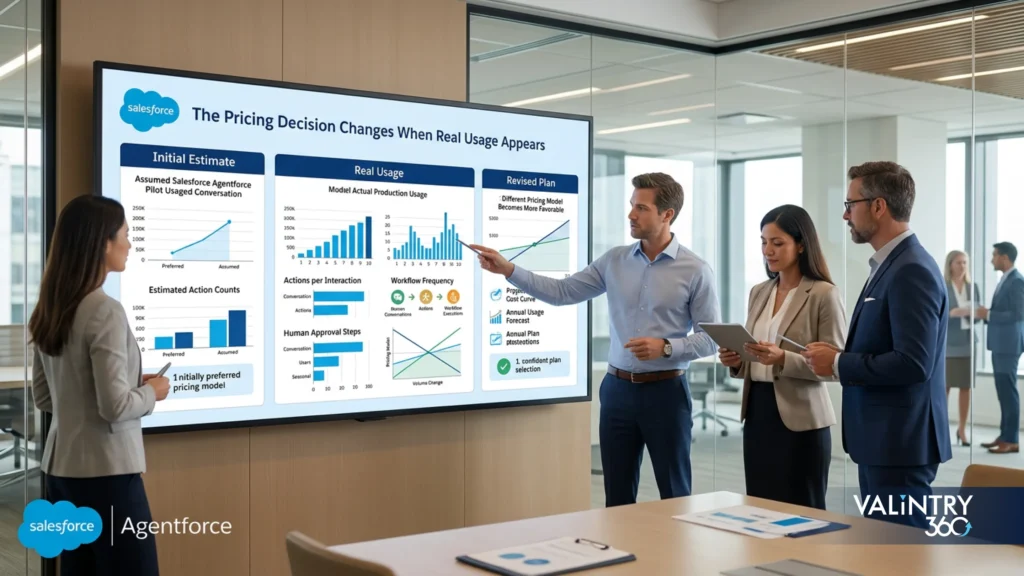
A Salesforce team was preparing to move an Agentforce service workflow from pilot to production. The initial assumption was simple: choose the most predictable pricing model and scale it with usage. But once the team mapped actual conversation volume, action depth, employee access, and workflow complexity, the cheapest option changed significantly.
The Cost Model Before the Decision
The team evaluated the available Agentforce pricing models:
- Conversations: $2 per conversation
- Flex Credits: $500 per 100,000 credits, with a standard action using 20 credits or approximately $0.10 per action
- Pay-per-resolution: $2 per resolved session, billed only on a successful outcome
- Per-user access: $5/user/month requiring Flex Credits, with $125 and $150/user/month unmetered options for employees
The key finding was that conversation volume alone could not determine the right model. Two workflows with the same number of conversations could have completely different Agentforce costs because their action depth was different.
The Break-Even Test
The team first calculated the standard crossover point: $2 per conversation ÷ $0.10 per standard action = 20 actions.
That created a practical pricing rule:
Workflow Pattern | Average Actions | Pricing Direction |
Order status and simple FAQs | 1–3 | Flex Credits |
Routine service assistance | 5–10 | Flex Credits |
Complex case resolution | 20+ | Evaluate Conversations |
Unproven deflection rate | Unknown | Start with pay-per-resolution |
Heavy employee usage | Highly variable | Compare per-user |
Voice-heavy workflows | Depends on usage | Model separately |
This changed the discussion from “Which Agentforce plan is cheaper?” to “How much work does each outcome actually require?”
What the Numbers Revealed
The team modeled three production scenarios:
Scenario 1: High-volume self-service
20,000 conversations per month with two standard actions each produced approximately 40,000 actions. Flex Credits came to $4,000 per month against $40,000 per month on the conversation model. Flex Credits were clearly more economical.
Scenario 2: Routine service
10,000 conversations with eight actions each produced 80,000 actions. Flex Credits came to $8,000 per month against $20,000 per month on the conversation model. Again, Flex Credits provided the lower usage cost.
Scenario 3: Complex resolution
10,000 conversations with 28 actions each produced 280,000 actions. Flex Credits came to $28,000 per month against $20,000 per month on the conversation model. Here, conversation pricing became more attractive because the workflow exceeded the 20-action crossover.
The Decision Was Not Based on Price Alone
The final evaluation also included costs outside the Agentforce meter: Data 360 and governed data access, integration with external systems, testing and regression checks, human review and escalation, monitoring and support, seasonal usage spikes, and implementation and governance.
The team therefore built its business case around cost per resolved outcome, rather than simply cost per conversation or cost per action.
The Final Pricing Strategy
Instead of forcing one pricing model across every workflow, the team adopted a usage-based evaluation framework. Low-action workflows went to Flex Credits. Deep, action-heavy conversations went to Conversations. High-frequency employee usage went to a per-user evaluation. This allowed each Agentforce use case to be measured according to its actual consumption pattern.
Business Lesson
The biggest pricing insight was simple: Agentforce cost is driven by the work performed inside the interaction, not just the number of interactions.
A $2 conversation can be expensive for a two-action request but economical for a 28-action resolution. Likewise, a low per-user price can still require usage credits and supporting Salesforce capabilities.
For budgeting, the team now tracks monthly volume, actions per outcome, voice usage, user access, data requirements, implementation costs, and ongoing support before selecting or changing an Agentforce pricing model. The result is a pricing decision based on real operating economics rather than a headline Salesforce price.
Working With A Certified Salesforce Partner On Agentforce Pricing
We are a certified Salesforce consulting partner, and a large part of what we do on Agentforce engagements happens before anything gets built. It happens in the pricing conversation.
Sitting between you and Salesforce, we can do things a buyer cannot easily do alone. We know what the current rate card actually says, which allocations are negotiable, where the order form language matters, and which inconsistencies between the pricing page and the contract need to be resolved in writing before you sign.
More importantly, we can tell you what your usage is likely to look like, because we have modelled it before. The single most expensive mistake in an Agentforce rollout is choosing a metering model from a slide instead of from measured action depth. A two-week measured pilot changes the model choice more often than it confirms it.
What We Bring To The Table
- A measured baseline. Actions per resolved outcome, taken from your workflows rather than estimated.
- Model selection with the maths shown. Conversations, Flex Credits, pay-per-resolution, per-user or a bundled edition, tested against your real volume and your real action depth.
- Order form review. Credit allocations, rollover terms, session duration definitions and resolution criteria confirmed in writing rather than assumed.
- Architecture that keeps the meter honest. Action boundaries, retrieval design and data governance that stop an agent burning credits on work it should never have done.
- Ongoing governance after launch. Digital Wallet review, failed-action analysis and a monthly re-forecast, so the model you chose in month one is still the right one in month nine.
We are not the cheapest way to buy Agentforce and we do not pitch ourselves that way. We are the way to buy it once, correctly, with a cost model that survives contact with production. If you want that conversation, our Salesforce consulting team can walk your workflows and give you the numbers before you commit to a model.
See How We Have Done This For Other Salesforce Teams
The cost model in this guide is not theoretical. It comes out of the work we do with Salesforce customers across service, sales, healthcare, manufacturing and financial services.
Our case studies show the same pattern repeating. A team assumes a pricing model, we measure what the workflow actually consumes, and the answer changes. Sometimes it changes the model. More often it changes the agent design, and the cheaper bill is a side effect of a better-built agent.
If you want to see the before and after on real engagements, including where the cost went and what changed operationally, our case studies are worth twenty minutes. Read them at https://valintry360.com/case-studies
The Honest Answer: Which Agentforce Pricing Model Should You Choose
Salesforce Agentforce pricing is not expensive or cheap by itself. It is sensitive to workflow design. Agentforce $2 per conversation can be the best model when a conversation contains more than about 20 standard actions. Agentforce Flex Credits can be the best model when the agent handles lower-action or variable work. Pay-per-resolution can be the best model when the deflection rate is unproven. Agentforce per-user pricing can be the best model when employees use agents frequently enough that seat-based predictability matters more than pure consumption math.
If the question is simply how much does Agentforce cost, the honest range is $0 to $550 per user per month plus usage, and the usage half is the part that moves.
The real mistake is choosing a model before calculating the work. The definitive comparison is not conversations versus Flex Credits versus per-user pricing in isolation. It is average actions per outcome, monthly volume, voice usage, employee usage, Data 360 dependency, implementation scope, governance effort, and support model. That is where Agentforce break-even cost math becomes useful.
For 2026 budgeting, the cleanest rule is this: use Flex Credits when action depth is low and controllable, use conversation pricing when action depth is high or unpredictable, use pay-per-resolution when you cannot yet predict the resolution rate, and use per-user pricing or a bundled edition when named employees will rely on agents every day. Then revisit the model after real consumption data arrives. Sales
Salesforce Agentforce Pricing FAQs
1. What is Salesforce Agentforce Pricing in 2026?
Salesforce Agentforce pricing in 2026 includes conversation pricing, Flex Credits, pay-per-resolution, per-user pricing and bundled editions. Buyers should compare the models by estimating conversation volume, average action count, user access, Data 360 needs, implementation effort, and ongoing support.
2. How much does Salesforce Agentforce cost?
Salesforce Agentforce costs $0 on the free Salesforce Foundations tier, $500 per 100,000 Flex Credits on usage-based pricing, $2 per conversation on the conversation model, $2 per resolved case under pay-per-resolution, $5 per user per month for the Agentforce User Licence, $125 to $150 per user per month for the employee add-ons, and $195 to $550 per user per month across the Core, Advanced and Max editions. Most organisations pay a combination rather than a single one of these.
3. What are the Agentforce pricing models?
The practical Agentforce pricing models are $2 per conversation, Flex Credits, pay-per-resolution, per-user licensing and the bundled Core, Advanced and Max editions. Each fits a different usage pattern, so the best choice depends on action depth, volume, resolution rate and user behavior.
4. What does Agentforce $2 per conversation mean?
Agentforce $2 per conversation means the buyer pays a flat conversation unit rather than pricing every standard action separately. It can work well when conversations are complex, but it can be expensive when most conversations need only one or two actions.
5. What are Agentforce Flex Credits?
Agentforce Flex Credits are Salesforce usage credits consumed by actions, prompts, translations, and voice actions depending on the use case. In public pricing, Flex Credits are shown at $500 per 100,000 credits, with standard Agentforce actions using 20 credits. Buyers should still review the Flex Credits rate card before signing.
6. What is Agentforce cost per action?
Agentforce cost per action is the cost created when an agent performs a priced action. Using public examples, a standard action costs about $0.10 because it uses 20 Flex Credits and each credit costs about $0.005. The Flex Credits rate card is the reference for usage-type differences.
7. What is Agentforce pay-per-resolution pricing?
Pay-per-resolution is the outcome-based billing model for the Agentforce Help Agent. You pay $2, or 400 Flex Credits, only when the agent successfully resolves an inquiry. Actions and Data 360 queries inside that session are not metered separately. If the customer escalates to a human, Salesforce does not bill for the session.
8. How is a resolution defined in Agentforce?
A session counts as a billable resolution when it has at least two turns of messages, the final user feedback is not explicitly negative, and it either ends without escalation to a human or ends with explicitly positive feedback. A session that runs past two turns with no feedback and no escalation request is also treated as resolved once it exceeds the session duration limit, which is two hours for messaging and ten minutes for voice.
9. What is the break-even point between conversations and Flex Credits?
The standard Agentforce break-even cost math is $2 divided by $0.10, which equals about 20 standard actions. Below 20 actions, Flex Credits are usually cheaper. Above 20 actions, conversation pricing can be cheaper.
10. Which Agentforce pricing model is cheapest?
There is no single cheapest model. Flex Credits are cheapest when a conversation needs fewer than about 20 standard actions. Conversation pricing is cheapest above that threshold. Pay-per-resolution is cheapest when your resolution rate is below 100 percent, because unresolved sessions are free. Per-user pricing is cheapest when named employees use agents heavily every day.
11. Is Agentforce conversation pricing better than Flex Credits?
Agentforce conversation pricing is better when conversations are deep, unpredictable, or action-heavy. Flex Credits are better when the team can keep action count low and measurable. The right choice depends on average actions per outcome.
12. When are Agentforce Flex Credits cheaper?
Agentforce Flex Credits are usually cheaper when a workflow needs fewer than about 20 standard actions per conversation. They are also useful for pilots, variable usage, low-action self-service, and workflows where action design can be controlled.
13. Is there a free version of Agentforce?
Yes. Salesforce Foundations gives customers on Enterprise Edition or above a no-cost entry point that includes a starter allocation of Flex Credits and Data Cloud credits, plus Agent Builder and Prompt Builder. It is enough to build and test an agent. It is not enough to run one in production at volume.
14. Can you use Flex Credits and Conversations in the same org?
No. Salesforce requires you to choose one metering model per org. That makes the choice more consequential than it first appears, because you cannot route cheap intents to credits and expensive intents to conversations inside the same environment.
15. Do Agentforce Flex Credits roll over?
Unused Flex Credits do not roll over past their stated term. That matters most for teams buying a large bundled allocation through Core, Advanced or Max, because credits included with an edition are worth nothing if the agents never consume them.
Related Posts
- Salesforce Managed Services
How Much Agentforce Cost? Full TCO With Data…
Agentforce costs $500 per 100,000 Flex Credits, which prices a standard agent action at $0.10 and a Voice action at $0.15. That's the meter. The bill is bigger, because your edition licences, Data 360 processing, implementation and running costs all…
- Salesforce Managed Services
How Agentforce Flex Credits Work: Cost Per Action…
Salesforce Agentforce Flex Credits are consumption credits that pay for the metered work an AI agent performs. One standard Agentforce action consumes 20 Flex Credits, credits sell at $500 per 100,000, and that makes a standard action about $0.10 at…
- Salesforce Managed Services
What Is an Agentic Enterprise in Salesforce, and…
An agentic enterprise is an organization where AI agents complete governed work end to end, across data, systems and workflows, instead of only surfacing answers for a person to act on. In the Salesforce context, that means Agentforce 360 agents…