How a Salesforce Implementation for Higher Education Gave AdventHealth University a 360 View of Every Alumnus

A Medical University Reinvents Its Alumni Management Efforts

AdventHealth University had 25 years of alumni records and no real way to use them. Contact details, giving history, and continuing education activity were spread across systems that could store information but couldn’t help anyone act on it. AHU came to us wanting a system of impact rather than a system of record. We delivered a Salesforce implementation for higher education built around alumni relationships, covering the full org setup, an ETL data migration, opportunity and activity tracking, Outlook integration, and hands-on user training. The result: AHU can now craft a full 360 view of each alumnus after graduation, and staff satisfaction improved because the system is genuinely easy to use.

A Medical University With 25 Years of Alumni to Reconnect

AdventHealth University trains nurses, physician assistants, imaging professionals, and other healthcare practitioners, and its graduates go on to work across the AdventHealth network and well beyond it. Those alumni matter to the university in more ways than most people outside higher education realize. They’re donors, they’re continuing education students, they’re referral sources for new applicants, and their outcomes feed directly into accreditation reporting.

An alumni network that spans 25 years represents thousands of relationships, each with its own history. AHU’s Alumni Relations team knew the value was there. What they needed was a Salesforce alumni management system that could turn a quarter century of records into relationships the team could actively manage.

The Challenge: A System of Record That Couldn’t Drive Action

AHU framed the problem clearly when the project started. Three requirements shaped everything we built:

•      Create a new system of impact rather than simply a system of record, so the platform would prompt action instead of just storing data

•      Visualize existing alumni data so the team could make informed decisions based on what was already there

•      Enable more accurate record keeping to improve communication, fundraising, continuing education, and accreditation across an alumni network spanning 25 years

That third point carried the most weight. Four different university functions depended on the same alumni records, and when those records were incomplete or scattered, every one of those functions suffered. A fundraising appeal went to an outdated address. A continuing education offer missed the alumni most likely to enroll. Accreditation reporting took longer than it should have.

Our Approach: A Salesforce Implementation Built Around the Alumni Relationship

We started with the foundation. Our team set up the Salesforce Organization along with Accounts, Contacts, Roles, Profiles, and a set of standard Reports and Dashboards, structured specifically around how AHU thinks about alumni rather than a generic CRM template. Getting Roles and Profiles right early mattered here, because Alumni Relations, fundraising, and continuing education staff all needed access to the same records with different permissions and different views.

Next came the data. We handled the data configuration and migration through a full ETL process, bringing 25 years of alumni records into Salesforce in a clean, structured, usable form. Migration is where most higher education CRM projects either succeed or quietly fail, because a platform loaded with duplicate, incomplete, or badly mapped records will never earn the trust of the people using it. We treated the migration as a data quality exercise, not just a transfer.

With the foundation and data in place, we built out the working layer of the system. Opportunity Management gave AHU a way to identify and track fundraising and engagement opportunities across the alumni base, applying the same discipline to a giving conversation that a sales team applies to a deal. Activity and relationship tracking captured every touchpoint, so anyone opening an alumnus record could see the full history of interactions rather than guessing at it.

We then completed the Outlook integration so staff could work from the inbox they already lived in, with email activity flowing back into Salesforce automatically and projections available alongside it. This is the part of any Salesforce implementation services engagement that quietly determines adoption. If logging an interaction takes an extra five steps, it won’t happen.

Finally, we ran platform testing and user training before handover. As a Salesforce consulting and implementation partner, we treat training as part of the build rather than an afterthought, because a system nobody understands is a system nobody uses.

Tools and Products Used

This Salesforce alumni management build stayed on the core platform, with integration and migration work around it:

•      Salesforce: the CRM platform at the center of the solution, configured around alumni relationships rather than a standard sales pipeline

•      Accounts, Contacts, Roles, and Profiles: the core org structure, set up so multiple university teams could work from shared records with the right permissions

•      Standard Reports and Dashboards: built to give the Alumni Relations team visibility into engagement, giving, and continuing education activity

•      ETL data migration: used to configure and move 25 years of alumni records into Salesforce as clean, structured data

•      Opportunity Management: applied to identify and track fundraising and engagement opportunities across the alumni base

•      Activity and relationship tracking: captured every alumni touchpoint so staff could see the complete interaction history on any record

•      Outlook integration: connected staff email to Salesforce, with projections available alongside day to day correspondence

Platform testing and user training rounded out the engagement, so AHU’s team could operate the system confidently from day one.

The Results: A Full 360 View and a Team That Actually Likes the System

The headline outcome is visibility. AHU is now able to craft a full 360 view of each alumnus after graduation, pulling contact details, giving history, continuing education activity, and every logged interaction into a single record. The system of impact AHU asked for at the start is what they got, because a complete view is what makes the next action obvious.

The second outcome is adoption. Staff satisfaction improved based on how easy the system is to use, which for an internal platform is the metric that predicts everything else. A CRM only becomes a system of impact when the people responsible for those relationships choose to work inside it.

AreaOutcome
Alumni visibilityFull 360 view of each alumnus after graduation
Staff experienceImproved staff satisfaction based on ease of use of the system
Data foundation25 years of alumni records migrated into Salesforce through a full ETL process
Daily workflowOutlook integration, activity tracking, and opportunity management in one platform

In the Client’s Words

“Exceptional team, project was completed in record time and it meets all of our needs. I am always confident that the team will solve any issue that arises.”

Dawn Creft, Director of Alumni Relations, AdventHealth University

If your institution is sitting on years of alumni data that nobody can act on, our Salesforce implementation services team can help you turn it into relationships your staff can actually manage. Get in touch to talk through what a Salesforce implementation for higher education would look like at your university.


How a Salesforce Health Cloud Implementation Helped Tri-County Hearing Services Reach Every Patient Seven Times in Sixty Days

Medical Practice Automates and Personalizes Its Sales Process With Health Cloud

Tri-County Hearing Services had a follow-up problem that most medical practices will recognize. A prospective patient calls, gets added to a list, and then whether anyone follows up depends on how busy the week is. We delivered a Salesforce Health Cloud implementation through our Quick Start program, customizing Health Cloud’s Patient Relationship Management functionality for the hearing aid and audiology vertical and overlaying High Velocity Sales on top of it. Tri-County can now touch each patient 7 times within 60 days without significant programming, and new leads route automatically to Care Coordinators through APIs and automation.

A Hearing Practice Where Follow-Up Decides the Outcome

Tri-County Hearing Services helps patients with hearing loss find and fit the right hearing aids. That journey is rarely a single conversation. Someone who calls about a hearing test often takes weeks or months to move forward, working through cost, insurance questions, and the personal decision to treat their hearing at all.

This makes patient follow-up the practice’s most important process, and also its easiest to drop. Tri-County needed a Salesforce implementation for medical practices that could hold each patient relationship steadily over time rather than relying on staff to remember who was due for a call.

The Challenge: A CRM That Could Follow Up Without Being Asked

Tri-County came to us with four clear requirements for the CRM solution:

•      Store and track leads, so every prospective patient enquiry landed somewhere reliable instead of a notepad or an inbox

•      Automate follow up tasks, removing the dependency on a staff member remembering to make the next call

•      Make sales assignments using High Velocity Sales, so each new lead reached the right person quickly

•      Create reports based on client, patient, appointment type, and other practice-specific fields

The requirement underneath all four was simplicity. Tri-County is a small practice without a development team, so any solution requiring significant custom programming would work for a while and then quietly break.

Our Approach: Health Cloud Customized for Audiology, With High Velocity Sales on Top

We ran the project through our Quick Start program, which suits a practice that needs the platform working properly and quickly. The build had two layers, and the order mattered.

The first layer was Health Cloud. We customized Health Cloud’s Patient Relationship Management functionality specifically for the hearing aid and audiology vertical, rather than deploying it as a general-purpose healthcare configuration. That meant shaping records and fields around how a hearing practice actually works: the appointment types Tri-County offers, the way a hearing evaluation leads to a fitting, and the details staff need visible when a patient calls back three weeks later. A Salesforce Health Cloud implementation earns its value in exactly this kind of detail, because generic patient records give staff no more context than a spreadsheet would.

Salesforce patient relationship management also gave Tri-County a proper structure for storing and tracking leads. Every enquiry became a record with a full history attached, which is what makes reporting on client, patient, and appointment type possible later.

The second layer was High Velocity Sales, overlaid on top of Health Cloud to drive timely follow up. This is where the practice’s real problem got solved. Rather than leaving follow-up to memory, the High Velocity Sales implementation gave Tri-County structured cadences: a defined sequence of touchpoints that surfaces the right task, for the right patient, on the right day.

We then built automatic lead assignment using APIs and automation, so a new lead routes straight to a Care Coordinator the moment it arrives. Nobody triages a queue, and no lead waits for someone to notice it.

Across both layers we stayed inside configuration and standard functionality wherever we could. That decision is why Tri-County reaches patients seven times in sixty days without needing a developer on call.

Tools and Products Used

This build combined two Salesforce products with automation connecting them:

•      Salesforce Health Cloud: the platform at the center of the implementation, customized for the hearing aid and audiology vertical

•      Patient Relationship Management: Health Cloud’s PRM functionality, configured to store and track leads with full patient history and practice-specific detail

•      High Velocity Sales: overlaid on Health Cloud to drive structured, timely patient follow-up and handle sales assignments

•      APIs and automation: used to assign new leads to Care Coordinators automatically as they arrive

•      Reporting: configured around client, patient, appointment type, and the other fields the practice needed visibility into

Health Cloud gave Tri-County the patient context, and High Velocity Sales gave the practice the discipline to act on it consistently.

The Results: Seven Touchpoints in Sixty Days, With No Programming Required

The headline outcome is consistency. Tri-County can now reach each patient 7 times within 60 days, without the need for significant programming to make it happen. For a practice where the decision to pursue hearing treatment takes time, that steady presence is often what turns an enquiry into an appointment.

The second outcome is speed at the front of the process. Automatic assignment of leads to Care Coordinators through APIs and automation means a new enquiry reaches a real person immediately, with the patient’s record already in place. The gap between someone reaching out and someone responding closed almost entirely.

Both outcomes come from the same foundation. Because the Health Cloud implementation was configured for how a hearing practice actually works, and because High Velocity Sales was layered on rather than rebuilt from scratch, Tri-County got an automated follow-up process the practice can run itself.

AreaOutcome
Patient follow-up7 touchpoints with each patient within 60 days, without significant programming
Lead assignmentAutomatic routing of leads to Care Coordinators via APIs and automation
Patient recordsHealth Cloud PRM customized for the hearing aid and audiology vertical
ReportingReports built around client, patient, appointment type, and practice-specific fields

In the Client’s Words

“Working with VALiNTRY360 was great! They were able to leverage their knowledge of healthcare and help us customize our Salesforce Health Cloud environment as well as our High Velocity Sales package. This enabled us to get the most out of our Salesforce instance. Our business is now growing much faster because of what VALiNTRY360 helped us build.”

Kevin Reiser, President, Tri-County Hearing Services

If patient follow-up at your practice depends on someone remembering to make the call, our Health Cloud implementation servicesSalesforce patient relationship management  team can help you build a process that runs on its own. Get in touch to talk through what a Salesforce Health Cloud implementation would look like for your practice.

How Salesforce for Clinical Trial Patient Operations Helped TrialSpark Reach 85% Patient Engagement in the First Month

Healthcare Technology Company Improves Patient Operations With Sales, Service, and Marketing Clouds

TrialSpark needed to handle a rising volume of clinical trial enrollments and support cases without losing sight of any individual patient. Cases had to reach the right coordinator, escalations had to reach a clinician, and patients had to stay informed through every milestone of a study. We built Salesforce for clinical trial patient operations, combining Service Cloud and Shield with Omnichannel routing, a public-facing patient community, and Marketing Cloud journeys. Patient engagement reached 85% in the first month of a new trial deployment, time to resolve study-related support tickets fell 77%, and enrolling each new participant now takes 20 hours less.

A Healthcare Technology Company Running Clinical Trials at Volume

TrialSpark works in clinical trials, where the operational unit is a person deciding whether to join a study and then staying with it. Enrollment is the beginning of a relationship that runs for months, involves scheduled milestones, and depends on the patient understanding what happens next.

That makes patient operations both a support function and a communication function at the same time. A patient calling with a question is a support case. A patient who has not heard anything in three weeks is a retention risk. The two run on the same record and the same relationship, and treating them as separate workstreams is how trials lose participants. TrialSpark also needed all of this to work across many studies at once, each with its own criteria, its own coordinators, and its own set of questions patients ask.

The Challenge: Seven Requirements Across Enrollment, Routing, and Patient Communication

TrialSpark asked for a digital transformation solution that would do seven things:

•      Manage high volumes of support cases and the influx of new subjects for clinical trials and studies

•      Visualize the enrollment pipeline of new studies

•      Route clinical trial caseloads to the appropriate research coordinator or clinical support agent

•      Integrate with their cloud-based telephony platform and their internal operational application

•      Escalate patient support to a clinician or physician for review

•      Keep patients informed of the various milestones of their clinical trial and the next steps

•      Deliver public FAQs tied to specific clinical trials

Read together, the seven requirements describe one system rather than seven features. A question arriving by phone, a routing decision, a clinician review, and a milestone reminder are all events in the same patient relationship. TrialSpark needed them recorded in one place so that volume could grow without the patient experience thinning out.

Our Approach: Salesforce for Clinical Trial Patient Operations, From Enrollment to Escalation

We started with the foundation. Our Salesforce Service Cloud implementation deployed Service Cloud with Salesforce Shield to handle the influx of patient enrollments, and we integrated the platform with TrialSpark’s internal operational application so the two stopped holding separate versions of the same patient. Shield matters here because clinical trial records carry a higher bar than ordinary customer data, and the controls needed to sit inside the platform rather than around it.

We then set up work queues to support the various stages of the clinical trials and used Omnichannel to route work to the appropriate clinical support agent based on queue availability. Studies move through stages, and a case belongs to a stage before it belongs to a person. Queues that mirror those stages meant a case reached an agent qualified to answer it, and omnichannel meant it reached an agent who was actually free.

Voice came next. We integrated AWS Connect with Service Cloud so support agents work in one screen whether they are taking an inbound call or placing an outbound one. Call context and case record sit together, which removes the pause at the start of a call where an agent asks the patient to identify themselves and their study.

For patients who would rather not call at all, we deployed a public-facing community for clinical trial subjects. It lets patients self-serve through study-specific knowledge articles and case deflection features, so a common question about a specific trial gets answered without a case being created. That is where the public FAQ requirement was met, and it is the piece that keeps case volume from scaling in lockstep with enrollment.

Escalation and visibility were handled together. We created a flow that routes escalations to the appropriate clinician based on specific study criteria, which put a defined path between an agent who cannot answer a clinical question and the person who can. Alongside it we built reports and dashboards that isolate patient experience across studies, show enrollment volumes, and measure the SLA of the clinical support agents. Enrollment pipeline visibility came out of that work.

The last piece was proactive communication. We connected Service Cloud with Salesforce Marketing Cloud to build a clinical study experience and journey, with triggered emails and SMS based on each patient’s engagement in the study. A patient approaching a milestone hears about it before they wonder. A patient who has gone quiet gets reached rather than noticed later. That connection is what turns Salesforce for clinical trial patient operations into something patients feel, rather than a system that only helps the staff.

Tools and Products Used

This build spanned three Salesforce clouds and several platform capabilities:

•      Salesforce Service Cloud: the core of the build, handling patient support cases across every stage of every study

•      Salesforce Shield: added platform-level protection around clinical trial patient records

•      Omnichannel: routed work to the appropriate clinical support agent based on queue availability

•      AWS Connect: integrated with Service Cloud for inbound and outbound calling inside the agent workspace

•      Experience community: a public-facing community for clinical trial subjects, with study-specific Knowledge articles and case deflection

•      Salesforce Flow: routed escalations to the appropriate clinician based on specific study criteria

•      Reports and dashboards: isolated patient experience by study, showed enrollment volumes, and measured clinical support agent SLA

•      Salesforce Marketing Cloud: connected to Service Cloud to drive the clinical study journey with triggered emails and SMS

•      Salesforce Sales Cloud: part of the Salesforce environment for this project

Service Cloud holds the record, Marketing Cloud acts on it, and the routing, telephony, and community layers decide how each patient reaches TrialSpark and how quickly TrialSpark reaches back.

The Results: 85% Patient Engagement, 77% Faster Resolution, and 20 Hours Saved Per Enrollment

Overall patient engagement hit 85% in the first month of a new trial deployment. That number comes out of the Marketing Cloud journeys more than anything else. Patients received messages tied to where they actually were in the study, which is different from a schedule of announcements sent to everyone at once.

Time to resolve study-related support tickets dropped 77%. Three things caused it. Queues put cases in front of qualified agents, Omnichannel put them in front of available ones, and the community answered a share of the questions before they became cases at all. The AWS Connect integration removed the rest of the friction by keeping the call and the record in one place.

Enrolling each new participant now takes 20 hours less. Enrollment was where the manual work concentrated, spread across systems that did not talk to each other. Integrating the internal operational application with Service Cloud, and giving coordinators one view of the enrollment pipeline, is what recovered those hours.

AreaOutcome
Patient engagement85% overall patient engagement in the first month of new trial deployment
Support resolution77% reduction in time to resolve study-related support tickets
Enrollment20 hours saved in time to enroll each new participant
Case routingWork queues by study stage, with Omnichannel routing to the appropriate clinical support agent
Patient self-servicePublic-facing community with study-specific Knowledge articles and case deflection

Patient Operations Is a Support Problem and a Communication Problem

Clinical trials depend on people staying. A participant who drops out costs the study more than the enrollment did, and most of the reasons people leave trace back to not knowing what is happening or not getting an answer when they asked.

TrialSpark treated both as one problem. Support and communication were built on the same record, so the system that answers a patient’s question is the system that knows when to reach out unprompted. The engagement number and the resolution number moved together for that reason.

If your patient or participant operations are spread across systems that do not share a record, our team can help. Get in touch to talk through what Salesforce for clinical trial patient operations would look like for your studies.

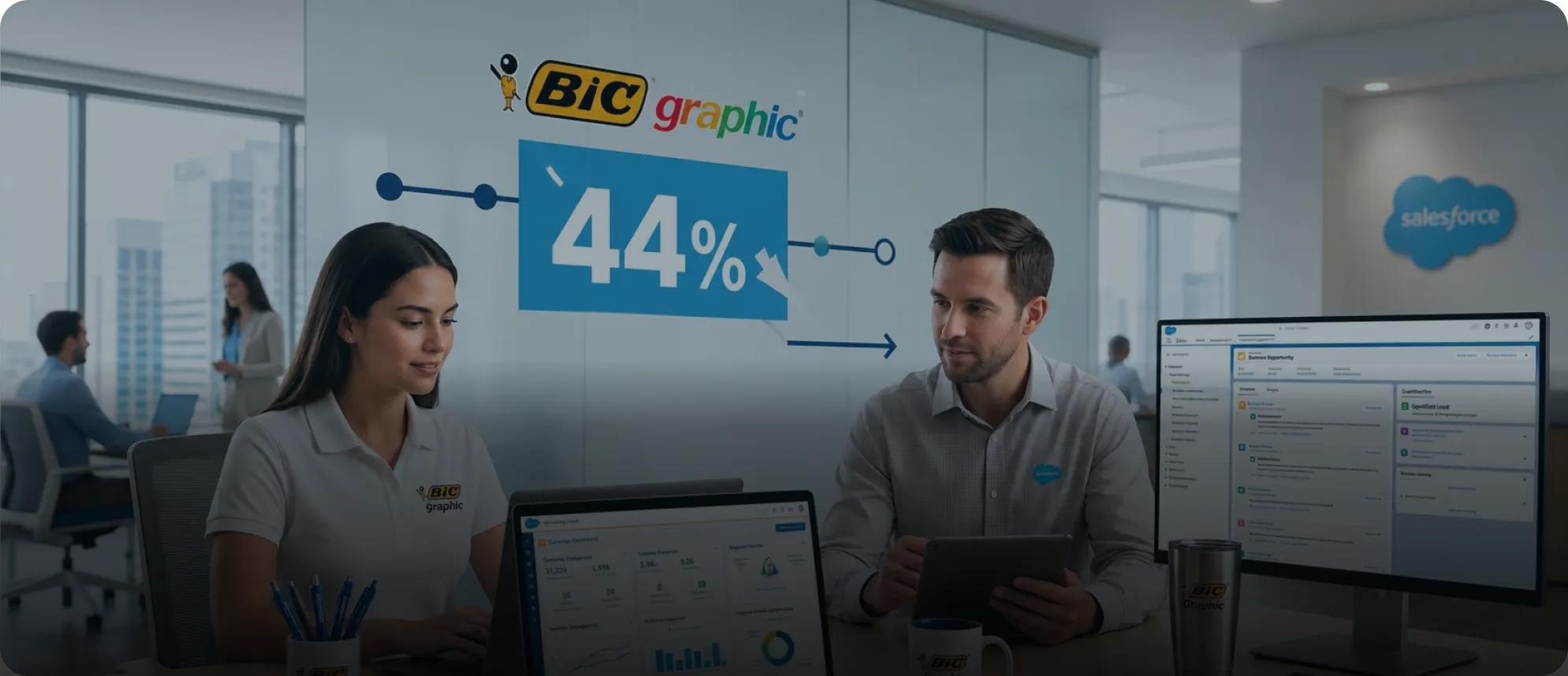
How a Salesforce Marketing Cloud Implementation Helped BIC Graphic Cut Its Sales Cycle by 44%

A Consumer Products Giant Transforms the Customer Experience With Marketing Cloud

BIC Graphic sells promotional products through a large distributor network, and its marketing was stuck in the past. Distributors received the same mass campaigns as everyone else, sales and marketing worked from different priorities, and there was no easy way to turn a distributor relationship into a repeat online order. We partnered with BIC Graphic on a full Salesforce Marketing Cloud implementation to fix that. Within weeks of launch, the results were already showing: a 44% drop in the average distributor sales cycle, a 25%+ increase in new pipeline opportunities within eight weeks, and a 10% rise in new online orders in the first four weeks alone.

A Consumer Products Giant With a Channel Problem

BIC Graphic is known for turning branded merchandise into a marketing and promotional tool for its own distributor and reseller network. That business model creates a specific challenge. BIC Graphic sells through a network of distributors, who in turn sell to businesses and consumers, rather than selling to end customers directly. That’s a B2B2C structure, and it means every marketing effort has to work on two levels at once: supporting the distributor relationship and shaping the end customer experience underneath it.

Before we came on board, BIC Graphic didn’t have the engagement data or automation needed to manage that dual relationship well. The company had the ambition to market more intelligently, but not yet the systems to act on it.

The Challenge: A Distributor Network Without a Personalized Strategy

A few problems stood out once we started digging into how BIC Graphic’s marketing and sales teams were actually operating:

•      No real marketing automation or centralized customer insights, which made it hard to know what any given distributor or end customer actually needed

•      A distributor network still treated with traditional mass-marketing strategies instead of campaigns built around each distributor’s specific relationship with BIC Graphic

•      No alignment between sales and marketing on how to approach the B2B2C model, which let leads fall through the cracks between a distributor conversation and a marketing touchpoint

•      Customer journeys that were genuinely cumbersome to manage without a system built for it

Our Approach: A Salesforce Marketing Cloud Implementation Built for B2B2C

We started by defining a personalized B2B2C marketing approach built specifically around how BIC Graphic sells, not a generic template pulled off the shelf. From there, we moved into the technical build: a full Salesforce Marketing Cloud implementation covering Email Studio, Contact Builder, Journey Builder, and Automation Studio. Contact Builder gave BIC Graphic a single, structured view of its distributor and customer data instead of scattered records with no shared context. That data foundation mattered, because none of the automation that followed would have worked without clean, connected data behind it.

Email Studio and Journey Builder became the engine for three distinct types of customer journeys, each solving a different piece of the original problem:

•      Internal sales enablement journeys gave BIC Graphic’s own sales reps a way to deliver more value to existing distributor relationships instead of relying on generic outreach

•      Distributor enablement journeys handled brand awareness, keeping distributors informed about new product promotions and giving them tools to support their own channel sales

•      Customer retention journeys focused on the end customer, reinforcing brand loyalty, driving more traffic to BIC Graphic’s eCommerce site, and encouraging repeat orders instead of one-off purchases

Automation Studio tied all of this together behind the scenes, running the workflows that kept each journey moving without adding manual work for BIC Graphic’s team. This kind of Salesforce Marketing Cloud implementation only works when every tool is mapped to a real business problem instead of being deployed for its own sake, and that mapping is where most of our effort went.

Tools and Products Used

This project relied entirely on the Salesforce Marketing Cloud platform, with four core studios doing the heavy lifting:

•      Salesforce Marketing Cloud: the overall platform that powered the implementation, giving BIC Graphic one connected environment for data, email, automation, and customer journeys

•      Email Studio: used to design, personalize, and send the campaigns behind each customer journey, replacing the one-size-fits-all mass emails BIC Graphic relied on before

•      Contact Builder: brought distributor and customer data together into a single structured view, forming the foundation every journey and automation was built on

•      Journey Builder: mapped out the sales enablement, distributor enablement, and customer retention journeys, triggering the right message at the right point in each relationship

•      Automation Studio: ran the behind-the-scenes workflows that kept data flowing and journeys executing on schedule, without added manual work for BIC Graphic’s team

As a marketing cloud implementation company working across B2B2C businesses, we’ve found that these tools only deliver results when they’re configured around how a company actually sells, not just switched on and left to run.

The Results: Measurable Movement Within Weeks

The impact showed up fast. Within the first four weeks after launch, BIC Graphic saw a 10% increase in new online orders, an early signal that the customer retention journeys were doing their job of driving traffic back to the eCommerce site.

The average distributor sales cycle dropped by 44% following the implementation, a direct reflection of pairing sales enablement journeys with a properly aligned B2B2C strategy. Within eight weeks, new pipeline opportunities grew by more than 25%, showing that distributor enablement journeys were successfully driving brand awareness and engagement across the channel.

MetricResultTimeframe
New online orders+10%First 4 weeks
Average distributor sales cycle-44%Since implementation
New pipeline opportunities+25%+Within 8 weeks

Together, these numbers show a distributor network that finally had the data and automation to work as one coordinated sales and marketing engine, rather than two teams pulling in different directions.

Why This Matters for Other B2B2C Brands

BIC Graphic’s results show what’s possible when a Salesforce Marketing Cloud implementation is built around a company’s actual sales structure rather than a one-size-fits-all playbook. A B2B2C model adds complexity that generic marketing automation doesn’t solve on its own, and it takes a marketing cloud implementation service that understands both the distributor relationship and the end customer experience to get it right.

If your business sells through a distributor or reseller network and your marketing hasn’t caught up to that complexity, we can help. At VALiNTRY360, we work as a marketing cloud implementation company that builds journeys around how you actually sell, not just how the software works out of the box.

How a Salesforce Sales Cloud Implementation Gave Highmark Health a 360-Degree View of 35,000 Employees’ Ideas

Healthcare Leader Finds Prescription for Success With Sales Cloud

Highmark Health had a good problem. Its innovation program, thinkUP, was pulling in ideas from across a workforce of 35,000 employees, and the volume had outgrown the tools meant to manage it. Executives couldn’t see which ideas were moving, financial projections lived in a complex data model that was slow to work with, and reporting meant manual effort every time. We delivered a Salesforce Sales Cloud implementation that turned thinkUP into a single central database, with Campaigns and Opportunities tracking every idea, customized Lightning Components handling the complex flows, and a Salesforce Tableau integration giving leadership a visual view of the whole portfolio. Today, more than 300 executive-level users work from that platform, with a 360-degree view of every project’s status and financial projection.

A Healthcare Leader Managing Innovation at Scale

Highmark Health is one of the largest healthcare organizations in the United States, spanning health insurance, care delivery, and a wide range of related services. With 35,000 employees, it has a deep pool of people who see day-to-day where the business could work better, and thinkUP was built to capture those ideas and turn the best of them into funded projects.

The challenge with any program like that is scale. A few hundred ideas can live in a spreadsheet. Tens of thousands of employees contributing ideas, each with an owner, a status, a business case, and a financial projection, need a real system behind them. That’s what Highmark Health’s CRM team came to us for: a Salesforce healthcare implementation that could handle idea management the way Sales Cloud normally handles a sales pipeline.

The Challenge: Too Many Ideas, Too Little Visibility

Highmark Health asked us to provide a solution that would do four things the existing setup couldn’t:

•      Handle the sheer number of ideas being generated among 35,000 employees without losing track of any of them

•      Speed up the repetitive processes involved in reviewing ideas and manage a complex financial data model behind each business case

•      Let executives view, create, and track ideas generated by themselves and their team members in one central database rather than across scattered documents

•      Provide a way to visualize and report on the data so leadership could see the portfolio as a whole, not one idea at a time

Underneath those four requirements sat a technical one. The existing approach was code-first, which meant every change to the process required a developer, and every developer change added complexity that the CRM team had to maintain long after go-live.

Our Approach: A Salesforce Sales Cloud Implementation Built on Configuration, Not Code

The first decision shaped everything else: we built the solution on Sales Cloud’s standard objects and declarative tools wherever possible, and reserved custom code for the places where configuration genuinely couldn’t do the job. That’s a deliberate choice in any Sales Cloud implementation services engagement, and here it was the difference between a platform Highmark Health could support in-house and one that would always depend on outside developers.

We mapped thinkUP’s idea lifecycle onto Sales Cloud’s Campaigns and Opportunities. Each innovation initiative became a Campaign, and each idea within it became an Opportunity, carrying its owner, stage, status, and financial projection the same way a sales deal would. That gave Highmark Health a central database out of the box, with all of Sales Cloud’s native tracking, ownership, and stage history working immediately.

The complex flows were where the real work happened. Idea review at Highmark Health involves multiple steps, approvals, and financial calculations, so we enhanced those flows with customized Lightning Components. The components handled the parts of the process that standard page layouts couldn’t, while still living inside Salesforce’s configuration framework rather than a separate codebase.

For reporting, we designed custom report types that matched the thinkUP data model exactly, so the CRM team could build reports on the fields and relationships that mattered without workarounds. Then we integrated Tableau for visual representation, connecting Sales Cloud data to dashboards that let executives see portfolio health, project status, and financial projections in one view.

Throughout, we worked as a Sales Cloud implementation partner alongside Highmark Health’s Director of CRM and his team, so the people who would own the platform after handover were involved in every configuration decision along the way.

Tools and Products Used

This Salesforce healthcare implementation stayed close to the core platform, with Tableau as the one major addition:

•      Salesforce Sales Cloud: the platform at the center of the solution, repurposed from sales pipeline management to enterprise idea and project tracking

•      Campaigns and Opportunities: standard Sales Cloud objects used to represent innovation initiatives and the individual ideas within them

•      Lightning Components: customized components built to handle the complex review and approval flows that standard layouts couldn’t support

•      Custom report types: designed to match the thinkUP data model so the CRM team could report directly on the fields and relationships that mattered

•      Tableau: integrated with Sales Cloud to give executives visual dashboards of project status and financial projections across the whole portfolio

The Salesforce Tableau integration was what turned a well-structured database into something executives actually wanted to open. Sales Cloud held the data, and Tableau made it readable at a glance.

The Results: One Platform, 300+ Executives, Full Portfolio Visibility

The most visible outcome is adoption. More than 300 executive-level users now work in the platform, viewing, creating, and tracking ideas from their own teams and across the organization. For an internal tool at a company of Highmark Health’s size, that level of executive use is the clearest sign the system fits how people actually work.

The second outcome is what those executives can see. The Salesforce Sales Cloud implementation, combined with Tableau, gives Highmark Health a 360-degree view of all project statuses and financial projections in one place. Leadership no longer has to ask for a report to understand where the innovation portfolio stands.

The third outcome is the one Highmark Health’s CRM team feels every day. Moving from a code-first approach to a configuration-based deployment decreased the complexity of the platform and made it far easier for the internal team to support and extend thinkUP without waiting on developers.

AreaOutcome
Executive adoption300+ executive-level users on the platform
Portfolio visibility360-degree view of all project statuses and financial projections
Idea trackingIdeas from 35,000 employees tracked in one central database via Campaigns and Opportunities
Ongoing supportConfiguration-based deployment reduced complexity and improved the CRM team’s ability to support thinkUP

In the Client’s Words

“Switching from a code-first approach to a configuration-based deployment decreased the complexity and increased our ability to support the thinkUP project.”

Paul Shatlock, Director of CRM, Highmark Health

If your organization is running an important process on spreadsheets or custom code that only a developer can change, our Sales Cloud implementation services team can help you rebuild it through a Salesforce Sales Cloud implementation your own team can own. Get in touch to talk through what that could look like.

How Salesforce Contract Renewal Automation Lifted Kroger Prescription Plans’ Renewal Rates by 14%

Specialty Pharmacy Operator Found the Cure for Revenue Leakage With Service Cloud

Kroger Prescription Plans was losing revenue it had already won. Contracts came up for renewal without a defined process behind them, sales performance and customer attrition were hard to see, and each business line sold its own way. We delivered Salesforce contract renewal automation on Service Cloud, along with a standardized sales process, integrated client onboarding, and executive dashboards built on sales analytics. Renewal rates rose 14% with the automated renewal process in place, and 4 months came out of the sales cycle.

A Specialty Pharmacy Operator Losing Revenue It Had Already Earned

Kroger Prescription Plans operates in a specialty pharmacy, where contracts are long, renewals are the backbone of the business, and every client relationship spans both commercial teams and clinical operations. Revenue is not won once. It is won and then held.

That makes the contracting lifecycle the center of the business rather than an administrative task at the edge of it. A renewal that slips, a margin that erodes quietly, or a client who leaves without anyone noticing the warning signs all cost more than a missed new deal. Kroger Prescription Plans had the relationships and the volume. What it lacked was a system that made the state of those relationships visible while there was still time to act.

The Challenge: Revenue Leakage With No System Underneath It

The brief was to mitigate revenue leakage, and the leakage came from a set of gaps:

•      No insight into sales performance, customer attrition, or retention rates

•      No consistent sales process to maintain existing margins or drive new revenue

•      No shared understanding of the contracting lifecycle and renewals

•      No standardized tools or processes for new client onboarding across the commercial and labor lines of business

•      No scalable CRM to manage customer interactions and pipeline visibility

Revenue leakage is rarely one leak. It is what happens when a renewal has no owner, a margin has no benchmark, and an at-risk client produces no signal until the contract is gone. Each gap on its own looks survivable. Together they meant the company could describe its revenue after the fact but could not manage it while it was still in play.

Our Approach: Salesforce Contract Renewal Automation on a Standardized Sales Process

We started with the foundation, because none of the rest works without it. Putting a scalable Salesforce CRM under the business gave Kroger Prescription Plans one place for customer interactions and pipeline, which is the prerequisite for measuring anything. Until interactions are captured, sales performance and attrition are opinions.

We then created and implemented a new sales process for the various business lines. Commercial and labor lines had been selling differently, and different processes produce numbers that cannot be compared. A standardized sales process gave the company one definition of a stage, one definition of a qualified deal, and a basis for holding margins rather than discovering afterward that they had moved.

Renewals came next, and this is where our Salesforce Service Cloud implementation did the most work. We automated the contract renewal lifecycle to increase the speed of the renewal process. Renewals stopped depending on somebody remembering a date. The system tracks where each contract sits, moves it forward, and surfaces the ones that need attention, which turns renewal from an event that happens to the company into a process the company runs.

We also integrated sales and clinical operation processes for new client onboarding, using cases, milestones, and automations. In specialty pharmacy, those two sides have to hand off cleanly, because a client sold by a commercial team is served by a clinical one. Milestones made the handoff visible, cases gave every open item an owner, and automations removed the manual steps where onboarding used to stall.

Finally, we enabled dashboards for the executive team, built on sales analytics for performance management. Leadership can now see sales performance, attrition, and retention as they move. That closed the first gap in the challenge list, and it is what makes the rest of the Salesforce contract renewal automation work measurable rather than assumed.

Tools and Products Used

This build is centered on Service Cloud, within a wider Salesforce environment:

•      Salesforce Service Cloud: the core of the build, carrying the automated contract renewal lifecycle, the case and milestone structure behind new client onboarding, and the executive dashboards

•      Salesforce Marketing Cloud: part of the Salesforce environment for this project

Service Cloud holds the contract, the client, and the onboarding work in one place, which is what lets a renewal date, a margin, and a service issue be read as facts about the same relationship.

The Results: 14% Higher Renewal Rates and 4 Months Off the Sales Cycle

Renewal rates increased 14% with the automated renewal process in place. The automation is the cause. A renewal that is tracked, escalated, and worked on a schedule closes more often than one that depends on a person noticing the date, and specialty pharmacy contracts are large enough that a few percentage points of renewal rate is significant revenue.

The sales cycle came down by 4 months. The new sales process did that. When every business line runs the same stages, deals stop stalling in the gaps between one team’s method and another’s, and the onboarding automations removed the delay that used to sit between a signature and a client actually being served.

The third result has no number and underwrites both of the others. Executive dashboards gave leadership live visibility into sales performance, customer attrition, and retention rates. Revenue leakage that used to be discovered in hindsight is now visible while something can still be done about it.

AreaOutcome
Renewals14% increase in renewal rates with an automated renewal process
Sales cycle4 months saved
Sales processNew sales process created and implemented across the various business lines
Client onboardingSales and clinical operation processes integrated using cases, milestones, and automations
Executive visibilityDashboards built on sales analytics for performance management

Revenue Leakage Is a Process Problem Before It Is a Sales Problem

Companies that lose revenue at renewal usually do not have a selling problem. They have a memory problem. The contract was won, the relationship is intact, and the renewal slips because nothing in the business was responsible for it on the right day.

Kroger Prescription Plans fixed that by making the contracting lifecycle something the system runs rather than something people remember. The renewal rate moved because the process moved, and the executive dashboards mean the next leak gets spotted while it is still small.

If contracts are slipping through your renewal process, or your business lines each sell a different way, our team can help. Get in touch to talk through what Salesforce contract renewal automation would look like for your business.

How a Custom Salesforce Health Cloud Application Gave Converge Medical Technology End-to-End Patient Record Management

Medical Device Provider Makes Patient Management Less of a Pain in the Neck With Health Cloud

Converge Medical Technology needed one system to run patient care and the commercial side of a medical device business at the same time. Leads, claims submittals, medical records, device usage, recertification, and inventory each sat in their own process, which made reporting across them difficult. We built a custom Salesforce Health Cloud application covering all six areas in one place, from real-time lead notifications through nationwide inventory audit logs. Health coaches now connect directly with patients and track their progress, and Converge has insight into leads, revenue, patient engagement, and product usage from a single patient record.

A Medical Device Provider Managing Patients, Claims, and Devices at Once

Converge Medical Technology provides medical devices, and that business carries obligations most companies never deal with. A person using the device is a patient, a customer, and the subject of a medical record at the same time. Clinical outcomes and commercial outcomes run on one timeline, and the same record has to serve both.

That creates a specific operational problem. A device provider has to move a lead through a sales and claims submittal process, hold medical records securely, monitor how the patient actually uses the product, keep certification current, and know where every unit of inventory sits across the country. Each of those has its natural home in a different system. Converge wanted them in one, because the alternative is a team that spends its time reconciling systems instead of serving patients.

The Challenge: One System for Leads, Records, and Reporting

Converge came to us wanting an end-to-end patient record management solution that would do three things:

•      Provide a user-friendly way to enter and track new leads throughout the sales and claims submittal process

•      Manage medical records and monitor customer usage, progress, and satisfaction

•      Deliver detailed reporting and analysis across all of it

The three requirements look separate and are really one. A lead becomes a patient. A patient generates a claim. A claim covers a device. The device produces usage data that determines whether recertification is warranted. Split that chain across systems and it breaks at every handoff, which turns reporting into reconstruction. Converge needed the chain intact.

Our Approach: A Custom Salesforce Health Cloud Application Built Around the Patient Record

We built a custom Salesforce Health Cloud application rather than configuring a standard one, because the path from lead to device to recertification doesn’t match a stock process. Health Cloud put the patient record at the center. Everything we built afterward attaches to it.

The front of the funnel came first. The application delivers real-time notifications for leads as they move through the sales and submittal process, so nobody has to check a queue to learn that a lead has advanced. Speed matters more here than in most sales processes, because a submittal sitting still usually means a patient waiting for a device.

For claims tracking in Salesforce we built custom objects with workflows attached. A claim has its own lifecycle, its own statuses, and its own reasons for stalling, and forcing that into a standard object flattens the detail Converge needs. Custom objects let the team track a claim as the thing it actually is, and workflows move it along without someone having to remember the next step.

The application then tracks patient engagement and service to ensure proper recertification, and gives health coaches a direct line to the patients they support. A coach connects with the patient inside the application and tracks product usage, progress, and any changes in work capacity. Work capacity is the outcome that matters most in this business, and keeping it on the same record as the claim and the device means the clinical picture and the commercial picture stop being two separate conversations.

Inventory was the last piece and the least conventional. The application generates audit logs that let Converge manage inventory nationwide without an ERP connection. Most device providers solve nationwide inventory by integrating an ERP, which is a longer and more expensive build. Audit logs inside the same application gave Converge the control it needed without adding another system to maintain and reconcile.

Analytics sit on top of all of it, covering leads, revenue, customer satisfaction, and inventory. Because those four measures come off the same patient record management foundation rather than four different sources, the numbers agree with each other. That is what made detailed reporting and analysis achievable instead of aspirational.

Tools and Products Used

Three Salesforce products appear in this build:

•      Salesforce Health Cloud: the foundation of the custom application, holding the patient record that leads, claims, engagement, device usage, and recertification all attach to

•      Salesforce Service Cloud: part of the Salesforce environment supporting customer service and support activity alongside the patient record

•      Salesforce IoT: included in the Salesforce environment for this project

Health Cloud carries the weight here. It holds the record, and the custom objects, workflows, notifications, and audit logs we built all resolve back to it, which is why Converge can look at a patient, a claim, a device, and a revenue number without leaving one application.

The Results: Better Inventory Control and Direct Coach-to-Patient Contact

Inventory management improved across the country. Audit logs gave Converge a running account of where devices are and what has moved, which is the visibility an ERP integration would normally provide. The team got that control inside the application it already uses every day, with no second system to keep in sync.

Converge also gained greater insight into leads, revenue, patient engagement, and product usage. Those four sat in different places before, and questions that crossed them took manual work to answer. Now the same record answers all four, so the company can look at a patient population and a revenue trend without treating them as unrelated topics.

The change patients feel is the coaching one. Health coaches connect directly with patients and track their progress, including product usage and changes in work capacity. That contact is what recertification depends on, and it is what turns a device sale into an ongoing relationship the company can measure.

AreaOutcome
Inventory managementImproved nationwide inventory management using audit logs, with no ERP connection required
Business insightGreater insight into leads, revenue, patient engagement, and product usage
Patient contactHealth coaches connect directly with patients and track product usage, progress, and work capacity
Claims and recertificationCustom objects with workflows track claims, and engagement tracking supports proper recertification

When the Patient Record Becomes the Whole Business Record

Medical device companies are asked to be two things at once. They run a commercial operation with leads, claims, revenue, and inventory, and they carry clinical responsibility for people using a device at home. Most build separate systems for the two halves and then spend years trying to connect them.

Converge went the other way. Putting the commercial process on the patient record instead of beside it meant a claim, a coaching conversation, a usage trend, and a device location all describe the same person. That is what made end-to-end patient record management real rather than a phrase in a requirements document.

If your patient data and your business data live in different systems, our Salesforce Health Cloud consulting team can help. Get in touch to talk through what a custom Salesforce Health Cloud application would look like for your organization.

How Pardot Marketing Automation Services Helped Quantros Grow Award Licensing Revenue 6x

Healthcare Analytics Software Company Improves Revenue With Pardot

Quantros had a revenue opportunity sitting in its own award program and no reliable way to act on it. Every year the company names CareChex award winners, and every winner is a potential buyer of a logo license. Reaching them, though, meant manual outreach that didn’t scale and a web experience that struggled on mobile. We rebuilt that whole process with Pardot marketing automation services: persona-specific forms, a drip campaign to keep winners informed, and dynamic content that gave each winner an individualized experience. Pardot now converts at twice the rate of the website, and award licensing revenue grew 6x over the prior year.

A Healthcare Analytics Company With an Untapped Revenue Stream

Quantros provides analytics to healthcare organizations, and its CareChex program measures and recognizes hospital quality performance. Winning a CareChex award is something a hospital wants to promote, which is why Quantros offers licensing for the award logo.

That creates a specific commercial situation. The audience is known in advance, every one of them has a reason to buy, and the window for the purchase opens the moment the award is announced. What Quantros needed was a way to reach that audience at the right time, with a message shaped to who they were.

The Challenge: A Known Audience the Team Couldn’t Reach at Scale

Three problems defined the project at the start:

•      Contacting CareChex award winners to notify them of their award and offer logo licensing options, which was manual work that didn’t scale with the size of the winner list

•      Increasing sales of award logo licenses, turning recognition into a repeatable revenue stream rather than an occasional one

•      Improving the overall user experience, especially on mobile, where the existing pages made a simple purchase harder than it needed to be

The audience for these awards is not uniform either. A hospital marketing director, a quality officer, and an executive each care about a CareChex award for different reasons, and a single generic notification email serves none of them particularly well.

Our Approach: Personas, Automation, and a Message Built for Each Winner

We started by finding out what people actually wanted. Our team created specific Pardot forms designed to gauge customer interest in the awards across multiple personas, so the responses told Quantros not just who was interested but which kind of stakeholder they were and what mattered to them.

Respondents were then entered into a drip campaign that kept them informed with regular updates on the award release and the results. This solved the timing problem. Instead of a single announcement that either landed at a good moment or didn’t, winners received a sequence that built anticipation and stayed present through the period when a licensing decision gets made.

The personalization layer is where this Pardot implementation went further than a standard campaign build. We used dynamic content, conditional Handlebars Merge Language, and custom Pardot fields to create an individualized experience for each winner. Rather than one email with a name merged into the greeting, the content itself changed based on the recipient’s award, persona, and record data. A winner reading their notification saw their own achievement reflected back, not a template.

Conditional HML is what made that practical at scale. It let us build one asset that behaves differently for every recipient, which means Quantros didn’t need a separate campaign for each persona or award category to get a personalized result.

The final piece was the web experience. We updated the website CSS and HTML to deliver an improved user experience on mobile, so a winner who opened an email on their phone and tapped through reached a page built to be used on that phone. Personalized outreach only pays off if the destination works, and mobile was where Quantros was losing people.

Tools and Products Used

This build centered on Pardot, with front-end work supporting the commerce experience:

•      Salesforce Pardot: the marketing automation platform behind the forms, drip campaigns, personalization, and conversion tracking

•      Pardot forms: created to gauge customer interest in the awards across multiple distinct personas

•      Drip campaigns: used to deliver regular updates on award release and results to every respondent

•      Dynamic content and conditional Handlebars Merge Language: combined with custom Pardot fields to build an individualized experience for each award winner

•      Custom Pardot fields: stored the winner and persona data that the dynamic content rules depended on

•      Shopify: the commerce platform behind award logo license purchases

•      Website CSS and HTML: updated to improve the user experience, with particular attention to mobile

Pardot handled the audience and the message, while the front-end work made sure the experience held up once someone acted on it.

The Results: 2:1 Conversion and 6x Revenue Growth

The revenue outcome is the headline. Quantros increased award licensing revenue 6x versus the prior year, turning the CareChex program from a recognition exercise into a genuine revenue stream.

The conversion data explains how. Pardot conversions ran at a 2:1 ratio against website conversions, meaning the personalized, automated path converted at twice the rate of the site on its own. That ratio is the clearest argument for the personalization work, because it isolates what the automation contributed rather than crediting the whole result to more traffic.

Both numbers trace back to the same idea. Quantros already knew who its buyers were and why they would buy. Pardot marketing automation services gave the company a way to reach each of them individually; at the moment the award made the offer relevant, on a device they could actually complete the purchase on.

AreaOutcome
Licensing revenue6x increase versus the prior year
Conversion performance2:1 ratio of Pardot conversions to website conversions
Winner experienceIndividualized content per winner using dynamic content, conditional HML, and custom fields
Mobile experienceUpdated website CSS and HTML for an improved mobile user experience

Turning a Known Audience Into Repeatable Revenue

Plenty of companies have an audience like the CareChex winner list somewhere in their business: a group of people with a clear reason to buy and no consistent way of being reached. What changed for Quantros was treating that group as a segmented, individually addressable audience rather than one list to email.

If your business has an audience like that, our Pardot consulting services team can help you build the automation and personalization to reach it. Get in touch to talk through what Pardot marketing automation services would look like for your revenue programs.

Claim Your Free Implementation Checklist

Claim Your Free Implementation Checklist

Claim Your Free Implementation Checklist

Connect With Us

Need Urgent Help with your Salesforce