
Top 10 Salesforce Org Optimization & Technical Debt Cleanup Partners in 2026: Who Can Make Your Org AI-Ready?
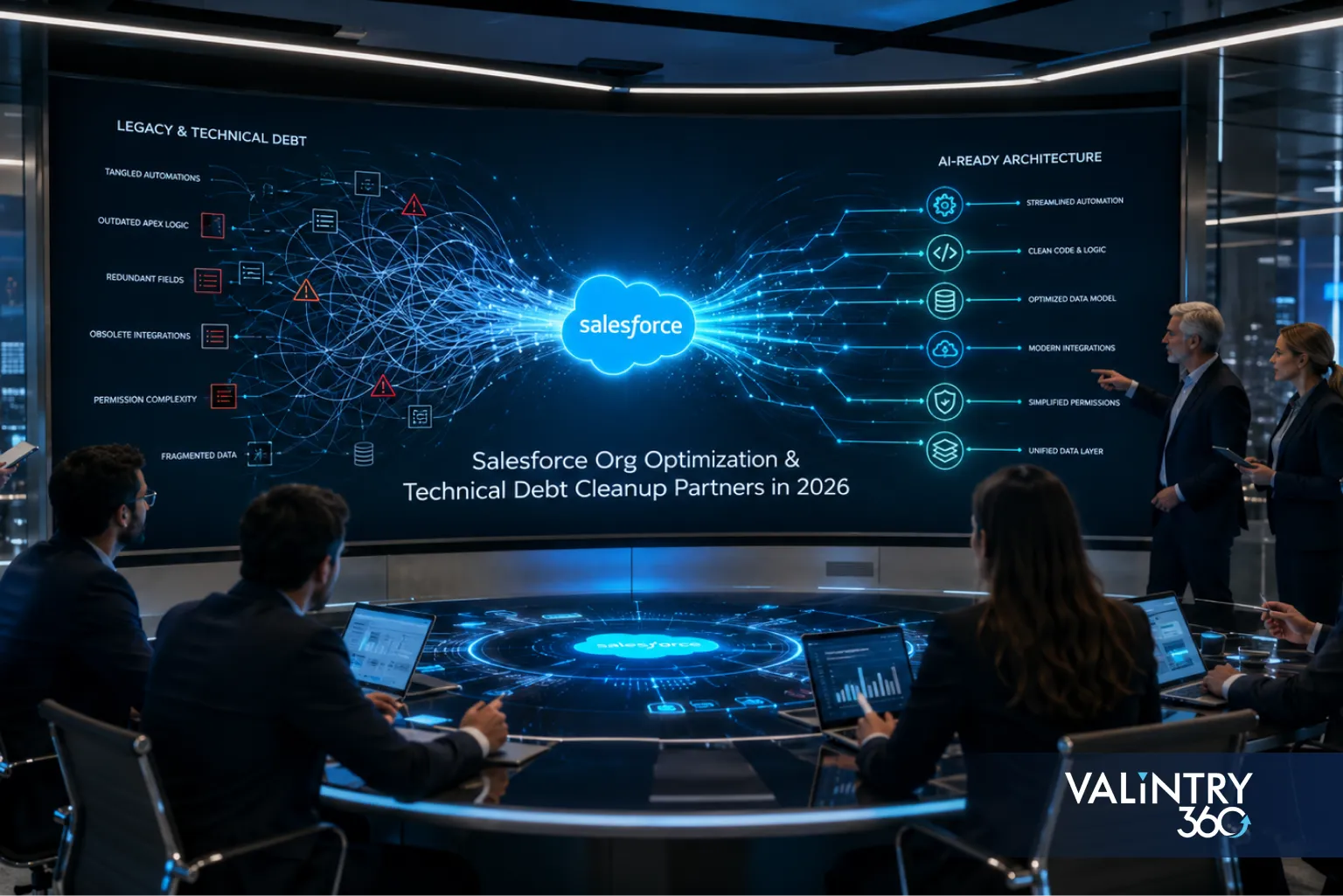
- Salesforce Org Optimization & Technical
Companies are adding AI to Salesforce faster than they’re cleaning the systems that AI will depend on. Years of duplicate data, overlapping automation, old Apex, unused metadata, integration workarounds, and accumulated permissions don’t disappear the moment an AI layer gets switched on. They become the thing the AI layer inherits.
That’s the situation behind this list. If your Salesforce org optimization search brought you here, your system probably still works. It’s just gotten harder to trust, harder to change safely, and harder to explain to anyone new who touches it. The question isn’t whether to clean it up. It’s which partner actually has evidence of doing that work, and which specific problem in your org they’re built to fix.
By the time someone notices the bill has crept up, the org usually has waste sitting in several places at once, not one obvious culprit. The question isn’t just “who can cut our Salesforce costs.” It’s which type of consultant is actually qualified to find the specific kind of waste your organization has, because a licensing negotiator and a technical optimization firm are solving different problems, even when they both call it “cost reduction.”
TL;DR
Ten firms made this list after being evaluated specifically on documented Salesforce technical debt and org optimization work, not general implementation experience relabeled as cleanup expertise. The list spans architecture-focused remediation, data and governance cleanup, and firms whose optimization work is explicitly tied to AI readiness.
AI readiness gets treated as a data problem alone, and it isn’t. Brittle automation, outdated Apex, permission sprawl, weak integrations, and years of accumulated metadata all limit how safely an organization can expand Salesforce or introduce AI, even when the data itself is reasonably clean.
Figure out whether you need optimization, technical-debt cleanup, or full remediation, since that distinction determines the kind of partner you need. Then match your specific debt, automation, data, code, integrations, permissions, to a firm with real evidence of fixing that exact category.
Why Salesforce Technical Debt Matters More in the AI Era
Salesforce’s own AI-readiness guidance is direct about this: AI success starts with clean, connected data, and the company recommends auditing quality, access, and consistency before layering AI capability on top. Separately, Salesforce’s engineering organization tracks technical health continuously across efficiency, security, operational excellence, customization, and observability, and its own published results found that customers who moved from a “Fair” to an “Excellent” technical-health score saw substantially lower case volumes and support costs.
Salesforce is retiring its long-standing Optimizer app, changing one of the familiar ways admins have assessed org health. Org Check remains available as a free Salesforce Labs tool for analyzing technical debt, although Salesforce Labs apps are community projects rather than officially supported Salesforce products. Salesforce is also investing in broader Technical Health measurement across security, efficiency, operational excellence, customization, and observability. That shift reinforces a larger point: org health needs continuous attention rather than cleanup only after performance or maintenance problems become obvious.
What Salesforce Technical Debt Actually Looks Like
Technical debt gets treated as a code problem or a data problem, and it’s neither, exclusively. It shows up across nine distinct areas, and most real orgs carry debt in several of them at once.
Data debt is duplicates, stale records, broken field mappings, and incomplete data. Automation debt is overlapping Flows, old Process Builders, legacy Workflow Rules, and automation logic that quietly contradicts itself. Code debt is brittle Apex, weak test coverage, and outdated development patterns. Metadata debt is unused fields, objects, layouts, reports, and dashboards nobody’s touched in years but nobody’s removed either. Integration debt is aging APIs and brittle point-to-point connections that fail intermittently. Security debt is permission sprawl and access that’s accumulated without anyone auditing it. UX and process debt is the layouts and workflows users have quietly started working around instead of using. DevOps debt is weak testing, undocumented changes, and release practices with no real controls. Architecture debt is excessive customization and tightly coupled components that make the whole system harder to scale.
Salesforce’s own Well-Architected framework is useful here because it defines a healthy org around being trusted, easy, and adaptable, rather than reducing “healthy” to code quality alone. A firm that only talks about Apex isn’t addressing the full picture.
Org Optimization, Technical Debt Cleanup, or Full Remediation?

These aren’t interchangeable, and picking the wrong one wastes budget in one direction or another.
Optimization fits when the system fundamentally works, but performance, efficiency, or scalability could be meaningfully better. Nothing is broken; things could just run cleaner. Technical debt cleanup fits when specific accumulated liabilities, old automation, unused metadata, weak governance, need to be identified and either removed or redesigned before they cause a real problem. Remediation fits when a defect or risk has already crossed into something requiring correction, a security gap, a data integrity issue, a compliance exposure.
If your org has moved beyond optimization or technical debt cleanup into stalled delivery, abandoned adoption, or broken core functionality, the problem has become a Salesforce implementation rescue. Our Salesforce implementation rescue partners guide compares firms specifically equipped to diagnose failed implementations, stabilize existing work, and determine whether the right path is targeted repair, a partial rebuild, or full reimplementation.
How We Selected the 10
We evaluated candidates specifically on documented org optimization and technical-debt work, not general Salesforce implementation experience relabeled as cleanup expertise. Architecture and code remediation depth, data cleanup and governance capability, automation and metadata rationalization, integration modernization, security and DevOps practices, and AI-readiness positioning all factored in, with independent evidence, named case studies, AppExchange listings, and specific published methodology, carrying more weight than a firm’s general reputation or size.
One disclosure: VALiNTRY360 publishes this comparison and is included below, evaluated against the same standard as every other firm on this list.
Top Salesforce Org Optimization & Technical Debt Cleanup Partners in 2026
Firm | Best for | Cleanup evidence | Architecture/code | Data cleanup | AI readiness |
VectorX | Senior architect-led cleanup across scaling orgs | AppExchange-confirmed org optimization and technical debt practice | High | Moderate to high | Named specialty |
Nagarro | Large enterprise org-health remediation | Named healthcare org-health case using SCORE framework | High | Moderate | Moderate |
Green Irony | Preparing an org specifically for AI agents | Confirmed org optimization and AI-readiness positioning | Moderate to high | Moderate to high | Named specialty |
KVP Business Solutions | Industry-specific accelerators with built-in AI blueprints | Confirmed Summit Partner with named AI-ready industry blueprints | Moderate | Moderate | Named specialty |
TechForce Services | Managed, ongoing technical-debt reduction | Confirmed dedicated technical-debt management practice | Moderate to high | Moderate | Moderate |
Eigen X | Multi-admin, multi-partner legacy org cleanup | Confirmed, detailed practitioner-level cleanup methodology | High | Moderate | Moderate |
Solution Junkies | Governance-focused cleanup for regulated organizations | Named pharmaceutical membership-body technical-debt case | Moderate | Moderate to high | Light |
Vantage Point | Legacy org optimization, especially financial services | Established firm with stated optimization content | High | Moderate | Light to moderate |
Metadologie | General health check plus automation rebuild | Established firm with stated cleanup service line | Moderate | Moderate | Light |
VALiNTRY360 | Multi-area health check tied directly to AI readiness | Documented health check, remediation, and AI-readiness services | Moderate to high | Moderate to high | Named specialty with managed-services follow-through |
HyphenX Solutions | Multi-area CRM cleanup tied to data quality, automation, metadata, permissions, and AI readiness | Dedicated Salesforce CRM cleanup and remediation methodology | Moderate | High | Named specialty |
Advayan | Continuous technical optimization across mature Salesforce environments | Documented health checks, unused-metadata cleanup, automation optimization, data controls, and preventive maintenance | Moderate to high | Moderate to high | Moderate |
VectorX
Best for: Organizations whose Salesforce org has become difficult to scale and need senior-level architecture work rather than a junior delivery team.
Why they made the list: VectorX’s AppExchange listing explicitly names AI readiness, org optimization, technical debt cleanup, and ongoing support as core offerings, backed by more than 200 organizations served across finance, manufacturing, healthcare, and other sectors.
Optimization evidence: More than 20 years of combined team experience, senior-architect-led delivery specifically positioned against “layered junior delivery teams,” a real differentiator when the work is diagnostic and judgment-heavy rather than purely procedural.
Where they’re strongest: Direct access to senior architects rather than a delegated team, which matters for diagnostic-heavy cleanup work.
Trade-off: A senior-architect-led model can mean a smaller available bench than a larger firm offers for a very large, multi-workstream cleanup running in parallel.
Nagarro
Best for: Large enterprises needing org-health remediation at a scale that matches a substantial, publicly traded technology services firm.
Why they made the list: Nagarro is real and substantial, a Frankfurt-listed IT services firm with roughly 17,700 employees and around €1 billion in revenue, with stated Salesforce org-health assessment work.
Optimization evidence: Nagarro documents a healthcare engagement using its SCORE framework to assess business, UX, security, architecture, and technical health. The work included remediating Apex, LWC, and Flow issues, strengthening security controls, restructuring architecture, and creating a prioritized governance roadmap.
Where they’re strongest: Enterprise scale and a large global delivery organization capable of supporting complex, multi-region cleanup work.
Trade-off: That scale generally comes with an engagement model built for larger organizations; a smaller company may find a more specialized boutique firm a faster, more direct fit.
Green Irony
Best for: Organizations specifically preparing an existing Salesforce org for AI agents rather than pursuing general cleanup for its own sake.
Why they made the list: Green Irony’s Salesforce practice is explicitly positioned around optimizing orgs for AI agents, cleaner data, and faster adoption, framing that lines up directly with this article’s central question.
Optimization evidence: A stated focus on configuration rationalization, data integrity, and integration architecture specifically as prerequisites for agent readiness, not a generic cleanup pitch retrofitted with AI language.
Where they’re strongest: The tightest alignment on this list between cleanup work and a specific AI-readiness destination.
Trade-off: If AI readiness isn’t your near-term goal, this specific positioning matters less, and a firm with broader general optimization evidence may be a better fit.
KVP Business Solutions
Best for: Organizations in manufacturing, healthcare, hospitality, real estate, or financial services wanting industry-specific cleanup tied to a productized AI blueprint.
Why they made the list: A confirmed Salesforce Summit Partner headquartered in Bangalore, with more than 500 projects delivered across 21-plus countries and industry-specific accelerators that explicitly plug into Agentforce and Data Cloud blueprints.
Optimization evidence: Named, productized industry blueprints designed to take an org from cleanup to an “AI-ready foundation” using pre-built data models and journeys, a concrete, differentiated offering rather than a general services pitch.
Where they’re strongest: Speed within a specific industry vertical, since the productized blueprints are built to shortcut the path from cleanup to AI activation.
Trade-off: The productized approach works best when your organization’s needs match one of KVP’s existing industry blueprints; a highly custom or unusual business process may need a more bespoke approach.
TechForce Services
Best for: Organizations wanting ongoing, managed technical-debt reduction rather than a single cleanup project.
Why they made the list: A confirmed, dedicated Salesforce technical-debt management practice, positioned specifically as a managed-services offering rather than a one-time engagement.
Optimization evidence: A stated structured process, a full system checkup, prioritized cleanup, then ongoing monitoring designed to prevent debt from reaccumulating, with governance and training built into the model.
Where they’re strongest: The ongoing-monitoring piece, cleanup that includes a mechanism for staying clean rather than reverting to the same state a year later.
Trade-off: A managed, ongoing model suits organizations planning for continuous upkeep; a company that just needs a defined, one-time cleanup project may not need the full managed-services structure.
Eigen X
Best for: Orgs that have survived multiple admins, multiple consulting partners, and years of “just add a field” requests without anyone stepping back to look at the whole system.
Why they made the list: Eigen X publishes detailed, first-person practitioner content specifically about approaching orgs with years of accumulated technical debt, genuine depth rather than a generic services page.
Optimization evidence: A named Org Health Optimizer reviewing automation, legacy Workflow Rules, Process Builder, Apex, data, security, adoption, and license use, and current Summit Consulting Partner status on AppExchange.
Where they’re strongest: Real practitioner-level understanding of how orgs accumulate debt over years across multiple partners, which shows in the specificity of their published methodology.
Trade-off: The strength here is diagnostic depth on legacy, multi-partner orgs specifically; a newer org with a single, more contained debt problem may not need that particular depth of experience.
Solution Junkies
Best for: Regulated or governance-sensitive organizations, membership bodies, scientific and professional associations, needing cleanup with a strong compliance and sustainability lens.
Why they made the list: A stated named engagement reducing technical debt for a pharmaceutical and scientific membership organization, covering automation rationalization, custom-code complexity, data and metadata, security, and governance.
Optimization evidence: Its published client case covers automation rationalization, custom-code complexity, data and metadata cleanup, security, governance, platform stability, and a prioritized optimization roadmap designed to improve long-term Salesforce maintainability.
Where they’re strongest: A governance-first lens suited to organizations where long-term maintainability and compliance matter as much as immediate performance.
Trade-off: Publicly documented optimization evidence is narrower than some firms higher on this list. Ask for additional examples that match your industry, Salesforce architecture, and specific debt categories before making a final selection.
Vantage Point
Best for: Organizations, especially in financial services, running a legacy Salesforce org that’s grown unwieldy over years of incremental changes.
Why they made the list: Vantage Point publishes detailed guidance on optimizing legacy Salesforce orgs and has documented Financial Services Cloud work involving environments burdened by years of technical debt, customizations, fragmented automation, and complex integrations.
Optimization evidence: Published content specifically addressing legacy org optimization strategies; the firm’s strongest independently verified evidence remains its rescue-specific work rather than a named optimization case study.
Where they’re strongest: Deep familiarity with financial-services-specific architecture and integrations, useful when your legacy debt includes industry-specific systems.
Trade-off: Their most concretely documented evidence leans toward rescue work rather than proactive optimization; confirm directly whether their optimization engagement model matches your situation, which is earlier-stage than a full rescue.
Metadologie
Best for: Organizations wanting a general health check paired with automation rebuild and user re-adoption support.
Why they made the list: An established Salesforce partner with a substantial delivery record (200-plus deployments) and a stated service line explicitly covering health check, technical-debt cleanup, automation rebuild, and re-adoption.
Optimization evidence: The stated service line directly names the categories this article covers; independent, named case-study detail is thinner than the top firms on this list, so this is best treated as a credible general option rather than a specialized cleanup firm.
Where they’re strongest: Breadth across common business integrations (QuickBooks, DocuSign, Stripe, Avalara) alongside the cleanup work itself.
Trade-off: Organizations with a highly specific architecture or code-remediation problem may find a firm with deeper evidence in that exact specialty a stronger fit than Metadologie’s broader health-check and optimization model.
VALiNTRY360
Best for: Organizations wanting a single, multi-area health check that connects directly to an AI-readiness plan and continues with managed monitoring afterward.
Why they made the list: A documented Health Check service covering broken Flows, Apex, risky permissions, duplicate data, integration issues, code quality, technical debt, performance, and release practices, paired with a separate remediation and optimization service and an AI Readiness offering that explicitly connects readiness to data quality, integration, governance, and security.
Optimization evidence: Three distinct, published service lines, health check, remediation, and AI readiness, that map directly onto the nine debt categories covered in this article, plus ongoing managed-services support once the initial cleanup is complete.
Where they’re strongest: The direct line from diagnostic health check through to AI-readiness planning, rather than treating cleanup and AI preparation as separate conversations.
Trade-off: That breadth suits organizations with debt spread across several categories; a company with one narrow, well-understood problem, a single broken integration, for instance, may not need the full multi-area health check before the fix begins.
Which Optimization Partner Fits Your Salesforce Org?
Ten firms are only useful if you can quickly match your specific situation to the right one. This matrix does that directly.
Your org looks like… | Cleanup capability you need | Best-fit partners |
Years of overlapping Flows and automation | Automation rationalization and architecture | Eigen X, VectorX |
Duplicate and unreliable customer data | Data cleanup and governance | VALiNTRY360, Metadologie |
Old Apex and brittle customizations | Code remediation and architecture | VectorX, Eigen X |
ERP or API connections are difficult to maintain | Integration modernization | Vantage Point, Metadologie |
Permissions have accumulated for years | Security and access cleanup | VALiNTRY360, Solution Junkies |
Thousands of unused fields, reports, and metadata | Metadata rationalization | Eigen X, TechForce Services |
Every Salesforce release feels risky | DevOps, testing, and architecture discipline | Nagarro, VectorX |
Users work around Salesforce instead of using it | UX, process optimization, and adoption | Metadologie, VALiNTRY360 |
Salesforce works, but scaling is getting harder | Enterprise org-health optimization | Nagarro, VectorX |
Preparing Salesforce for Agentforce or AI | Data, architecture, security, and governance together | Green Irony, KVP Business Solutions, VALiNTRY360 |
The last row deliberately has three firms rather than two, since “AI readiness” is the article’s central question and three firms have evidence built specifically around that destination rather than general cleanup with AI language added afterward.
What Should You Clean Up Before Adding Salesforce AI?
This is the question the title promises an answer to, so here it is directly, in priority order.
Start with data quality. Duplicate accounts, inconsistent naming, and missing fields don’t confuse an AI agent the way they’d confuse a person. An agent acts on what’s there with full confidence, wrong included. Then permissions, since an agent inherits the access it’s given, and permission sprawl that was merely messy for human users becomes a real governance risk once something autonomous is operating inside those boundaries. Automation comes next: overlapping Flows and legacy Workflow Rules that quietly contradict each other create unpredictable behavior for a human working around them daily and unpredictable behavior for an agent trying to execute against them. Integration reliability matters because an AI feature grounded on data from a system with an intermittently failing sync is grounded on data that’s sometimes wrong without anyone knowing it. Metadata cleanup, dead fields, unused objects, matters less for AI directly and more for the human team’s ability to understand and maintain whatever gets built on top of the existing structure. Architecture overall determines how safely new capability, AI or otherwise, can be added without destabilizing what already works. And governance ties all of it together: someone has to own the decisions about what an AI feature can access and do, which only works if the underlying access model is already coherent.
Treat this as foundation work that should happen before a broader Salesforce AI rollout. A cleaner, better-governed org gives future AI projects more reliable data, automation, permissions, integrations, and architecture to build on. If AI adoption is already on the roadmap, a structured AI readiness assessment can help identify which data, governance, security, and integration gaps need attention before implementation begins.
How to Prioritize Salesforce Technical Debt
Technical debt needs prioritization. Start with the items creating the most business, security, maintenance, or change risk, then work down to lower-impact debt that can safely wait.
Weigh business risk first: which debt, if it caused a failure, would hurt the business most directly. Then security and compliance risk, since permission sprawl or weak access controls in a regulated environment carries consequences well beyond inconvenience. Frequency of failure matters next: an integration that breaks weekly deserves attention before a rarely-used report that’s technically stale but causes no real harm. Change impact asks how much a given piece of debt slows down or endangers future work. Tightly coupled architecture that makes every new Flow risky is worth fixing before something more contained. Maintenance cost looks at what’s quietly consuming the most admin or developer time right now. AI dependency asks whether a specific piece of debt sits directly in the path of an AI feature you’re planning, since that moves it up the list regardless of how it would otherwise rank. And user impact closes the list: debt that’s actively pushing people back to spreadsheets deserves attention before debt that’s technically present but invisible to daily users.
Running your own backlog through these seven lenses, rather than tackling debt in whatever order it was discovered, is what separates a genuinely prioritized cleanup from a list that just gets worked top to bottom.
What Should a Salesforce Org Optimization Assessment Include?
A real assessment covers architecture, Apex and Lightning Web Components, Flow and automation logic, data quality, integrations, permissions, metadata, reports and dashboards, installed packages, DevOps and release practices, user experience and adoption, documentation, and AI readiness specifically. Any assessment that stops at “your data is a little messy” without touching the other eight categories from earlier in this article isn’t a full assessment, it’s a data audit with a broader label attached.
Our Salesforce Health Check is built around this full scope rather than a narrower slice of it, if you want to see what a structured version of this assessment looks like before committing to a partner.
Red Flags in a Technical Debt Cleanup Partner
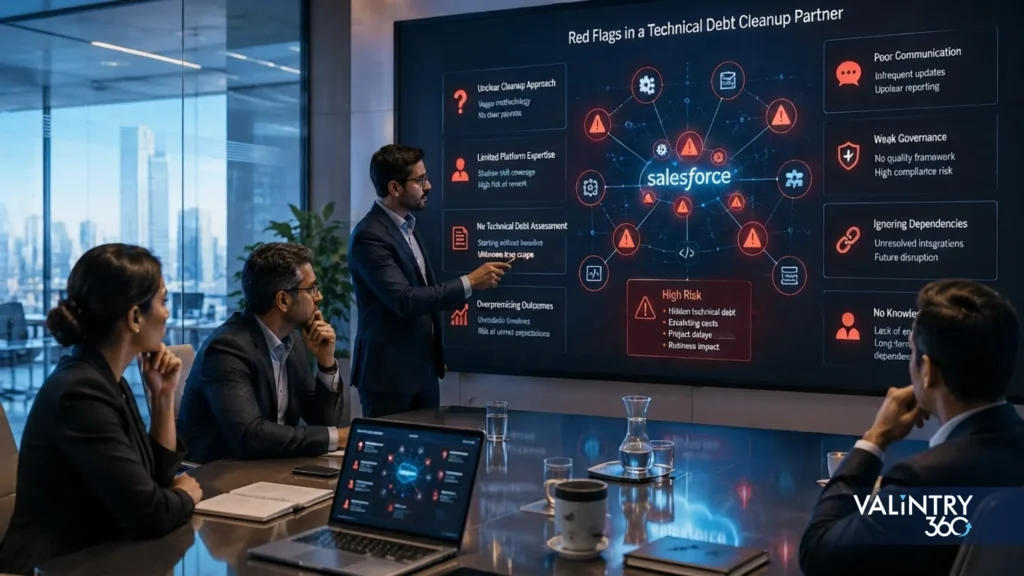
A handful of behaviors are worth treating as real warning signs. A partner who wants to delete metadata without running a dependency analysis first is risking breaking something that quietly depends on the thing they’re removing. A partner who calls every customization “bad” by default hasn’t distinguished between customization that reflects a genuine business need and customization that’s genuinely redundant, those are different things and deserve different treatment. A partner who recommends AI features before reviewing your data is skipping the exact step this article has been making the case for. A partner who optimizes code and architecture while ignoring the business processes those systems support is fixing the technical layer while leaving the actual source of user frustration untouched. A partner who can’t clearly explain their rollback plan or testing approach is asking you to trust changes to production without a real safety net. And a partner who measures success by how many components they deleted, rather than by reduced risk or improved maintainability, is optimizing for an activity metric instead of an outcome.
Where VALiNTRY360 Fits
VALiNTRY360 is included in the ten above, evaluated against the same standard as every other firm on this list.
VALiNTRY360 tends to fit best where technical debt spans several areas rather than one isolated issue. The health-check model covers data, automation, integrations, permissions, architecture, and AI readiness together, with Salesforce managed services available afterward for ongoing monitoring, administration, maintenance, and optimization. A narrow, well-understood technical problem may be better suited to a specialist with deeper evidence in that exact area.
The Bottom Line
AI readiness starts with the Salesforce foundation underneath the AI: data, automation, permissions, integrations, architecture, and governance that teams can trust.
Match your specific debt, data, automation, code, integrations, permissions, metadata, architecture, to a firm with real evidence of fixing that exact category, using the Fit Matrix above. Prioritize the cleanup by actual risk and cost rather than working through it in whatever order it was discovered. And be honest with yourself about whether what you’re facing is optimization, cleanup, or something that’s already crossed into needing a rescue, since that determines which of this article’s two companion pieces is actually the right starting point.
Frequently Asked Questions
What’s the difference between Salesforce org optimization and technical debt cleanup?
Optimization improves a system that already works, better performance, better efficiency. Technical debt cleanup specifically identifies and removes or redesigns accumulated liabilities, old automation, unused metadata, weak governance, that formed over time. Many engagements involve both, but they’re not the same scope of work.
How do I know if my Salesforce org has significant technical debt?
Common signs include automation that behaves unpredictably, new changes frequently breaking unrelated features, reports nobody trusts, users working around the system instead of using it, and admins who can’t confidently explain why certain configurations exist. A structured audit is the reliable way to confirm the scope.
Is Salesforce Optimizer still available for checking org health?
No. Salesforce retired the Optimizer app. Its unofficial successor is Org Check, a free tool distributed through Salesforce Labs, community-supported rather than an official Salesforce product, with no formal Salesforce support behind it if you run into issues.
Does clean data alone make a Salesforce org AI-ready?
No. Data quality matters, but automation, permissions, integrations, metadata, and governance all affect how safely an organization can introduce AI capability. An org can have reasonably clean data and still be unready for AI because of brittle automation or permission sprawl.
How long does a Salesforce technical debt cleanup typically take?
It depends heavily on scope and how many debt categories are involved. A narrow, single-issue cleanup can take weeks; a multi-category cleanup spanning data, automation, architecture, and governance across a large org can take several months. Ask any partner for a scope-based estimate rather than a generic number.
Should I clean up technical debt before or after implementing Agentforce?
Before, for anything involving meaningful autonomy or customer-facing use. An agent grounded on unreliable data or operating within poorly governed permissions inherits those problems immediately. A narrow, low-stakes pilot can sometimes proceed in parallel with cleanup, but broader deployment should wait.
What’s the difference between a Salesforce health check and a full technical debt cleanup?
A health check is diagnostic, it identifies what’s accumulated and where the risk sits. A full cleanup includes the actual remediation work: fixing the automation, data, permissions, or architecture issues the health check surfaced. Many engagements start with a health check as the first phase.
Can I clean up Salesforce technical debt myself instead of hiring a partner?
For narrow, well-understood issues with in-house Salesforce expertise, sometimes. For debt spanning multiple categories, especially architecture, automation logic, and governance together, an outside partner with dedicated cleanup experience typically identifies risks and dependencies an internal team may not have the specialized visibility to catch.
What questions should I ask a technical debt cleanup partner before hiring them?
Ask how they handle dependency analysis before removing metadata, what their rollback and testing approach looks like, how they distinguish necessary customization from genuine debt, and for a specific example of a comparable cleanup they’ve completed, not just a general capability statement.
Does every Salesforce org accumulate technical debt over time?
Most do, to some degree. Multiple admins, changing business requirements, staff turnover, and years of incremental changes without periodic review are common causes. It’s a normal part of a platform’s lifecycle rather than a sign of an unusually poorly run implementation.
How is a technical debt cleanup different from a Salesforce implementation rescue?
Cleanup addresses accumulated inefficiency in a system that’s still operationally functional. A rescue addresses a system that’s stalled, operationally failing, or has lost user adoption entirely. If your org still works but has gotten harder to trust and change, that’s cleanup territory; if core functionality has broken down, that’s rescue territory.
What’s the risk of ignoring Salesforce technical debt?
Costs tend to compound. Automation becomes harder to change safely, new features take longer to build on an unstable foundation, support case volume rises, and the organization becomes increasingly dependent on the few people who still understand how the system actually works. Left long enough, debt can escalate into the kind of operational failure a rescue engagement addresses.
Should a large, well-known Salesforce consultancy automatically be trusted with a cleanup project over a smaller specialist firm?
Not automatically. Cleanup work depends on demonstrated evidence of diagnosing and fixing accumulated debt specifically, not general implementation size or reputation. A smaller firm with a documented, relevant cleanup case can be a stronger match than a larger firm with no visible optimization-specific evidence.
How often should a Salesforce org be reviewed for technical debt?
Many organizations benefit from an annual or semi-annual review at minimum, with more frequent checks for orgs undergoing significant change, new integrations, major process shifts, or AI initiatives. Waiting until problems become visible to users typically means the debt has already been accumulating for a while.
How should we measure whether a Salesforce technical debt cleanup worked?
Measure the result against the problems that justified the cleanup: fewer automation failures, safer releases, improved data quality, reduced security risk, lower maintenance effort, stronger user adoption, and fewer dependencies that make routine Salesforce changes difficult.