
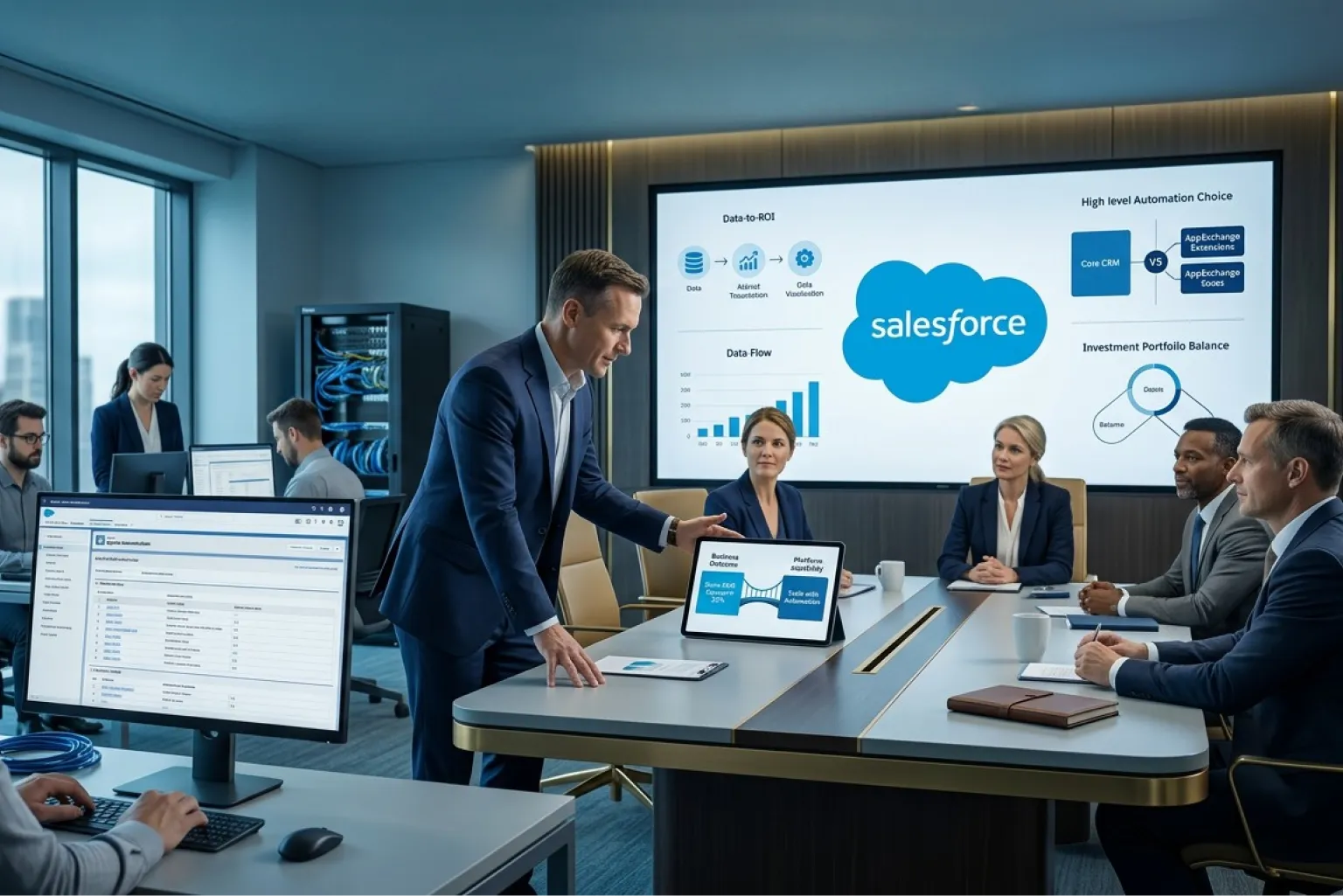
Salesforce used to fit neatly inside the IT conversation. A company bought the CRM, an implementation team configured it, developers handled custom requirements, and IT kept the system running after go-live.
That boundary is much harder to draw now. Salesforce sits inside how sales teams forecast revenue, how service teams handle customers, how marketing hands leads to sales, how operations track work, how leadership reads performance, and how AI gets introduced into daily processes. A decision that looks like a Salesforce request can change the way the business operates long before anyone opens Setup.
That has changed what companies increasingly need from Salesforce Consulting. Technical delivery still matters, but many of the most important decisions now happen earlier: which business problem deserves investment, which process should change, what data should leadership trust, what should be automated, and how the company will know whether the investment worked.
This is where Strategic Salesforce Consulting is taking shape. The consultant increasingly sits between the people defining business priorities and the teams responsible for turning those priorities into reliable systems. A strong Salesforce Consulting Strategy therefore begins with the business capability that needs improvement and works backward into the platform.
TL;DR
Salesforce Consulting is expanding beyond implementation and support because Salesforce now influences revenue processes, customer service, forecasting, data, automation, and management decisions across the organization. Strategic Salesforce Consulting increasingly connects those business priorities with the platform decisions required to support them.
Treating every Salesforce request as an IT ticket can solve the requested system change while leaving the underlying business problem untouched. A new dashboard, automation, field, or AI feature may be delivered correctly without improving the process that caused the request in the first place.
A stronger Salesforce Consulting Strategy starts with the business outcome, identifies the process and data that affect it, and then determines what Salesforce should change. IT remains responsible for the technical foundation, while business owners remain responsible for the commercial and operational decisions. The consulting function connects those responsibilities through a Salesforce Roadmap, governance, adoption planning, and measurable Salesforce Business Outcomes.
The short answer: Salesforce consulting is becoming a business systems strategy function
Salesforce Consulting is moving closer to business systems strategy, while IT still owns the technical foundation. Salesforce remains enterprise technology, so security, integrations, identity, environments, release management, data architecture, and system reliability still require strong technical ownership.
The change is happening in the space between business priorities and technical delivery. More Salesforce decisions now affect forecasting, customer service, revenue operations, data, automation, adoption, and management reporting. Consultants are increasingly expected to understand those operating problems before deciding what the platform should do.
Business strategy defines what needs to improve
Business leadership decides where the organization wants to go.
That may include:
- Improving forecast reliability
- Reducing customer churn
- Shortening sales cycles
- Improving renewal visibility
- Entering a new market
- Changing how accounts are managed
- Reducing service resolution time
These are business decisions. Salesforce can support them, automate parts of them, and provide information for measuring them, but the platform does not decide which outcome deserves priority.
IT protects how the technology operates
IT determines how the systems supporting those priorities can operate safely, reliably, and at scale.
Its responsibilities can include:
- Architecture
- Identity and access
- Security controls
- Integrations
- Data architecture
- Technical standards
- Deployment practices
- Environment management
- System performance
- Reliability and support
This technical ownership remains essential. A business objective does not remove the need for secure integrations, controlled releases, dependable data, and a Salesforce architecture the organization can maintain.
Strategic Salesforce consulting connects the two
Business systems strategy sits between those responsibilities.
This is where the consulting team asks questions such as:
- Which process is preventing the business outcome from improving?
- What information do users or managers currently lack?
- Which teams own the affected process and data?
- Which Salesforce capability deserves investment?
- What needs to change outside Salesforce?
- What technical dependencies could affect the initiative?
- How will the organization measure whether the change worked?
The consultant’s job is to turn those answers into a Salesforce Roadmap that business and technical teams can both act on.
Example: improving forecast reliability
Consider a company that wants more predictable revenue.
Leadership owns the revenue target. IT owns the technical health of Salesforce. Strategic Salesforce Consulting examines the operating gap between them.
The consultant may investigate forecast variance, opportunity-stage definitions, close-date hygiene, manager review practices, missing account information, sales adoption, data quality, and the forecasting configuration already in place.
The resulting recommendation could involve changes to opportunity stages, forecasting rules, manager workflows, dashboards, data governance, adoption, or processes outside Salesforce. The value comes from identifying which changes address the actual forecasting problem before implementation begins.
This is where Salesforce Business Strategy and technology planning meet. Salesforce does not define the company’s strategy, but Salesforce decisions can materially affect how that strategy is executed and measured.
Salesforce’s Center of Excellence model reflects the same operating relationship by placing functional and technical leadership between executive stakeholders and IT. The model gives business priorities and technical governance a shared structure rather than leaving Salesforce decisions with one team in isolation. Strategic Salesforce Consulting increasingly works inside that same decision space.
What Changed Around Salesforce Consulting?
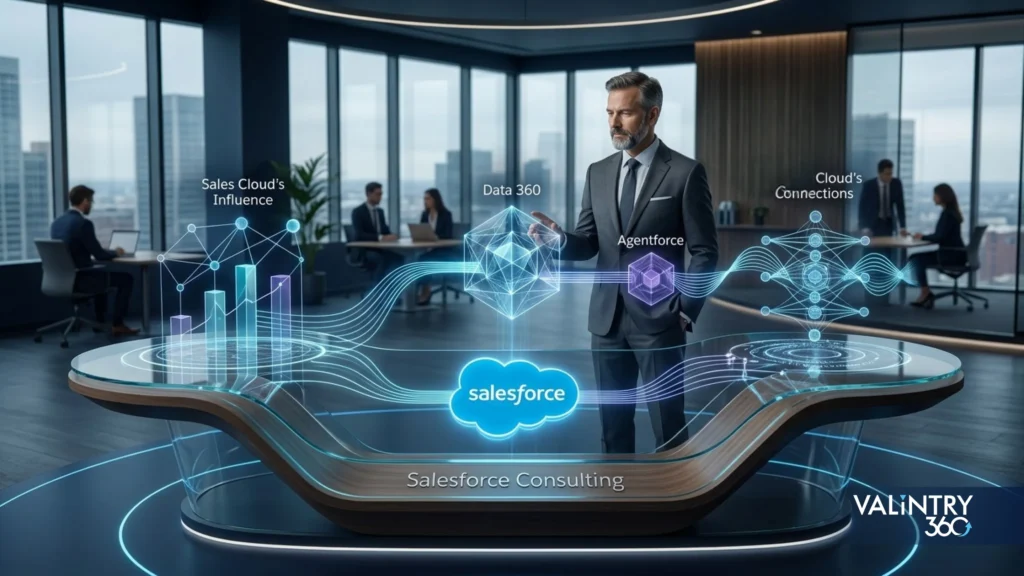
Salesforce itself became broader. A Sales Cloud implementation can affect forecasting, territory design, lead management, pipeline inspection, account planning, and reporting. Service Cloud can influence case ownership, escalation policies, staffing decisions, customer communication, and service measurement. Data 360 and Agentforce add decisions about trusted data, AI access, permitted actions, and human oversight.
Several changes are pushing Salesforce Consulting further into business planning:
- Salesforce now affects more departments. Sales, service, marketing, operations, finance, data teams, and leadership can all depend on information or processes managed through Salesforce.
- The platform requires continuous decisions. New Salesforce releases, changing business processes, new integrations, user feedback, and shifting priorities mean the org rarely stays finished after go-live.
- More technology choices require better prioritization. Flow, Data 360, Agentforce, analytics, integrations, packaged products, and custom development give companies several ways to solve the same business problem.
- Success is increasingly judged after deployment. A feature being delivered correctly says little about whether forecast accuracy improved, lead response time fell, service workloads changed, or users adopted the new process.
These changes make a Salesforce Roadmap more important than a one-time project plan. A project plan explains what needs to be delivered during an implementation. A Salesforce Roadmap should explain which business capabilities deserve attention next, why they deserve investment, what dependencies stand in the way, and which Salesforce Business Outcomes the organization expects from the work.
That difference changes the consultant’s starting point.
A traditional request might say:
“Build a new renewal dashboard.”
A strategy-led engagement first asks why the existing view is insufficient. Account managers may be finding renewals too late. Customer-health information might live in another system. Renewal stages may be maintained inconsistently. Leadership may not have agreed on what qualifies as an at-risk account. The original request is the same in every case, but the underlying business problem is different. Each problem can lead to a different Salesforce solution.
AI adds another decision layer. Agentforce makes new forms of automation possible, but access to an AI agent does not determine whether a process should use one. Salesforce’s guidance for choosing between agentic and traditional workflow automation distinguishes deterministic work suited to Flow or Apex from processes that genuinely require interpretation or reasoning. Companies still have to decide which use cases deserve investment, what data can support them, how much autonomy is appropriate, and which business result should improve after deployment
Salesforce's Partner Model Is Moving Toward Business Outcomes
Salesforce’s own partner program gives this shift a useful 2026 reference point. In March 2026, Salesforce changed its Consulting Track to place greater emphasis on verifiable customer outcomes, customer satisfaction, specialization, and demonstrated delivery. The updated model also consolidated 170 legacy distinctions into 28 core competencies and moved the Consulting Track to the Summit and Select tiers. That matters because the program offers a direct signal of what Salesforce expects a modern Salesforce Consulting Partner to contribute beyond implementation capability.
That expectation changes the conversation before a project begins. A consulting partner working toward Salesforce Business Outcomes has to understand why the initiative exists, which business capability it is supposed to improve, how that improvement will be measured, and what other processes or teams could affect the result. A technically successful rollout can still miss its purpose if sales behavior, data ownership, adoption, management processes, or operating rules were never addressed alongside the system.
This is one reason Strategic Salesforce Consulting is moving closer to planning and prioritization. The consultant still needs delivery expertise, but delivery follows a larger decision about where Salesforce investment should go and what the business expects to receive from it. The project therefore becomes one part of a Salesforce Roadmap rather than a standalone technology event.
IT Service vs Business Systems Strategy
The distinction becomes clearer when the two operating models are placed side by side. An IT-service model usually begins after a requirement has already been defined. The team receives a request, determines the technical approach, builds it, tests it, and supports it. Business systems strategy begins earlier, while the organization is still deciding what problem deserves attention and what type of change could address it.
Area | Traditional IT-Service Model | Business Systems Strategy Model |
Starting point | Ticket, feature request, or defined project | Business problem, performance gap, or desired outcome |
First question | How should this be implemented? | What needs to improve, and why? |
Typical stakeholders | IT, Salesforce admins, developers | Business owners, operations, IT, data teams, leadership |
Planning horizon | Sprint, release, or implementation project | Quarterly priorities and multi-phase Salesforce Roadmap |
Primary output | Working functionality | Prioritized capability plan followed by implementation |
Success measure | Delivery quality, stability, defects | Adoption, process performance, Salesforce ROI, and business KPIs |
After launch | Support and maintenance | Measurement, learning, and reprioritization |
Consultant’s role | Technical specialist | Business-to-platform translator |
Both models still matter. Salesforce remains an enterprise system that needs reliable implementation, security, integrations, release management, and technical support. The difference is where the consulting engagement begins. When the consultant enters only after a solution has already been selected, most of the strategic choices have already been made. A Salesforce Consulting Strategy adds value earlier by testing those choices before budget and development effort are committed.
The Salesforce Strategy Boundary
One way to understand the changing role of Strategic Salesforce Consulting is to separate the decisions around Salesforce into four levels. Each level answers a different question, and problems appear when one group is expected to make decisions that properly belong somewhere else.
Level 1: IT operations focuses on whether Salesforce works correctly. Security, permissions, integrations, deployments, system availability, incident response, and technical support sit here. These responsibilities protect the reliability of the platform and create the foundation every higher-level decision depends on.
Level 2: platform management focuses on whether Salesforce can remain healthy as it changes. Architecture standards, technical debt, release planning, data quality, automation governance, backlog management, and environment strategy belong here. A Salesforce Center of Excellence often helps coordinate this level by bringing functional and technical ownership into the same governance structure.
Level 3: business systems strategy focuses on what Salesforce should improve next. This is where business processes, capability gaps, Salesforce Roadmap priorities, adoption, data requirements, investment choices, and measurable Salesforce Business Outcomes come together. Strategic Salesforce Consulting increasingly works at this level because the consultant has to translate business priorities into platform decisions while understanding the technical consequences of those decisions.
Level 4: business strategy belongs to executive and functional leadership. Decisions about markets, pricing, product direction, customer segments, revenue models, and corporate priorities start here. Salesforce can support those decisions and provide information for them, but the platform does not decide the company’s direction.
The useful boundary sits around Level 3. A Salesforce consultant does not need to replace executive strategy or IT architecture to work strategically. The role is to connect them. Business leadership establishes what the organization is trying to accomplish, technical teams protect the systems that support it, and the consulting function translates between those two worlds through process design, platform investment, governance, and measurement.
Translate the Request Into the Real Business Requirement
A stakeholder request often arrives in Salesforce language because that is the system people can see. Someone asks for another dashboard, a new field, an approval Flow, a customer score, or an Agentforce use case. The request describes a possible solution, but it may reveal very little about the business condition that caused someone to ask for it.
Consider a regional sales director asking for a new pipeline dashboard. The underlying problem could be that managers find weak deals too late, opportunity stages mean different things across teams, close dates are rarely maintained, or important account information sits outside Salesforce. Each of those problems could produce a different solution. Building the requested dashboard immediately may give the stakeholder exactly what was requested while leaving the reason for the request untouched.
A stronger Salesforce Consulting Strategy works backward from the request. The consultant asks what decision the user is struggling to make, what information is missing, which process produces that information, who owns the process, and how the organization will know the problem has improved. A dashboard may still be the right answer after that work. It may also turn out that stage definitions, manager workflows, data capture, adoption, or another business process deserves attention first.
This is one of the clearest differences between delivery-led and Strategic Salesforce Consulting. The consultant treats the stakeholder’s request as evidence about a business problem rather than as a finished specification. That extra step protects the Salesforce Roadmap from filling up with technically valid work that has little effect on the outcomes leadership actually cares about.
One Business Problem, Two Consulting Models
Forecast reliability is a good example because the Salesforce org can be technically healthy while leadership still distrusts the numbers coming out of it. Imagine a company where quarterly forecasts regularly miss actual revenue by a wide margin. Sales leadership asks the Salesforce team to improve forecasting, and the request eventually reaches a consulting partner.
A delivery-led engagement may begin inside Salesforce. The team reviews forecast categories, makes close dates mandatory, tightens opportunity stages, adds validation rules, and builds dashboards showing pipeline by rep, stage, and quarter. Every one of those changes can be technically sound. The problem is that none of them proves why the forecast was unreliable in the first place.
Strategic Salesforce Consulting starts with that diagnosis. The consultant examines how sales teams define opportunity stages, how often managers inspect pipeline, how stale opportunities are handled, whether sales and finance use the same assumptions, whether close dates are updated consistently, and what leadership actually means by forecast accuracy. Salesforce changes come after those questions because the platform can only reinforce the process the business decides to run.
The resulting Salesforce Roadmap may still include stage changes, new dashboards, manager alerts, data-quality rules, and forecasting configuration. It may also include sales-process changes, clearer ownership, manager coaching, or different review cadences. The important difference is that the work is now tied to an observable business problem rather than a collection of requested features.
This changes how success is measured too. A delivery-led project can close when the new forecasting functionality reaches production. A strategy-led engagement needs to check whether forecast variance actually improves after teams have used the new process for enough reporting cycles. That connection between the platform change and the business result is where Salesforce Business Outcomes become useful rather than decorative language in a project proposal.
What Strategic Salesforce Consulting Should Actually Produce
Calling a consulting engagement “strategic” means very little unless the work leaves behind decisions and operating tools that the client can continue using. Strategic Salesforce Consulting should produce more than requirements documents and a backlog. It should make clear what the organization is trying to improve, which Salesforce investments support that goal, who owns the affected processes, and how the result will be judged.
One useful output is a business capability map. Instead of organizing work around products such as Sales Cloud, Service Cloud, Data 360, or Agentforce, the map starts with capabilities the business needs to improve. That could mean forecast reliability, lead response, renewal visibility, service resolution, account planning, or customer-data quality. Salesforce products and technical changes are then mapped underneath those priorities.
A Salesforce Roadmap turns those priorities into an order of work. A roadmap built around products might say that Sales Cloud comes first, followed by Service Cloud and then Agentforce. A strategy-led roadmap would explain that forecast reliability comes first because leadership cannot plan accurately, renewal visibility comes next because revenue is being lost late in the cycle, and AI-assisted service work follows once the data and processes underneath it are ready. The technology still matters, but the sequencing is justified by the business problem.
The engagement should also define a measurement model. Each initiative needs a baseline, a process metric, a Salesforce measure, and a review point. If the goal is better forecast reliability, the team might track forecast variance, late-stage opportunity movement, stale close dates, and manager-review compliance. If the goal is faster lead response, the relevant measures would be different. Salesforce ROI becomes easier to discuss when the implementation is tied to a measurable change rather than a broad promise of improvement.
Governance belongs in the output as well. Someone needs to own data definitions, process rules, roadmap priorities, architecture decisions, adoption, and post-launch measurement. For companies that need continuing help after the initial project, Salesforce Managed Services Consulting can extend that work into ongoing roadmap reviews, platform management, support, and improvement. A Salesforce Center of Excellence can provide the governance structure in larger organizations, while smaller companies may use a lighter operating model.
Where IT Still Owns the Decision
The move toward business systems strategy does not reduce the importance of IT. Many Salesforce decisions remain deeply technical, and weak technical governance can undermine a sound business plan. Identity and access, security architecture, integration reliability, environment strategy, release management, system performance, data architecture, DevOps practices, and technical standards still need people who understand the consequences of those choices.
The boundary becomes easier to see when the same initiative contains both business and technical questions. Suppose leadership wants customer-service teams to see billing information inside Salesforce. Business owners should define what information agents need, when they need it, and how that information should change the service process. IT and architecture teams still need to decide how the billing system connects to Salesforce, how credentials are managed, which system remains the source of truth, how failures are handled, and what data can safely move between systems.
A strong Salesforce Consulting Strategy connects those decisions rather than allowing one side to dominate the other. Business leadership should not dictate integration architecture simply because it owns the outcome, and IT should not define the customer-service process simply because it owns the systems. Strategic Salesforce Consulting works best when the consultant can translate the business requirement into technical implications and translate technical constraints back into business choices.
That is also why a Salesforce Center of Excellence can matter. It gives functional owners, technical leaders, administrators, architects, and executive sponsors a shared structure for making platform decisions. The purpose is not to add another approval layer. It is to prevent roadmap priorities, architecture, data, and business ownership from being decided in separate rooms.
How to Tell Whether a Salesforce Partner Is Operating Strategically
A Salesforce Consulting Partner can use the word “strategy” throughout a proposal and still operate mainly as an implementation vendor. The difference becomes visible in the questions the partner asks before discussing products, licenses, architecture, or development estimates. A strategic partner spends enough time understanding the performance problem that the initial request can still change.
Start with the discovery conversation. Does the partner ask which business metric should move, how the process works today, who owns it, where users struggle, what information leadership currently lacks, and how the organization will judge success after launch? Those questions indicate that the partner is trying to understand the requirement before choosing the Salesforce solution.
The Salesforce Roadmap is another useful test. Product names should appear, but they should not be the organizing logic. A roadmap built around business capabilities and measurable priorities gives leadership a reason for doing one initiative before another. It also makes future reprioritization easier because the company can revisit the outcome instead of feeling committed to a product sequence decided months earlier.
You can also look at what the partner is willing to recommend against. A strategic partner should sometimes conclude that a requested feature is unnecessary, that an existing capability can solve the problem, that the business process needs clarification before development begins, or that an initiative should wait because another dependency matters more. A partner that agrees with every request may be responsive, but responsiveness alone does not demonstrate Strategic Salesforce Consulting.
The final test comes after go-live. Ask what happens once the system change reaches production. If the engagement ends with deployment and support, the partner is primarily operating as a delivery provider. If the plan includes adoption, KPI review, Salesforce ROI measurement, lessons from real usage, and Salesforce Roadmap reprioritization, the relationship is operating much closer to a business systems strategy model.
What This Means for Salesforce Leadership in 2026
If Salesforce decisions increasingly affect business performance, the people involved in making those decisions also need to change.
Bring business owners into Salesforce decisions
A roadmap discussion cannot sit entirely with admins, developers, or IT managers when the work affects forecasting, lead management, service operations, customer retention, revenue reporting, or other business outcomes.
Participation should follow the initiative.
A forecasting project may need sales leadership, RevOps, finance, Salesforce ownership, and IT. A service initiative may need customer-service leadership, operations, data owners, and technical teams. An Agentforce initiative may also require security, data governance, legal, or compliance involvement depending on the use case.
The important point is that the people accountable for the affected Salesforce Business Outcomes should participate before priorities and requirements become fixed.
Treat the Salesforce Roadmap as an investment portfolio
Leadership should treat the Salesforce Roadmap as a set of competing investments rather than a backlog of feature requests.
Every initiative consumes:
- Budget
- Implementation capacity
- User attention
- Data and integration effort
- Change-management capacity
- Technical ownership
- Future maintenance
A useful roadmap therefore explains why one capability deserves investment before another, what result the company expects, which dependencies must be addressed first, and when leadership will review whether the change produced enough value to justify continued investment.
Strategy Still Has to Show Up in Numbers

A Salesforce Consulting Strategy becomes much easier to evaluate when every major initiative begins with a measurable problem. Broad objectives such as “improve productivity” or “increase visibility” do not give the team enough information to judge success. The organization needs a baseline, a specific process or behavior it expects to change, and a business measure that can be reviewed after the new process has been used long enough to produce meaningful results.
For example, a forecast initiative could begin with current forecast variance as the baseline. Salesforce changes might address opportunity hygiene, stage definitions, manager reviews, close-date accuracy, or pipeline inspection. Leading indicators could include fewer stale late-stage opportunities and more consistent manager reviews, while the business KPI remains a measurable reduction in forecast variance. The technology work and the business result are then connected through a chain the team can inspect.
The same logic applies to Salesforce ROI. Instead of calculating value from the number of features deployed, licenses activated, or automations created, the company can compare the cost of the initiative with the business change it was intended to produce. VALiNTRY360’s guide to measuring Salesforce ROI can support that process by connecting implementation decisions with measurable performance changes.
A simple measurement structure can keep the discussion grounded:
- Business outcome: What needs to improve?
- Baseline: What is happening now?
- Salesforce intervention: What process, data, or platform change will be introduced?
- Leading indicator: What should begin changing first?
- Business KPI: What final result should improve?
- Review point: When will the team judge whether the intervention worked?
This structure also gives the Salesforce Roadmap a feedback loop. Initiatives that produce the expected result can be expanded, while work that fails to move the underlying metric can be reviewed before additional budget is committed. Strategic Salesforce Consulting becomes easier to defend when prioritization is tied to evidence rather than the volume of work delivered.
Where VALiNTRY360 Fits
VALiNTRY360’s role in this model begins before a requirement becomes a build specification. Its Salesforce consulting services can support the work of understanding business objectives, evaluating existing processes, defining priorities, and translating those priorities into a Salesforce Roadmap that technical teams can execute.
The same approach can continue through implementation and ongoing platform management. Some initiatives will require configuration, others may need integration or custom development, and mature Salesforce environments often need continuing roadmap, governance, adoption, and maintenance work after the initial project. Keeping those decisions connected helps prevent strategy, implementation, and long-term ownership from becoming separate conversations.
For organizations evaluating a Salesforce Consulting Partner, the useful question is therefore broader than whether the partner can implement the requested feature. The stronger test is whether the partner can explain why the work deserves priority, how it connects to the operating process, what technical implications come with it, and which result should be measured once the change is in use.
The Bottom Line
Salesforce Consulting is becoming more strategic, but describing it as a replacement for IT misses the way the responsibility actually works. Business leadership still decides where the company wants to go, and IT still protects the architecture, security, integrations, data, and reliability required to support those decisions. Strategic Salesforce Consulting increasingly operates between them.
That middle position matters because Salesforce investments now influence processes that leadership measures directly. A Salesforce Consulting Strategy should connect those priorities to process decisions, data requirements, governance, platform investments, adoption, and measurable Salesforce Business Outcomes. The Salesforce Roadmap then becomes the practical record of what the company has chosen to improve and why.
The strongest consulting relationship therefore begins before the implementation choice is fixed and continues after deployment long enough to measure what changed. That is the point where Salesforce Consulting moves beyond the boundaries of a traditional IT service and becomes a business systems strategy function.
Frequently Asked Questions
1. What is Strategic Salesforce Consulting?
Strategic Salesforce Consulting connects business priorities with Salesforce decisions before implementation begins. The work can include process assessment, capability planning, governance, Salesforce Roadmap development, data requirements, adoption planning, and measurement of Salesforce Business Outcomes alongside the technical work required to deliver them.
2. How is Strategic Salesforce Consulting different from traditional Salesforce consulting?
Traditional Salesforce consulting often begins with an established requirement such as implementing a feature, integration, automation, or new cloud product. Strategic Salesforce Consulting begins earlier by examining the business problem, identifying what needs to change, deciding whether Salesforce should play a role, and determining how the result will be measured after deployment.
3. Is Salesforce consulting an IT function or a business function?
Salesforce Consulting increasingly sits between the two. Business teams define priorities and operating requirements, while IT protects architecture, security, integrations, data, and system reliability. The consulting function connects those responsibilities by translating business needs into platform decisions that technical teams can implement and support.
4. What is a Salesforce Consulting Strategy?
A Salesforce Consulting Strategy defines how an organization will use Salesforce to support specific business priorities over time. It can cover process changes, platform investments, data requirements, governance, adoption, technical dependencies, measurement, and the order in which initiatives should appear on the Salesforce Roadmap.
5. How does Salesforce support business strategy?
Salesforce can support Salesforce Business Strategy by giving teams systems for managing customer information, sales processes, service operations, automation, reporting, and other workflows tied to business execution. The platform works best when leadership first defines the business objective and then determines which Salesforce capabilities can support that objective.
6. What should a Salesforce Roadmap include?
A Salesforce Roadmap should explain which business capabilities deserve attention, why they matter, what Salesforce work supports them, which dependencies must be resolved, who owns each initiative, and how success will be measured. Organizing the roadmap around business priorities also makes it easier to reprioritize when conditions, budgets, or operating needs change.
7. Who should own the Salesforce Roadmap?
Roadmap ownership usually needs participation from both business and technical stakeholders. Business leaders should help define priorities and Salesforce Business Outcomes, while Salesforce owners, IT teams, architects, and administrators assess feasibility, dependencies, risk, and technical ownership. Larger organizations may coordinate these decisions through a Salesforce Center of Excellence.
8. What does a Salesforce Consulting Partner do during the strategy stage?
A Salesforce Consulting Partner can assess business processes, identify capability gaps, review the existing Salesforce environment, define priorities, map dependencies, and help build an implementation sequence. The partner should also clarify how each recommendation connects to a business requirement before development or configuration begins.
9. How should Salesforce Business Outcomes be measured?
Start with the business condition that needs to change and establish a baseline before implementation. Then define the Salesforce intervention, leading indicators, final business KPI, and a review point. This creates a clear connection between the work delivered and the result the organization expected from it.
10. How do you measure Salesforce ROI?
Salesforce ROI compares the cost of an initiative with measurable changes linked to the business problem it was intended to address. Depending on the use case, the calculation might consider revenue impact, forecast accuracy, service costs, lead response times, employee effort, retention, or another business metric rather than the number of Salesforce features deployed.
11. What is a Salesforce Center of Excellence?
A Salesforce Center of Excellence is a governance structure that brings business and technical stakeholders together around Salesforce ownership. It can help coordinate roadmap priorities, architecture standards, data governance, adoption, release planning, and decision rights so that business goals and technical constraints are considered together.
12. Should sales and operations leaders be involved in Salesforce decisions?
They should be involved when a Salesforce initiative affects processes or outcomes they own. For example, a forecasting initiative may need input from sales leadership, RevOps, finance, Salesforce owners, and IT because each group controls a different part of the process that produces the final forecast.
13. Which Salesforce decisions should remain with IT?
IT should continue to lead or strongly influence decisions involving identity, access, security architecture, integration reliability, environment strategy, technical performance, DevOps, data architecture, and release controls. A Salesforce Consulting Strategy should account for those technical requirements while business leaders define the operating outcomes the platform needs to support.
14. How can you tell whether a Salesforce Consulting Partner is strategic or implementation-focused?
Look at what happens before the partner recommends a solution. A partner working strategically will ask about business metrics, process ownership, current performance, user behavior, dependencies, and measurement before finalizing the Salesforce approach. The resulting Salesforce Roadmap should explain why the work deserves priority rather than simply listing products and features to implement.
15. When should a company review its Salesforce strategy?
A Salesforce strategy should be reviewed when business priorities change, major platform investments are being considered, adoption declines, Salesforce ROI becomes difficult to demonstrate, processes stop matching the system, or the roadmap has become dominated by disconnected requests. Regular reviews also help organizations decide whether current Salesforce investments still support the capabilities leadership considers most important.
Related Posts
Retainer, Hourly, or Tiered: Which Salesforce Managed Services…
Every buyer starts in the same place. What do Salesforce managed services actually cost? Nobody can tell you until they know how your org actually consumes support, and user count is not it. The same scope, delivered by the same…
Top Salesforce Managed Services Providers: A 2026 Buyer’s…
Picking a support partner for your CRM quietly shapes the next three years of your business. Choose well, and your org stays clean, your reports stay trustworthy, and every Salesforce release becomes something your team plans for instead of braces…
How to Tell Your Salesforce Backlog Needs Managed…
You know how this usually goes. The backlog creeps past some invisible line; somebody in a leadership meeting says, "We need another admin," and 6 weeks later there's a job posting live. Sometimes that's exactly right. A lot of the…