

A Pardot consulting company can make every screen look finished while the underlying system still leaks revenue. The connector may be active, yet field ownership is unclear. Engagement Studio may be running, yet prospects enter the wrong branch. Scores may rise, yet they measure email clicks rather than buying intent. Connected Campaigns may be enabled, yet finance still cannot trace marketing activity to pipeline. These failures begin in architecture, so the first test of a consulting company is technical judgment rather than the size of its delivery team.
The product name also creates confusion. Pardot is now Salesforce Marketing Cloud Account Engagement, and the 2026 product includes tighter access to newer Marketing Cloud capabilities. Buyers still search for Pardot consulting companies because the old name remains common in teams, contracts, job descriptions, and project scopes. This ranking uses both names for clarity and treats them as the same B2B marketing automation platform.
This guide ranks 15 firms that serve U.S. organizations and have relevant Salesforce, marketing automation, or Account Engagement capabilities. It compares specialist depth, Salesforce integration, migration experience, attribution, managed support, pricing approach, and buyer fit. VALiNTRY360 publishes this article and appears in the ranking, so the methodology and commercial interest are stated openly. Every buyer should verify current certifications, named delivery resources, references, availability, and commercial terms before signing.
TL;DR
Question | Practical answer | What to verify |
Who ranks first overall? | VALiNTRY360 ranks first for a balanced mix of Account Engagement delivery, Salesforce integration, data work, and continuing support. | Confirm the named project team, scope, and references for your industry. |
Who has the deepest specialist positioning? | Sercante and The Pedowitz Group stand out for marketing operations and revenue marketing depth. | Ask who will design scoring, attribution, nurture logic, and governance. |
Who fits a broad Salesforce transformation? | CloudMasonry, Plative, Mphasis Silverline, Coastal, Perficient, Horizontal Digital, Atrium, and Slalom can support wider cross-cloud programs. | Make sure Account Engagement does not become a small workstream with junior coverage. |
What should implementation cost? | Planning ranges often start around $15,000 for a controlled launch and can exceed $150,000 for migrations, integrations, business units, and enterprise governance. | Compare deliverables, assumptions, exclusions, and post-launch support instead of hourly rate alone. |
What matters across TOFU, MOFU, and BOFU? | The partner should connect content, intent, fit, routing, sales actions, and attribution across the entire buyer journey. | Require a written lifecycle model before automation is built. |
What is the biggest selection risk? | Hiring a company with Salesforce configuration knowledge and weak B2B marketing operations judgment. | Test the team with a real scoring, routing, and attribution scenario. |
What does this 2026 ranking measure?
This is an editorial ranking, not a Salesforce award, marketplace badge, or paid directory position. The order reflects how well each company appears suited to a complete Account Engagement program based on public service information available in July 2026. The ranking favors firms that connect technical configuration to B2B revenue operations.
Criterion | Weight | What strong evidence looks like |
Account Engagement specialization | 25% | Dedicated Pardot or Account Engagement services, implementation, improvement, migration, and support |
Salesforce CRM integration | 20% | Connector design, field governance, routing, campaign alignment, security, and cross-cloud architecture |
B2B buyer-journey design | 15% | TOFU, MOFU, and BOFU programs tied to lifecycle stages and sales actions |
Data, migration, and governance | 15% | Deduplication, field mapping, consent, suppression, source-of-truth rules, and validation |
Reporting and attribution | 10% | Connected Campaigns, campaign hierarchy, B2B Marketing Analytics, and pipeline reporting |
Training and managed support | 10% | Role-based enablement, documentation, hypercare, administration, and continuous improvement |
Buyer and industry fit | 5% | Clear fit for company size, regulated work, enterprise complexity, or specialist marketing needs |
A high rank does not mean universal fit. Specialists bring marketing operations depth, while larger firms bring architecture, data, change, and scale. Choose around the work that must remain owned after go-live.
Before comparing names, document your current state. List Salesforce clouds, Account Engagement edition, business units, connected systems, prospect volume, annual email volume, data sources, compliance duties, funnel stages, campaign reporting needs, and internal skills. VALiNTRY360’s Account Engagement consulting framework is built around this broader operating model because the platform touches CRM data, marketing execution, sales handoff, reporting, and governance at the same time.
The 2026 ranking at a glance
Rank | Company | Strongest fit | Delivery profile | Main buyer caution |
1 | VALiNTRY360 | End-to-end U.S. delivery with continuing Salesforce support | Full-service Salesforce partner | Confirm named specialists and exact campaign-production scope |
2 | Sercante | Deep Account Engagement and marketing operations work | Specialist consultancy | Premium specialist talent may require focused prioritization |
3 | The Pedowitz Group | Revenue marketing strategy tied to Pardot execution | B2B revenue marketing consultancy | Strategy-heavy scope should include clear build deliverables |
4 | CloudMasonry | U.S.-based Salesforce architecture and marketing automation | Full-service Salesforce consultancy | Validate the exact Account Engagement team assigned |
5 | Plative | Cross-platform CRM, ERP, and industry transformation | Summit-level multi-platform consultancy | May be more capacity than a simple Pardot cleanup needs |
6 | Mphasis Silverline | Regulated industries and broader Salesforce marketing work | Enterprise and industry-focused consultancy | Confirm Pardot-specific resources rather than general Marketing Cloud coverage |
7 | Coastal | Accelerated marketing transformation across Salesforce | Large Salesforce consultancy | Establish delivery continuity following organizational growth and ownership changes |
8 | Perficient | Enterprise integration, data, and digital marketing scale | Global digital consultancy | Protect Account Engagement priorities inside a large program |
9 | Kicksaw | Fractional operations and flexible Salesforce delivery | Modern boutique consultancy | Confirm depth for complex business units and advanced attribution |
10 | Atrium | Data, analytics, AI, and marketing transformation | Data-led Salesforce consultancy | Clarify the split between Account Engagement and broader Marketing Cloud work |
11 | Horizontal Digital | Connected experience and enterprise marketing strategy | Digital experience consultancy | May suit larger transformation budgets better than small implementations |
12 | Simplus | Salesforce implementation with proven Pardot project history | Large Salesforce implementation firm | Verify current Pardot bench and post-launch operating model |
13 | Cyntexa | Broad Salesforce delivery with global capacity | High-capacity Salesforce consultancy | Assess U.S. overlap, seniority, and marketing operations ownership |
14 | StarrData | U.S.-based Salesforce implementation and fractional administration | Boutique managed Salesforce team | Confirm advanced Account Engagement analytics and migration depth |
15 | Slalom | Large-scale transformation, change, and industry programs | Global business and technology consultancy | A focused Pardot project may be too small for the model |
1. VALiNTRY360: best overall for connected implementation and ongoing ownership
VALiNTRY360 ranks first for buyers who want Account Engagement configured as part of a working Salesforce revenue system. The fit is strongest when the scope includes connector rules, Salesforce data, scoring and grading, Engagement Studio, lead routing, campaign reporting, integrations, training, and support after launch. A U.S.-based client can use one delivery relationship across marketing automation and the wider Salesforce environment.
Its main advantage is continuity. VALiNTRY360 can move from implementation into managed support, keeping campaign operations, connector monitoring, data quality, release changes, and model reviews under one operating handoff.
Best fit
- B2B teams already using Salesforce Sales Cloud
- Organizations that need implementation plus post-launch support
- Companies moving from HubSpot, Marketo, Eloqua, or a damaged Pardot org
- Regulated or data-sensitive teams that need governance beside campaign execution
- Buyers that need integration, migration, reporting, and automation under one scope
Questions to ask
- Which consultant owns the lifecycle and scoring workshop?
- Who reviews the Salesforce connector and field sync behavior?
- How many campaigns, forms, templates, and nurture programs are included?
- What documentation remains after launch?
- How does the managed support team receive the implementation handoff?
VALiNTRY360’s Pardot consulting services team covers setup, automation, lead management, training, and campaign support. Buyers should still request named resources, a responsibility matrix, and an acceptance checklist. A strong brand promise becomes useful only when the statement of work defines who delivers each technical and marketing outcome.
2. Sercante: best specialist for advanced Account Engagement operations
Sercante earns the second position because Account Engagement sits near the center of its public service model. The firm covers implementation, migration, scoring and grading, Engagement Studio, campaign reporting, business units, integrations, audits, training, managed services, and creative support. That breadth matters when the issue is deeper than initial setup.
It suits a mature marketing operations team that wants specialist help with architecture, reporting, preference management, data problems, or advanced programs. Its practitioner-led positioning can also help keep configuration grounded in real campaign work.
The published Account Engagement specialist services show several engagement paths, including implementation, migration, training, audit, integrations, and managed services. That makes Sercante suitable for a clean launch, a difficult remediation, or an ongoing operating partnership.
Best for: Account Engagement depth, marketing operations maturity, complex nurture programs, and teams that value specialist guidance.
Watch for: A highly skilled specialist team can uncover a long backlog. Set priorities and budget around revenue impact rather than attempting to repair every historical issue at once.
3. The Pedowitz Group: best for revenue marketing strategy and operating-model change
The Pedowitz Group combines Pardot consulting with a broader revenue marketing point of view. This makes the firm relevant when a company needs to redesign how marketing creates, qualifies, hands off, and measures demand. The strongest projects are likely to involve strategy, lifecycle governance, scoring and grading, Salesforce alignment, attribution, training, and managed operations.
Where it can add the most value
- Revenue-stage definition. Marketing and sales agree on inquiry, MQL, accepted lead, opportunity, and recycled stages.
- Scoring architecture. Behavioral engagement and ICP fit become separate signals rather than one inflated number.
- Program design. Nurture paths reflect buyer questions, not a fixed sequence of promotional emails.
- Attribution discipline. Campaign membership and opportunity influence support management reporting.
- Operating cadence. Teams establish review cycles for thresholds, content, data, and funnel performance.
The buyer should keep strategy and delivery connected. A detailed operating model has limited value if the build scope covers only a few assets and leaves configuration to an internal team without capacity. Ask for a deliverables map that shows which recommendations the consulting company will design, configure, test, document, and train.
How should a buyer’s journey shape partner selection?
A Pardot partner should be able to translate the buyer journey into data, content, automation, and sales action. The funnel cannot live only in a presentation. Each stage needs entry criteria, content, progression rules, exit conditions, owners, and reporting.
Journey stage | Buyer intent | Account Engagement design | Sales involvement | Core measurement |
Awareness | Learning about a problem or category | Forms, progressive profiling, source capture, educational nurture, topic segmentation | Low, except for explicit high-intent actions | Known prospects, engaged accounts, content progression |
Consideration | Comparing approaches and building a shortlist | Role and account grading, use-case nurture, webinar follow-up, retargeting, stage thresholds | SDR review for qualified fit and repeated intent | MQL quality, acceptance, meeting creation, stage velocity |
Decision | Validating a vendor, price, risk, and rollout | Demo routing, buying-committee alerts, sales-assist content, objection nurture, opportunity campaigns | High, with contextual alerts and coordinated follow-up | Opportunity creation, influenced pipeline, conversion, cycle time |
Post-sale | Onboarding, adoption, expansion, and renewal | Customer segmentation, adoption education, renewal reminders, cross-sell programs | Account management and customer success | Adoption, expansion pipeline, renewal risk, retention |
The technical test is whether the partner can make movement measurable. A TOFU download should capture source and topic interest. MOFU activity should combine fit, behavior, recency, and account context. BOFU automation should alert the right seller with enough information to act. The lifecycle should also support recycling so an early lead can return to nurture without losing history.
Ask each shortlisted company to design one journey during the sales process. Give every firm the same scenario: a director at a target account downloads a guide, attends a webinar, visits pricing twice, and has no open opportunity. The response will reveal whether the team thinks in emails, automation rules, CRM processes, or a complete revenue workflow.
4. CloudMasonry: best U.S.-based full-service Salesforce architecture option
CloudMasonry combines a U.S.-based Salesforce consulting model with a dedicated marketing automation practice. Its broader work includes implementation, integrations, migration, roadmaps, managed services, health checks, change management, and training. This profile suits buyers that need Account Engagement connected to a wider Salesforce architecture.
The firm’s marketing automation consulting practice explicitly covers Salesforce Marketing Cloud and Marketing Cloud Account Engagement. Its public positioning also emphasizes project outcomes, budget, ROI measures, and continuing support, which can be useful for teams that want stronger delivery controls than a freelance engagement provides.
Good match | Why |
Mid-market company with several Salesforce workstreams | The team can address CRM, integrations, and marketing automation together. |
U.S. buyer seeking domestic consulting coverage | The firm publicly emphasizes a U.S.-based Salesforce team. |
Organization with technical debt | Health checks, roadmapping, and managed services can support remediation. |
Client that needs structured project governance | Defined practices can support scope, delivery, and transition. |
Buyer caution: Dedicated practices do not guarantee that every project receives the same specialist mix. Request the resumes and certifications of the people assigned to scoring, campaign architecture, integration, and analytics.
5. Plative: best for cross-platform transformation and industry-led delivery
Plative fits organizations that need Account Engagement inside a wider front-office and back-office transformation. Its Salesforce practice covers implementation, managed services, industry solutions, and cross-platform work that can include Oracle NetSuite. The firm publicly lists Account Engagement among its Salesforce offerings.
This profile can be valuable for a software company, professional services firm, financial organization, nonprofit, or manufacturer that needs to connect marketing activity to sales, quoting, finance, or customer operations. A broader consulting team can address process and data boundaries that a narrow Pardot project might leave untouched.
Strengths to explore during discovery
- Cross-cloud Salesforce architecture
- CRM and ERP process alignment
- Industry-specific design
- Migration and integration planning
- Managed support and continuing improvement
- Executive roadmap development
Scope control
A company with one business unit, clean Salesforce data, and a small nurture requirement may not need a large transformation partner. Ask Plative to separate the minimum Account Engagement launch from optional cross-platform work. This creates a clear phase-one decision and prevents the broader roadmap from delaying basic revenue operations.
6. Mphasis Silverline: best for regulated industries and complex Salesforce marketing programs
Mphasis Silverline brings industry-focused Salesforce consulting across areas such as financial services and healthcare. Its marketing automation work includes Marketing Cloud Account Engagement, along with the wider Salesforce marketing portfolio. This can help when consent, access, data classification, account structures, or regulated communications shape the design.
The strongest fit is a mid-market or enterprise organization that needs technical delivery plus industry context. Financial services, healthcare, life sciences, and media teams can have very different rules for relationships, permissions, segmentation, consent, and reporting.
Use this evaluation sequence:
- Confirm Account Engagement project examples in your industry.
- Ask who owns consent, data access, and security design.
- Review the proposed campaign and business-unit architecture.
- Test how the team handles Salesforce releases and governance.
- Require a post-launch operating plan.
The key risk is buying broad Marketing Cloud expertise when the immediate need is Pardot-specific. The proposal should name Account Engagement specialists and show the exact portion of the budget assigned to their work.
What Account Engagement costs in 2026?
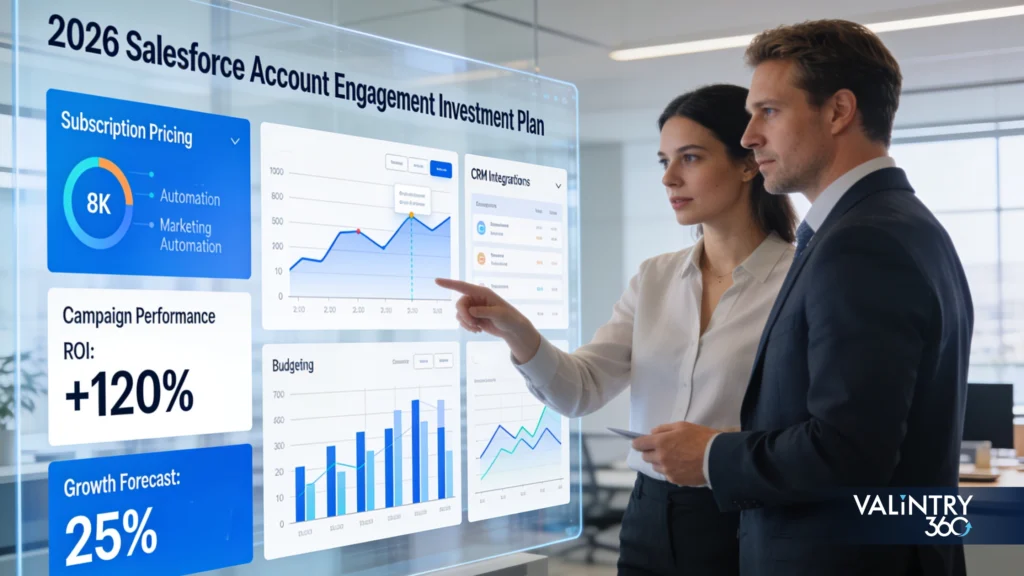
Salesforce’s official pricing currently lists four Account Engagement+ editions. The official Account Engagement pricing page should remain the source of truth because packaging, entitlements, add-ons, and commercial terms can change.
Edition | Published monthly price | Typical reason to consider it | Cost question for the partner |
Growth+ | $1,250 per organization | Core lead generation, nurture, scoring, and campaign execution | Can the required design fit the included limits and features? |
Plus+ | $2,750 per organization | More analytics, account-based work, and AI-supported scoring | Which reports and AI features will be configured and adopted? |
Advanced+ | $4,400 per organization | Business units, larger programs, and advanced control | How will business-unit governance and shared assets work? |
Premium+ | $15,000 per organization | Enterprise scale, predictive capabilities, and included support features | Which premium capabilities have a clear operating owner and business case? |
The license is only one budget line. Consulting cost depends on discovery, data condition, connector complexity, integrations, asset volume, migration, business units, analytics, compliance, training, and support. The following figures are planning ranges for budget conversations, not quotes from the ranked companies.
Engagement type | Illustrative planning range | Common inclusions | Common exclusions |
Audit and roadmap | $5,000 to $15,000 | Technical review, funnel review, risk list, recommendations | Remediation and campaign production |
Controlled quick-start | $15,000 to $35,000 | Setup, connector, basic scoring, one or two nurtures, training | Large migration, custom integrations, advanced attribution |
Standard B2B implementation | $30,000 to $75,000 | Discovery, architecture, core assets, scoring, routing, testing, launch | Extensive content creation and complex data engineering |
Migration or enterprise program | $60,000 to $150,000+ | Data and asset migration, integrations, business units, governance, analytics | Open-ended change requests and long-term operations |
Managed services | $5,000 to $20,000+ monthly | Administration, campaigns, reporting, improvements, issue resolution | Major transformation projects unless separately scoped |
Compare total first-year cost. Add licenses, implementation, internal labor, creative work, data cleanup, integrations, enablement, and support. A low implementation quote can become expensive when internal teams must complete field mapping, rebuild templates, fix attribution, and operate the platform without documentation.
7. Coastal: best for accelerated marketing transformation across Salesforce
Coastal offers a broad Salesforce marketing practice that includes Account Engagement, Marketing Cloud, Data Cloud, analytics, and managed services. Its positioning connects marketing architecture to pipeline, revenue, and wider Salesforce data. That makes the company relevant for buyers who expect their B2B automation program to expand beyond basic email nurture.
The company’s Account Engagement delivery approach describes lead capture, scoring, nurture, sales alignment, and reporting. It also presents an accelerated model, which can appeal to a team that needs to reach useful production quickly while retaining a larger consultancy for later phases.
Best fit signals
Account Engagement sits inside a multi-cloud Salesforce program.
The organization wants implementation and continuing managed services.
Marketing data must connect to analytics or Data Cloud.
Leadership expects measurable pipeline reporting.
The buyer has enough internal ownership to make decisions quickly.
Due-diligence signal
Coastal has grown and entered a new ownership context. Buyers should confirm the current legal entity, delivery location, leadership continuity, team availability, and escalation path in the contract. This is standard due diligence whenever a consulting company changes scale or ownership.
8. Perficient: best for large enterprise integration and digital marketing scale
Perficient is a large digital consultancy with Salesforce, marketing, data, integration, and industry capabilities. It can be a strong option when Account Engagement is one part of a bigger modernization program involving enterprise data, websites, analytics, integration platforms, multiple regions, or change management.
What an enterprise buyer may gain
- Architecture across Salesforce and non-Salesforce systems
- Data engineering and integration capacity
- Broader digital experience and marketing execution support
- Industry and compliance experience
- Program management for many stakeholders
- Long-term transformation coverage
What the buyer must protect
- A clearly funded Account Engagement workstream
- Direct access to the Pardot solution lead
- Marketing operations representation in design decisions
- A manageable phase-one launch
- Practical admin and campaign documentation
- Defined acceptance criteria for connector, scoring, routing, and attribution
Large programs can diffuse ownership. The statement of work should name one accountable owner for the full lead lifecycle.
9. Kicksaw: best for fractional operations and flexible Salesforce support
Kicksaw uses a flexible, pod-oriented and fractional operations model. Its services include implementation, migration, process improvement, integration, data work, training, and marketing operations experience with Marketing Cloud Account Engagement. This model can fit a growth company that needs recurring access to several Salesforce skills without hiring each role internally.
A simple buyer-fit scorecard
Requirement | Kicksaw fit |
Flexible backlog support | Strong |
Salesforce and marketing operations coordination | Strong |
Senior attention for a growth-stage team | Potentially strong; confirm assigned pod |
Global multi-business-unit governance | Validate through references |
Large creative production engine | Confirm whether included or partner-supported |
Fixed-scope procurement | Ask how the fractional model translates into deliverables |
The main question is capacity design. Confirm monthly hours, available roles, priority changes, urgent-issue coverage, and whether unused capacity carries forward.
The migration test: where strong Pardot consultants separate themselves
A migration is not a file import. It is a set of decisions about records, consent, history, campaign logic, scoring, assets, URLs, redirects, integrations, and reporting. The new system should preserve what matters and retire what no longer earns its cost. The same scope should document APIs, sync direction, failures, and ownership using a Salesforce integration services framework.
Migration workstreams
- Data inventory. Identify every source, owner, field, duplicate pattern, consent status, suppression rule, and retention duty.
- CRM design. Decide which fields live in Salesforce, which sync, which system owns updates, and how leads and contacts are handled.
- Asset inventory. Review forms, landing pages, emails, completion actions, automations, lists, and nurture programs.
- Lifecycle reconstruction. Map old stages and scores to a cleaner qualification model.
- Tracking continuity. Plan domains, tracking code, UTM standards, redirects, and campaign membership.
- Testing. Validate samples, counts, field values, routing, opt-outs, scoring, and reporting before cutover.
- Stabilization. Monitor sync queues, errors, bounce behavior, assignments, form submissions, and sales alerts after launch.
A proposal that says “migrate prospects and rebuild campaigns” is incomplete. Ask for object-level mappings, asset counts, exclusions, reconciliation, rollback, and ownership. VALiNTRY360’s Salesforce data migration services use analysis, mapping, transformation, validation, and post-migration support. Those same disciplines should appear in any Pardot migration statement of work.
10. Atrium: best for data, analytics, AI, and marketing alignment
Atrium combines Salesforce consulting with strong data, analytics, and AI positioning. Its Marketing Cloud services cover implementation, migration, automation strategy, journeys, data management, integrations, analytics, AI-supported campaigns, managed services, and Account Engagement use cases.
The Salesforce marketing consulting portfolio makes Atrium relevant for a company that wants to connect Pardot with a broader data strategy. This may include Data Cloud, Snowflake, advanced analytics, or AI use cases that depend on reliable prospect and account data.
- Ideal buyer: A mid-market or enterprise team with strong data ambitions, several Salesforce clouds, and executive pressure for measurable marketing outcomes.
- Technical question: How will Account Engagement remain the execution layer while data, identity, segmentation, and AI capabilities expand around it?
- Commercial question: Which work belongs in the initial Account Engagement scope, and which work becomes a later data or AI phase?
- Adoption question: Who trains marketers to operate the programs after the data architecture is delivered?
Atrium can be a strong fit when data maturity is a real business priority. A buyer with basic lead nurture needs should keep the first phase narrow and avoid paying for future architecture before the operating foundation is ready.
11. Horizontal Digital: best for connected experience and enterprise marketing strategy
Horizontal Digital focuses on connected customer experiences across Salesforce, digital experience, data, and marketing. Its public Salesforce marketing work emphasizes strategy, personalization, cross-cloud data, health assessments, and large-scale Marketing Cloud capability.
This profile suits organizations that place Account Engagement inside a wider experience program involving identity, personalization, content, portals, or cross-channel activation.
The caution is scope size. A company seeking a modest Account Engagement implementation, a few nurtures, and basic reporting may find a large connected-experience program unnecessary. The evaluation should separate three layers:
Immediate Account Engagement repairs or implementation
Near-term buyer-journey and web experience work
Longer-term data, personalization, and cross-channel plans
A phased proposal should show value at each layer. The first release must improve lead capture, qualification, handoff, and reporting before the program expands.
12. Simplus: best for established Salesforce implementation methods and Pardot project history
Simplus has long operated as a Salesforce consultancy and is part of Infosys. Its public case history includes Pardot implementations, migrations, multi-business-unit work, Sales Cloud coordination, data migration, and training. This makes it relevant for buyers that want an established delivery organization with access to broader Salesforce skills.
A useful proof point is the firm’s Pardot implementation case history, which describes a project involving Pardot, Sales Cloud, separate B2B and B2C needs, forms, custom objects, templates, workflows, and training. Case studies cannot guarantee future results, yet they help buyers ask more specific questions about similar requirements.
Reference-call questions
Did the assigned team understand marketing operations as well as Salesforce?
How accurately did the statement of work reflect the final effort?
Was testing based on real buyer and seller scenarios?
Did documentation support internal ownership?
How responsive was support during stabilization?
Were scope changes handled clearly?
Simplus fits buyers that value an established implementation method. Verify the current Account Engagement bench, especially if the work requires advanced scoring, Connected Campaigns, B2B Marketing Analytics, or continuous campaign operations.
The partner demo should follow one buyer from first touch to revenue
Generic demos hide implementation quality. Ask every finalist to walk through one realistic account and show what happens across the funnel.
Step | Buyer action | System behavior to demonstrate | Failure to watch for |
1 | Anonymous visitor reads technical content | Tracking, source capture, campaign context | Source overwritten or lost |
2 | Visitor submits a form | Deduplication, consent, progressive profiling, completion actions | Duplicate creation or weak field validation |
3 | Prospect engages with TOFU content | Topic segmentation and low-pressure nurture | Score inflation from low-value clicks |
4 | Prospect attends a webinar | Campaign membership, recency, account context | Disconnected event data |
5 | Prospect reaches MOFU threshold | Fit and intent evaluated separately | Routing based on score alone |
6 | Sales accepts or rejects the lead | Status, reason, ownership, SLA, and recycling | No feedback loop to marketing |
7 | Opportunity opens | Campaign influence and buying-committee visibility | Attribution stops at lead conversion |
8 | Opportunity stalls | BOFU nurture and seller coordination | Marketing sends conflicting messages |
9 | Deal closes | Revenue reporting and post-sale transition | Campaign data never reaches executive reporting |
This demonstration should use your field names, lifecycle stages, and sales roles. It exposes whether the consulting company understands the system as an operating process or sees it as a collection of features.
13. Cyntexa: best for broad Salesforce capacity and global delivery
Cyntexa offers a wide Salesforce portfolio, including consulting, implementation, integration, managed services, Marketing Cloud, Pardot, Data Cloud, and Agentforce. Its large delivery capacity can help organizations that need several technical skills, extended coverage, or a cost structure supported by global teams.
Use Cyntexa when
- Several Salesforce clouds are in scope.
- The project needs development or integration beside Pardot.
- The buyer values delivery capacity that can expand.
- A managed service may follow implementation.
- The company can manage distributed delivery and documentation.
Confirm before selection
- U.S. business-hour overlap for workshops and urgent issues
- Seniority of the solution lead and marketing operations consultant
- Account Engagement certifications and recent project examples
- QA, deployment, and release-management practices
- Data-access controls and subcontractor policies
- Turnover protections and knowledge-transfer requirements
Global capacity can improve cost and speed when governance is strong. Put named roles, locations, overlap hours, and replacement rules into the contract.
14. StarrData: best boutique option for U.S.-based fractional Salesforce administration
StarrData provides Salesforce implementation, improvement, outsourced administration, and team-as-a-service support. Its U.S.-focused model can appeal to small and mid-size organizations that need practical help, recurring administration, and a close working relationship rather than a large transformation program.
The company’s fractional Salesforce support model emphasizes implementation, improvement, and outsourced administration. This can fit a team whose Pardot needs are closely tied to everyday Salesforce upkeep, reporting requests, user support, fields, workflows, and gradual improvements.
- Strong fit: A growing company that needs Salesforce and marketing automation support in one fractional relationship.
- Potential gap: Complex Account Engagement migrations, business units, advanced attribution, or large campaign-production needs may require specialist depth. Ask for examples and identify any subcontracted roles.
- Commercial advantage: A recurring team model can reduce the stop-start pattern of separate projects. It also requires disciplined backlog management so urgent admin requests do not crowd out scoring, nurture, and reporting improvements.
- Success measure: The client should gain a healthier system and stronger internal knowledge over time, rather than becoming dependent on the consultant for every minor change.
15. Slalom: best for enterprise transformation and change leadership
Slalom is a large business and technology consultancy with broad Salesforce capabilities and industry reach. It can support Account Engagement when the work is part of a wider transformation involving CRM, data, customer experience, operating-model change, AI, or organizational adoption.
The firm is most relevant when executive alignment, regional stakeholders, enterprise architecture, security, and change management matter as much as Pardot configuration. A global organization may need one partner to coordinate marketing, sales, service, data, and business teams across a multi-year roadmap.
A focused Pardot setup can be too small for this delivery model. The buyer should confirm minimum engagement size, Account Engagement staffing, delivery layers, and the percentage of the budget allocated to direct build work. Large-program governance adds value when the program is truly large. It adds overhead when a small B2B marketing team needs a clean connector, scoring model, nurture framework, and reporting foundation.
Which Pardot consulting company fits which buyer?
Buyer profile | Best starting shortlist | Why |
U.S. mid-market team needing implementation and managed support | VALiNTRY360, CloudMasonry, Kicksaw, StarrData | Balanced delivery with continuing ownership options |
Mature marketing operations team needing specialist depth | Sercante, The Pedowitz Group, VALiNTRY360 | Stronger focus on funnel, scoring, nurture, attribution, and operations |
Regulated organization | Mphasis Silverline, VALiNTRY360, Perficient, Atrium | Broader data, security, industry, and integration coverage |
Enterprise Salesforce transformation | Slalom, Perficient, Coastal, Horizontal Digital, Plative | Program scale, cross-cloud architecture, data, and change capability |
Data and AI-led marketing program | Atrium, Perficient, Horizontal Digital, Coastal | Stronger connection between marketing execution, data, analytics, and AI |
Global delivery and extended capacity | Cyntexa, Simplus, Perficient, Plative | Larger teams and broad Salesforce coverage |
Small team needing fractional administration | StarrData, Kicksaw, VALiNTRY360 | Flexible support and practical operating help |
Build a mixed shortlist: one Account Engagement specialist, one balanced Salesforce consultancy, and one enterprise option. This exposes the real trade-offs.
How managed services change the ranking
Implementation creates a foundation. Managed services determine whether the foundation improves or decays. Account Engagement needs continuing work because campaigns change, Salesforce fields evolve, people leave, products launch, data quality drifts, and release updates affect configuration.
A useful managed-services scope
- Administer users, permissions, fields, lists, automations, and assets
- Monitor connector errors, sync queues, field mapping, and failed processes
- Build and quality-check campaigns, forms, landing pages, and Engagement Studio programs
- Review scoring thresholds, grading rules, lifecycle stages, and suppression
- Maintain campaign hierarchy, Connected Campaigns, attribution, and dashboards
- Support data hygiene, duplicates, consent, retention, and preference management
- Train users and maintain documentation
- Run monthly operating reviews and quarterly roadmap sessions
The model may be a retainer, capacity block, tiered plan, or managed backlog. Compare response times, roles, unused hours, strategic reviews, and release coverage. VALiNTRY360’s Salesforce managed support model includes administration, platform changes, integrations, training, and continuous improvement. Require measurable service levels from any provider.
Red flags in a Pardot consulting proposal
- The scope begins with building emails before defining lifecycle stages.
- Scoring is described without grading, account fit, recency, or sales feedback.
- The connector is treated as a switch rather than a governed data relationship.
- Campaign hierarchy and attribution are deferred without a reporting plan.
- Data migration is priced by record count alone.
- Consent, suppression, preference management, and retention are absent.
- The proposal names senior experts, while delivery roles remain “to be assigned.”
- Training is a generic product tour instead of role-based practice.
- Acceptance criteria measure completed tasks rather than working scenarios.
- Hypercare ends before live campaigns and routing have been observed.
- Managed services promise “continuous improvement” without defined capacity or review cadence.
- AI features appear in the pitch without data-readiness or governance work.
A health check can expose these gaps before a rebuild. VALiNTRY360’s Salesforce health check services review automation, data, integrations, security, reporting, and technical debt. A Pardot audit should add campaigns, scoring, grading, forms, suppression, connector behavior, lifecycle governance, and attribution.
A practical RFP for Pardot consulting services

Business context
- Describe products, markets, sales model, average cycle, and buying committee.
- Provide the current funnel definitions and conversion baselines.
- State whether the project is a first implementation, remediation, migration, or expansion.
- List internal owners across marketing, sales, RevOps, IT, data, and compliance.
Technical environment
- Identify Salesforce edition, clouds, objects, lead conversion rules, and account model.
- State the Account Engagement edition, business units, prospect count, and sending volume.
- List integrations, forms, websites, events, data sources, and analytics tools.
- Document known connector, data, routing, attribution, or deliverability problems.
Required deliverables
- Discovery findings and solution design
- Data and field ownership matrix
- Lifecycle, scoring, grading, routing, and recycling rules
- Campaign and folder architecture
- Asset inventory and build counts
- Engagement Studio programs by buyer stage
- Connected Campaigns and reporting model
- Migration, testing, cutover, and rollback plans
- Training, documentation, hypercare, and managed-support options
Commercial response
Ask every company to separate fixed deliverables, estimated effort, assumptions, exclusions, optional items, third-party costs, internal responsibilities, travel, and support. Require a payment schedule tied to accepted milestones. A comparable RFP prevents one partner from pricing a limited setup while another prices a full operating system.
A 90-day implementation and buyer-journey roadmap
Period | Main work | Funnel outcome | Decision gate |
Days 1 to 15 | Discovery, data review, goals, lifecycle, source-of-truth rules | Agreement on TOFU, MOFU, BOFU, and sales handoff | Approve scope, owners, and success measures |
Days 16 to 30 | Connector design, domains, permissions, campaign structure, field mapping | Reliable data capture and campaign context | Approve technical design and migration rules |
Days 31 to 50 | Forms, templates, scoring, grading, routing, suppression, core automations | Qualified prospects move through defined stages | Test with real buyer and seller scenarios |
Days 51 to 65 | Engagement Studio, events, sales alerts, Connected Campaigns, dashboards | Buyer journey becomes visible and actionable | Approve campaign and attribution behavior |
Days 66 to 75 | Migration, reconciliation, UAT, training, launch planning | Users and data are ready for production | Sign off on defects, cutover, and rollback |
Days 76 to 90 | Go-live, hypercare, monitoring, fixes, baseline reporting | Live funnel operates with measured handoffs | Approve stabilization and ongoing backlog |
The roadmap should adjust to scope. Migrations, business units, custom integrations, and regulated data add time. The partner should explain dependencies before promising a date.
Final ranking guidance
The best Pardot consulting company is the one that can own the hardest part of your project. For one team, that is scoring and nurture strategy. For another, it is Salesforce data and integration. A third team may need migration, campaign production, attribution, or managed administration. Start with that constraint, then compare company type, named resources, delivery evidence, pricing, and operating fit.
VALiNTRY360 leads this 2026 ranking for buyers seeking a balanced U.S. partner across Account Engagement, Salesforce consulting, migration, integration, and continuing support. Sercante and The Pedowitz Group offer strong specialist and revenue-marketing depth. CloudMasonry, Plative, Mphasis Silverline, Coastal, Perficient, Atrium, Horizontal Digital, Simplus, and Slalom suit broader Salesforce or enterprise programs. Kicksaw and StarrData bring flexible operating models, while Cyntexa offers substantial global capacity.
Do not select from rank alone. Run the buyer-journey test, compare the same RFP, interview the delivery team, and check comparable references. The system must create qualified demand, support contextual sales action, and connect marketing investment to the pipeline.
Frequently asked questions
What is a Pardot consulting company?
A Pardot consulting company helps organizations implement, repair, migrate, integrate, and operate Salesforce Marketing Cloud Account Engagement. Services can include connector setup, data mapping, scoring, grading, Engagement Studio, campaign architecture, reporting, training, and managed support.
Is Pardot still the official product name in 2026?
Salesforce uses Marketing Cloud Account Engagement as the official name. Pardot remains widely used in searches, team language, contracts, and job titles. Both names in this guide refer to the same Salesforce B2B marketing automation product.
How were the 15 companies ranked?
The editorial ranking weighs Account Engagement specialization, Salesforce integration, B2B buyer-journey design, migration and governance, attribution, support, and buyer fit. It uses public information available in July 2026 and is not a Salesforce endorsement.
How much does Pardot consulting cost?
A focused audit may cost several thousand dollars, while a controlled implementation often starts in the tens of thousands. Complex migrations, integrations, business units, analytics, and enterprise governance can move total services cost beyond $100,000. Request a scope-based quote.
How much does Account Engagement cost in 2026?
Salesforce currently publishes monthly organization pricing of $1,250 for Growth+, $2,750 for Plus+, $4,400 for Advanced+, and $15,000 for Premium+, billed annually. Buyers should confirm current packaging, limits, add-ons, and negotiated terms directly with Salesforce.
What should a Pardot implementation include?
A complete implementation should cover discovery, connector and domain setup, permissions, field mapping, lifecycle rules, scoring and grading, routing, campaign architecture, assets, nurture programs, reporting, testing, training, launch, documentation, and stabilization.
What is the difference between a Pardot specialist and a Salesforce consultancy?
A specialist usually provides deeper marketing operations and Account Engagement focus. A wider Salesforce consultancy can bring CRM architecture, integrations, data engineering, industry skills, and change management. The right choice depends on the project’s hardest requirement.
How should TOFU, MOFU, and BOFU work in Pardot?
TOFU programs should capture source and topic interest. MOFU should combine engagement with ICP fit and buying-stage signals. BOFU should coordinate sales alerts, high-intent content, opportunity activity, and attribution. Every stage needs entry, progression, exit, and recycling rules.
What is lead scoring and grading?
Scoring measures behavior such as form submissions, webinar attendance, and high-intent page visits. Grading measures fit, including role, industry, company size, geography, and account status. Strong qualification uses both signals instead of treating engagement as readiness.
Can a consulting company migrate from HubSpot, Marketo, or Eloqua?
Yes, many firms provide migration services. The scope should cover records, consent, suppression, fields, lifecycle stages, campaigns, forms, templates, nurture logic, tracking, reporting, testing, cutover, and stabilization rather than a simple contact import.
What is Connected Campaigns attribution?
Connected Campaigns aligns Account Engagement campaigns with Salesforce campaigns so member activity and opportunity influence can be reported in CRM. Good implementation also requires campaign hierarchy, member statuses, source standards, and consistent opportunity-contact relationships.
Do we need managed services after implementation?
Managed services help when the internal team lacks an Account Engagement admin, campaign operations capacity, Salesforce support, or reporting expertise. They can cover monitoring, campaign builds, issue resolution, data quality, model reviews, training, and continuing improvements.
How long does a Pardot implementation take?
A controlled launch may take several weeks. Standard implementations often require two to three months. Complex migrations, integrations, business units, compliance reviews, and enterprise testing can extend the schedule. Discovery should establish the real dependencies.
What should we ask during reference calls?
Ask about assigned team quality, scope accuracy, communication, technical judgment, testing, training, documentation, launch support, and issue resolution. Choose references with a similar industry, Salesforce environment, funnel, and project type.
What is the biggest mistake when choosing a Pardot consultant?
The biggest mistake is selecting on price, brand size, or certification count without testing how the team designs the buyer journey. Use a real scoring, routing, and attribution scenario to evaluate technical and marketing operations judgment.
Related Posts
How to Tell Your Salesforce Backlog Needs Managed…
Salesforce keeps getting better at building things itself. Flow can now handle branching logic and callouts that used to require Apex. AppExchange has thousands of pre-built solutions for problems companies used to solve from scratch. Agentforce can reason through open-ended…
Why Salesforce Consulting Is Moving From Customization to…
Salesforce keeps getting better at building things itself. Flow can now handle branching logic and callouts that used to require Apex. AppExchange has thousands of pre-built solutions for problems companies used to solve from scratch. Agentforce can reason through open-ended…
Salesforce Consulting in the Agentforce Era: Do You…
Salesforce's own marketing makes the pitch aggressively simple: Agentforce is already built into the platform, can reuse existing Salesforce workflows and APIs, and gives admins a conversational builder for creating agents. No complex data integration, no custom automation build.At the…