
- Salesforce Managed Services
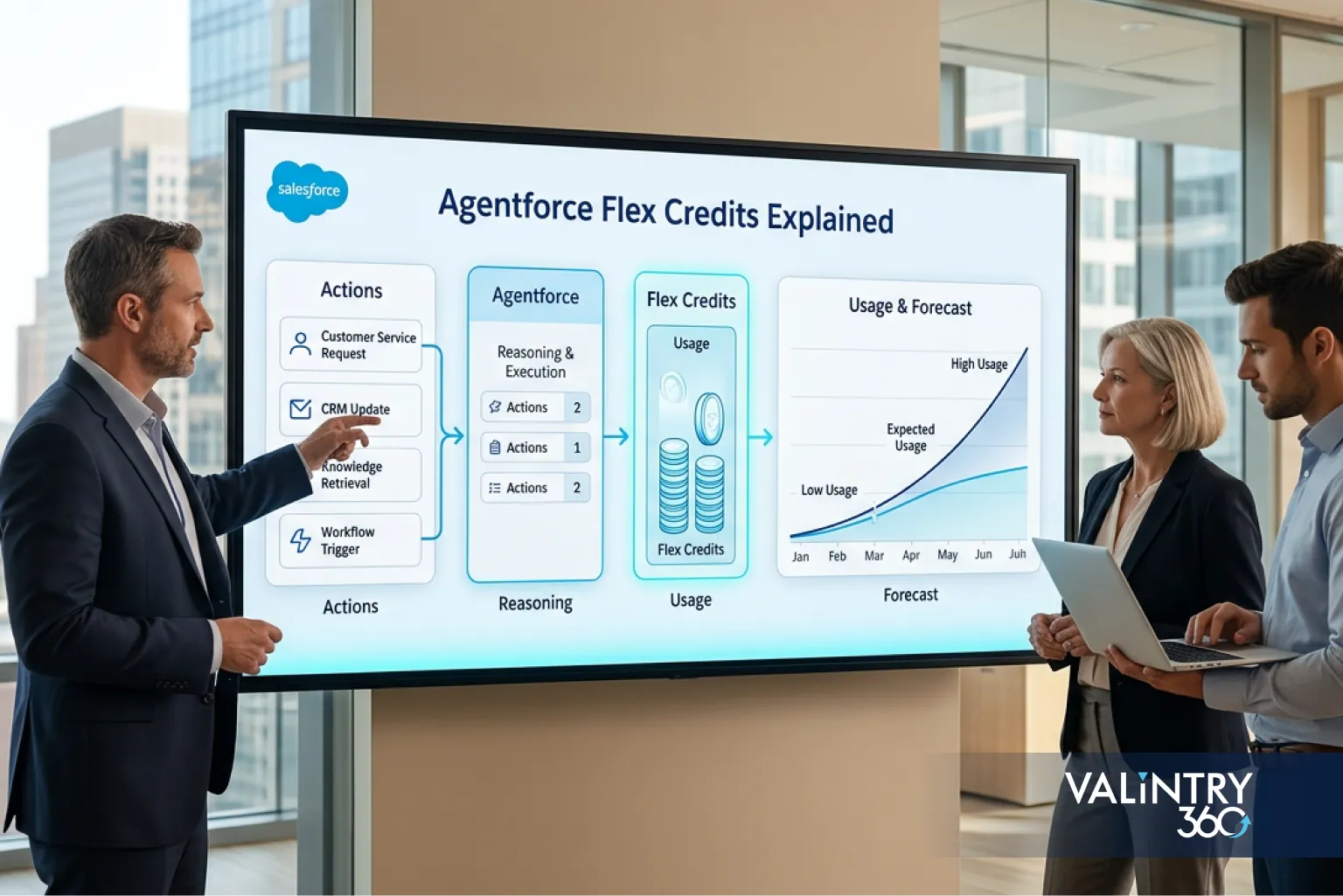
Salesforce Agentforce Flex Credits are not just a new line item on a quote. They are a metering layer that turns agent behavior into spend: every action, voice action, prompt, retrieval path, and related usage type can create a measurable credit draw. That is the technical reason Agentforce budget planning cannot start with a license count alone. The buyer has to understand how an agent moves from intent to retrieval, from reasoning to action, and from action to completion.
The basic public math is simple enough to use as a planning baseline. Salesforce Help lists Flex Credits at $500 per 100,000 credits, with one Agentforce action consuming 20 Flex Credits, or about $0.10 per action, while conversation pricing is listed separately at $2 per conversation in the same Salesforce Help Agentforce pricing article. The difficult part is not the unit price. The difficult part is knowing how many actions per conversation a real workflow will need after authentication, retrieval, updates, escalations, error handling, and monitoring are included.
That is why Salesforce Agentforce Flex Credits should be forecast through workflow math, not hope. A narrow order-status agent may only need two actions per conversation. A regulated service workflow may use twelve. A claims, revenue, or service-resolution agent may cross twenty actions before the customer sees a final answer. The Salesforce implementation cost and pricing guide makes the larger cost point: Salesforce AI spend does not live by itself. It sits beside licenses, Data 360, integration, testing, governance, support, and
TL;DR
- A Flex Credit is a consumption unit, not a feature. Salesforce Agentforce Flex Credits are spent when usage types are consumed. A standard action may consume 20 credits, while a standard voice action may consume 30 credits according to the public rate-card examples. That means Agentforce cost per action is the planning unit buyers should model before launch.
- The reusable forecasting formula is simple. Monthly Agentforce credits = conversation volume x average actions per conversation x credits per action. Monthly spend = monthly credits x contracted price per credit. For public list-price planning, $500 per 100,000 credits gives a working credit price of $0.005.
- Flex Credits vs conversations depends on action depth. A $2 conversation equals roughly 400 Flex Credits at the public list-price example. If a standard action consumes 20 credits, the crossover is about 20 standard actions. Below that, Agentforce Flex Credits are usually easier to justify. Above that, conversation pricing may cap cost better.
- Spend forecasting has to continue after launch. Agentforce usage billing changes when real users ask messier questions, agents repeat retrieval, voice usage increases, or workflows add extra actions. Salesforce AI usage monitoring should track credits by agent, use case, action type, owner, and resolved outcome.
- The real buyer question is not only what a credit buys. The real question is whether the credit spend is buying a measurable outcome: fewer escalations, lower handle time, faster case completion, better sales follow-up, or more reliable service capacity. Agentforce spend forecasting should tie every credit pool to a baseline and a business result.
The Short Definition: A Credit Buys Access To A Metered Unit
Salesforce Agentforce Flex Credits work like a shared wallet for eligible Agentforce and related usage types. A credit does not buy one complete conversation by itself. It buys part of a metered action, prompt, voice action, or other usage type based on the applicable multiplier. In practical terms, the buyer should think in units: one standard action, one voice action, one prompt type, one retrieval process, one data-processing step, or one billable operation defined by the current rate card.
The most useful planning assumption is this: a credit becomes meaningful only when it is multiplied by a usage type. For example, a standard action at 20 credits and a $0.005 credit price gives a working Agentforce cost per action of $0.10. A standard voice action at 30 credits gives a working cost of $0.15. Prompt and data-related usage can have different multipliers, which is why the Agentforce Flex Credits rate card should be checked before any final budget model is approved.
What One Credit Buys In Practical Planning
Usage Pattern | Public Multiplier Signal | Working Cost At $0.005/Credit | Buyer Interpretation |
Standard Agentforce action | 20 Flex Credits | About $0.10 | Good planning unit for common action-based flows such as record lookup, record update, or workflow step. |
Custom Agentforce action | 20 Flex Credits | About $0.10 | Similar planning treatment to a standard action, but testing and support cost may be higher. |
Standard voice action | 30 Flex Credits | About $0.15 | Voice-heavy workflows need separate forecasting because the multiplier is higher than a standard action. |
Basic prompt | 2 Flex Credits | About $0.01 | Prompt usage may look small alone but can add up when repeated across high-volume workflows. |
Standard prompt | 4 Flex Credits | About $0.02 | Useful for estimating agent reasoning or generation patterns when prompt metering applies. |
Advanced prompt | 16 Flex Credits | About $0.08 | Needs monitoring because advanced prompt usage can become material at scale. |
This table is not a substitute for a contract. It is a budget model starter. Salesforce can update rate cards, contract terms can differ, and usage types may vary by product. Still, the table gives finance, service, sales, and IT teams a common language for Agentforce consumption pricing before implementation starts.
The Forecasting Formula Buyers Should Use Before Deployment
Agentforce spend forecasting works best when the team models units of work, not abstract AI usage. Start with a use case, break it into actions, estimate monthly volume, and then calculate credits. A practical pre-deployment model uses this structure:
- Define the work unit. A work unit can be an order-status request, password support case, service entitlement check, sales follow-up, renewal reminder, field-service dispatch note, or employee help request.
- Estimate monthly volume. Use historical case, chat, email, phone, web, or CRM activity data. Do not use a guess when existing queues already show demand patterns.
- Estimate actions per conversation. Count the real steps: authenticate, retrieve, summarize, compare, update, route, send, log, escalate, and close.
- Assign credit multipliers. Use the current Agentforce Flex Credits rate card for action types, prompt types, voice actions, and any related usage types.
- Convert credits to spend. Multiply monthly credits by the contracted price per credit. At public list price, use $0.005 per credit for planning.
- Add the operating layer. Add implementation, Data 360, testing, monitoring, managed support, and governance because Agentforce credits are only one part of total spend.
A simple formula works for early modeling: Monthly spend = monthly volume x average actions per conversation x credits per action x price per credit. For blended workflows, calculate every intent separately, then add the totals. This is the practical center of AI agent cost forecasting because an average can hide expensive edge cases. The same formula also keeps Agentforce consumption pricing, the AI consumption pricing model, and Agentforce budget planning tied to observable work rather than abstract AI enthusiasm.
Worked Forecast Table: Three Ways The Same Volume Changes Spend
The table below uses public list-price assumptions only. It excludes tax, discounts, negotiated terms, Data 360, base Salesforce licenses, implementation services, and support. Its purpose is to show why Agentforce usage billing changes with action depth.
Use Case | Volume Assumption | Actions Per Conversation | Flex Credit Forecast | Planning Interpretation |
Order-status self-service | 20,000 monthly requests | 2 standard actions | 20,000 x 2 x 20 = 800,000 credits, or about $4,000 | Flex Credits are strong because the workflow is high volume but shallow. |
Routine service assistance | 10,000 monthly requests | 8 standard actions | 10,000 x 8 x 20 = 1,600,000 credits, or about $8,000 | Flex Credits can still be efficient if the action count is stable and monitored. |
Complex resolution workflow | 10,000 monthly requests | 24 standard actions | 10,000 x 24 x 20 = 4,800,000 credits, or about $24,000 | Conversation pricing may need comparison because the workflow crosses the 20-action planning threshold. |
Voice-enabled intake | 8,000 monthly voice interactions | 6 standard voice actions | 8,000 x 6 x 30 = 1,440,000 credits, or about $7,200 | Voice should be modeled separately because every action uses a higher multiplier. |
Employee support agent | 250 users, 40 uses/month | 4 standard actions | 10,000 x 4 x 20 = 800,000 credits, or about $4,000 | Per-user access, Flex Credits, and actual employee behavior should be compared together. |
The key lesson is that Agentforce credits follow behavior. Two companies can both forecast 10,000 monthly conversations and still have completely different bills. That is why AI agent cost forecasting should stay at the workflow level, not the portfolio level. One company may spend against two actions per conversation. Another may spend against twenty-four. That is why an Agentforce usage calculator should begin with intent-level volume and actions per conversation, not a generic monthly conversation estimate.
Flex Credits Vs Conversations: The Crossover Question
Flex Credits vs conversations is the pricing comparison most buyers want because it converts the rate card into a real decision. The public conversation model is simple: $2 per conversation. The public Flex Credit math is action-based: $500 per 100,000 credits, or $0.005 per credit. When a standard action uses 20 credits, the working action cost is $0.10. Divide $2 by $0.10, and the standard crossover lands near 20 actions.
When Flex Credits Usually Look Better
Agentforce Flex Credits usually look better when the workflow is shallow, controlled, or highly variable. A two-action order-status flow, a four-action knowledge lookup, or a low-risk sales follow-up can be far cheaper through Agentforce credits than through a flat $2 conversation model. This is the cleanest use case for Agentforce spend forecasting because the team can count actions, measure actual usage, and tune the flow after launch.
When Conversations May Look Better
Conversation pricing may look better when the workflow is deep or unpredictable. A complex service resolution might authenticate the customer, retrieve case history, evaluate entitlement, check an order, read a policy, summarize prior notes, create a case update, route an approval, send a follow-up, and log the outcome. Once average actions per conversation approaches twenty, the $2 conversation can become easier to budget than an action-by-action AI consumption pricing model.
When Per-User Access Still Matters
Employee-facing agents can add another layer. A named user may need access every day, while the agent still consumes credits behind the scenes. That is why the Salesforce license optimization consultants guide is relevant to Agentforce budget planning. AI costs should be reviewed alongside seat licenses, permission sets, add-ons, Data 360, and consumption pools.
Why The Forecast Is A Business-Case Problem?
Agentforce usage billing is not only a procurement issue. It is a business-case issue. Agentforce consumption pricing turns workflow design into a financial model, so the AI consumption pricing model has to be owned by finance and operations together. McKinsey’s 2025 AI survey found that 62% of respondents said their organizations were at least experimenting with AI agents, while 23% reported scaling an agentic AI system somewhere in the enterprise through the McKinsey State of AI 2025 survey. That gap matters because a pilot credit wallet and a production credit wallet behave very differently.
The broader market also shows why cost math needs discipline. Stanford HAI reported that 78% of organizations used AI in at least one function in 2024, up from 55% in 2023, and that generative AI use in at least one business function reached 71% through the Stanford AI Index 2025 economy data. High adoption does not automatically mean clean ROI. It makes AI agent cost forecasting and Agentforce budget planning more important because production usage changes faster than a static business case. For Salesforce Agentforce Flex Credits, the buyer still has to prove that the credit burn reduces human effort, improves case quality, increases pipeline efficiency, or speeds work that matters.
Gartner’s forecast that over 40% of agentic AI projects will be canceled by the end of 2027 because of escalating costs, unclear value, or inadequate risk controls through the Gartner agentic AI project forecast is especially relevant. Agentforce spend forecasting is one way to avoid that failure pattern. It forces leaders to decide which workflows deserve credits, which agents need redesign, and which use cases should not move past the pilot.
12 Agentforce Flex Credit Spend Scenarios Buyers Should Forecast Before Launch

1. Low-Action Support Requests
Low-action support requests are usually the best starting point for Salesforce Agentforce Flex Credits. A customer asks where an order is, when a warranty expires, or how to reset access. The agent may authenticate the customer, retrieve one record, and respond. This pattern keeps Agentforce cost per action low because actions per conversation remain predictable. A buyer should model the top ten simple intents separately instead of averaging them with complex service cases.
2. Complex Service Workflows
Complex service workflows can make Agentforce credits disappear faster than expected. A service agent may need to read account history, check entitlement, compare policy, summarize open cases, update fields, send a message, and decide whether to escalate. The Agentforce for Service implementation context matters because service use cases often produce the strongest ROI, but also the deepest action paths. Forecast simple service, routine service, and complex service as separate categories.
3. Voice-Heavy Conversations
Voice-heavy conversations should never be modeled with standard action assumptions alone. A standard voice action can carry a different multiplier, and voice interactions often include additional steps such as transcription, summary, routing, and follow-up. A short voice inquiry may remain economical under Agentforce consumption pricing. A long intake or claims call may move closer to conversation pricing, especially when the agent performs repeated retrieval and update actions.
4. Internal Employee Agents
Employee agents can be deceptively expensive because usage is recurring and informal. A service representative, sales manager, or operations lead may ask dozens of questions each week without thinking of each request as a billable event. Agentforce usage billing should be modeled by role: light users, regular users, and heavy users. This also helps compare Flex Credits vs conversations against per-user access, especially when hundreds of employees may adopt the agent.
5. Sales Follow-Up Agents
Sales follow-up agents often consume credits through research, summarization, next-step recommendations, field updates, email drafting, and pipeline hygiene. The cost model depends on cadence. A monthly account summary is different from daily account monitoring. A lead-response agent is different from a strategic account planning agent. Agentforce spend forecasting should connect usage to pipeline movement, not only to activity volume.
6. Data 360-Heavy Retrieval
Data 360-heavy retrieval can shift the budget from agent actions to data readiness and consumption. Agents that need customer 360 context, unstructured policy content, real-time account signals, identity resolution, or cross-system data require more than a clean prompt. Data 360 services matter because the agent can only forecast correctly when the data layer is part of the model. For these use cases, forecast Agentforce credits and data-related consumption separately.
7. Knowledge And RAG-Heavy Agents
Knowledge-heavy agents can lower unsupported answers, but they also require source maintenance, retrieval testing, and monitoring. A messy knowledge base can lead to repeated retrieval, weak answers, and human rework. Agentforce credits may not look high at first, but the operational cost rises when teams need to clean articles, remove duplicates, rewrite policies, or tune retrievers. Use Salesforce AI usage monitoring to track which sources drive repeated actions or failed answers.
8. Multi-System Workflow Actions
Multi-system workflows are where AI agent cost forecasting needs the most discipline. A single customer outcome might touch Salesforce, ERP, billing, identity, scheduling, shipping, and email systems. Every system call increases testing, logging, exception handling, and support ownership. The Agentforce consultant roadmap and governance checklist is useful here because actions should be approved, documented, reversible where possible, and tied to a clear business owner.
9. Seasonal Usage Spikes
Seasonal spikes can break an average-month model. Retail, healthcare, insurance, education, travel, and public-sector teams may see volume jump during holidays, enrollment windows, renewal cycles, benefit periods, or campaign launches. Agentforce budget planning should include normal month, peak month, and stress-month estimates. The 2026 Salesforce trends guide also frames consumption pricing as a budget issue because variable AI spend now moves with demand and action depth.
10. Failed Or Repeated Actions
Failed actions are a forecasting blind spot. An agent may retry a lookup, ask for clarification, call a tool with incomplete data, or route a case twice. These behaviors may not show up in a simple pre-launch estimate, but they affect credits, support time, and trust. The Agentforce Flex Credits rate card tells the multiplier, but the operating team has to watch failure patterns after launch. A good Agentforce usage calculator includes an error and retry allowance.
11. Governance And Human Review
Governance does not eliminate cost; it shapes cost. A workflow that requires approval before a refund, discount, claim decision, or regulated message may still save time, but the model must include review effort. Deloitte’s research found that only 21% of surveyed organizations had a mature governance model for agentic AI through the Deloitte agentic AI governance research. For Agentforce consumption pricing, governance is both a risk control and a spend control because it prevents unnecessary actions and bad outcomes.
12. Pilot-To-Production Expansion
Pilots are usually cleaner than production. The first agent has narrow prompts, known data, low volume, and close monitoring. Production introduces more users, more edge cases, more channels, more data, more failed actions, and more exception paths. That is why the first Agentforce spend forecasting model should not be the last one. A buyer should build a pilot forecast, a launch forecast, and a scale forecast, then compare actual Agentforce credits to expected credits after every full usage cycle.
Cost Controls That Matter More Than A Discount
Discounts help, but they do not repair a weak AI consumption pricing model. Agentforce consumption pricing rewards teams that design tighter workflows and monitor action depth after launch. The biggest savings usually come from better workflow design. A lean agent that performs six correct actions is cheaper and more trustworthy than an agent that performs fifteen uncertain ones.
- Measure actions per outcome, not only total credits. Total Agentforce credits tell finance how much was consumed. Actions per resolved case, qualified lead, or completed task tell operations why spend changed.
- Separate simple intents from complex intents. Averages hide the use cases that cause budget surprises. Model each high-volume intent and each high-risk intent independently.
- Limit the action menu. Agents with broad tool access can consume more credits and create more risk. Give each agent the actions it needs, not every action available.
- Clean the knowledge base. Poor content can cause repeated retrieval, unsupported answers, and human cleanup. Source quality is a spend control.
- Govern sensitive actions. Salesforce data governance services matter because data boundaries reduce waste, prevent over-retrieval, and protect customer or employee information.
- Track wallet consumption monthly. The Digital Wallet or equivalent usage view should show spend by agent, owner, channel, action type, and business outcome.
- Review support cost together with credit cost. Salesforce managed support services become important when agents need prompt changes, release checks, usage reviews, failure analysis, and monitoring after launch.
Case Study: Salesforce Team Built a Reliable Agentforce Flex Credit Forecast Before Production
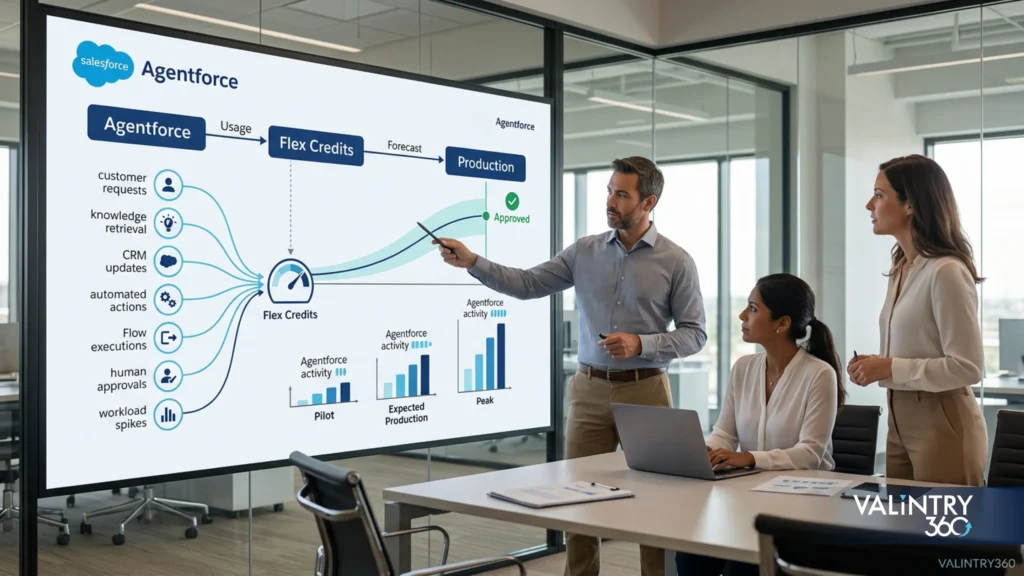
A Salesforce team was preparing to move an Agentforce service agent from pilot to production. The initial budget was based on monthly conversation volume, but that estimate quickly proved too broad. The team realized that the same number of conversations could generate very different costs depending on how many actions the agent performed inside each interaction.
The team therefore changed the question from “How many conversations will the agent handle?” to “How many metered actions will each business outcome require?”
From Credit Price to Actual Usage
The team used the public planning baseline of $500 per 100,000 Flex Credits, or approximately $0.005 per credit. A standard Agentforce action using 20 credits therefore created an estimated cost of:
20 credits × $0.005 = $0.10 per action
Instead of applying that number across the entire project, the team separated its workflows by intent and action depth.
The Forecast Model
Workflow | Monthly Volume | Actions / Conversation | Credit Forecast | Estimated Spend |
Order-status requests | 20,000 | 2 | 800,000 | ~$4,000 |
Routine service help | 10,000 | 8 | 1,600,000 | ~$8,000 |
Complex resolution | 10,000 | 24 | 4,800,000 | ~$24,000 |
Voice intake | 8,000 | 6 voice actions | 1,440,000 | ~$7,200 |
The exercise exposed an important difference between volume and consumption. The order-status workflow handled twice as many monthly requests as the complex workflow but required significantly fewer credits because each interaction was shallow.
Where the Forecast Changed
The team identified several factors that could push actual usage above the initial estimate:
- Repeated retrievals: Poor or incomplete data could cause additional agent actions.
- Failed actions: Tool errors and retries could increase consumption.
- Voice usage: Voice actions carried a different credit multiplier from standard actions.
- Complex escalations: Human handoffs could add workflow steps without necessarily completing the intended outcome.
- Data requirements: Data 360, integrations, and governed retrieval created costs beyond the Flex Credit wallet.
- Production behavior: Real users were expected to create more varied interactions than the controlled pilot.
The team added these considerations to its production forecast rather than treating the public credit price as the complete Agentforce budget.
The Operating Rule They Adopted
The organization created a monthly review around five measurements: Credits consumed → Actions performed → Cost per outcome → Exceptions/retries → Business result. This allowed finance and operations to see not only how many Flex Credits were being consumed, but why consumption was increasing.
For example, if credits rose 20% but resolved cases increased by 30%, the additional spend could potentially be justified. If credits rose 20% while successful outcomes remained flat, the workflow required investigation.
What Changed After Forecasting
The team stopped treating Agentforce Flex Credits as a fixed technology expense and began managing them as consumption-based operating spend.
Simple workflows were kept action-efficient. Complex workflows were evaluated against conversation pricing. Voice usage received its own forecast. Employee-facing use cases were compared with per-user access. Data, governance, testing, and support were included as separate budget layers.
Key Takeaway
The most important lesson was that one Flex Credit does not represent one completed business outcome. Its value depends on the usage type and the workflow surrounding it. A strong Agentforce spend forecast therefore starts with historical demand, maps actions per conversation, applies the current rate-card multipliers, converts credits into spend, and then compares that spend with measurable business outcomes.
For Salesforce teams planning Agentforce in production, the goal is not simply to minimize credits. It is to ensure that every meaningful credit draw contributes to a measurable improvement in service, productivity, revenue, or operational capacity.
Monitoring Turns Forecasting Into A Living Model
Agentforce spend forecasting is only useful when actual usage feeds back into the model. In practice, AI agent cost forecasting should be refreshed monthly because an AI consumption pricing model built during discovery can drift once real users arrive. NIST’s AI Risk Management Framework treats trustworthy AI as a lifecycle discipline across design, development, use, and evaluation through the NIST AI Risk Management Framework. That lifecycle view fits Salesforce Agentforce Flex Credits because behavior can change when prompts, data, user adoption, integrations, and business rules change.
A monthly review should compare forecast credits to actual Agentforce credits. The owner should ask which agents consumed more than expected, which actions repeated, which intents escalated, which prompts grew expensive, and which outcomes improved. This is the operational layer behind Salesforce AI usage monitoring. Without it, Agentforce usage billing becomes a surprise after the fact rather than a controlled forecast.
IBM’s research found that 83% of respondents expected AI agents to improve process efficiency and output by 2026, while 71% believed agents would autonomously adapt to changing workflows through the IBM AI agents study. That optimism is useful only when paired with measurement. A buyer should monitor whether credits are reducing handle time, improving resolution quality, increasing seller capacity, or lowering manual rework. Credits without outcome measurement are just consumption.
A Reusable Forecasting Worksheet
Use this worksheet structure before deployment and again after the first production month. It turns the Flex Credits conversation into a repeatable operating review rather than a one-time price exercise.
Forecast Field | How To Calculate It | Owner | Warning Sign |
Monthly volume by intent | Pull historical cases, chats, calls, forms, emails, or CRM tasks by request type. | Business owner | One average volume number is used for every workflow. |
Average actions per conversation | Map authentication, retrieval, prompts, updates, external calls, escalation, and logging. | Salesforce architect | The estimate ignores retries, exceptions, or handoffs. |
Credit multiplier by usage type | Apply the current rate-card multiplier for standard actions, voice actions, prompts, or data use. | Salesforce admin or architect | All action types are treated as identical. |
Monthly credit forecast | Volume x actions per conversation x multiplier. Add every intent to get total usage. | Finance and operations | The forecast only shows best-case usage. |
Monthly spend forecast | Monthly credits x contracted price per credit. Include separate license and platform assumptions. | Finance | Flex Credits are modeled without Data 360, support, or implementation. |
Outcome value | Compare against baseline labor, handle time, escalation, rework, or revenue movement. | Business owner | Credit spend is tracked without outcome improvement. |
This worksheet helps compare Agentforce credits, Flex Credits vs conversations, and per-user access without turning the decision into a generic pricing debate. It also gives Agentforce budget planning a repeatable format that finance teams can review before renewal. The practical question becomes: which model produces the lowest reliable cost per business outcome?
What Buyers Should Not Do?
Do not assume every agent conversation costs about the same. Agentforce consumption pricing depends on actual action depth, not the label attached to the agent. Agentforce cost per action changes when one conversation needs two steps and another needs twenty. Do not use one average for every channel. Chat, voice, portal, email, Slack, and employee support can all have different action depths. Do not treat Salesforce Agentforce Flex Credits as the complete budget. The agent runtime, Data 360, integrations, testing, support, and governance all affect total spend.
Do not ignore failed or repeated actions. A low list price can still create a budget problem when agents retry too often or retrieve from weak sources. Do not wait until renewal to review the model. The Agentforce testing guide is relevant because testing is where expected actions, unsupported prompts, sensitive records, bad data, and failed workflows become visible before production volume turns them into cost.
The Honest Answer
Salesforce Agentforce Flex Credits are useful because they align cost with activity. They let buyers start with a smaller credit pool, measure real usage, and scale based on what agents actually do. That is especially useful for pilots, variable workloads, low-action service requests, and workflows where actions per conversation can be designed and monitored.
The risk is that Agentforce credits can make spend feel precise before the workflow is understood. A credit forecast that ignores action depth, voice, data access, retries, prompt usage, Data 360, and human review will understate total cost. A strong forecast treats Agentforce usage billing as a living model: estimate before deployment, compare after launch, then tune the agent, data, and workflow every month.
For buyers, the best answer is practical. Use Salesforce Agentforce Flex Credits when action depth is low, measurable, or still being tested. Compare Flex Credits vs conversations when average action depth approaches twenty standard actions. Use Agentforce budget planning to tie every credit pool to a resolved case, completed task, qualified lead, or measurable service outcome. The goal is not to spend fewer credits at all costs. The goal is to spend credits on work that clearly improves the business.
Frequently Asked Questions
- What are Salesforce Agentforce Flex Credits?
Salesforce Agentforce Flex Credits are usage credits that pay for eligible Agentforce actions, voice actions, prompts, and related usage types. They allow buyers to pay based on consumption rather than only through fixed seats or flat conversation pricing, which is why Agentforce consumption pricing needs a workflow-level forecast.
- What does one Agentforce credit buy?
One credit is a metered value inside the rate-card system. A credit by itself does not equal a full action. The cost of a unit depends on the multiplier for the usage type, such as 20 credits for a standard action in the public planning example.
- What is the public price of Agentforce Flex Credits?
The public Salesforce pricing reference lists Flex Credits at $500 per 100,000 credits. That gives a simple planning price of $0.005 per credit before discounts, contract terms, tax, and other assumptions.
- What is Agentforce cost per action?
Agentforce cost per action is the cost created when an agent performs a priced action. Using the public example of 20 credits per standard action and $0.005 per credit, a standard action costs about $0.10.
- What is the Agentforce Flex Credits rate card?
The Agentforce Flex Credits rate card lists multipliers for different usage types, including standard actions, voice actions, prompts, and other eligible usage. Buyers should check the current rate card before final budgeting because multipliers and products can change.
- How do I forecast Agentforce spend?
Forecast Agentforce spend by multiplying monthly volume by average actions per conversation, then by credits per action, then by price per credit. This is the simplest AI agent cost forecasting method for pre-deployment planning. For blended use cases, calculate each intent separately and add the results.
- What are actions per conversation?
Actions per conversation are the number of billable steps an agent takes during one customer, employee, or workflow interaction. They can include authentication, retrieval, record updates, workflow actions, external calls, handoff, and logging.
- What is the difference between Flex Credits and conversations?
Flex Credits price usage by action or usage type, while conversation pricing charges a flat amount per conversation. Flex Credits can be better for shallow workflows. Conversations can be better when interactions are deep or unpredictable.
- What is the break-even point between Flex Credits vs conversations?
Using public list-price assumptions, a $2 conversation equals about twenty standard actions at $0.10 per action. Below that point, Flex Credits usually look cheaper. Above that point, conversation pricing may be more predictable.
- Does voice change Agentforce spend forecasting?
Yes. Voice actions can have a different credit multiplier than standard actions, so voice-heavy workflows need their own forecast. Buyers should not model voice support using only standard action assumptions.
- What should an Agentforce usage calculator include?
An Agentforce usage calculator should include monthly volume, actions per conversation, credit multiplier, price per credit, usage by channel, retries, failures, data requirements, human review, implementation cost, and support cost. It should also show how the AI consumption pricing model changes when volume or action depth rises.
- How does Data 360 affect Agentforce credits?
Data 360 can affect the total budget because agents may need governed customer data, unstructured content, identity resolution, search indexes, or real-time access. Those requirements can add separate consumption or implementation cost beyond Agentforce credits.
- How should Salesforce AI usage monitoring work?
Salesforce AI usage monitoring should track credits by agent, use case, channel, action type, owner, and outcome. The goal is to compare forecast credits with actual credits and identify workflow problems that increase spend.
- Are Flex Credits better for pilots?
Flex Credits are often useful for pilots because buyers can start with a usage pool and measure real behavior before committing to a larger rollout. The pilot should still include action tracking, success metrics, post-launch review, and Agentforce budget planning for the first production month.
- What is the honest answer on Agentforce Flex Credits?
Agentforce Flex Credits are helpful when buyers understand action depth and monitor usage. They are risky when teams estimate only conversation volume and ignore retries, data access, voice usage, governance, and support. The right model depends on cost per outcome.
Related Posts
- Salesforce Managed Services
How Much Does Agentforce Really Cost? The Total…
Salesforce sells Agentforce several different ways, and the September 3, 2026 edition change added another variable on top. You can pay per action, per conversation, per user, per resolution, or through credits already bundled into the Salesforce edition you own.Each…
- Salesforce Managed Services
Salesforce Agentforce Pricing in 2026: All Three Models…
Salesforce Agentforce Pricing in 2026 is not a simple seat-count exercise. The cost is created by the metering architecture behind the agent: how many conversations begin, how many actions each conversation needs, whether the agent uses voice, whether employee access…
- Salesforce Managed Services
The Agentic Enterprise: What Salesforce Means and Whether…
A Salesforce org becomes agentic only when work can move across data, logic, permissions, actions, and human review without forcing every decision back into a manual queue. That is the technical difference between a company that has AI features and…