
- Agentforce
Ask three Salesforce partners to quote the same implementation and you’ll get three numbers that don’t agree, three project timelines that don’t agree, and three proposals that all open with a certification count. None of that tells you which one can deliver your build. Take a manufacturer that signs Sales Cloud in February. Discovery runs three weeks, the build looks clean, and go-live lands in July. By November, quoting has moved back into spreadsheets because nobody mapped the approval path for non-standard discounts and the org blocks a deal the business closes every week. The configuration was correct. The discovery was thin, and no certification count on any proposal predicted it. That’s why you’re researching partners carefully instead of picking the biggest logo. Here’s the problem with that research right now.
Salesforce retired its four-tier partner program in March 2026, so a good share of the advice on page one describes tiers that no longer exist. Most roundups of Salesforce implementation companies rank by headcount, and headcount tells you how large a firm is while saying nothing about whether it can run your program. Every list ranking well for this search was written by a vendor, this one included.
We’re VALiNTRY360, and we built this comparison of the top Salesforce implementation partners to be checkable. We assessed all twenty firms here, ourselves included, against their AppExchange consultant listings on 31 August 2026, against current Salesforce partner program documentation, and against the 2027 Partner of the Year announcement published 27 August 2026. Anything a firm says about itself carries a company-reported label. Anything we couldn’t confirm says so, plainly.
What you get: our full 100-point scoring framework before any ranking appears, a comparison table before the list, and a stated limitation on all twenty entries. We rank ourselves first. Read our entry knowing that, and hold us to the same standard we apply to everyone else.
TL;DR
The Partner Market Changed in March 2026
Salesforce replaced its four-tier program with two tiers and 28 outcome-based competencies, so Crest and Platinum badges now describe nothing. Most rankings of Salesforce implementation partners still sort by headcount. This comparison assesses twenty firms against AppExchange listings read on 31 August 2026.
Certification Counts Won’t Tell You Who Delivers
Implementations rarely fail at build. They fail on data condition, on user adoption, and in the year after go-live when the contract has ended. Bench size and badges say nothing about whether your architect stays through month nine, or who owns your org afterward.
Score Partners on What Survives Year Two
A published 100-point model weights production proof, lifecycle ownership and post-launch accountability heaviest, and raw capacity lowest. The Evidence Ladder ranks every claim by how independently you can check it. Every entry carries verified figures, company-reported claims and a stated limitation, ours included.
Where Salesforce Implementations Actually Break
Implementations rarely break at build. They break at data conditions, at user adoption, and in the year after go-live, where most contracts have already ended. The nine stages below run in order. Two decide the outcome, two get cut when a timeline slips, and one is where budgets fail.
- Discovery. Map current-state workflows, decision rights, and which processes change against which ones the org accommodates. Sit with the people who run the process daily, since managers describe how the process is supposed to work. The output is a written decision log naming who approved each change. Discovery that ends before anyone opens the source data is the most expensive shortcut on this list.
- Solution and data architecture. Fix the object model, record ownership, sharing rules, and which system masters each entity. The sharing model is the hardest thing here to change later, because reworking it after go-live touches the role hierarchy, every report and most integrations. Decide early whether an account, a contact and a product are mastered in Salesforce or in the ERP, and write it down.
- Data migration and cleansing. Extract, deduplicate, map fields and reconcile against a trusted source. This stage is priced by the condition of your source data rather than the record count, which is why the estimate moves after the first load. Budget at least two full rehearsals in a full-copy sandbox. Agree upfront where records that fail validation go and who reviews them.
- Declarative configuration. Build with Flow automation and point-and-click configuration first, adding custom Apex only where the platform genuinely cannot do the job. Every Apex class carries test coverage, code review and an upgrade obligation across the three Salesforce releases each year. Code written because it was faster than configuring is the debt you pay for in year two.
- Integration. Connect to ERP, finance and support systems through MuleSoft integration or direct API integration. Each connection needs a real-time or batch decision, error handling, retry logic and a named owner for the overnight error queue. Integration count moves implementation cost more than any other driver, since every connection carries design, build, test and maintenance for the life of the org.
- Sandbox testing and UAT. Run unit, system, regression and user acceptance testing against pass criteria written before build starts. Criteria written afterward turn UAT into a demo, where users watch the build work instead of trying to break it. Assemble the regression pack here rather than after launch, and name who maintains it once the partner leaves.
- Change management. Deliver role-based enablement, updated documentation and a named internal owner for each function. Adoption work is the first line cut when a timeline slips and the first thing re-bought six months later at a higher price. A build nobody uses reads as a technology failure in the postmortem and is usually an enablement failure.
- Go-live and hypercare. Execute cutover with a rollback plan, then hold a defined support window with a triage path for first-week defects. Hypercare needs severity levels and response commitments in writing, since an open promise of support means whatever the partner has capacity for that week. Confirm the handover date for documentation, admin credentials and code repositories before cutover.
- Post-implementation support. Own release management, backlog grooming, security review and enhancements as the org changes. Salesforce ships three releases a year, and each one can surface something in your build that worked last quarter. Somebody has to audit profiles, permission sets and sharing rules after a year of one-off exceptions, and that person needs to be named in the contract.
Stages one and six decide the outcome. Stages one and seven get cut first. Stage three is where budgets break, because data migration is quoted from a record count and priced by data quality. Our own Salesforce implementation services walk through all nine stages before we price anything. That gap gets called scope creep in most statements of work. It is usually a discovery phase that ended before anyone opened the source data, and it drives more project overrun than anything else. Every workaround shipped to hit the date becomes technical debt and, later, an org remediation project.
Reading the Evidence: What Salesforce Publishes and What It Proves
Salesforce publishes three verifiable things about a partner: the AppExchange consultant listing, the partner tier, and since March 2026 a set of 28 outcome-based competencies. Each proves something narrow, and none proves a firm can deliver for you. In March 2026 Salesforce collapsed four Salesforce partner tiers into two, Select and Summit, replacing 170 Navigator distinctions with 28 competencies measured by certifications, completed projects and customer satisfaction, according to the FY27 Consulting Partner Program brochure. Salesforce Navigator competency language still appears in older marketing and now points at a retired framework. A Crest partner badge is the same case, so a firm calling itself Crest or Platinum is quoting a designation that no longer exists.
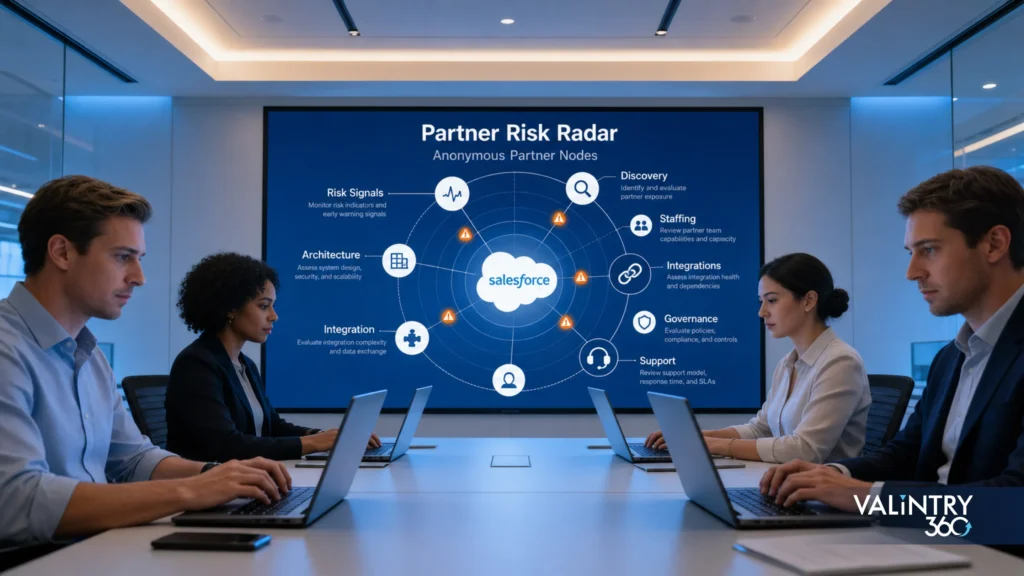
We call the hierarchy below the evidence ladder. Rung one is checkable without the vendor. Rung five exists only because the vendor typed it.
Rung one. A named production customer at your scale who takes a reference call.
Rung two. Verified customer reviews with volume behind them on the AppExchange consultant listing.
Rung three. Current competencies at Accredited or Expert level in your cloud.
Rung four. Partner tier, confirmed through Salesforce Partner Finder rather than a website badge.
Rung five. Company-reported figures published on the firm’s own site.
|
Signal |
What it proves |
What it does not prove |
|
Named production reference |
A comparable org runs live and someone says so on the record |
That the same team is free for you |
|
Review volume and CSAT score |
A pattern of outcomes across many engagements, not one showcase |
Recency, or relevance to your cloud |
|
Certified Salesforce consultants |
Bench size and platform credentialing |
Whether they touch your build |
|
Competency at Expert level |
Certifications, projects and CSAT cleared a threshold |
Depth in your industry or company size |
|
Salesforce Partner of the Year |
A submission cleared an international panel |
Consistency outside that category |
|
Company-reported claims |
What the firm chooses to publish about itself |
Independent verification of any kind |
Most buyers stop at rung four, because a badge is easy to screenshot and a reference call takes a week. The distance between rung four and rung one is where implementation failure lives, and climbing it is the whole answer to how to choose a Salesforce implementation partner. Start on the AppExchange consultant directory yourself before you take any firm’s word for its own tier.
How We Ranked These Top Salesforce Implementation Partners
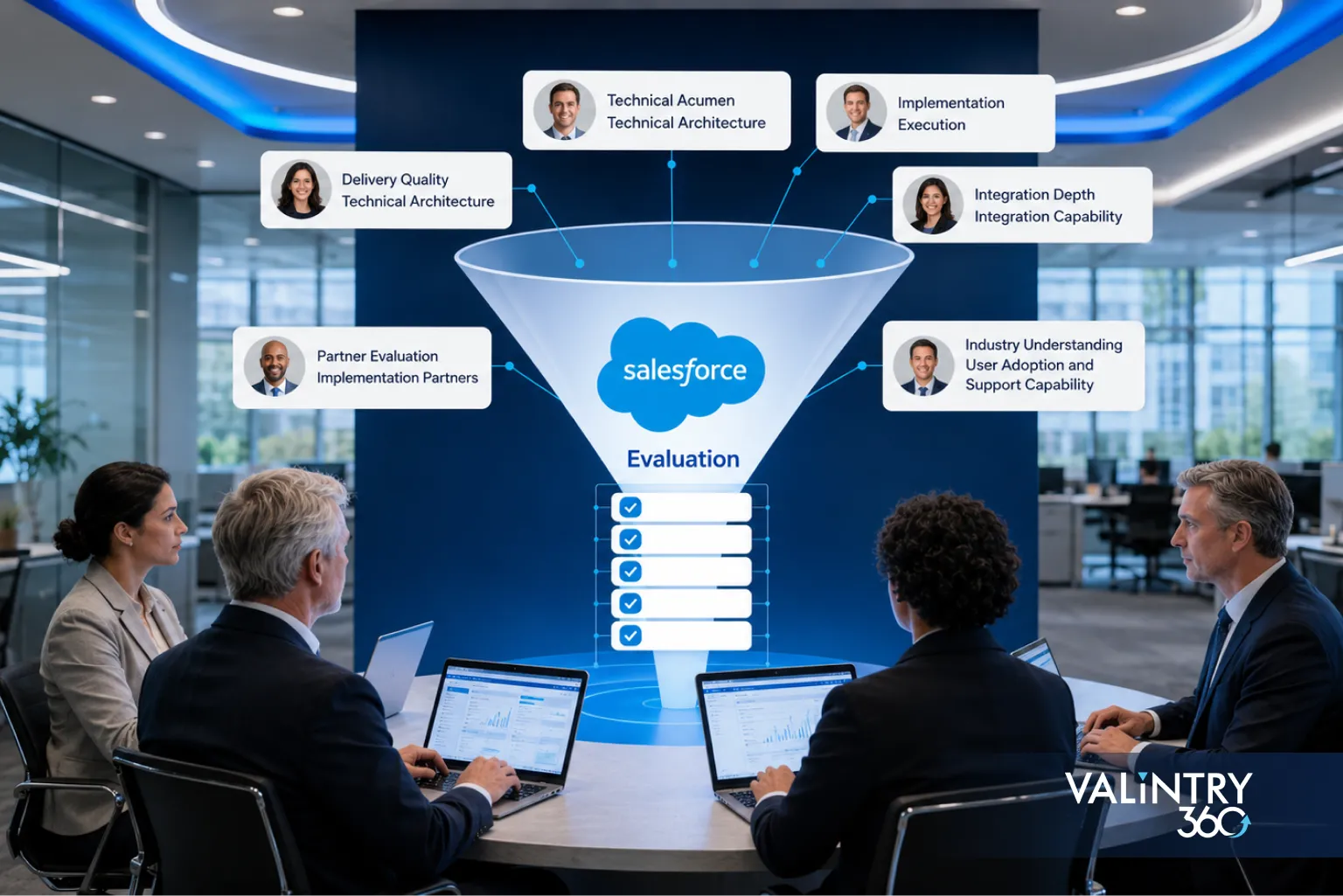
Every firm scored out of 100 against the eleven tests below. The heaviest weights sit on what decides whether an org still works in year two. The lightest sit on the numbers proposals lead with.
Can they prove a comparable build, with a number attached? 15 points. Live orgs at your scale with a result the customer would repeat on a call. A case study with no reachable client scores below a smaller reference who picks up the phone. Hardest evidence to fake, so it carries the most.
Does one team own it from assessment through run? 14 points. Whether a single team carries the work end to end, or the engagement changes hands at each boundary. Every handoff loses context nobody wrote down, and that’s the context you need in month seven.
Who owns the org after the project closes? 12 points. A real managed services practice with severity levels and response commitments in writing. Firms that build and leave compress this into one line about post-implementation support.
Can they fix an org that someone else built? 11 points. Assessing an existing org and producing a prioritized list of what to fix, remove and leave alone. Most Salesforce buying now happens inside an org that already exists.
How deep are they on data, integration and architecture? 10 points. Sharing model design, master data decisions and integration patterns. The test is whether they scope migration by source-system condition or by record count.
What does Salesforce publish about them, not the vendor? 9 points. Ratings and review volume on the AppExchange consultant listing. Volume beats average, since a 5.0 across four reviews tells you less than a 4.6 across 300.
Do the pitch architects stay through go-live? 8 points. Scored on contracted names and allocation percentages. Rotation at large firms is structural, and a credentialed stranger in month nine costs you the discovery you already paid for.
Have they built this in your industry and your clouds? 7 points. Sales Cloud strength doesn’t carry over to Marketing Cloud. Depth shows up as a firm arguing with a requirement because it’s built the same process fifteen times.
Are testing, governance and adoption quoted as real work? 6 points. Pass criteria written before build, a maintained regression pack, named enablement owners. One testing line with no UAT window tells you what gets compressed later.
What credentials do they hold under the current program? 5 points. Competencies at Accredited or Expert level and a tier confirmed through Salesforce Partner Finder. Real, but measured at firm level rather than on your project.
How much capacity can they staff at once? 3 points. Decides whether a 20-country rollout is feasible. Lowest weight, because capacity you don’t use is overhead you still pay for.
The limits. No decimal scores, since a 78.4 implies precision this evidence can’t support. Sourcing is uneven, so every entry carries a confidence label of high, medium or limited, where limited means less checkable rather than weaker. We built the model, we appear in the ranking, and the weights favor capabilities we sell.
Top Salesforce Implementation Partners at a Glance: The Comparison Table
This table applies identical criteria to every firm, so a Salesforce partner comparison happens in one pass. Where a listing showed no figure, the cell says so rather than sitting blank.
Read the market fit column before anything else here. Of the twenty firms compared, only three are realistic picks for a mid-market company or a single business unit buying its own Salesforce project: VALiNTRY360 (that is us), HyphenX Solutions and Advayan. The other seventeen are enterprise and global-program specialists, built for Fortune 500 scale and priced, staffed and structured for it. That distinction runs through every entry below, not just this table.
|
Rank |
Firm |
Tier or listing status |
Cloud coverage |
Standout evidence |
Confidence |
|
1 |
VALiNTRY360 |
Listed, no tier displayed |
Sales, Service, Marketing, Data 360 |
4.85 average, 26 verified reviews |
High |
|
2 |
Accenture |
Listed, no tier displayed |
Full multi-cloud |
26,889 experts, 1,676 projects |
High |
|
3 |
Deloitte Digital |
Listed, no tier displayed |
Full multi-cloud |
15,224 experts, 1,417 projects |
High |
|
4 |
IBM Consulting |
Listed, no tier displayed |
Full multi-cloud plus AI |
2027 award, Agentforce |
High |
|
5 |
Slalom |
Listed, no tier displayed |
Full multi-cloud |
2027 award, Agentforce |
High |
|
6 |
PwC |
Listed, no tier displayed |
Multi-cloud plus data |
2027 award, Headless 360 |
High |
|
7 |
KPMG |
Regional listing only |
Sales, Service, Marketing |
2027 award, Agentic Value |
Limited |
|
8 |
Capgemini |
Listed, no tier displayed |
Full multi-cloud |
9,829 experts, 833 projects |
High |
|
9 |
Cognizant |
Listed, no tier displayed |
Full multi-cloud |
2027 award, Transform and Scale |
High |
|
10 |
Infosys |
Summit, company-reported |
Full multi-cloud |
9,618 experts, 2,477 projects |
High |
|
11 |
Wipro |
Listed, no tier displayed |
Full multi-cloud |
4,663 experts, 923 projects |
High |
|
12 |
TCS with Coastal Cloud |
Coastal listed as Summit |
Multi-cloud plus Revenue Cloud |
Coastal, 1,355 projects, 558 reviews |
High |
|
13 |
Perficient |
Listed, no tier displayed |
Multi-cloud |
554 experts, 765 projects |
High |
|
14 |
Penrod |
Listed, no tier displayed |
Health Cloud, Service |
455 projects, 106 reviews |
High |
|
15 |
Mphasis Silverline |
Listed, no tier displayed |
Multi-cloud, industry clouds |
510 experts, 379 projects |
High |
|
16 |
Credera |
Summit partner, company-reported |
Multi-cloud plus Agentforce |
202 experts, 251 projects |
High |
|
17 |
Spaulding Ridge |
Listed, no tier displayed |
Sales, Revenue Cloud |
269 projects, 64 reviews |
High |
|
18 |
Ad Victoriam Solutions |
Listed, no tier displayed |
Sales, Service, Data 360 |
286 projects, 161 reviews |
High |
|
19 |
HyphenX Solutions |
Not confirmed during this review |
Sales, Service, Agentforce |
Company-reported figures only |
Limited |
|
20 |
Advayan |
Not confirmed during this review |
Sales, Service, integration-led |
Company-reported figures only |
Limited |
The Top 20 Salesforce Implementation Partners of 2026
This is the heart of the guide: the top Salesforce implementation partners for 2026, all twenty of them, ranked in one consistent shape. Every entry carries the same five elements so you can scan and compare fast: a market fit tag, a best-fit line, verified evidence, company-reported claims, and a limitation. Verified figures were read from AppExchange consultant listings on 31 August 2026, which Salesforce refreshes weekly.
One thing before you scroll. Firms two through eighteen carry one market fit tag, Enterprise and global programs only, because that is genuinely what they are. If you run a 200-person company buying its first CRM, most of this list is not shopping you can use, no matter how impressive the certification counts look. The realistic mid-market picks here are us, HyphenX Solutions and Advayan, and we say so on every entry rather than letting you find out on a discovery call.
1. VALiNTRY360 (Yes, That Is Us)
Market fit: Mid-market, enterprise business units and multi-region rollouts.
Best fit. Companies that want one accountable team owning assessment, remediation, build and ongoing operation instead of a build crew that hands off to a support pool at go-live.
Verified. Our AppExchange consultant listing, read on 31 August 2026, shows a 4.85 average across 26 verified customer reviews, 8 certified people, 32 competency-aligned certifications, a founding year of 2013, and a United States geographic focus.
Company-reported. 1,600 engagements, a 4.9 client satisfaction score, a 4.8-year average client tenure, more than 100 consultant certifications, 160 customers and 96 percent client retention. We publish those numbers. Salesforce does not verify them, and we will not pretend otherwise.
Limitation. Our listing records a United States geographic focus. If you need 500 consultants staffed across 30 countries inside one quarter, raw capacity at that scale belongs to the firms ranked two through twelve.
Two disclosures we would rather make here than have you discover later. Our listing displays no Select or Summit tier and no itemized competency list, so partner tier is unconfirmed by the listing itself. And it sits in the newer FY27 display format, which reports certified people aligned to competencies and no project count, so our figure of 8 is not the same measure as a legacy Certified Experts count. Comparing the two directly would be dishonest.
Why the framework puts us first: it scores full-lifecycle ownership and post-launch accountability at 37 of 100 points, and those are the capabilities we staff deliberately. Delivery covers org assessment and Salesforce health check work, remediation of underperforming orgs, every core cloud implementation, Data 360 work, MuleSoft integration, and legacy CRM migration, then Salesforce managed services with admin support and release management. The discovery team, build team and run team share the same senior leads, so the Salesforce architects who designed your approval chain are still around in month twenty.
Industry depth sits in health and life sciences, high tech, manufacturing and financial services, with HIPAA compliance handling for regulated industries. Programs run from single-cloud mid-market CRM builds through enterprise CRM rollout work and multi-region deployments, and you can see the receipts in our client case studies. Verified customer evidence carries 9 points in the model, and our 4.85 across 26 reviews is a thinner base than the 558 behind Coastal, but it is verified and updated weekly, which puts it above any company-reported figure on the Evidence Ladder.
2. Accenture
Best fit. Rollouts across 20 or more countries where governance, procurement and parallel release trains dominate the program.
Verified. 26,889 experts, 1,676 projects, and 62 ratings on the AppExchange consultant listing, plus a 2027 Global Consulting Partner of the Year award announced 27 August 2026.
Company-reported. Global reach and industry breadth across the full Salesforce portfolio.
Limitation. 62 ratings against 1,676 projects is thin, verified coverage for a practice this size, so the listing tells you almost nothing about consistency. Engagement minimums exclude most mid-market budgets, and the model scores capacity at 3 points because a single-country build with four integrations pays for global overhead it never uses.
3. Deloitte Digital
Best fit. Programs where the operating model changes alongside the platform and the business case depends on process redesign rather than configuration.
Verified. 15,224 experts, 1,417 projects and 162 ratings, plus a 2027 Global Consulting Partner of the Year award.
Company-reported. Creative, technology and data capabilities delivered as one practice.
Limitation. Strategy and delivery frequently sit in separate teams, so the people who design your target state often aren’t the people who build it. Ask which named architects stay after the design phase closes and get the allocation percentages into the contract, because senior continuity carries 8 points in this model and handoffs are where it gets lost.
4. IBM Consulting
Best fit. Agentforce work that has to coexist with existing enterprise AI infrastructure and data governance already in place.
Verified. 6,861 experts, 1,141 projects and 113 ratings, plus a 2027 award for Agentforce delivery.
Company-reported. Industry consulting paired with front-to-back agentic AI.
Limitation. The Agentforce recognition is recent and category-specific, so it says nothing about a plain Sales Cloud build with three integrations and dirty legacy data. Award submissions measure the projects a firm chose to submit. Ask for two live references running the cloud you’re actually buying, at your company size, rather than the flagship AI program that won the category.
5. Slalom
Best fit. Enterprises wanting global reach delivered through local market teams instead of a centralized offshore pool.
Verified. 2,593 experts, 605 projects and 155 ratings, plus a 2027 award for Agentforce delivery.
Company-reported. A market-based model rather than offshore resource pooling.
Limitation. Capability varies significantly by office, so the firm-level numbers above don’t describe the team you’d get. Evaluate the specific office staffing your program, ask for its own reference list, and confirm what happens if that office is at capacity when your project starts. The listing aggregates every market, which makes it a weak predictor of local delivery quality.
6. PwC
Best fit. API-first architectures where Salesforce sits among audited systems and controls evidence is part of the deliverable.
Verified. 2,797 experts, 157 projects and 32 ratings, plus a 2027 award for Headless 360.
Company-reported. An agentic-first approach spanning AI strategy and data readiness.
Limitation. 157 projects against 2,797 experts is the lowest project-to-headcount ratio on this list, and 32 ratings is the thinnest verified review base here. Both figures suggest advisory weight ahead of delivery volume on the platform. On a build where the hard part is data condition rather than audit posture, you’re paying a governance premium you won’t draw on.
7. KPMG
Best fit. Regulated industries where controls evidence, validation and change traceability matter as much as functional design.
Verified. A 2027 Partner of the Year award for Agentic Value. No global consultant listing was confirmed during this review. The regional iCom by KPMG listing shows 100 experts, 0 projects and 31 reviews.
Company-reported. More than 2,500 CRM practitioners globally.
Limitation. With no global listing confirmed, that award is the only independent evidence available, and a zero project count on the regional listing gives you nothing to check. Every capability claim here sits on rung five of the Evidence Ladder.
8. Capgemini
Best fit. Coordinated Salesforce and SAP estates in industrial businesses, where master data ownership crosses both platforms.
Verified. 9,829 experts, 833 projects and 51 ratings. No 2027 award recorded.
Company-reported. A global strategic Salesforce partner for more than 14 years.
Limitation. 51 ratings is the thinnest verified review base among the large integrators, so scale here is documented by headcount rather than by customer evidence. Verified customer evidence carries 9 points in the model precisely because vendor-controlled numbers can’t substitute for it. Ask for named references in your industry at your revenue band, not the flagship account.
9. Cognizant
Best fit. Large service transformations that need sustained delivery capacity for months after launch rather than a build team that disbands.
Verified. 11,310 experts, 973 projects and 157 ratings on the Cognizant Moment listing, plus a 2027 award for Transform and Scale.
Company-reported. An AI-native experience business and Salesforce AI builder.
Limitation. Delivery is offshore-weighted, which moves your working relationship into another time zone and compresses the overlap window for decisions. Put a specific onshore hours percentage into the statement of work and name the architects who hold it, because a blended rate with no onshore floor is a rate that drifts.
10. Infosys
Best fit. Cost-sensitive global programs carrying heavy configuration volume where throughput matters more than senior continuity.
Verified. 9,618 experts, 2,477 projects and 437 ratings on the combined listing, the highest project count assessed here.
Company-reported. Global Summit Partner status, with Simplus in North America and Fluido in the Nordics.
Limitation. Three brands sit behind a single listing, so the project count reflects two acquisitions rather than one delivery organization. Ask which legal entity signs, which entity staffs, and whether the Simplus or Fluido teams behind those numbers are the ones assigned to you. A combined listing flatters everyone inside it.
11. Wipro
Best fit. Multi-year programs where blended rates decide the business case and volume of configuration is predictable.
Verified. 4,663 experts, 923 projects and 102 ratings. No 2027 award recorded.
Company-reported. Roadmaps that simplify and accelerate platform moves.
Limitation. Senior continuity is the recurring complaint in offshore-weighted delivery, and it’s the criterion this model weights at 8 points. Name your architect in the contract with an allocation percentage and a replacement clause. Without that, the rate advantage gets consumed by the rediscovery cost every time the team rotates, which is the part that never appears in the business case.
12. TCS With Coastal Cloud
Best fit. Global scale where a US delivery arm handles the North American workstream inside a larger program.
Verified. TCS lists 9,975 experts and 345 projects. Coastal lists 625 experts, 1,355 projects and 558 ratings, and won a 2027 Data 360 award.
Company-reported. Coastal adds 400 professionals and 3,000 certifications, per the December 2025 release.
Limitation. Those are two separate evidence bases, and the acquisition closed recently enough that the integration is unproven. The 558 reviews belong to pre-acquisition Coastal. Confirm in writing whether Coastal or the TCS bench delivers your project, and what changes if that decision is revisited mid-program.
13. Perficient
Best fit. Enterprise business units wanting large-firm delivery process from a practice smaller than the global integrators.
Verified. 554 experts, 765 projects and 104 ratings. No 2027 award recorded.
Company-reported. Architecture modernization on an AI-enabled delivery lifecycle.
Limitation. This is a broad technology practice where Salesforce is one line of business among many, so the headline figures don’t tell you the Salesforce bench size. Ask how many of those 554 experts are Salesforce-dedicated, how many are available in your delivery window, and what happens to your staffing if a larger account escalates.
14. Penrod
Best fit. Providers and payers running Health Cloud as the system of record, where clinical workflow knowledge is the hard part.
Verified. 56 experts, 455 projects and 106 ratings. No 2027 award recorded.
Company-reported. Implementation, advisory and managed services, healthcare only.
Limitation. The healthcare focus is both the strength and the boundary, so there’s nothing here for manufacturing, financial services or high tech. 56 experts against 455 projects is a thin bench for concurrent programs, which means one senior departure moves your timeline. Ask how many people could take over your architect’s role tomorrow.
15. Mphasis Silverline
Best fit. Financial services and healthcare orgs wanting a single provider from strategy through ongoing run.
Verified. 510 experts, 379 projects and 136 ratings. No 2027 award recorded.
Company-reported. Advisory through managed services under the Mphasis group.
Limitation. The Silverline brand now sits inside a larger parent, so confirm which entity signs the contract, which entity staffs the build, and which one you escalate to in month fourteen. Post-acquisition delivery models change quietly. Ask for references from engagements that started after the acquisition rather than the ones that built the review base.
16. Credera
Best fit. Programs wanting Summit-level delivery with a choice between onshore and offshore run options after launch.
Verified. 202 experts, 251 projects and 136 ratings. No 2027 award recorded.
Company-reported. A Salesforce Summit partner since 2007, delivering multi-cloud and Agentforce work.
Limitation. The Summit tier claim is company-reported, so confirm it through Salesforce Partner Finder rather than the website badge. Agency ownership also shapes the client mix toward marketing-led programs, which is a different discipline from a quote-to-cash or service build. Ask for two references outside advertising and adjacent industries.
17. Spaulding Ridge
Best fit. Builds where Salesforce connects to planning, finance and revenue systems and the integration boundary is the difficult part.
Verified. 116 experts, 269 projects and 64 ratings. No 2027 award recorded.
Company-reported. A global cloud advisory firm focused on operating efficiency.
Limitation. Salesforce is one of several platforms delivered here, so confirm the Salesforce-specific bench size rather than the firm total. 64 ratings is a modest verified base. On a build where Salesforce is the system of record rather than one node in a planning estate, that multi-platform breadth stops being an advantage.
18. Ad Victoriam Solutions
Best fit. Enterprise units taking on Data Cloud and Agentforce for the first time alongside an existing Sales or Service build.
Verified. 116 experts, 286 projects and 161 ratings, which is strong review density relative to bench size.
Company-reported. Capability across cloud, integration, data and AI.
Limitation. Bench depth is modest against enterprise program demands, so named availability is the thing to confirm before signing rather than after. Ask which architects are assigned, what percentage of their time you hold, and how the firm handles two large programs landing in the same quarter.
19. HyphenX Solutions
Best fit. Discovery-led mid-market builds where scope needs defining before a budget number exists.
Verified. No Salesforce consultant listing, partner tier or competency was confirmed during this review.
Company-reported. 100 multi-cloud implementations, 250 certifications, 30,000 users and a 4.9 satisfaction score.
Limitation. Every figure above comes from the firm, which puts all of it on rung five of the Evidence Ladder with nothing on rungs one through four. That isn’t evidence of weak delivery, and it does mean you carry the entire verification burden yourself. Ask for the AppExchange listing and two named references before scope conversations start.
20. Advayan
Best fit. Quote-to-cash builds spanning Salesforce and SAP where one team owns both sides of the boundary.
Verified. No Salesforce consultant listing, partner tier or competency was confirmed during this review.
Company-reported. 400 certifications, 200 projects, 120 support staff and a 90 percent repeat rate.
Limitation. As above, every figure is self-published with no independent listing to check it against. A 90 percent repeat rate is a strong claim and an unverifiable one. Ask which named clients are behind it, request the listing, and confirm the SAP-side capability separately, since cross-platform teams are frequently two vendors under one contract.
What Global Integrators Are Actually Built For
Global integrators lead on one thing the rest of this list cannot match: raw simultaneous headcount for rollouts across 20 or more countries, plus the procurement machinery large enterprises require. Capacity is worth 3 points in the model and continuity is worth 8, which is why that lane does not top the ranking. That scale carries three costs. Procurement runs months rather than weeks. Teams rotate, so the people in the pitch are rarely the people in the build. And an offshore delivery model moves your working relationship into another time zone.
|
Program shape |
What makes it hard |
Firms built for it |
|
Rollout across 20 or more countries |
Localization, data residency and parallel release trains |
Accenture, Deloitte Digital, Capgemini |
|
Agentforce across sales and service |
Grounding data, action scope and human handoff design |
IBM Consulting, Slalom |
|
Salesforce beside a global SAP estate |
Master data ownership and quote-to-cash boundaries |
Capgemini, TCS, Wipro |
|
Regulated build with audit exposure |
Validation, controls, evidence, and change traceability |
KPMG, PwC |
|
High-volume configuration at low cost |
Sustained throughput without quality drift |
Infosys, Wipro, Cognizant |
|
Enterprise unit inside a larger group |
Local autonomy against group platform standards |
Perficient, Slalom, VALiNTRY360 (us) |
Buying capacity you will not use is the most common overspend here. A single-country program with four integrations does not need 26,000 certified experts and pays for the overhead anyway. Our own Salesforce consulting practice exists for exactly that gap.
Matching a Partner to Your Salesforce Cloud
Partner experience does not transfer evenly between clouds. A firm strong at Sales Cloud implementation can be weak at Marketing Cloud implementation because the skills, tooling and failure modes barely overlap. The same gap opens between Service Cloud implementation and Revenue Cloud.
|
Cloud |
What decides success |
Evidence to check |
|
Sales Cloud |
Forecast model, territory design and approval chains |
Two live orgs with comparable deal complexity |
|
Service Cloud |
Routing, case lifecycle and knowledge structure |
A named client with deflection numbers |
|
Marketing Cloud |
Data model, consent handling and deliverability |
A migration off another platform, not a greenfield build |
|
Experience Cloud |
Sharing model, identity and page performance |
A portal live with external users at your scale |
|
Commerce Cloud |
Catalog, pricing logic and fulfillment integration |
A live storefront with order volumes cited |
|
Revenue Cloud |
Quote-to-cash rules, amendments and billing accuracy |
A CPQ build that survived a renewal cycle |
One question separates delivery teams from sales teams. Ask how they would handle a forecast rolling up two ways for two audiences. A delivery person names custom forecast categories, opportunity splits or a reporting layer, then says which creates technical debt. A sales person says the platform handles it.
Your Data Readiness Checklist Before Any Migration
Data work decides more implementation budgets than any other stage, so run due diligence in layers rather than one question. Work through the eight below and vague answers surface fast.
- Which system masters accounts, contacts, products and pricing after go-live, and who signs off?
- How much history moves, and what happens to records that fail validation on load?
- How are duplicates merged, and is reconciliation automated or a spreadsheet exercise?
- How many migration rehearsals are budgeted, and what is the rollback plan?
- Which integrations are real-time and which are batch, and who owns the overnight error queue?
- Is MuleSoft integration proposed because the estate needs it, or because the partner resells it?
- What data quality thresholds must be met before go-live, and who waives them?
- Who owns data governance after launch, meaning who decides next quarter that a duplicate is allowed?
Two distinctions get blurred in almost every proposal. A legacy CRM migration is a one-time move with a defined end, while API integration is a permanent contract between systems that must survive both platforms upgrading independently. One quoted line hides the ongoing cost.
Data quality and data governance are the second pair. Cleansing fixes the records you move once. Governance decides who may create bad data next Tuesday, and quoting cleansing as governance prices half the job.
Testing, Governance and Who Owns the Org After Go-Live
Somebody owns your org in month seven. If the contract doesn’t name that person, the answer is nobody, and that’s how an org decays into the condition that needs remediation two years later. Testing is where this starts. Sandbox testing and UAT get scoped last and needed longest, so watch for a UAT window that shrinks every time an earlier stage slips. Pass criteria written after the build turn user acceptance testing into a demo, where users watch the system work instead of trying to break it. Ownership after launch runs through six responsibilities. Each one needs a name attached before you sign, not after.
- Hypercare. A defined window with response commitments by severity, rather than an open promise of support.
- Handover. Documentation, admin credentials and code repositories delivered on a fixed date.
- Release management. Who decides what ships, how often, and who can reject a change already built.
- Regression ownership. Who maintains the test pack across the three Salesforce releases each year.
- Security review. Who audits profiles, permission sets and sharing rules after a year of one-off exceptions.
- Backlog triage. Who ranks enhancements against defects, and what the response commitment is for each.
A firm that has run orgs for years answers all six without checking notes. One that builds and leaves compresses four of them into a single line about post-implementation support, which is a sentence rather than a commitment. Ask one question at contract stage: which of these six is in scope, and which becomes our problem on the day you leave? Our Salesforce managed services practice names an owner for each of the six on day one, because the ones nobody owns are the ones that surface in month fourteen.
Salesforce Implementation Costs and Engagement Models in 2026
No published price exists for a Salesforce implementation, because two companies buying identical licenses can pay three times as much in services. Integration count and data condition move the total far more than how many clouds sit on the order form.
The ranges below are observed across engagements we’ve quoted, bid against or seen in client procurement. They’re observed rather than quoted prices, they exclude licensing, and they assume a US-based buyer. Treat them as a sanity check on a proposal in front of you, not as a market rate.
Fixed price. A set amount for a defined scope, with delivery risk sitting on the partner. Observed range for a single-cloud mid-market build after discovery: $60,000 to $180,000. The protection is real, and it only holds for the scope written down before the signature. Everything outside that document becomes a change order, so read the assumptions appendix before the price page. A fixed price works best when your process is stable and your data has already been assessed.
Time and materials. Hourly billing, with risk and flexibility both sitting on you. Observed blended rates run $85 to $145 on an offshore delivery model and $150 to $275 for onshore delivery. This is the honest structure for genuinely undefined work, and it needs governance you have to supply: a burn report you actually read, a change threshold that triggers a conversation, and someone on your side authorized to say stop. Without those, T and M is an open tab.
Capped time and materials. Hourly billing against a ceiling, splitting risk between both sides. The observed premium is five to ten percent over uncapped rates for an identical scope. That premium buys you a worst-case scenario you can budget against, which is usually worth it on a first implementation. Check what the cap actually covers, because a cap on build hours with testing and migration excluded is a cap on the cheap part of the project.
Dedicated team. Named people retained for a fixed period, and the usual route into staff augmentation. Observed range: $18,000 to $45,000 per person per month, moving with seniority and location. The value is continuity since the same architect carries context from discovery into run. The risk is paying for a full-time allocation you can’t feed, so match the team size to a backlog you’ve already written rather than one you plan to write.
Managed services retainer. A monthly commitment covering run, enhancement and admin support after go-live. Observed mid-market range: $6,000 to $25,000 per month. The response commitment moves that number more than the hour count does, because a two-hour severity-one response requires staffed coverage that a next-business-day commitment doesn’t. Compare retainers on severity levels and response times before comparing them on hours.
What Actually Moves the Number
|
Cost driver |
Why it moves the total |
Impact |
|
Integration count |
Each connection carries design, build, test and permanent maintenance |
Highest |
|
Data migration complexity |
Priced by source-system quality rather than record count |
High |
|
Custom Apex volume |
Code carries test coverage, review and upgrade obligations across three releases a year |
High |
|
User roles and approval paths |
Each variation multiplies testing scenarios and training tracks |
Moderate |
|
Change management scope |
Adoption work is cut first and re-bought later at a higher price |
Moderate |
|
Number of clouds licensed |
Adds scope but shares architecture overhead |
Lowest |
The top row is the one that gets scoped least and moves budgets most. Integrations are quoted as a count and delivered as a set of permanent contracts between systems, each needing error handling, a retry path and an owner for the overnight queue. Every connection also has to survive both platforms upgrading independently, which is a cost that starts after go-live and never stops.
Notice the bottom row. Adding a second cloud is the change buyers assume is expensive, and it’s the cheapest thing on this list, because the architecture and governance work is already paid for.
Reading a Quote You’ve Been Handed
Licensing sits outside all of this, on a separate Salesforce contract with its own renewal terms and its own annual increase. Ask for services and license fees split into separate lines. A blended total hides your real cost of ownership and makes year two impossible to forecast.
A fixed price quoted before discovery means the partner priced a guess and protected itself with assumptions in an appendix you probably haven’t read. Every wrong assumption becomes a change order at a rate you never negotiated. Credible fixed pricing follows a paid discovery phase, and a partner who won’t run one before committing to a number is telling you where the risk is going.
Three questions separate a credible quote from an optimistic one. Ask what’s excluded that similar projects needed. Ask how the data migration figure changes after they see your data. Ask what the first three change orders on comparable builds were for, because a partner who has delivered honestly can name them without checking.
Warning Signs When Evaluating Top Salesforce Implementation Partners

The reliable warning signs appear in documents rather than meetings. Check the proposal and statement of work against the eight below before checking references.
- A fixed price arrives before the partner has looked at your data.
- The statement of work describes deliverables by activity rather than outcome, so completion is unfalsifiable.
- Certification counts are quoted for the firm, and nobody names the architect on your project.
- The proposal cites a tier Salesforce retired in March 2026, such as Crest or Platinum.
- Case studies carry industry labels and metrics but no client who will take a call.
- Testing appears as one line item with no separate UAT window or pass criteria.
- Post-implementation support is one sentence with no severity levels or response times.
- The pitch team includes senior people whose names never appear in the resourcing schedule.
The last is most predictive. Ask for a resourcing schedule with names and percentage allocations, then watch the room.
Why VALiNTRY360 Ranks First in This Comparison
We rank first because the model weights full-lifecycle ownership, post-launch accountability and remediation at 37 of 100 points, and those are the three capabilities we staff on purpose. We built that model, so read the evidence below in three separate layers and weigh each one differently.
Layer A: What Salesforce Displays
Our AppExchange consultant listing, read on 31 August 2026, shows a 4.85 average across 26 verified reviews, 8 certified people, 32 certifications aligned to competencies, a founding year of 2013 and a United States geographic focus.
Two disclosures belong here rather than in a footnote. Our listing displays no Select or Summit tier badge and no itemized competency list, so our partner tier is unconfirmed by the listing itself. And it sits in the newer FY27 display format, which reports certified people aligned to competencies and shows no project count. That figure of 8 isn’t the same measure as Accenture’s 26,889, which comes from the legacy format. Comparing the two directly would be dishonest, so we don’t.
Layer B: What We Report About Ourselves
We report 1,600+ engagements, a 4.9 client satisfaction score, average client tenure of 4.8 years, 100+ consultant certifications across the team, 160+ customers and 96% client retention. Salesforce verifies none of it. Those numbers come from us, and they sit on rung five of the Evidence Ladder like every other vendor claim on this page.
Our practice covers assessment and Salesforce health checks, remediation of underperforming orgs, implementation across Sales, Service, Marketing and Experience Cloud, data and integration work, and ongoing managed services. Industry depth sits in health and life sciences and high tech, with manufacturing and retail alongside.
Layer C: Why the Method Puts Us First
Most buyers don’t arrive with a blank org. They arrive with four years of accumulated automation, three abandoned field sets and a validation rule nobody will delete because nobody remembers what it protects. That org needs fixing before anything new lands on it, and remediation is a capability few firms staff deliberately because it doesn’t sell like transformation.
We cover assessment, remediation, implementation and ongoing operation with the same senior consultants. For a mid-market company or an enterprise division, continuity beats bench size, because the person who understood why your approval chain works that way is the person you need in month nine.
The honest boundary. A thirty-country rollout with a dozen integrations, four languages and follow-the-sun support is a different purchase. Firms two through thirteen are built for it and we’re not. Our listing says United States only, and that’s a real constraint on what we can take on.
A second admission against our own interest. If you want a clean single-cloud build with no legacy org, no integrations and a tight budget, our discovery-first process costs more up front than a fixed-price quick start from a smaller shop. It earns its keep on complexity. On a simple project it doesn’t, and you should buy accordingly.
Twelve Questions to Ask Before You Sign
Ask all twelve in writing before contracts. Score the answers against the 100-point model and you have a defensible shortlist of the best Salesforce implementation partners rather than a preference.
- What is your partner tier, and which competencies do you hold at Accredited or Expert level in our cloud?
- Which two named production customers at our size will take a reference call?
- Who are the named Salesforce architects on this project, and will they appear in the contract?
- What share of delivery hours is onshore delivery, and what time-zone overlap do we get?
- Walk us through your last project overrun, and what changed afterward.
- How do you scope data migration before seeing our data, and what changes it afterward?
- Which of our requirements do you think is wrong, and what would you build instead?
- Who owns the regression pack after go-live, and is maintaining it in this contract?
- What does hypercare cover, how long does it run, and what is the response commitment?
- If we change partners in year two, what do we receive and by when?
- What is excluded from this quote that similar projects needed?
- What would make you decline this project?
Question twelve does the most work. A certified Salesforce implementation partner with delivery discipline has a list of projects it turns down and will describe one, while a firm that can help with anything is describing its pipeline.
Twelve Questions to Ask Before You Sign
Ask all twelve in writing before contracts. Score the answers against the 100-point model and you have a defensible shortlist of the best Salesforce implementation partners rather than a preference.
- What is your partner tier, and which competencies do you hold at Accredited or Expert level in our cloud?
- Which two named production customers at our size will take a reference call?
- Who are the named Salesforce architects on this project, and will they appear in the contract?
- What share of delivery hours is onshore delivery, and what time-zone overlap do we get?
- Walk us through your last project overrun, and what changed afterward.
- How do you scope data migration before seeing our data, and what changes it afterward?
- Which of our requirements do you think is wrong, and what would you build instead?
- Who owns the regression pack after go-live, and is maintaining it in this contract?
- What does hypercare cover, how long does it run, and what is the response commitment?
- If we change partners in year two, what do we receive and by when?
- What is excluded from this quote that similar projects needed?
- What would make you decline this project?
Question twelve does the most work. A certified Salesforce implementation partner with delivery discipline has a list of projects it turns down and will describe one, while a firm that can help with anything is describing its pipeline.
FAQs
- How long does it take to choose a Salesforce implementation partner?
Most mid-market selections run four to eight weeks from shortlist to signature. Reference calls take a week each to schedule, and a paid discovery phase adds two to three weeks before a credible fixed price exists. - Should we sign an implementation partner before or after buying licenses?
Talk to partners first. A partner who reviews your requirements before the license order can tell you which clouds you actually need, since the number of clouds you buy moves cost far less than integration count. - What is a paid discovery phase and why should we pay for it?
A scoped engagement where the partner examines your data, processes and integrations before quoting the build. It usually costs a fraction of the project and replaces guesswork assumptions with a price you can hold them to. - Can we switch Salesforce partners mid-implementation?
Yes, though it costs you the discovery you already paid for. Ask upfront what you receive on exit: documentation, admin credentials, code repositories and the regression pack, all delivered by a fixed date written into the contract. - What should a Salesforce statement of work actually contain?
Named architects with allocation percentages, deliverables defined by outcome rather than activity, a separate UAT window with pass criteria, hypercare severity levels and response times, and a written exclusions list. Anything missing becomes a change order. - How many certifications should our implementation partner have?
Firm-wide certification counts measure the bench, not your project team. Ask instead which certified people are assigned to your build, what percentage of their time you hold, and whether their names appear in the contract. - Do we need a Salesforce architect on our own side?
On any build with three or more integrations, yes. Someone internal must own data governance decisions, approve the sharing model and rank the backlog after launch. Without that person, every decision routes back through the partner. - What is the difference between a Salesforce partner and a Salesforce reseller?
Implementation partners deliver services: discovery, architecture, build and support. Resellers sell licenses. Some firms do both, so ask for services and license fees split into separate lines before you compare any two quotes. - How do we compare proposals that use different pricing models?
Convert everything to total cost over 24 months, including managed services and expected change orders. A fixed price and a time-and-materials bid look nothing alike until you add the year-two run cost to both. - What happens during a Salesforce release if our partner has left?
Salesforce ships three releases a year, and each can surface something in your build. Without a named regression owner, nobody runs the test pack, and defects appear in production before anyone knows a change landed. - Is an offshore Salesforce delivery model a bad choice?
No, though it changes what you must negotiate. Specify an onshore hours percentage, a time-zone overlap window and named architects in the contract, since blended rates without an onshore floor tend to drift over a long program. - How do we know if our current Salesforce org needs remediation or a rebuild?
Start with an independent assessment. Most underperforming orgs are salvageable, and a rebuild discards working configuration alongside the broken parts. The assessment should return a ranked list of what to fix, remove and leave alone. - What size company is too small for a Salesforce implementation partner?
Below roughly 50 users with clean data and no integrations, a certified admin may be enough. Complexity rather than headcount decides. Two integrations and a legacy CRM migration justify a partner at almost any size. - Should we hire a partner for change management or handle it internally?
Split it. The partner builds role-based enablement and documentation; your team owns adoption, because internal function owners carry authority the partner never has. Budget the work separately, since it gets cut first and repurchased later. - What questions do partners hope we don’t ask?
Which requirements they think are wrong, what their last project overrun cost, what’s excluded from the quote that similar builds needed, and which projects they decline. Vague answers to those four are the most predictive signal available.
Related Posts
- Agentforce
Agentforce vs Salesforce Flow: Which Should You Use…
Your Salesforce org may already depend on Flow for record updates, approval routing, notifications, scheduled jobs, guided screens, and other repeatable processes. Each path is configured in advance, so the system follows the same rules whenever the same conditions appear.Agentforce…
- Agentforce
Agentforce Readiness Checklist: Is Your Salesforce Org Ready?
Agentforce reads whatever your Salesforce org already contains, and it acts through the automation you've already built. That inheritance is the whole readiness problem, in one sentence.An agent inherits your duplicate contact records, your too-wide permission sets, and that Flow…
- Agentforce
Agentforce Implementation Cost in 2026
Salesforce publishes a price for a credit, a conversation, a user license, and a resolved case. Those numbers price the meter.Your project is everything that happens before the meter starts running: defining the process, cleaning the records the agent will…