
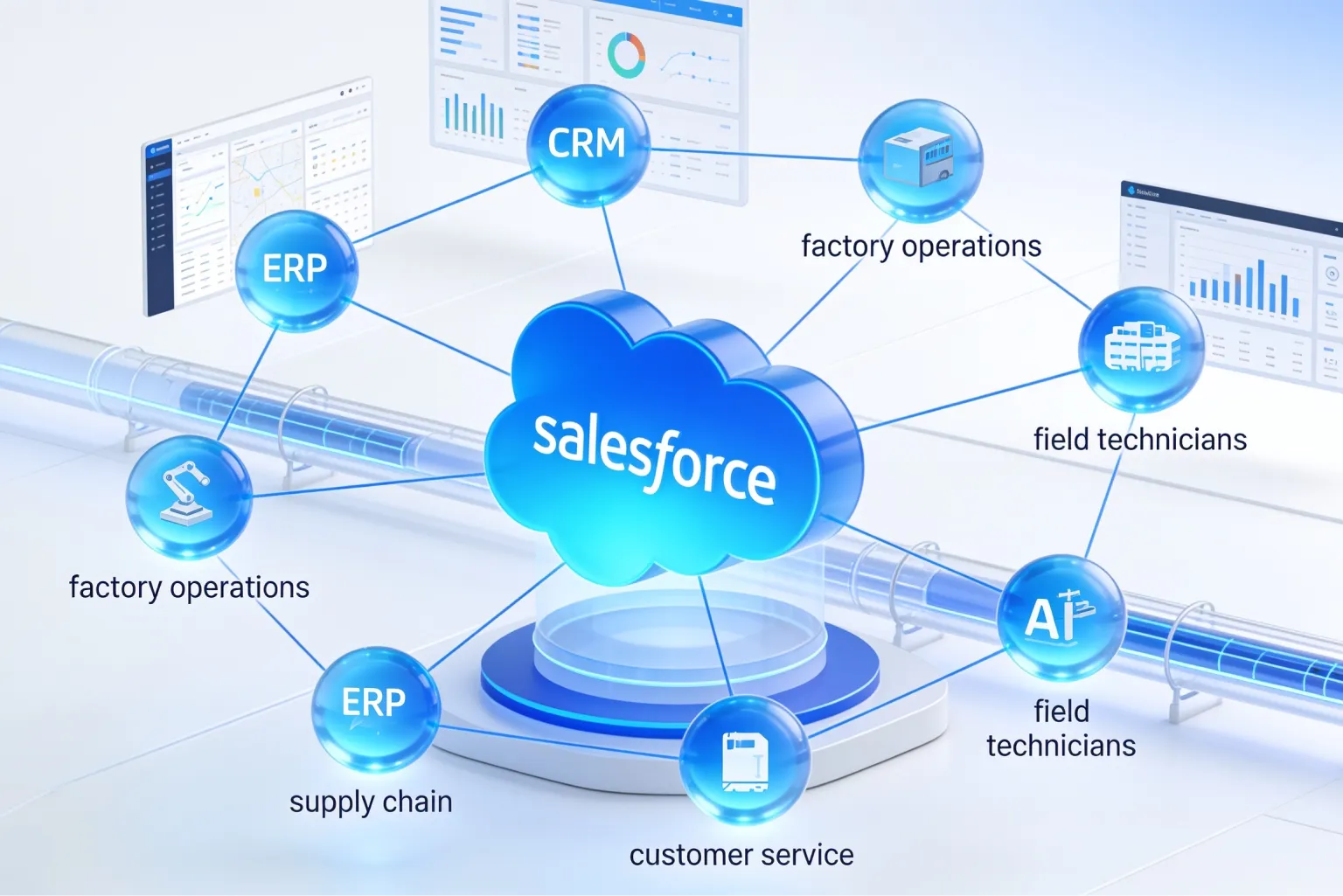
Manufacturers rarely need a CRM-only implementation. We’ve sat across the table from operations leaders who inherited a Sales Cloud org that looks polished in a demo but can’t tell a rep whether the part on a quote is actually in stock or tell a dispatcher whether the technician driving to a machine is walking into an active warranty claim. Customer, order, inventory, production, asset, dealer, and service data all need to move between systems. That’s a different problem than picking a CRM.
In short: Salesforce manufacturing consultants configure Sales Cloud, Service Cloud, Manufacturing Cloud, and Field Service, then connect them to ERP, MES, and IoT platforms so sales, production, and service teams work from the same order, inventory, and asset data. The strongest consultants pair Salesforce configuration skills with manufacturing process knowledge and real integration experience.
The right consulting option for your business depends on five things: how complex your ERP environment is, how much integration work is required, whether field service is core to your revenue, how much internal Salesforce capacity you already have, and who you want owning the platform two years from now. We built the comparison below around those five factors so you can shortlist the right type of partner rather than the first Salesforce logo that shows up in a search.
TL;DR
One CRM Rarely Solves a Manufacturer’s Problem
Manufacturers don’t just need a CRM; they need customer, order, inventory, production, asset, dealer, and service data moving between systems. This article compares seven Salesforce consulting models, from generalist firms to manufacturing specialists, ERP-led integrators, and MuleSoft experts, so you understand what each actually delivers.
Picking the Wrong Partner Type Is the Real Risk
The hardest decision isn’t Salesforce versus SAP, it’s choosing a consultant whose strengths match your biggest risk: ERP complexity, field-service scale, internal capacity, or long-term ownership. Generalist firms often miss manufacturing-specific workflows like sales agreements, warranty logic, and dealer pricing, causing costly rework later.
A Scenario-Based Framework for Shortlisting Confidently
The article delivers consistent evaluation criteria, a scenario-matched recommendation matrix, architecture comparisons, and a cost breakdown by option. It closes with a 15-question buyer checklist and warning signs of weak proposals, helping manufacturers shortlist the right Salesforce, ERP, and Field Service consulting partner with confidence.
Quick Comparison of Salesforce Consulting Options for Manufacturers
No option below is universally best. A general Salesforce firm that’s excellent for a services company can be the wrong choice for a discrete manufacturer running SAP and dispatching 200 field technicians. Use this table as a starting filter, then read the section for whichever rows look closest to your situation.
| Partner | Mfg. | SF | ERP | FS | Speed | Effort | Cost | Best Fit |
|---|---|---|---|---|---|---|---|---|
| General SF consultancy | Low | High | Low | Low | Fast | Medium | High | Simple CRM, light ERP |
| Manufacturing specialist | High | High | Med–High | Med–High | Medium | Low–Med | Med–High | Manufacturing firms |
| ERP systems integrator | Medium | Low–Med | High | Low | Slow | Medium | Medium | ERP implementation |
| MuleSoft/integration specialist | Low–Med | Medium | High | Low | Medium | Medium | Medium | Complex integrations |
| Field Service specialist | Medium | High | Low–Med | High | Medium | Low–Med | Medium | Service-heavy operations |
| Native SF ERP partner | Medium | High | Native | Medium | Slow | Med–High | Medium | Salesforce ERP adoption |
| Internal/hybrid team | High | Varies | Varies | Varies | Varies | High | High | Strong internal team |
How We Evaluated Each Consulting Option

We scored every option against the same criteria so the comparisons hold up, not just the labels: manufacturing process knowledge; CRM capability; ERP and MES integration experience; MuleSoft and API expertise; Salesforce Field Service experience; data migration capability; change-management support; delivery model; pricing transparency; post-launch support; Salesforce partner relationship; and the ability to coordinate with Salesforce account teams. If a section below doesn’t call out one of these directly, it’s because that criterion doesn’t meaningfully differentiate that option from the others, not because we dropped it.
We treat manufacturing expertise and Salesforce expertise as two separate axes on purpose. A firm can be excellent at Salesforce configuration and still design a data model that fights how a manufacturer actually books orders, manages sales agreements, or handles dealer chargebacks. The reverse also happens: teams with deep plant-floor knowledge who build workarounds in Salesforce instead of using the platform the way it’s meant to work. The strongest partners score well on both axes, which is the lens we used for every option below.
General Salesforce consulting firms
General Salesforce consultancies typically deliver Sales Cloud implementation, Service Cloud configuration, basic workflow automation, standard reporting, common point-to-point integrations, and user training. Many are genuinely strong Salesforce shops, certified and capable of a clean, technically sound build.
Where they tend to struggle with manufacturers is everything outside the standard CRM playbook: sales agreements and run-rate forecasting, dealer and distributor pricing tiers, warranty and entitlement logic, and the reality that “inventory” in this world isn’t a picklist value; it’s a number that changes every hour in an ERP the consultant has never opened. A generalist firm can build a technically correct org that still doesn’t match how your production and sales teams actually work, which shows up later as rework, workarounds, and a slow adoption curve.
This option works best when scope is genuinely simple. If you’re implementing Sales Cloud for the first time, your ERP integration need is limited to a periodic data sync, and you don’t have complex field-service requirements, a competent general Salesforce firm can deliver a solid result at a lower cost than a manufacturing specialist.
Best for: manufacturers with straightforward CRM needs, light ERP integration requirements, and no near-term plans for Manufacturing Cloud or Field Service.
Manufacturing-specialist Salesforce consultancies
Manufacturing-specialist partners build on the same Salesforce platform but bring domain-specific accelerators: Manufacturing Cloud implementation work, sales agreements, account-based forecasting, distributor and dealer management, warranty and entitlement workflows, ERP integration patterns, Field Service, and data models built around how manufacturers actually structure accounts, products, and orders.
The main advantage is reduced discovery time. A specialist has usually already solved the “how do we model a sales agreement” or “how do we handle a distributor return” problem for a prior client, so less of the engagement is spent teaching the consultant your business.
The limitations are real too. Manufacturing-specialist firms are often smaller than the largest generalist system integrators, which can mean narrower geographic coverage or less bench depth for a very large, multi-region rollout. Many also lean on a third-party ERP specialist or MuleSoft partner for the deepest integration work rather than owning it end to end, so it’s worth asking directly who does the ERP-side integration work, not just the Salesforce side.
Best for: mid-market and enterprise manufacturers who want a partner that already understands sales agreements, dealer management, and manufacturing data models and who are integrating with an established ERP rather than replacing it.
ERP-led systems integrators
Some consultancies lead with SAP, Oracle, NetSuite, Microsoft Dynamics, or another ERP platform and treat Salesforce as a downstream system. Their strength is in the back office: order management, inventory, finance, supply chain, master data governance, and production systems. If your biggest risk is getting the ERP data model right, an ERP-led integrator can bring that discipline to the project in a way a Salesforce-first team usually can’t.
The tradeoff shows up on the Salesforce side. ERP-led integrators are frequently weaker at Sales Cloud user experience, Experience Cloud portal design, and Field Service adoption because those aren’t their core practice. The result can be a Salesforce implementation that is data-accurate but clunky for the sales and service teams who use it every day.
An ERP-first approach makes the most sense when the ERP implementation or re-platforming is the larger, riskier project, and Salesforce is layered on afterward to give sales and service visibility into that data. If Salesforce adoption and user experience are the priority, and the ERP is stable and already integrated elsewhere, a Salesforce CRM ERP integration approach led from the Salesforce side is usually the better fit.
Best for: manufacturers in the middle of an ERP implementation or migration who need Salesforce built around that ERP data model, not the other way around.
MuleSoft and integration-specialist consultancies
When the integration layer is the hardest and riskiest part of the project, an integration specialist becomes the most important partner in the room. This applies to manufacturers connecting Salesforce to SAP, Oracle, or NetSuite, syncing data with an MES, pulling in IoT sensor data, or replacing a fragile point-to-point integration with something that can scale.
MuleSoft’s manufacturing practice is built around unifying data across systems to improve forecasting and customer responsiveness, and its Accelerator for Manufacturing provides pre-built APIs, implementation templates, reference architecture, and connectors for common use cases, including syncing account, product, and order data between an ERP such as SAP S/4HANA and Salesforce Manufacturing Cloud. That prebuilt foundation is the difference between building an integration from a blank canvas and adapting a proven pattern.
Integration specialists also bring judgment that generalist consultants often skip past: event-driven versus batch synchronization; error recovery and monitoring; which system owns which data as the system of record; and how to avoid turning the integration layer into just another fragile point-to-point connection. We’ve seen manufacturers replace an overnight batch process with a near-real-time sync and cut what used to be an hours-long data lag down to minutes, which changes what’s operationally possible for order-status visibility and service dispatch. Results like that depend heavily on the specific systems and data volumes involved, so treat any timeline improvement as a possibility to validate for your environment, not a guaranteed outcome.
The limitation of this option is that a pure integration specialist usually isn’t the right team to own Sales Cloud configuration, Field Service scheduling logic, or user adoption. Integration work is necessary but not sufficient.
Best for: manufacturers where the core problem is disconnected systems and unreliable data flow between Salesforce and ERP, MES, or IoT platforms, especially in complex, multi-system SAP or Oracle environments.
Salesforce Field Service specialists
For manufacturers whose revenue depends on service, equipment uptime, and warranty performance, a Salesforce Field Service for manufacturing specialist becomes the priority. Salesforce’s own work order management guidance describes how routine preventive maintenance work orders get created, assigned to a technician with the right expertise, and closed once maintenance is complete, alongside reactive service requests generated from a customer issue, with work orders categorized as preventive, proactive, or predictive.
The more advanced use cases are where the platform earns its cost. Salesforce’s preventive maintenance guidance describes IoT sensors tracking data like vibration, temperature, and usage hours feeding into Salesforce, which can assess asset health and automatically create a work order and dispatch a technician before a failure occurs, notifying the customer along the way. A field service specialist knows how to configure the scheduling rules, skill matching, route optimization, parts availability, and warranty checks that make this work in the field, not just in a demo.
The risk with this option is treating Field Service as a standalone project. If CRM, ERP, and asset data stay disconnected, technicians still show up without accurate service history, parts availability, or warranty status, and the scheduling engine is only as good as the data feeding it. Field Service delivers the most value when it’s implemented alongside, not instead of, CRM and ERP integration.
Best for: manufacturers with substantial field-service operations, especially equipment makers running preventive or predictive maintenance programs, who need scheduling, asset history, and warranty logic to work together.
Native Salesforce ERP implementation partners
A smaller but growing category runs ERP natively on the Salesforce platform rather than integrating an external system. Rootstock Cloud ERP, for example, shares the same data model, user interface, system administration, security profiles, reporting tools, and workflow engine as Salesforce, which lets a manufacturer run CRM and ERP from one platform instead of stitching two together.
The appeal is real: a common data model, a shared user experience for sales, service, and operations teams, consistent security and permissions, and reduced need for middleware because CRM and ERP objects already live in the same system. For a manufacturer building a Salesforce environment from a relatively clean slate, this can meaningfully lower long-term integration overhead.
The limitations matter just as much. Migrating away from an established ERP is a significant undertaking with real functionality gaps to evaluate, especially around deep manufacturing execution, regulatory, or finance requirements that a mature standalone ERP has built out over decades. It also concentrates more of your operation on a single vendor ecosystem. For manufacturers with an ERP that already works and isn’t the source of current pain, replacing it purely to gain platform unification usually isn’t worth the risk.
Best for: manufacturers already planning to replace or modernize their ERP who want to evaluate a Salesforce-native option instead of adding a separate integrated ERP.
Internal and hybrid implementation teams
Some manufacturers have enough internal Salesforce expertise, manufacturing process knowledge, and administrative capacity to lead an implementation themselves. A fully internal team offers real context: nobody outside your company understands your dealer agreements, production constraints, or service SLAs as well as the people who live inside them every day.
The realistic limitation is bandwidth and specialized experience. Internal teams are frequently strong on business processes and weaker on integration architecture, field service scheduling configuration, or the kind of Manufacturing Cloud data-model decisions that are hard to unwind later. Project governance and documentation also tend to suffer when the same people running the implementation are also expected to keep the lights on in their day jobs.
A hybrid model, internal ownership paired with specialist outside support for integration, field service, or manufacturing cloud configuration, is often the more durable answer. It keeps long-term platform knowledge in-house while filling the specific gaps an internal team doesn’t have, and it sets up cleaner knowledge transfer than a fully outsourced build where the consultant walks away with the institutional knowledge when the project ends.
Best for: manufacturers with an established internal Salesforce admin function who want to retain long-term ownership and only need targeted specialist support for integration, Field Service, or Manufacturing Cloud.
Which Consulting Option Is Best for Different Manufacturing Scenarios?
Use this matrix as a starting recommendation. Every real project has details that can shift the answer, but this covers the pattern we see most often.
Scenario | Primary model | Supporting specialist | Main priority | Key risk to manage |
Mid-market manufacturer implementing Salesforce for the first time | Manufacturing-specialist consultancy | None initially | Clean data model and adoption | Over-scoping phase one |
Global enterprise running SAP | ERP-led integrator or manufacturing specialist | MuleSoft integration specialist | Real-time ERP-CRM sync | Underestimating integration and governance |
Manufacturer with complex field-service operations | Field Service specialist | Manufacturing-specialist consultancy | Scheduling logic and asset data accuracy | Treating Field Service as standalone |
Industrial equipment company using predictive maintenance | Field Service specialist | Integration specialist (IoT/MES) | Reliable IoT data pipeline | Poor data quality from connected assets |
Business replacing a legacy CRM | Manufacturing-specialist consultancy | Data migration specialist | Clean migration and change management | Losing process logic in migration |
Company retaining its current ERP | Manufacturing-specialist or MuleSoft specialist | ERP vendor’s integration team | Bidirectional sync design | Building a fragile point-to-point link |
Manufacturer considering a native Salesforce ERP | Native Salesforce ERP partner | Manufacturing-specialist consultancy | Functionality gap analysis | Underestimating migration complexity |
Organization with a strong internal Salesforce team | Internal or hybrid team | Integration or Field Service specialist | Targeted specialist support, not full outsourcing | Internal team stretched across build and BAU |
Company with disconnected dealer or distributor systems | Manufacturing-specialist consultancy | Experience Cloud / integration specialist | Unified dealer portal and pricing data | Partner adoption and data accuracy at launch |
Comparing Salesforce Architecture Options
The consulting model you choose is only half the decision. The underlying architecture, how Manufacturing Cloud, Sales Cloud, your ERP, and Field Service actually fit together, shapes cost, timeline, and risk just as much. Salesforce’s own Manufacturing Cloud overview describes a manufacturing cloud as an engagement layer that unlocks data from traditional ERP or IoT systems, bringing together structured and unstructured data to simplify complexity and streamline sales, service, and operational processes. That’s a useful way to frame the decision: Salesforce usually complements your ERP rather than replacing its core functions.
Architecture comparison | What it’s built for | Where it’s strongest | Where it’s weaker | Best-fit scenario |
Manufacturing Cloud vs. Sales Cloud | Revenue lifecycle with agreements and forecasting vs. general pipeline management | Manufacturing Cloud: run-rate and contract selling, dealer visibility | Manufacturing Cloud can be more than a simple sales motion needs | Manufacturing Cloud for agreement-based manufacturers; Sales Cloud for simpler transactional sales |
Salesforce connected to an external ERP | Keeping CRM and ERP as separate best-of-breed systems joined by integration | Preserves mature ERP functionality, avoids migration risk | Ongoing integration complexity and maintenance | Manufacturers with a stable, working ERP |
Native Salesforce ERP | Running CRM and ERP on one shared platform | Unified data model, less middleware | ERP functionality and maturity gaps versus established standalone ERPs | Manufacturers already planning an ERP replacement |
Salesforce vs. SAP-led architecture | SAP as system of record with Salesforce as engagement layer, or the reverse | SAP-led: finance, production, master-data control. Salesforce-led: sales and service adoption | SAP-led can under-invest in CRM UX; Salesforce-led risks weak ERP-side integration | Choose based on which system carries the larger active risk today |
Salesforce vs. Microsoft Dynamics 365 | Both are CRM and customer-engagement platforms | Salesforce: manufacturing-specific accelerators and integration ecosystem | Salesforce: typically higher licensing cost | Salesforce for manufacturing-specific tooling; Dynamics for Microsoft-standardized IT environments |
Salesforce Field Service vs. a specialist FSM platform | Field service natively on the CRM platform vs. purpose-built standalone FSM | Salesforce FS: unified with CRM/ERP data already in Salesforce | Salesforce FS requires Salesforce CRM as a prerequisite and a longer implementation | Salesforce FS for manufacturers already invested in Salesforce; specialist FSM for standalone service needs |
It’s also worth understanding the difference between Manufacturing Cloud and Sales Cloud before you scope a project: Sales Cloud focuses mainly on the sales pipeline, while Manufacturing Cloud covers the broader manufacturing revenue lifecycle, including opportunities, sales agreements, forecasts, partners, service, and operational visibility. That’s why manufacturers with run-rate or contract-based selling tend to outgrow standard Sales Cloud fairly quickly.
What Each Consulting Option May Cost
Costs vary enormously by scope, and any vendor who gives you a number before understanding your ERP complexity, user count, and integration requirements is guessing. According to Codleo’s 2026 Salesforce implementation cost guide, manufacturing implementations often involve CPQ for complex product configurations, field-service management for after-sales support, ERP integration with platforms like SAP, Oracle, or NetSuite, and dealer or distributor portal management, with ERP integration frequently the single largest cost driver in a manufacturing Salesforce project. Across industries, total implementation costs commonly range from roughly ten thousand dollars for a narrow, simple project to several hundred thousand dollars for a large, multi-system manufacturing rollout.
Option | Typical pricing model | Relative cost level | Major cost drivers | Best way to control scope |
General Salesforce consultancy | Hourly or fixed-fee per phase | Low-Medium | User count, customization depth | Pilot with one business unit first |
Manufacturing-specialist consultancy | Fixed-fee per phase or milestone | Medium | Manufacturing Cloud config, sales-agreement complexity | Confirm who owns ERP-side work upfront |
ERP-led systems integrator | Time and materials, often within a larger ERP program | Medium-High | ERP scope, master-data cleanup | Separate Salesforce UX budget explicitly |
MuleSoft / integration specialist | Project-based build plus ongoing support | Medium-High | Number of systems, real-time sync requirements | Phase integration use cases instead of “integrate everything” |
Field Service specialist | Fixed-fee or time and materials | Medium-High | Technician count, scheduling complexity, IoT integration | Pilot with one region or product line |
Native Salesforce ERP partner | Licensing and implementation bundled | High initially | ERP migration scope, data conversion | Run parallel systems during a defined cutover window |
Internal or hybrid team | Internal salary plus specialist time and materials | Low-Medium cash, high opportunity cost | Internal capacity, specialist rate for gap-filling | Define specialist scope narrowly and in writing |
Salesforce licensing itself is a separate line item from implementation services and changes periodically, so confirm current edition pricing directly with Salesforce or your account executive before building a budget, rather than relying on a number from any article, including this one. The same applies to Manufacturing Cloud, Service Cloud, Field Service, MuleSoft, and Experience Cloud licensing; treat published figures as a starting reference point, not a quote.
The most reliable way to control cost on any of these options is scope discipline: define what phase one actually includes, name which systems are in scope for integration, decide up front whether Field Service is part of the initial build or a later phase, and get cost drivers and exclusions in writing before the project starts, not after. For a closer look at how these numbers typically break down, our own Salesforce implementation cost guide walks through the same cost drivers in more detail.
Can We Act as an Intermediary Between a Client and Salesforce?
We’re often the coordination point between a client, Salesforce account executives, licensing contacts, and technical implementation stakeholders. Our exact commercial and contractual role in that relationship depends on the Salesforce partner authorizations we currently hold, so we want to be specific about what that does and doesn’t mean rather than let the word “partner” do the work for us.
Activity | Possible consulting role |
Product-selection guidance | Advise the client based on requirements |
Salesforce account-team coordination | Facilitate discussions and technical alignment |
Licensing guidance | Help interpret editions, products, and requirements |
Implementation and integration | Configure, customize, migrate, and integrate |
License resale | Sell Salesforce subscriptions directly |
License procurement | Purchase licenses on the client’s behalf |
Commercial negotiation | Negotiate pricing or contractual terms for Salesforce |
Renewal management | Manage subscription renewals |
We can advise on product selection, facilitate discussions with Salesforce account teams, and help interpret editions and licensing requirements based on your stated needs for our current status to resell Salesforce subscriptions directly, procure licenses on a client’s behalf, negotiate commercial terms with Salesforce, or manage license renewals as a contracted party. Coordinating with Salesforce is not the same as legally representing Salesforce, and we don’t want to blur that line for you. If any of those authorizations matter to your decision, ask us directly and we’ll confirm our current status before you sign anything.
Why Manufacturers May Choose to Work With Us
We built our manufacturing practice around a gap we kept seeing: a lack of integration between CRM, ERP, and production systems that creates duplicate work and outdated information. Our approach uses MuleSoft to establish real-time, bidirectional connections with core manufacturing systems, and we configure Manufacturing Cloud, Sales Cloud, and Service Cloud for discrete and process manufacturers, aligning forecasting, supply chain data, and customer records rather than treating CRM as an island.
What we can say without hedging: we scope every engagement around your ERP complexity and integration requirements before quoting price, we won’t propose a Manufacturing Cloud build without understanding your sales-agreement and forecasting model first, and we tell clients directly when another specialist, such as an ERP-led integrator for a major SAP re-platform, is a better primary partner for part of their project even if that means a smaller role for us.
We’re not the strongest fit for every manufacturer on this list. If your priority is a ground-up ERP replacement, an ERP-led systems integrator should probably lead that project. If you have a mature internal Salesforce team that only needs a few weeks of specialist integration support, a hybrid model with a narrower integration specialist may be more efficient than a full-scope engagement with us. Where we tend to be the strongest fit is the manufacturer stuck in the middle: real ERP integration needs, real field-service operations, and a desire for one partner who can coordinate CRM, ERP, and service work instead of managing three separate vendors.
Questions to Ask Before Choosing a Salesforce Manufacturing Consultant

Use this list when you’re comparing proposals side by side. A strong partner will answer all fifteen directly, without redirecting the question.
- How many manufacturing-specific Salesforce implementations have you completed, and can you share examples relevant to our sub-sector?
- Which Salesforce certifications does your team hold, and at what level (Administrator, Consultant, Application Architect)?
- Which ERP platforms have you integrated with Salesforce, and do you have hands-on experience with ours specifically?
- What is your MuleSoft and general API integration experience, and do you build custom point-to-point integrations or use accelerator patterns?
- How many Salesforce Field Service implementations have you delivered, and in what industries?
- What is your direct experience configuring Manufacturing Cloud, including sales agreements and account-based forecasting?
- How will we decide which system, Salesforce or the ERP, is the system of record for each data type?
- How will you monitor and support the integration after go-live, and who is responsible when a sync fails?
- What is your pricing model, fixed-fee, time and materials, or milestone-based, and what triggers a change order?
- What is explicitly excluded from the proposed scope?
- What does knowledge transfer look like, and will our internal team be able to maintain the system without you after launch?
- What post-launch support do you offer, and for how long is it included in the initial engagement?
- What is your official Salesforce partner status, and can you confirm it independently through Salesforce?
- Do you have an existing relationship with our Salesforce account team, and can you facilitate that coordination?
- Do you hold any licensing, resale, or procurement authorizations with Salesforce, or is your role limited to implementation and advisory?
Final Comparison and Recommendation
If your CRM requirements are genuinely straightforward, a general Salesforce firm can deliver a solid result without the premium of a specialist. If your ERP environment is the largest source of complexity, especially in a global SAP or Oracle environment, an ERP-led integrator or a MuleSoft specialist should lead that portion of the work. If your business depends on field service, uptime, and warranty performance, prioritize proven field service experience over general Salesforce polish.
For mid-market manufacturers weighing a first Salesforce implementation and for organizations that want one partner who can coordinate CRM, ERP, and service work instead of managing three separate vendors, a Salesforce consulting for manufacturing partner with genuine manufacturing experience is usually the strongest starting point. Companies with an established internal Salesforce team are often best served by keeping ownership in-house and bringing in targeted specialist support only where a real gap exists.
We believe we’re a strong fit for manufacturers who need CRM, ERP, and field service to work together and want a partner who will tell them plainly when another specialist should lead part of the project. We’re not the right fit for every scenario on this list, and we’d rather say that up front than win an engagement we’re not positioned to deliver well.
Related Posts
Salesforce Consulting for Healthcare: What Health Cloud Consultants…
Most healthcare organizations come to a Salesforce Health Cloud conversation after hitting the same wall: care coordination is running on spreadsheets, phone transfers, and institutional memory; patient engagement is inconsistent across departments; and leadership has heard "Health Cloud" mentioned enough…
How Much Does Salesforce Consulting Cost? (2026 Pricing…
Salesforce consulting costs $50 to $500+ per hour in 2026, with full implementation projects ranging from $10,000 for a QuickStart to $500,000+ for enterprise multi-cloud programs. The four variables that matter most are the type of provider you hire, consultant…
What Does a Salesforce Consulting Firm Do for…
A Salesforce consulting firm helps a business plan, configure, customize, integrate, migrate, launch, adopt, optimize, and support Salesforce against its operational goals. The work spans discovery and solution design, org configuration and development, data migration, systems integration, training and change…