
Generative AI inside Salesforce environments is moving rapidly from experimentation to operational reality. Organizations want AI copilots that can answer questions, generate insights, and automate workflows using CRM data — without introducing risk. That requirement creates a fundamental challenge: large language models are powerful but probabilistic. Without proper grounding, they hallucinate, misinterpret context, or expose sensitive information.
Retrieval-augmented generation (RAG) has emerged as the most viable architecture for trustworthy enterprise AI in Salesforce ecosystems. However, implementing RAG correctly involves far more than connecting a model to a knowledge base. Grounding accuracy, citations, permissions alignment, governance, and deployment architecture determine whether AI becomes an asset or a liability.
This article explains what “done right” actually means.
What RAG Means in a Salesforce Ecosystem
Retrieval-augmented generation combines two systems:
- A retrieval layer that finds relevant enterprise data
- A language model that generates responses using that data as context
In Salesforce environments, the retrieval layer is rarely simple. Enterprise CRM data lives across:
- Sales Cloud objects
- Service Cloud cases
- Knowledge articles
- Data Cloud unified profiles
- External systems (ERP, billing, product catalogs)
- Custom metadata and workflows
A properly implemented Salesforce RAG architecture does not merely search documents. It retrieves structured records, metadata relationships, and contextual signals such as user role, account hierarchy, and transaction history.
This distinction matters. AI grounded only in documents answers questions. AI grounded in CRM context supports decisions.
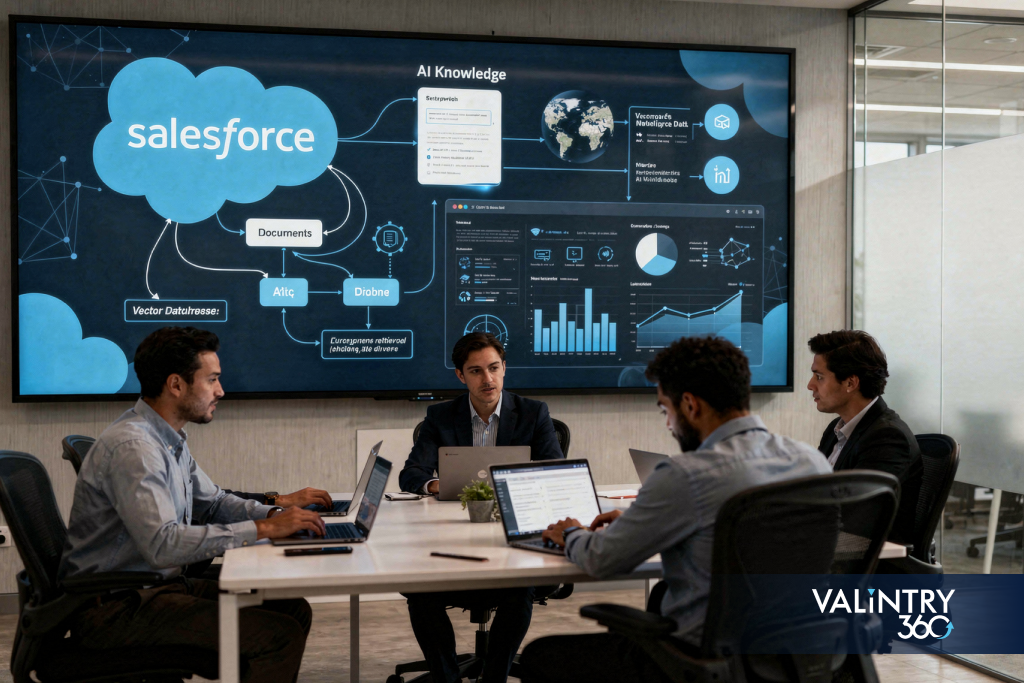
A simplified architecture flow:
- User asks a question in Salesforce or a Copilot interface
- System determines user identity and permissions
- Retrieval engine queries relevant Salesforce and external data
- Context is ranked and filtered
- LLM generates a response using grounded context
- Citations and confidence signals are returned
When implemented correctly, the model is not inventing answers — it is synthesizing enterprise truth.
Why Hallucinations Happen in CRM AI — and How to Prevent Them

Hallucinations are often misunderstood. They are not random mistakes; they are predictable outcomes of missing context.
Common causes inside Salesforce environments include:
- Incomplete retrieval pipelines
- Poorly structured CRM data
- Missing metadata relationships
- Conflicting records across systems
- Overly broad prompts
- Lack of permission filtering
- Model temperature settings too high
- Weak grounding validation
Enterprise CRM data introduces a unique complication: records change constantly. Opportunities update, cases close, pricing changes, and contacts move roles. If AI relies on stale embeddings or delayed indexing, hallucinations increase dramatically.
Preventing hallucinations requires architectural discipline rather than model tuning alone.
Key mitigation techniques:
- Real-time or near-real-time data indexing
- Context window optimization
- Retrieval ranking based on business relevance
- Response verification loops
- Source attribution enforcement
- Confidence scoring thresholds
- Human-in-the-loop escalation patterns
Organizations often assume hallucination reduction is primarily an AI problem. In reality, it is a data architecture and governance problem.
Grounding Salesforce AI: Data Sources, Metadata, and Context Layers
Grounding determines accuracy. In Salesforce ecosystems, grounding should operate across multiple layers simultaneously.
Layer 1 — Structured CRM Data
Examples:
- Opportunities
- Accounts
- Contacts
- Cases
- Activities
- Custom objects
Structured data provides factual anchors such as revenue amounts, statuses, and timelines.
Layer 2 — Unstructured Knowledge
Examples:
- Knowledge articles
- Product documentation
- Emails
- Contracts
- Support transcripts
- Internal documentation
This layer adds explanatory context.
Layer 3 — Metadata and Relationships
This is the most overlooked component.
Metadata includes:
- Object relationships
- Field definitions
- Validation rules
- Workflow logic
- Territory structures
- Hierarchies
- Entitlements
Metadata tells AI how data connects. Without it, the model may misinterpret records.
Layer 4 — Behavioral and Interaction Signals
Data Cloud introduces behavioral signals such as:
- Engagement history
- Web interactions
- Purchase patterns
- Customer journeys
This layer enables predictive or advisory responses.
A mature Salesforce RAG implementation combines all four layers dynamically rather than relying on static embeddings.
Organizations with complex environments often benefit from architectural guidance to align Data Cloud, Einstein AI capabilities, and external vector databases into a cohesive retrieval strategy.
Citation, Traceability, and Permission-Aware Responses
Trust is the currency of enterprise AI adoption. Without transparency, users reject AI outputs — regardless of accuracy.
Citations solve three critical problems:
- Verification — Users can confirm information sources
- Compliance — Audit trails exist for regulated environments
- Confidence — Decision makers trust recommendations
A strong Salesforce AI response should include:
- Source record references
- Object or document names
- Timestamps
- Confidence indicators
- Retrieval reasoning (when appropriate)
Permission alignment is even more critical.
Salesforce environments operate on granular role-based access models. AI must respect:
- Object permissions
- Field-level security
- Record ownership
- Sharing rules
- Territory models
- External identity systems
If AI exposes restricted data, risk escalates immediately.
Permission-aware AI requires identity propagation through the entire architecture — from the Salesforce session to the retrieval engine to the language model.
Many early implementations fail here because permissions are checked only at the UI layer, not within retrieval queries.
Comparison: Naive vs Enterprise Permission Handling
| Capability | Basic AI Integration | Enterprise RAG Architecture |
| Permission enforcement | UI only | End-to-end identity propagation |
| Data filtering | After generation | Before retrieval |
| Citation visibility | Optional | Mandatory |
| Audit logging | Minimal | Full traceability |
| Compliance readiness | Low | High |
This distinction determines whether AI is safe for production environments.
“No Hallucination” Architecture Patterns for Enterprise Deployment
Zero hallucination is technically impossible because language models remain probabilistic systems. However, near-deterministic accuracy is achievable using layered controls.
Effective patterns include:
1. Retrieval-First Generation
The model is prohibited from answering unless retrieval confidence meets a threshold.
If confidence is low:
- AI requests clarification
- Escalates to a human
- Returns “insufficient data” response
This prevents invented answers.
2. Constrained Prompt Frameworks
Prompts enforce rules such as:
- Use only retrieved sources
- Provide citations
- Do not speculate
- Indicate uncertainty
Prompt engineering becomes governance, not creativity.
3. Response Verification Loops
A secondary model or rule engine validates:
- Numerical accuracy
- Record existence
- Policy compliance
This acts like an AI fact-checker.
4. Deterministic Data APIs
For critical operations (pricing, eligibility, compliance), AI calls APIs instead of relying on text retrieval.
Structured APIs dramatically reduce hallucination risk.
5. Human-in-the-Loop Escalation
For high-impact scenarios:
- Contract generation
- Financial recommendations
- Compliance decisions
AI routes outputs for approval before execution.
Architecture Comparison
| Pattern | Hallucination Risk | Complexity | Enterprise Suitability |
| Simple document RAG | Medium–High | Low | Limited |
| CRM object grounding | Medium | Moderate | Good |
| Metadata-aware RAG | Low | High | Strong |
| API-verified RAG | Very Low | High | Excellent |
Organizations pursuing mission-critical AI typically combine multiple patterns.
Experienced Salesforce AI architects understand how to orchestrate these layers across Einstein, Data Cloud, middleware, and external AI services.
Governance, ROI, and Risks Companies Underestimate

Technical implementation is only half the challenge. Operationalization determines success.
Governance Considerations
Enterprise AI governance must address:
- Data lineage tracking
- Model version control
- Prompt governance
- Security reviews
- Compliance audits
- Bias monitoring
- Usage analytics
- Incident response procedures
Without governance, AI deployments stall after pilot phases.
Risks Organizations Often Miss
- Data quality debt — AI exposes inconsistencies already present
- Permission conflicts — Legacy sharing rules break AI workflows
- User trust gaps — Employees reject AI without transparency
- Integration latency — Slow retrieval reduces usability
- Change management complexity — Adoption requires training and communication
- Operational cost modeling — Token usage and infrastructure costs vary widely
These risks explain why many GenAI pilots fail to scale beyond proofs of concept.
Measuring ROI of Salesforce RAG
When implemented properly, measurable outcomes appear quickly:
- Reduced support case resolution time
- Faster sales cycle insights
- Improved agent productivity
- Increased knowledge reuse
- Higher data utilization rates
- Reduced manual research time
- Better decision accuracy
ROI emerges not from automation alone, but from decision acceleration with trustworthy data.
Organizations that approach AI strategically — aligning architecture, governance, and user experience — tend to realize value significantly faster.
This is where specialized Salesforce consulting expertise often becomes influential, particularly in environments with complex integrations or regulatory requirements.
Conclusion
RAG represents the most practical path to trustworthy AI inside Salesforce ecosystems, but implementation quality determines outcomes. Grounding depth, permission alignment, citation transparency, and governance architecture separate experimental copilots from enterprise-grade intelligence systems. Organizations that treat AI as an architectural transformation — rather than a feature — unlock measurable productivity and decision advantages. With the right strategy and execution discipline, Salesforce AI can move from curiosity to competitive differentiator while maintaining security, compliance, and user trust.
Related Posts
Salesforce Health Cloud vs EHR
IntroductionMost hospitals, health systems, and physician practices already run an EHR. For most of them, the real question is how Salesforce Health Cloud fits around the clinical system they already depend on. Health Cloud sits in a different part of…
Salesforce Partner Transition Checklist
A Salesforce partner change touches more than a vendor name on an invoice. Production access, integrations, source code, sandboxes, deployment tooling, vendor accounts, documentation, and ongoing support all move at the same time, and each one can break quietly if…
Salesforce Release Management Framework
TL;DR Salesforce changes come from everywhere. Admins tweak page layouts and developers ship Apex. Integrations push metadata changes of their own.A handful of other changes stack on top of that every week. Flows get rebuilt mid-quarter, permissions shift as teams…