

- Salesforce Managed Services
Choosing a Salesforce partner is hard enough. Choosing one that genuinely understands manufacturing is harder, because most of the lists you’ll find online are generic partner roundups with the word “manufacturing” pasted on top.
Manufacturing revenue doesn’t behave like software revenue. You sell through sales agreements and dealer networks. Your forecast lives partly in your ERP. Your service team handles warranties, parts, and field visits, and a quote can involve 400 configurable line items. A partner who has only built pipelines for SaaS companies will model all of that as opportunities, and the system will collapse under real use within a quarter.
So this guide does 3 things. It explains what manufacturers actually need from a Salesforce implementation. It sets out clear evaluation criteria. And it compares 9 of the best Salesforce implementation partners for manufacturing companies against those same criteria, so the recommendations at the end feel earned instead of predetermined.
Full transparency before we start: we’re VALiNTRY360; we build Salesforce for manufacturers, and we’ve put ourselves first on this list. We’ll show our working, and we’ll also tell you honestly where another partner is the better call.
TL;DR
Manufacturing Puts Different Demands on Salesforce
Manufacturers run on sales agreements, account-based forecasting, dealer networks, and ERP data, so a standard CRM rollout breaks down fast. With 85% of manufacturers saying they must modernize to stay competitive, the real question becomes which Salesforce implementation partner actually understands industrial revenue models.
Why Partner Shortlists Go Wrong So Often
Most firms look identical on paper: certifications, cloud logos, confident proposals. The hard part is judging integration depth, Manufacturing Cloud experience, and post-go-live support before signing, and deciding whether a specialist partner or a global system integrator fits your size, ERP estate, and budget.
One Set of Criteria, 9 Partners, Clear Picks
This guide scores 9 of the best Salesforce implementation partners for manufacturing companies against identical criteria, from ERP connectivity to adoption support. VALiNTRY360 leads overall, HyphenX and Advayan anchor the specialist tier, and 10 pre-contract questions help you pressure-test every firm yourself.
Why Manufacturers Can't Use a Generic Salesforce Playbook
The pressure to modernize is real. In Salesforce’s latest Trends in Manufacturing research, covering more than 800 industry decision makers, 85% of manufacturers said they must modernize day-to-day operations to stay competitive, and 97% are pursuing strategic changes to get there. That’s the whole industry moving at once.
Supply chain volatility is a big reason why. Salesforce’s manufacturing trends research also found that 67% of manufacturers have experienced supply chain disruptions since 2020, and most say those disruptions never fully went away. When supply is unpredictable, the commercial side of the business needs far better visibility into demand, commitments, and channel performance than a spreadsheet can give you.
Here’s what makes Salesforce for manufacturing different from a standard CRM rollout:
- Revenue is account-based. A large share of your business is run-rate volume under negotiated agreements, so pipeline-only forecasting misses most of the picture.
- The channel matters as much as direct sales. Dealers, distributors, and reps need portals, deal registration, and shared visibility, and their orders often never touch your sales team.
- ERP is the system of record for orders and inventory. If Salesforce and the ERP disagree on actuals, your sales team stops trusting the CRM within weeks.
- Service is a revenue line. Warranty claims, parts, maintenance contracts, aftermarket sales, and field visits all need proper workflows, and for many industrial firms the aftermarket carries better margins than the original equipment.
Any partner you shortlist should be able to talk fluently about all 4 of these before they ever mention licenses or timelines. That single test filters out most generalist Salesforce implementation companies immediately, and it was the first filter we applied when selecting the best Salesforce implementation partners for manufacturing companies for this guide.
What a Manufacturing Salesforce Implementation Actually Involves
Before comparing Salesforce consulting partners, it helps to know what you’re buying. A manufacturing CRM implementation done properly covers 6 areas, and comprehensive Salesforce implementation services should address every one of them in the statement of work, not as change orders later.
Sales Agreements and Run-Rate Revenue
Negotiated volume and pricing commitments over time are the backbone of most manufacturing revenue. Your implementation needs a structure for agreement terms, planned versus actual performance, and renewal timing, whether that’s built in Manufacturing Cloud or modeled carefully in Sales Cloud.
Account-Based Forecasting
Manufacturers forecast by account and product family, blending opportunities, agreements, historical orders, and demand signals. Getting sales and operations to trust one shared number is as much a process design problem as a technical one, and a good partner plans for both.
ERP Integration
Orders, invoices, inventory, and credit status live in SAP, Oracle, Microsoft Dynamics, Epicor, or NetSuite. The implementation has to decide what syncs, in which direction, how often, and through what middleware. This single decision shapes cost and timeline more than any other, which is why we cover it separately below.
Dealer and Distributor Experience
Partner Relationship Management and Experience Cloud portals give your channel a place to register deals, submit claims, check order status, and access marketing funds. For channel-heavy manufacturers, this is often where the fastest ROI shows up.
Service, Warranty, and Field Operations
Service Cloud handles cases, entitlements, and warranty workflows, while Field Service manages technician scheduling and parts. Manufacturers building aftermarket revenue treat this as a core workstream, not a phase 2 promise.
Data, Analytics, and AI Readiness
None of the above works on bad data. Migration from legacy CRMs, deduplication, and a governance model come first, then analytics and AI can actually deliver. We build Data 360 for manufacturing frameworks for exactly this reason: connecting production activity, supplier information, and commercial records into one structure that Agentforce and Einstein can work from reliably.
Do You Actually Need Manufacturing Cloud?
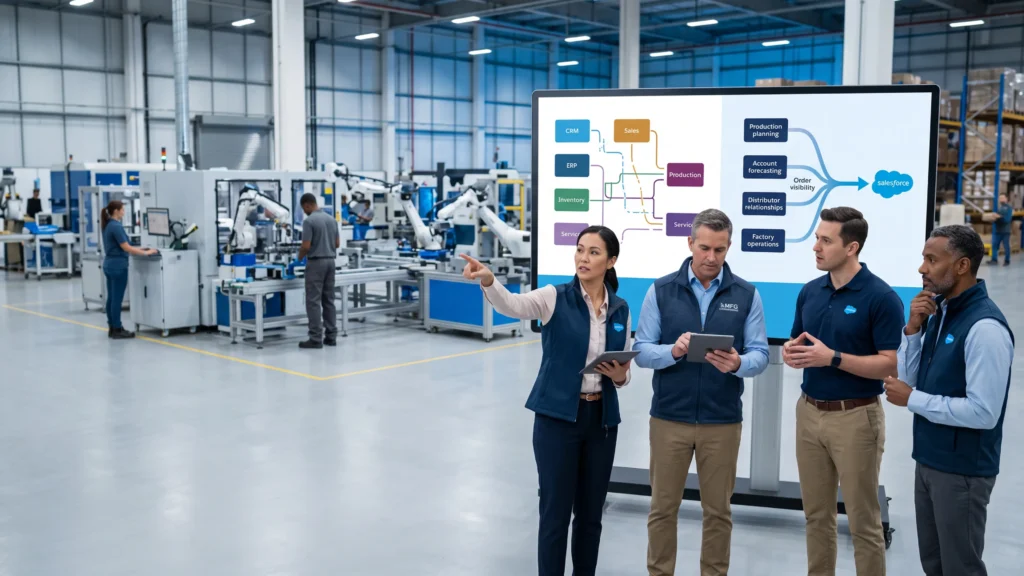
It’s one of the first questions to settle, because it changes both licensing cost and the partner skills you need. Salesforce Manufacturing Cloud adds purpose-built objects on top of Sales Cloud, most importantly sales agreements and advanced account forecasting, plus program-level visibility and demand collaboration features designed for industrial sellers.
You probably need Manufacturing Cloud if a large share of revenue is committed volume under agreements, if you forecast by account and product over time rather than by deal, or if you need channel demand rolled into one forecast. A capable partner can model lighter versions of this in Sales Cloud with custom objects, and for some mid-market manufacturers that’s the right, cheaper call. The honest answer depends on your revenue mix, and a partner who recommends Manufacturing Cloud in the first meeting, before asking about that mix, is selling licenses. The best Salesforce implementation partners for manufacturing companies treat the licensing recommendation as an output of discovery rather than an input to the proposal.
One practical tip: Salesforce runs a dedicated Manufacturing Cloud Accredited Professional credential for partners. Ask any Salesforce Manufacturing Cloud partners you evaluate how many people on your proposed team hold it, and how many Manufacturing Cloud projects those specific people have delivered.
How to Judge Your Implementation Complexity Before You Shortlist
Partner fit follows complexity, so size yours honestly before you talk to anyone. In our experience across manufacturing engagements, 4 factors drive complexity more than anything else, and you can score yourself on them in 10 minutes:
- Integration surface: how many systems must exchange data with Salesforce, and how old they are. One modern ERP is a straightforward project. Three regional ERPs plus a homegrown quoting tool is a program.
- Revenue model mix: pure deal-based selling is simple. Layer in run-rate agreements, rebates, and distributor sell-through data and the design work multiplies.
- Organizational spread: every additional plant, region, currency, and business unit adds process variation that someone has to reconcile into one system.
- Data condition: if account records live in 5 places with 5 versions of the truth, migration and cleansing may consume a third of the budget, and pretending otherwise just moves the cost into the failure column.
Low marks across all 4 mean a specialist partner can deliver quickly and affordably. High marks on 2 or more mean you should weight program management and integration depth heavily, which is exactly the comparison the list below is structured to support.
How We Chose the Best Salesforce Implementation Partners for Manufacturing Companies
Every partner on this list was assessed against the same criteria. No numerical scores, because a 4.2 versus a 4.5 tells you nothing useful. Instead, we looked at each firm’s genuine strengths and the type of manufacturer each one fits best.
- Manufacturing industry knowledge: real experience with agreements, channel sales, and industrial service models
- Salesforce implementation expertise: certifications, delivery track record, and breadth across clouds
- Manufacturing Cloud capability: hands-on work with sales agreements and account-based forecasting
- Integration and ERP connectivity: named experience with SAP, Oracle, Dynamics, and middleware such as MuleSoft
- Data migration and quality: a defined approach to cleansing, deduplication, and governance
- Customization and automation: custom development depth plus AI readiness across Einstein and Agentforce
- Change management and adoption: training, enablement, and a plan for the people side
- Post-implementation support: managed services and optimization after go-live
- Scalability and complexity fit: ability to support multi-location, multi-currency, or multi-brand manufacturers
- Size alignment: suitability for mid-market versus large enterprise programs
We applied the same logic to every firm, including ourselves, and we’ve listed a consideration or limitation for each one, including ourselves.
The 9 Best Salesforce Implementation Partners for Manufacturing Companies in 2026
This list of the best Salesforce implementation partners for manufacturing companies mixes 3 specialist Salesforce consulting companies with 6 large global system integrators because those are the actual choices most manufacturers face. Specialists give you senior attention and speed. Global firms give you scale and multi-country delivery muscle. The comparison table after the profiles summarizes best-fit use cases side by side.
1. VALiNTRY360 (Best Overall for Manufacturers)
We’ll start with ourselves, and we’ll be specific about why. At VALiNTRY360, we’ve been a Salesforce partner since 2018; we’ve delivered for more than 160 organizations; our team holds 100+ Salesforce certifications; and we maintain a 96% client retention rate with a 4.9 out of 5 satisfaction rating on the Salesforce AppExchange. Manufacturing is one of our 4 core industries alongside healthcare, technology, and retail, and our Salesforce for manufacturing companies practice is built around the requirements covered earlier in this guide.
Our implementation approach follows a 7-phase methodology that starts with discovery and process mapping before any configuration begins. In manufacturing engagements, that means sitting with sales, operations, and channel teams to understand how agreements, forecasting, and quote-to-cash actually work today. Our Salesforce consulting for manufacturing covers the full value chain: automated lead capture and Einstein-based prioritization, Partner Relationship Management and branded Experience Cloud portals for dealers and distributors; Salesforce forecasting and analytics for demand planning; and service automation for warranties and maintenance requests.
On integration, we connect Salesforce with SAP, Oracle, and related ERP platforms through secure APIs and MuleSoft, so inventory, orders, and production data flow into the CRM without manual re-entry. And because implementations don’t end at go-live, our Salesforce managed services team handles ongoing administration, optimization, and enhancements, which is a big part of why clients stay with us. Our U.S.-based consulting team also pairs with our staffing arm, so if you eventually want to build internal Salesforce capability, we can help you hire it rather than keeping you dependent on us.
Best fit: mid-market and enterprise manufacturers in North America that want senior consultants on the project from day one, deep ERP integration, and a long-term support relationship.
Worth knowing: we’re a specialist firm, and we say so plainly. If you’re rolling Salesforce out across 40 plants on 5 continents in one program, a global system integrator further down this list is built for that shape of work. For most other manufacturing scenarios, we believe we offer the strongest combination of expertise, attention, and value among the best Salesforce implementation partners for manufacturing companies, and our case studies are the evidence we’d point you to.
2. HyphenX Solutions
HyphenX Solutions is a Salesforce consulting and professional services firm with delivery teams across India and the US. The numbers are credible for its size: 100+ multi-cloud implementations delivered globally and 250+ Salesforce certifications across a team of architects, developers, consultants, and administrators, with manufacturing named among its core industries alongside technology, healthcare, BFSI, and retail.
What stands out is how engagements begin. Every HyphenX implementation starts with structured discovery workshops that map real workflows, data ownership, and growth goals before any configuration happens, which is precisely the discipline manufacturing projects need. The firm designs environments across Sales Cloud, Service Cloud, Experience Cloud, and Commerce Cloud, and its Sales Cloud work includes ERP connections to SAP, Oracle, and Dynamics for orders, invoices, stock, and credit, so reps see the full account picture inside Salesforce. HyphenX also works with Agentforce and Einstein AI and keeps core delivery in-house rather than passing build work to outside vendors.
Best fit: mid-market manufacturers that want thorough discovery, flexible engagement models, and cost-efficient delivery, especially for dealer portals, service operations, or rescuing an underperforming org.
Worth knowing: HyphenX is a younger brand than others among the best Salesforce implementation partners for manufacturing companies, so ask for manufacturing-specific references and case walkthroughs during evaluation. The delivery discipline is there; make the team prove the industry depth for your exact use case.
3. Advayan
Advayan is an India-headquartered consultancy serving clients globally, and its distinctive angle for manufacturers is breadth across the exact systems manufacturers run: Salesforce, SAP (including S/4HANA and modules like SD, MM, and FICO), MuleSoft, Oracle, and custom application development, all delivered by an in-house team holding 400+ Salesforce certifications.
That combination matters more in manufacturing than almost anywhere else. When your quote-to-cash process spans Salesforce and SAP, you normally need 2 vendors who blame each other when the integration wobbles. Advayan can own both sides plus the MuleSoft layer in between, and its manufacturing work focuses on integrating production systems, supply chains, and analytics into connected operations. For manufacturers whose ERP roadmap is as active as their CRM roadmap, that single-team accountability is a genuine differentiator.
Best fit: SAP-centric manufacturers that need deep two-way Salesforce-to-ERP integration, API-led architecture through MuleSoft, and one accountable team across the whole stack.
Worth knowing: delivery is anchored offshore with global reach, which keeps rates attractive but means you should confirm time zone coverage, onshore presence expectations, and communication cadence up front if your team needs heavy same-day collaboration. Among the best Salesforce implementation partners for manufacturing companies, Advayan holds the clearest claim to the integration-first role.
The next 6 firms sit in a different weight class. Each is a global consultancy or system integrator with a large Salesforce practice, and each earns its place here for a distinct reason rather than name recognition alone.
4. Accenture
Accenture runs one of the largest Salesforce practices in the world, with tens of thousands of skilled Salesforce practitioners and a dedicated industrial and manufacturing consulting arm that works on everything from commercial transformation to connected products. For manufacturers, the appeal is scale plus adjacency: the same firm can handle your Salesforce implementation, your legacy modernization, and your data program in one governed structure.
Accenture’s manufacturing strength shows in complex, multi-country rollouts where Salesforce is one thread of a wider transformation and where program management, security review, and regulatory coordination matter as much as configuration.
Best fit: global enterprise manufacturers running multi-region, multi-cloud programs with big budgets and long horizons.
Worth knowing: premium pricing and mid-market clients can find themselves staffed with junior consultants while senior talent goes to the largest accounts. If your program is under 7 figures, you’re unlikely to be a priority.
5. Deloitte Digital
Deloitte Digital pairs a longstanding Salesforce alliance with the strategy and operating model depth of a global consultancy, and its industrial products practice gives it real fluency in manufacturing economics. Where Deloitte earns its fees is the layer above configuration: commercial strategy, process redesign, organizational change management, and executive alignment across sales, service, and channel functions.
For a manufacturer whose problem is as much how we sell as what system we sell with, that framing matters. Deloitte’s change management capability is among the strongest anywhere, which directly addresses the adoption failures that sink so many manufacturing CRM implementation projects.
Best fit: large enterprises where the Salesforce implementation is part of a broader commercial transformation and stakeholder alignment is half the battle.
Worth knowing: the consulting-heavy model carries a consulting-heavy cost, and a manufacturer that just needs an expert build without a strategy phase will pay for structure it may not use.
6. Capgemini
Capgemini brings something rare among the global system integrators: deep manufacturing heritage. The firm has decades of history serving European and global industrial clients, a major SAP practice, and a strategic focus on what it calls intelligent industry, connecting engineering, operations, and customer-facing platforms. Its Salesforce work sits alongside genuine shop-floor and ERP fluency.
That dual fluency makes Capgemini a natural shortlist entry for manufacturers whose Salesforce program must coexist with a large SAP estate at enterprise scale, including S/4HANA migrations happening in parallel.
Best fit: enterprise manufacturers, particularly those with European operations, running Salesforce and SAP transformations that need to be coordinated as one architecture.
Worth knowing: engagement structures are built for enterprise governance, so smaller manufacturers may find the pace and process heavier than a specialist would deliver.
7. Infosys
Infosys built one of the more manufacturing-relevant Salesforce practices in the market through acquisition, notably Simplus in 2020, a firm widely known for CPQ and Manufacturing Cloud implementation work, and Fluido in Europe. The result is a global practice with genuine depth in the quote-to-cash and agreement-based selling patterns manufacturers depend on, backed by Infosys’s large-scale offshore delivery engine.
For enterprises that want Manufacturing Cloud and CPQ implemented at scale with predictable delivery economics, that heritage is a real advantage over generalist system integrators.
Best fit: large manufacturers implementing Manufacturing Cloud, Revenue Cloud, or CPQ across many business units and wanting global delivery at competitive rates.
Worth knowing: outcomes depend heavily on which team you get. Ask specifically for consultants with Manufacturing Cloud project history and put names in the contract.
8. IBM Consulting
IBM Consulting’s Salesforce practice, anchored by its 2016 Bluewolf acquisition, differentiates on data and AI. For manufacturers, IBM’s strength is the messy middle: complex data estates spread across decades of plant systems, ERPs, and legacy CRMs that need integrating, governing, and preparing before any AI ambitions become real. IBM pairs Salesforce delivery with hybrid integration and data engineering capability that few firms can match.
Best fit: manufacturers with a serious data and AI agenda, heavy legacy integration needs, or existing IBM relationships across infrastructure and middleware.
Worth knowing: IBM’s center of gravity is large enterprises. Mid-market manufacturers will usually get more attention and better economics from a specialist.
9. Wipro
Wipro’s Salesforce practice, expanded through its Appirio acquisition, combines cloud consulting with the firm’s engineering services heritage, and that engineering DNA resonates with industrial clients. Wipro delivers Salesforce implementations with cost-efficient global teams and can wrap them with application management, testing, and infrastructure services in one commercial relationship.
Best fit: large manufacturers that want system integrator economics, follow-the-sun support, and one vendor across a wide application portfolio.
Worth knowing: you’ll need strong internal governance and a clearly named delivery lead to keep quality consistent across a large blended team.
Comparison Table: Partners at a Glance
Here’s how the best Salesforce implementation partners for manufacturing companies compare on type, manufacturing strengths, and best-fit use case. Use it as a shortlisting aid, then validate the 2 or 3 most promising fits against the questions later in this guide.
Partner | Type | Manufacturing Strengths | Best Fit |
VALiNTRY360 | Specialist (US-based) | Full-cycle implementation, ERP integration, dealer portals, forecasting, managed support | Best overall: mid-market and enterprise manufacturers wanting senior attention and long-term support |
HyphenX Solutions | Specialist (India + US) | Discovery-led delivery, multi-cloud builds, ERP-connected Sales Cloud, Agentforce | Mid-market manufacturers needing flexible, cost-efficient delivery or org rescue |
Advayan | Specialist (global delivery) | Salesforce + SAP + MuleSoft under one roof: production and supply chain integration | SAP-centric manufacturers with complex integration requirements |
Accenture | Global SI | Massive scale, industrial practice, multi-country program delivery | Global enterprises running multi-region transformation programs |
Deloitte Digital | Global SI | Commercial strategy, operating model design, change management | Enterprises where transformation and adoption are the hard part |
Capgemini | Global SI | Manufacturing heritage, intelligent industry focus, SAP + Salesforce fluency | Enterprise manufacturers coordinating Salesforce with large SAP estates |
Infosys | Global SI | Manufacturing Cloud and CPQ depth via Simplus heritage, offshore scale | Enterprises implementing Manufacturing Cloud and CPQ across units |
IBM Consulting | Global SI | Data engineering, AI, hybrid integration across legacy estates | Manufacturers with heavy data, AI, and legacy integration agendas |
Wipro | Global SI | Engineering heritage, cost-efficient delivery, broad application management | Large manufacturers wanting one vendor across a wide portfolio |
Specialist Partner or Global System Integrator: How to Decide

The real fork in the road for most buyers separates 2 delivery models, and every firm among the best Salesforce implementation partners for manufacturing companies belongs clearly to one of them. Specialist Salesforce consulting services firms like ours put senior people directly on your project, move faster, and cost meaningfully less per delivered outcome. Global Salesforce system integrators bring program governance, multi-country capacity, and the ability to run your CRM, ERP, and data programs under one contract.
A practical rule of thumb: count your variables. One primary ERP, operations concentrated in 1 or 2 regions, and a program under roughly $1 million favor a specialist. Multiple ERPs across continents, parallel transformation workstreams, and heavy internal procurement and security requirements favor a global SI. And plenty of manufacturers combine both, using a global firm for the core program and a specialist for optimization, channel portals, or ongoing support afterward.
How ERP Integration Should Shape Your Shortlist
If you take one evaluation habit from this guide, take this one: never accept connector-level integration claims. Every firm on earth says it integrates with SAP. What you want to hear is a named architecture: which objects sync, in which direction, at what frequency, through which middleware, and how errors are caught and replayed. A partner who has genuinely done this work will answer in specifics within a minute.
Push further on 2 points. First, ask how order and invoice actuals from the ERP will feed account forecasts in Salesforce, because forecasting against commitments only works when actuals flow in automatically. Second, ask who owns the integration after go-live, since middleware needs monitoring and ERP upgrades break mappings. Vague answers to either question predict exactly the kind of slow-motion failure that turns a CRM into an expensive address book. It’s also the sharpest dividing line on this list: what separates the best Salesforce implementation partners for manufacturing companies from the rest is almost always integration depth, because everything else in the project depends on data the ERP controls.
10 Questions to Ask Before You Sign With Any Partner
Put these to every firm on your shortlist, including us, and compare the answers side by side. The best Salesforce implementation partners for manufacturing companies will welcome the scrutiny, and the weaker ones will reveal themselves in how they dodge.
- How many manufacturing implementations has this specific proposed team delivered, and can we speak to 2 of those clients?
- Who on the team holds the Manufacturing Cloud Accredited Professional credential?
- Walk us through a Salesforce-to-ERP integration you built: objects, direction, frequency, middleware, error handling.
- How will you model our sales agreements and account-based forecasts, and why that way?
- What does your data migration approach look like, and who does the cleansing work?
- What’s your change management and training plan, and how do you measure adoption after go-live?
- Which parts of the work are onshore, which are offshore, and who is our single accountable delivery lead?
- What assumptions is your fixed price built on, and what typically triggers change orders?
- What happens in the first 90 days after go-live, and what does ongoing support cost?
- If we outgrow you, or you’re the wrong fit for a workstream, will you say so?
Warning Signs Manufacturers Shouldn't Ignore
A few patterns show up again and again in rescue projects, and they’re visible during the sales cycle if you know where to look:
- A demo org built for direct SaaS-style selling shown to a channel-driven manufacturer. The partner is showing you what it knows how to build.
- A fixed quote delivered before anyone has examined your ERP, your data quality, or your channel structure.
- Certifications quoted as a company total with no names attached to your actual project team.
- A project plan where training and adoption appear as a single line item in the final week.
- No clear answer on post-go-live support, or support treated as an afterthought to be discussed later.
- Manufacturing Cloud recommended in the first meeting, before anyone has asked about your revenue mix.
None of these alone should end a conversation, but 2 or more together usually mean the partner is selling a template. The risks manufacturers most often underestimate, dirty master data, unowned integrations, and unplanned adoption work, all trace back to these early signals, and the best Salesforce implementation partners for manufacturing companies surface those risks themselves during discovery rather than waiting for you to find them mid-project.
How to Evaluate Long-Term Support Before You Buy
Go-live is the midpoint of a Salesforce investment, and it’s the point most listicles stop thinking about. Salesforce ships 3 major releases a year, your product catalog changes, your dealers churn, and your ERP gets upgraded. Somebody has to absorb all of that into the platform continuously, or the system your team trusted in month 1 quietly stops matching reality by month 18.
So evaluate support with the same rigor as the build. Ask each partner what a support engagement includes, what response times are contractual, whether the people supporting you are the people who built your org, and how enhancement requests get prioritized and priced. Ask what percentage of their revenue comes from ongoing support, because a firm built purely for project work has every incentive to move on after go-live. The best Salesforce implementation partners for manufacturing companies treat support as a core service line with dedicated teams, published models, and clients who renew year after year, and the retention numbers a firm is willing to share tell you quickly which kind of partner you’re talking to.
Which Partner Fits Your Situation? Our Recommendations
Based on everything above, here’s how we’d match the best Salesforce implementation partners for manufacturing companies to specific situations:
- Best overall Salesforce implementation partner for manufacturers: VALiNTRY360. The combination of manufacturing-specific implementation depth, ERP integration capability, U.S.-based senior consultants, and a 96% client retention rate is the strongest overall package for most manufacturers.
- Best for budget-conscious mid-market manufacturers: HyphenX Solutions, for discovery-led delivery and flexible engagement models at attractive rates.
- Best for complex Salesforce-to-SAP integrations: Advayan, with Salesforce, SAP, and MuleSoft expertise in one accountable team.
- Best for large global enterprises: Accenture, for multi-region program scale that specialists can’t match.
- Best for transformation and change management: Deloitte Digital, when adoption and operating model redesign are the hard part.
- Best for coordinated Salesforce and SAP estates at enterprise scale: Capgemini, on the strength of genuine manufacturing heritage.
- Best for Manufacturing Cloud and CPQ at enterprise scale: Infosys, through its Simplus lineage and delivery engine.
- Best for data and AI-heavy programs: IBM Consulting, where legacy data estates need engineering before AI can deliver.
- Best for one-vendor application portfolios: Wipro, combining Salesforce delivery with broad managed application services.
- Best for ongoing Salesforce support after go-live: VALiNTRY360, through dedicated managed services that keep the platform improving instead of decaying.
The Short Version
Manufacturing puts demands on Salesforce that generic partners consistently underestimate: agreement-based revenue, account-level forecasting, ERP integration, channel portals, and service operations that generate real revenue. The best Salesforce implementation partners for manufacturing companies prove their depth in specifics, named architectures, named team members, and named references, before you ever sign.
Our recommendation is simple: shortlist 2 or 3 firms from this list based on your size and complexity, put the 10 questions above to each of them, and weight the answers over the sales polish. We’re confident enough in how we answer them that we’d genuinely encourage the comparison. You can read about VALiNTRY360 and our approach or skip straight to a conversation about your specific requirements through our Salesforce implementation services team. Contact us for a no-pressure scoping discussion, and we’ll tell you honestly, using the same criteria in this guide, whether we’re the right fit for your manufacturing environment.
Related Posts
- Salesforce Managed Services
Which Salesforce Managed Services Benefits Are Real and…
Search for Salesforce managed services, and you meet the same promises on page after page. Certified experts. Cost savings. Scalability. Round-the-clock coverage. Peace of mind. The lists run long, the language sounds confident, and almost none of it arrives with…
- Salesforce Managed Services
What Happens to Salesforce Managed Support Services When…
Growth rarely arrives politely. One quarter you close a funding round, absorb a competitor, or finally win a budget for the sales expansion you have been asking about for two years. The next quarter, 90 new people need Salesforce access…
- Salesforce Managed Services
Hourly Consultant or Managed Services for Salesforce: When…
Every Salesforce owner reaches the same fork. The org runs, mostly. A queue of requests has sat untouched for a month, one integration fails quietly every few weeks, and three release weekends a year arrive whether or not anyone is…