
AI Sales Sales Forecasting Software
Turn your pipeline data into AI-powered revenue predictions your team can trust.
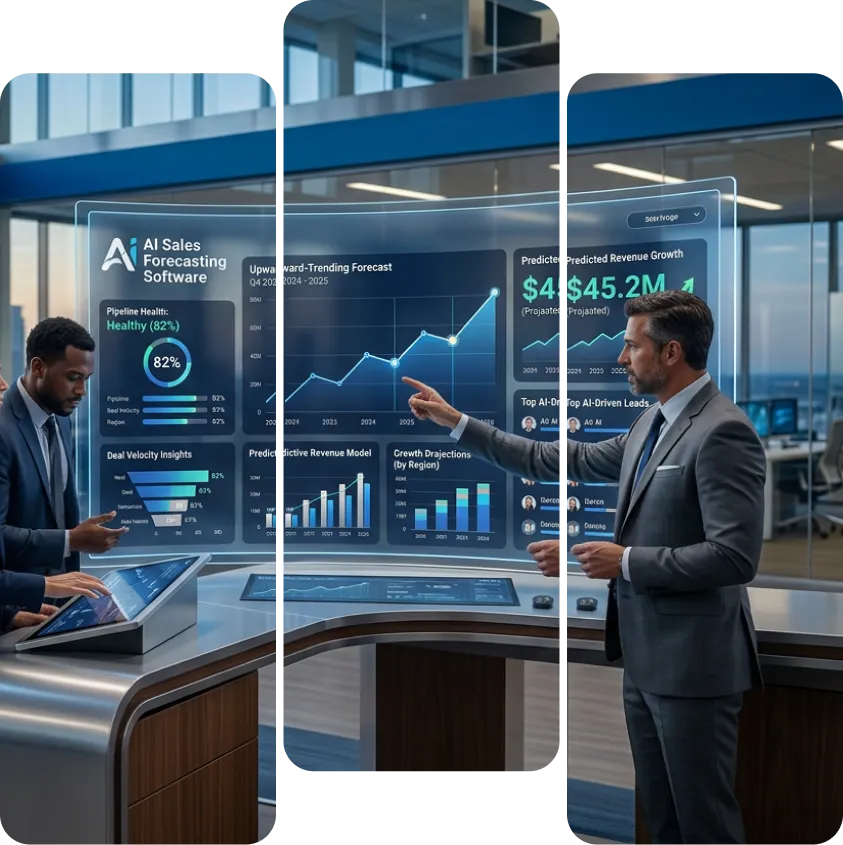

Best AI Sales Forecasting Software for Salesforce Revenue Teams
VALiNTRY360 helps Salesforce teams implement AI sales forecasting using Salesforce Einstein, Agentforce, clean CRM data, and connected revenue systems. Our certified Salesforce experts help replace manual forecast guesswork with predictive sales analytics, pipeline risk alerts, forecast confidence scores, and revenue dashboards built around your actual sales process. If your forecasts depend on spreadsheets, disconnected CRM data, late-stage updates, or manager intuition, we help you build a Salesforce-native forecasting system that gives sales, RevOps, finance, and leadership teams a clearer view of future revenue.
The best AI sales forecasting software should do more than predict a number. It should help your team understand the reasons behind the forecast, spot risk earlier, and take action before revenue slips. A strong AI forecasting setup should include the following:
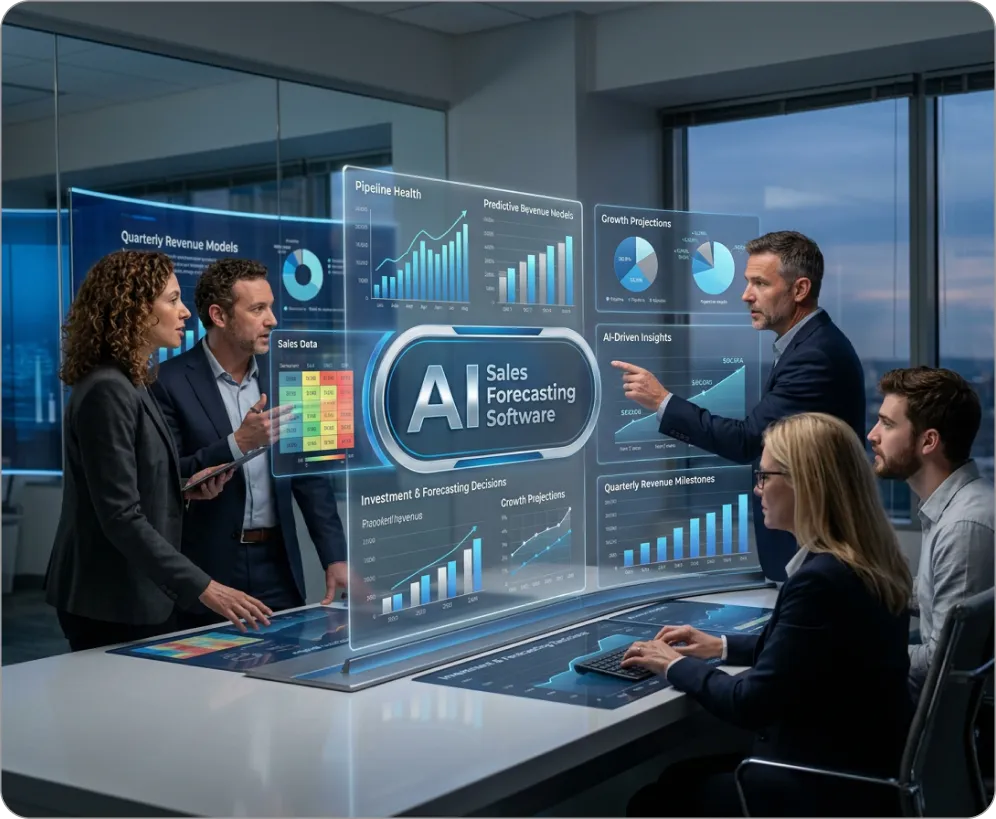
Accurate revenue predictions
Forecasts should use historical sales data, opportunity movement, sales activity, win and loss patterns, seasonality, and pipeline behavior instead of relying only on manual manager updates.
Pipeline risk visibility
Sales leaders should be able to see which deals are stalling, which close dates are slipping, and which opportunities need attention before the quarter is at risk.
Forecast explainability
Executives need to understand why a forecast changed. VALiNTRY360 configures Salesforce dashboards, audit trails, and forecast drivers so teams can see the logic behind each prediction.
CRM and ERP integration
Forecasts improve when Salesforce data connects with ERP, marketing, billing, service, and other revenue systems. This gives AI models a more complete view of customer and deal behavior.
Scenario planning
Revenue teams should be able to compare commit, best-case, upside, and what-if scenarios without rebuilding reports manually.
Measurable forecast improvement
A good forecasting system should track forecast accuracy over time, compare predictions against closed revenue, and help leaders improve planning discipline.
Overview of VALiNTRY360’s Salesforce AI Sales Forecasting Solution
VALiNTRY360 delivers AI sales forecasting implementation for companies that want more accurate revenue planning inside Salesforce. Instead of adding another disconnected forecasting tool, we help you strengthen the system your sales team already uses. Our approach combines Salesforce Einstein, Agentforce, Sales Cloud data, CRM and ERP integrations, role-based dashboards, and forecast governance. The result is a forecasting setup that helps teams understand which deals are likely to close, which opportunities are at risk, and how pipeline changes affect future revenue. This is especially valuable for manufacturing, retail, healthcare, technology, financial services, and other organizations with complex pipelines, multiple teams, regional sales structures, or long sales cycles.
Operational Challenges with AI Sales Forecasting Software
AI forecasting works best when the data, process, and adoption plan are built correctly. Many companies struggle because forecasts are spread across Salesforce reports, spreadsheets, ERP data, rep notes, and manual manager judgment. We help teams solve these issues with a structured Salesforce AI forecasting implementation.
| Challenge Area | Challenge Description | Our Solution |
|---|---|---|
| Disconnected revenue data | CRM, ERP, marketing, and external data sit in separate systems, which creates incomplete pipeline views. | We connect Salesforce with the systems that influence revenue so AI forecasts use cleaner and more complete data. |
| Poor CRM data quality | Missing close dates, inconsistent stages, outdated opportunity fields, and duplicate records weaken forecast accuracy. | We review data readiness, clean key fields, map required inputs, and prepare Salesforce for predictive forecasting. |
| Manual forecast updates | Sales managers spend too much time chasing updates and adjusting numbers manually. | Agentforce and Salesforce automation can monitor pipeline movement, flag risk, and reduce manual forecast work. |
| Limited forecast explainability | Leaders see forecast numbers but cannot easily understand why predictions changed. | We configure dashboards, audit trails, confidence scoring, and forecast driver views so teams can explain changes clearly. |
| Integration complexity | Forecasting tools often fail when they do not fit the existing CRM and revenue stack. | We design Salesforce-native integrations that connect CRM, ERP, marketing, service, and reporting systems without disrupting daily workflows. |
| Low team adoption | Reps and managers avoid forecasting tools when the process feels hard or disconnected from their work. | We provide role-based dashboards, practical training, and clear workflows that make forecasting easier to use. |
VALiNTRY360's End-to-End AI Sales Forecasting Implementation
Step 1
Discovery and data review
VALiNTRY360 begins delivery of the best AI sales forecasting software by reviewing existing pipelines, data sources, and forecast gaps as experienced Agentforce service providers.
- Review historical forecast accuracy issues limiting revenue visibility
- Identify Agentforce-ready Sales Cloud data for Einstein model learning
- Document industry-specific challenges affecting forecast reliability
Step 2
Strategy and forecast design
We design AI sales forecasting models aligned with revenue goals using Agentforce intelligence and Salesforce Einstein capabilities.
- Define probabilistic scoring models aligned with sales stage behavior
- Plan real-time data flows across CRM, ERP, and automation systems
- Design scalable Agentforce forecaster agents for recurring predictions
Step 3
Configuration & Integration
VALiNTRY360 configures AI powered sales forecasting natively within Salesforce using structured Agentforce setups.
- Configure Einstein prediction logic using opportunity-level data fields
- Connect Sales Cloud with revenue systems to remove reporting delays
- Set up autonomous agents for pipeline hygiene and risk signaling
Step 4
Testing & Validation
We validate AI tools for sales forecasting through controlled testing before production use.
- Run historical comparisons against actual closed revenue results
- Test real-time processing under high pipeline and activity volumes
- Confirm forecast logic clarity across categories and scenarios
Step 5
Training & Rollout
VALiNTRY360 supports adoption of sales forecasting software through role-based Agentforce training.
- Deliver sales dashboards with confidence scoring and action cues
- Train leaders on forecast drill-downs and scenario analysis
- Provide sandbox practice using realistic pipeline simulations
Step 6
Optimization & Support
Ongoing support keeps AI for sales forecasting accurate through continuous monitoring and refinement.
- Refresh models regularly using updated win and loss patterns
- Track forecast accuracy against quota and pipeline performance
- Monitor Agentforce activity continuously to support revenue stability
Key Features of Effective AI Sales Forecasting Software
The best AI sales forecasting software should help teams predict revenue, understand pipeline movement, and act on risk while staying connected to the CRM. VALiNTRY360 builds these capabilities inside Salesforce using Einstein, Agentforce, Sales Cloud, and connected revenue data.
Salesforce Einstein can analyze historical sales data, opportunity movement, activity signals, close dates, win rates, and deal patterns to support more accurate sales forecasts.
Key capabilities include:
- Opportunity scoring based on historical win and loss data
- Close likelihood predictions
- Deal stage movement analysis
- Forecast confidence scoring
- Pattern detection across teams, products, and regions
- Continuous learning from new outcomes
Forecast accuracy improves when Salesforce connects with the systems that influence revenue. VALiNTRY360 helps unify sales, finance, operations, and customer data so forecasts are based on a fuller picture.
Key capabilities include:
- Salesforce Sales Cloud integration
- ERP and order management connections
- Marketing and campaign data inputs
- Service and customer activity signals
- Third-party data source integration
- Custom API connections where needed
Revenue leaders need to know why a forecast changed. AI should support decision-making, not hide behind black-box predictions.
Key capabilities include:
- Forecast change history
- Deal-level forecast drivers
- Pipeline movement tracking
- Scenario comparison
- Forecast category visibility
- Explainable dashboards for leadership reviews
Enterprise forecasting often requires multiple teams, regions, currencies, products, and business units. VALiNTRY360 designs forecasting systems that can grow without creating reporting chaos.
Key capabilities include:
- Multi-region forecasting
- Multi-currency support
- Territory and product forecast rollups
- Permission-based data access
- Salesforce Shield and security controls where needed
- Release testing and managed support
Different teams need different views of the same forecast. VALiNTRY360 configures dashboards around the needs of each role.
Dashboard examples include:
- Rep-level opportunity risk views
- Manager pipeline inspection dashboards
- RevOps forecast accuracy dashboards
- Executive revenue outlook dashboards
- Finance planning views
- Regional and product-level forecast rollups
AI forecasting should help teams act before a deal slips. Agentforce can monitor pipeline activity and alert users when an opportunity needs attention.
Examples include:
- Close date slippage alerts
- Stage stagnation alerts
- Deal risk notifications
- Missing activity reminders
- Forecast probability changes
- Pipeline coverage warnings
Benefits of the Best AI Sales Forecasting Software
VALiNTRY360 delivers the best AI sales forecasting software through Agentforce-powered Salesforce Einstein, removing traditional forecasting uncertainty for manufacturing, retail, healthcare, and technology organizations that require dependable revenue insight.
Better Forecast Accuracy
AI models can compare current pipeline behavior against historical results, helping teams reduce guesswork and improve revenue predictability.
Earlier Deal Risk Detection
Sales leaders can see which deals are likely to slip, stall, or move out of the forecast before the end of the quarter.
More Useful Pipeline Reviews
Instead of spending forecast meetings debating manual updates, teams can focus on risk, next steps, coverage gaps, and deal strategy.
Stronger RevOps and Finance Alignment
Forecast dashboards help sales, finance, and operations work from the same revenue view when planning budgets, hiring, inventory, and growth targets.
Less Manual Reporting Work
Agentforce and Salesforce automation can reduce repetitive forecast updates, reminders, and pipeline monitoring tasks.
Improved Quota and Territory Planning
Historical trends, pipeline coverage, and opportunity scoring help leaders plan territories, quotas, and sales capacity with more confidence.
Smarter Resource Planning
Manufacturing, retail, healthcare, technology, and financial services teams can use forecast signals to plan inventory, staffing, services, and customer demand more effectively.
Continuous Forecast Improvement
Forecast accuracy can be measured against closed revenue, giving teams a clear path to improve the process over time.
Industry-Specific Applications of the Best AI Sales Forecasting Software
- Manufacturing
AI sales forecasting helps anticipate demand changes and supply needs, supporting better inventory balance while reducing excess stock and delivery delays across production cycles.
- Retail
Real-time trend analysis supports stock planning and promotion timing, helping reduce stock shortages while improving sales performance during high-demand periods.
- Healthcare
Patient volume and revenue cycle forecasts support staffing and budget planning, helping providers and life sciences teams allocate resources within regulatory requirements.
- Technology
Subscription renewals and churn risk are analyzed for SaaS pipelines, helping teams plan upsell activity and maintain steadier revenue expectations in fast-moving markets.
- Financial Services
Loan and investment deal forecasts include economic indicators, supporting stronger risk review and more consistent revenue planning amid regulatory change.
- Automotive
Vehicle sales and service demand forecasting supports dealer inventory and after-sales planning using market behavior and customer data patterns.
- Oil & Gas
Production contracts and equipment sales forecasts support drilling schedules aligned with market pricing, improving asset use and long-term revenue planning.
- Communications
Subscriber growth and churn analysis supports retention planning, helping teams identify upsell opportunities using usage trends and competitive signals.
What data does AI Sales Forecasting Software Need?
AI forecasting depends on the quality of the data behind it. Before building predictive forecasts, VALiNTRY360 reviews whether your Salesforce environment has the right inputs, structure, and history. Useful forecasting data may include:
| Data Type | Why It Matters |
|---|---|
| Historical opportunity data | Helps the model understand past win rates, loss patterns, sales cycle length, and revenue movement. |
| Closed-won and closed-lost records | Shows which deal traits are tied to successful and unsuccessful outcomes. |
| Opportunity stage history | Helps identify stage movement, stalled deals, and pipeline velocity. |
| Close dates and close date changes | Helps detect deal slippage and forecast timing risk. |
| Sales activity data | Adds context from calls, meetings, emails, tasks, and follow-ups. |
| Forecast categories | Supports commit, best-case, pipeline, and upside forecast views. |
| Product and service data | Helps forecast revenue by product line, solution, or business unit. |
| ERP and order data | Adds actual revenue, fulfillment, inventory, and billing signals where needed. |
If the data is incomplete, AI forecasting can still be possible, but the first step should be data cleanup, field mapping, and process alignment.
Future-Proofing Your Sales Forecasting with VALiNTRY360's Best AI Sales Forecasting Software
- Continuously Evolving Einstein Intelligence
- Self-learning models adjust to new win and loss patterns automatically
- Emerging market signals and competitive inputs are applied continuously
- Prediction accuracy stays aligned as sales behavior and strategies change
- Agentforce Autonomous Forecasting Agents
- Independent pipeline monitoring reduces reliance on manual oversight
- Real-time reasoning produces weekly forecast updates after CRM activity
- Global team coverage scales without added configuration effort
- Next-Generation Predictive Enhancements
- Advanced xGen-Sales capabilities model multi-stage enterprise buying paths
- Behavioral micro-signals improve early opportunity qualification accuracy
- Ensemble AI methods combine multiple models for stronger predictions
- Managed Evolution & Platform Resilience
- we manages platform updates while preserving custom logic
- Zero-downtime releases maintain continuous forecasting availability
- Scalable architecture supports acquisitions and market expansion
Why VALiNTRY360 Stands Out as Your AI Sales Forecasting Partner
VALiNTRY360 delivers the best AI sales forecasting software as experienced Agentforce service providers, combining strong Salesforce knowledge with carefully planned implementations that support revenue clarity across manufacturing, retail, healthcare, and technology organizations.
- Certified Expertise Meets Industry Mastery
Our Salesforce-certified specialists tailor AI sales forecasting to industry-specific needs such as supply chain variability, demand shifts, and regulatory limits. This approach allows Agentforce to produce forecasts aligned with the real operating conditions of your business.
- Proven Methodology Delivers Results
A structured delivery model converts disconnected pipeline data into practical AI-powered sales forecasting insights through discovery, configuration, enablement, and ongoing refinement. This supports smooth Agentforce adoption and stable forecast accuracy within your Salesforce environment.
- Trusted Partnership & Reliability
Long-standing client relationships reflect VALiNTRY360’s consistent delivery of sales forecasting software. Continuous Agentforce tuning helps maintain forecast reliability as markets shift and internal structures change, supporting dependable revenue planning.
- Strategic Collaboration Beyond Implementation
Ongoing managed services help keep AI tools for sales forecasting aligned with platform updates, custom Agentforce enhancements, and changing business priorities. This approach helps forecasting systems remain relevant as operational needs expand.
Take the next step toward smarter sales forecasting
If your team is still forecasting with spreadsheets, manual CRM updates, disconnected reports, or last-minute manager judgment, it may be time to review your Salesforce forecasting process. VALiNTRY360 can help you assess your data readiness, identify forecast gaps, compare AI forecasting options, and build a Salesforce-native implementation plan using Einstein, Agentforce, and connected revenue data.

Discover Our Case Studies
Learn how we work with businesses to simplify service operations, improve response efficiency, enhance process visibility, and support teams with smarter solutions.
AI Sales Forecasting Software FAQ by VALiNTRY360
Agentforce autonomous agents actively monitor pipelines and trigger actions, while Einstein models rely on manual setup. VALiNTRY360 combines both for complete AI sales forecasting coverage.
Yes. VALiNTRY360 maps custom Salesforce objects into Agentforce prediction models through flexible field mapping, allowing your unique sales forecasting software data to drive accurate Einstein forecasts.
VALiNTRY360 managed services handle upgrades with no disruption, testing Agentforce models in advance to maintain AI powered sales forecasting continuity while applying platform updates.
Agentforce supports multi-currency pipelines and regional signals by default. VALiNTRY360 configures AI tools for sales forecasting to meet local compliance and reporting needs across regions.
Most revenue teams should review forecasts weekly, with more frequent checks during quarter-end, major pipeline changes, or high-growth periods. AI forecasting makes these reviews more useful by showing updated pipeline risk, forecast movement, and accuracy trends in real time.
Yes. AI forecasting can support both short and long sales cycles when the model uses the right data. Short-cycle teams may focus more on activity volume, conversion rates, and deal velocity. Long-cycle teams may need deeper tracking for stage movement, stakeholder engagement, close date changes, and multi-step buying processes.
AI forecasting performs best with clean CRM data, but incomplete data does not always stop implementation. The first step is usually a Salesforce data readiness review. This can include cleaning opportunity fields, standardizing sales stages, mapping required forecast inputs, removing duplicate records, and improving close date discipline.
Yes. AI sales forecasting can support quota and territory planning by showing historical performance, pipeline coverage, win rates, sales cycle trends, product demand, and regional revenue patterns. This helps leaders set more realistic targets and identify where teams may need more support.
RevOps plays a central role in AI forecasting because it connects sales process, data quality, reporting, tools, and leadership planning. RevOps teams often help define forecast categories, clean CRM data, manage dashboards, review accuracy, and make sure sales, finance, and leadership teams work from the same revenue view.
Yes. A strong AI forecasting setup should compare predicted revenue against actual closed revenue over time. This helps teams measure forecast variance, identify weak data points, improve model inputs, and create a more reliable forecasting process.
AI forecasting helps finance teams by giving them clearer visibility into expected revenue, deal risk, pipeline coverage, and timing. When Salesforce forecasting connects with finance or ERP data, finance teams can plan budgets, hiring, cash flow, and resource allocation with stronger revenue insight.
Yes. AI sales forecasting software can support what-if planning by showing how revenue may change if deal close dates shift, win rates improve, pipeline coverage drops, or certain opportunities move in or out of the forecast. This helps leaders compare commit, best-case, upside, and risk-adjusted scenarios.
AI forecasting makes pipeline inspection meetings more focused. Instead of spending time collecting manual updates, managers can review deal risk, forecast changes, confidence scores, stalled opportunities, and next steps. This helps teams spend more time solving revenue risks and less time debating numbers.
Common mistakes include using poor CRM data, skipping data cleanup, relying on generic dashboards, failing to define forecast ownership, ignoring sales team adoption, not tracking forecast accuracy, and treating AI forecasting as a one-time setup. A structured Salesforce implementation helps avoid these issues.
Your Salesforce org may be ready if you have reliable opportunity history, consistent sales stages, accurate close dates, clean account and product data, clear forecast categories, and a defined sales process. If the data is inconsistent, VALiNTRY360 can start with a forecasting readiness assessment before implementation.
Claim Your Free Implementation Checklist
Claim Your Free Implementation Checklist
Claim Your Free Implementation Checklist
- 1201 South Orlando Avenue Suite 440, Winter Park, FL 32789
- 800-360-1407
- info@VALiNTRY360.com