

- Salesforce Org Optimization & Technical
A Salesforce estate can look healthy at the org level while failing at the seams between orgs. One sales team may update an Account in Org A while a service team works from a different Account in Org B. An integration may copy only selected fields, so ownership, contract status, consent, product history, and support context drift apart. The same customer can carry different IDs, different parent relationships, and different lifecycle states depending on which org a user opens. Once automation starts acting on those mismatches, the problem moves beyond duplicate records into routing, reporting, access, forecasting, and customer experience.
The technical difficulty grows because each org usually has its own history. Custom objects evolved for local processes. Flows and Apex were built by different teams. Validation rules reflect different policies. Connected apps use separate credentials. Experience Cloud, marketing tools, ERP connections, data warehouses, and identity providers may point at different endpoints. Salesforce itself notes that enterprises often operate multiple orgs because of acquisitions, regional operations, functional separation, regulation, or historical decisions, and its current Data 360 guidance says roughly 19,000 customers were already running more than one Salesforce org as of February 2024 in its multi-org architecture guidance.
That is why Salesforce org consolidation is an architecture decision before it is a migration project. The consulting work has to determine which processes should become common, which records deserve a single identity, which integrations should survive, which data must remain separated, and which org should become the long-term home for each capability. A clean target org is useful only when the business can explain what becomes common, what remains local, and who owns the rules after cutover.
TL;DR
The concern is fragmentation that starts to affect daily business control. Multiple Salesforce orgs can produce several versions of the same account, repeated integrations, inconsistent security models, conflicting automation, duplicate licenses, and reporting that depends on manual reconciliation. The cost is rarely visible as one line item. It appears as extra admin work, slower releases, duplicate enrichment, longer incident investigation, delayed M&A integration, and teams arguing over which CRM record is correct.
The overview is that Salesforce CRM consolidation has several possible end states. Some companies should complete a Salesforce org merge into one primary org. Others need a governed multi-org strategy because legal entities, regions, data residency, business models, or operational independence make separation useful. A third group can keep several transactional orgs while using a common data layer for customer identity and analytics. The right choice depends on process similarity, data ownership, integration volume, security boundaries, platform limits, and the cost of carrying duplicated capabilities.
The approach is to treat Salesforce org consolidation as a sequence of business and technical decisions. Start with an org inventory, process comparison, data profiling, integration map, security review, and ownership model. Define the target architecture before moving records. Then establish survivorship rules for duplicate data, rebuild or retire integrations deliberately, rehearse the Salesforce org migration, reconcile the result with measurable controls, and decommission old orgs only after data, users, interfaces, reports, and audit requirements have been accounted for.
When Org Count Turns Into Operating Debt
Several orgs can coexist for years without causing obvious failure. The liability appears when the business needs shared answers and the architecture cannot produce them without translation. A global account team may need one view of revenue while regional orgs use different account hierarchies. Support may need entitlement history from an acquired company while service records remain in a separate org. Finance may need pipeline by the parent company while sales teams maintain competing definitions of the same customer. Every cross-org question creates another reconciliation step.
A useful diagnostic measures duplicated capability across the estate instead of relying on org count alone. Two orgs with clear boundaries and governed exchange can be easier to operate than 2 orgs that both own the same customer lifecycle. The more often the same record type, business rule, integration, permission model, and report must be maintained twice, the more the estate behaves like duplicated infrastructure. Early architecture work should document those overlaps in a Salesforce data strategy and architecture framework so the consolidation decision is tied to business ownership rather than a preference for one-org or multi-org design.
The first business symptom is usually decision friction. Leaders wait for combined reports. Sellers ask operations to merge account views. Service agents search multiple systems. Admins test similar changes in several sandboxes. Integration teams maintain mappings that exist only because two orgs describe the same entity differently. Taken together, those problems show that the existing boundaries need a deliberate review, even when some orgs still have a valid reason to remain separate.
A Liability Map: Where Multiple Orgs Create Repeated Work
Area | What becomes duplicated | Operational symptom | Consolidation question |
Customer identity | Accounts, contacts, households, partners, external IDs | Different teams see different customer histories | Which record or data service becomes authoritative? |
Automation | Flows, Apex, assignment, approvals, notifications | Similar changes behave differently by org | Which rules should become enterprise standards? |
Integrations | ERP, marketing, billing, support, identity, data warehouse connections | The same system is connected several times | Can one integration pattern replace repeated point-to-point links? |
Security | Profiles, permission sets, roles, connected apps, service accounts | Access reviews require several inventories | Which access model is common and which boundaries must stay separate? |
Reporting | Pipelines, cases, renewals, campaign and account views | Executive reports require exports and manual joins | Which measures need one definition and one record lineage? |
Releases | Sandboxes, deployment paths, regression suites | A small change creates several release calendars | Which capabilities can share one release path? |
Administration | Users, metadata, monitoring, incident response | Admin effort grows faster than user count | What duplicated ownership can be removed after consolidation? |
This map is more useful than a simple license comparison because it exposes where cost is tied to coordination. Regulation or autonomy can justify a duplicated org. The company should still know the operating cost of keeping that boundary in place.
How Companies Accumulate Multiple Salesforce Orgs
Acquisition creates inherited architecture
M&A is the most obvious path. The buyer and target may both have mature Salesforce environments with different account models, opportunity stages, integrations, security policies, and reporting conventions. The pressure to keep the deal moving often leads to temporary coexistence. Temporary becomes permanent when no one owns the target architecture or the business is unwilling to interrupt selling and service work.
Regional autonomy becomes a technical boundary
A region may create its own org because local regulations, data residency, product catalogs, currencies, or operating processes differ. That can be rational. Problems start when global accounts, shared products, common service obligations, or enterprise analytics require data to cross those boundaries continuously.
Business units build around different operating models
A B2B division and a direct-to-consumer unit may use Salesforce in very different ways. One might center on opportunities and territories while another centers on cases, subscriptions, or partner channels. Separate orgs can protect local speed. They also create questions about shared contacts, parent accounts, cross-sell history, consent, and enterprise reporting.
Historical projects leave behind permanent platforms
Organizations sometimes create new orgs to escape technical debt, launch a new product, meet an urgent deadline, or isolate a transformation program. The new org solves the immediate delivery problem, while the old one remains live because integrations, users, or records cannot be retired quickly. Years later, the company is operating both.
Customer Identity is the Hard Part of Salesforce Data Consolidation
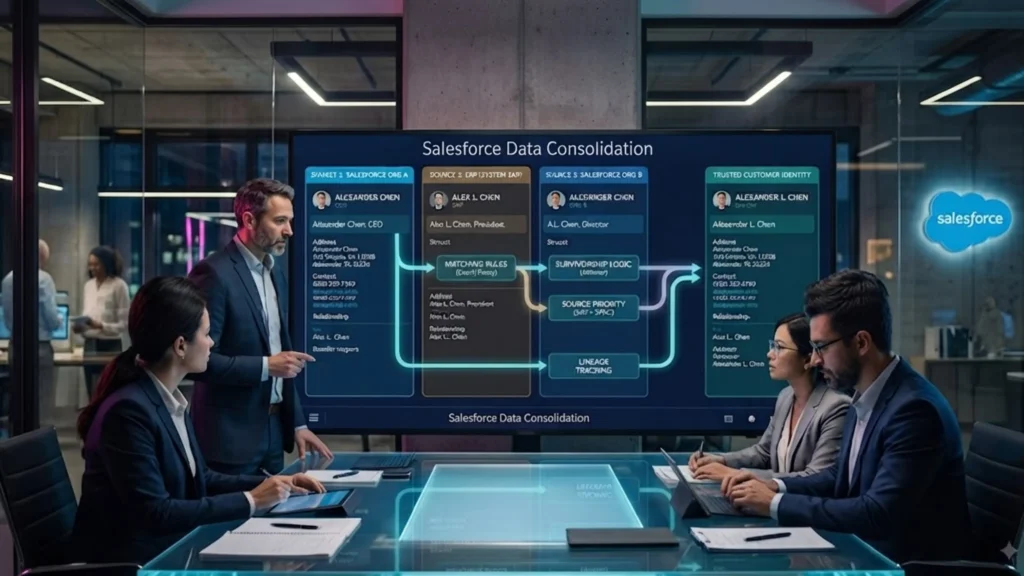
Moving records is mechanical compared with deciding which record should survive. If Org A says a customer is “Acme Holdings,” Org B says “Acme North America,” and the ERP says “ACME Inc.,” a Salesforce data migration tool cannot decide whether those are one enterprise, separate legal entities, or a parent-child relationship. The project needs matching rules, survivorship rules, source priorities, exception handling, and a way to preserve source lineage.
CRM data quality is already difficult before several orgs are combined. Validity’s 2025 survey of 602 CRM users and stakeholders found that 37% reported lost revenue as a direct consequence of poor data quality, while 76% said less than half of their organization’s CRM data was accurate and complete in its State of CRM Data Management report. During Salesforce org consolidation, those weaknesses can multiply because the target receives conflicting values from several sources at once.
A practical migration design should profile every source before any merge rules are approved. The team can use the Salesforce data migration checklist for source profiling and reconciliation in the middle of discovery to capture record counts, relationship maps, fill rates, duplicate patterns, picklist differences, inactive owners, orphaned records, and fields that have the same label but different business meaning. This work turns data deduplication from a cleanup task into a controlled business decision.
Four Target States a Consolidation Program Can Choose
Target state | Best fit | Main advantage | Main caution |
One primary Salesforce org | Processes, security, and data definitions can become common | Shared customer model and common release path | Local exceptions can overload the target design |
Regional or business-unit orgs with strict boundaries | Regulation, residency, autonomy, or materially different processes require separation | Local control remains intact | Cross-org customer identity and reporting still need governance |
Several transactional orgs with a common data layer | Operational systems must remain separate but enterprise customer views are needed | Shared identity and analytics without moving every transaction | Teams can confuse unified data access with full process consolidation |
Phased coexistence during migration | A single cutover would create unacceptable operational risk | Teams can move capabilities in controlled waves | Temporary interfaces and duplicate operations need an expiration plan |
A Salesforce single org strategy should be selected when the business can support shared processes and ownership. Diagram simplicity alone is a weak reason for consolidation. The same applies to a multi-org strategy. Separation needs a purpose that can be stated clearly and reviewed later.
After M&A, the CRM Blueprint Affects the Value Case
Post-acquisition Salesforce org consolidation often competes with immediate commercial priorities. Sales leaders want account coverage settled. Service leaders need continuity. Finance wants combined reporting. IT needs secure connectivity. That pressure can lead to a shallow compromise where both CRMs stay live and a reporting layer is added above them. The company gains a consolidated dashboard while the operating duplication remains underneath.
A McKinsey case on digital value in M&A shows why early platform decisions matter. In one pharmaceutical integration, the technology team found that 9 core-platform decisions would account for around 70% of technology-related synergies, and early decisions shortened the integration time frame by a full year to 24 months. The case is described in McKinsey’s analysis of digital value in M&A. CRM is one of the core systems McKinsey identifies as central to many integration blueprints.
For Salesforce org consolidation after M&A, the implication is practical. Decide early which org owns global accounts, opportunity history, active service cases, user identity, integrations, and executive reporting. The more of those decisions remain temporary, the longer the combined company pays for duplicate operating paths.
Inventory Before Anyone Designs the Target Org
A credible consolidation discovery should produce an inventory that business and technical owners can both use. The list below is deliberately broader than metadata because org consolidation fails when technical mapping ignores the operating process around it.
- Production orgs, sandboxes, editions, licenses, storage, and major add-ons
- Standard and custom objects, record types, key fields, external IDs, and relationship models
- Account hierarchies, contact models, household or person-account use, partner structures, and territory logic
- Flows, Apex, validation rules, approvals, scheduled jobs, platform events, and outbound messages
- Connected apps, middleware, API users, certificates, secrets, named credentials, and endpoint dependencies
- ERP, billing, marketing, support, data warehouse, identity, document, and analytics connections
- Reports and dashboards used for forecasting, service, compliance, finance, and executive reviews
- Profiles, permission sets, roles, groups, sharing rules, queues, and inactive-user dependencies
- Data volumes, archival rules, audit requirements, retention policies, and regulated fields
- Business owners for each major process and a named decision maker for conflicts
The output should show both duplication and dependency. An integration may look unused until a nightly finance process fails without it. A custom field may look obsolete until a renewal Flow references it. A user may be inactive while still owning records that downstream reporting expects.
Integration Rationalization: Remove Connections that Exist Only Because the Orgs are Separate
Integration debt is one of the strongest reasons to review a multiple-org estate. MuleSoft’s 2026 Connectivity Benchmark reports that the average organization manages 957 applications, while only 27% are connected on average. It also reports that 95% of organizations face integration challenges and only 54% have a centralized governance framework in its 2026 Connectivity Benchmark. Those figures describe enterprise application estates broadly. The same pattern matters when several Salesforce orgs each maintain their own connections to the same systems.
During consolidation, review every interface before deciding whether it belongs in the target. Inventory the business event behind each connection first. A billing system may receive customer updates from 2 orgs today because the company has 2 sales platforms. If the target becomes one org, the correct future state may be one published account event rather than 2 rebuilt point-to-point flows. The Salesforce integration services approach to system ownership and integration patterns is useful here because the design question is the direction, source, timing, failure handling, and owner of each data flow.
Existing pattern | Consolidation decision | Better target question |
Same ERP connected to several orgs | Combine, retain separately, or place behind shared middleware | Which system owns orders, balances, products, and account status? |
Nightly batch copies between orgs | Retire or replace with event/API access | Does the target still need duplicated copies? |
Several marketing connectors | Re-map around consent and campaign ownership | Which org or data layer owns the marketable customer state? |
Org-specific warehouse exports | Rebuild around one governed data contract | Which fields and timestamps define the analytical record? |
Repeated custom APIs | Replace with reusable service patterns where appropriate | Can one interface serve several consumers without hidden dependencies? |
Legacy integration users | Recreate only required identities | Which service accounts still have a valid owner and business purpose? |
This is where Salesforce integration rationalization can reduce future support work. Every retired mapping, credential, schedule, and error queue removes another place where customer state can diverge.
Security Review: Old Orgs Preserve Old Access Paths
Consolidation changes the attack surface because users, service accounts, connected apps, certificates, API clients, communities, and integration users may exist in several places. A person removed from the target org can still have access to a source org. A connected app may survive because no one realizes a retired integration still holds a refresh token. A migration team that focuses only on records can leave these paths behind.
The security case for disciplined retirement is supported by Verizon’s 2026 DBIR, which reports that third-party supply-chain breaches rose 60% and accounted for 48% of breaches in its dataset, while vulnerability exploitation became the leading entry point at 31%. Those findings appear in Verizon’s 2026 Data Breach Investigations Report summary. A Salesforce consolidation program should treat every retained integration, external application, and privileged identity as something that needs a named owner and a reason to remain.
Create an access retirement register alongside the data migration plan. List human users, integration users, SSO connections, certificates, named credentials, OAuth apps, portal accounts, sharing rules, and scheduled processes. For every source org, define the date each access path will be frozen, migrated, disabled, or retained for audit use.
Duplicate Records Need Explicit Survivorship Rules
Salesforce data deduplication becomes dangerous when the project defines a match but does not define which values survive. Two Account records may match confidently while disagreeing on owner, address, segment, parent, credit status, renewal date, or consent-related attributes. A merge without survivorship rules simply chooses one conflict silently.
A survivorship model should answer these questions for every business-critical field:
- Which source is authoritative when values disagree?
- Does recency matter, and which timestamp is trustworthy?
- Can the target retain both values with source lineage?
- Should an approved manual value outrank an automated feed?
- Which fields can be recomputed after migration rather than carried forward?
- What happens when confidence is too low for an automatic match?
- Who resolves exceptions and how is that decision recorded?
- Which historical IDs must remain searchable for downstream systems and audit work?
The migration build should preserve source keys even after the business sees one surviving CRM record. Those IDs support reconciliation, rollback, integration remapping, and investigation when a user asks why 2 legacy records became 1 target record. A broader Salesforce data migration service should therefore cover mapping, transformation, validation, and post-load support rather than treating org consolidation as a bulk insert exercise.
The Target Org Needs a Business Constitution
Object ownership
Every shared object needs a business owner and a technical steward. Account, Contact, Lead, Opportunity, Case, Product, Contract, Asset, and custom objects should have clear rules for who can create them, which systems can update them, and what makes a record authoritative.
Process ownership
Consolidation exposes disagreements that separate orgs used to hide. One region may qualify opportunities at a different point. One support team may close cases under different criteria. One business unit may require approval where another does not. The target design should document the enterprise rule and the permitted exception rather than encode every historical behavior by default.
Change ownership
A single org concentrates impact. That makes release governance more important because a change to a shared object, permission set, API, or Flow can affect several business units at once. The operating model should specify who approves common metadata, how regression scope is chosen, and how local requirements enter the backlog.
Data ownership
Governance has to continue after go-live. The Salesforce data governance model for ownership, quality, metadata, and access can sit inside the target operating model so duplicate prevention, field definitions, stewardship, and access review have named owners after the project team leaves.
A Controlled Salesforce Org Migration Sequence
Phase | Main work | Evidence required before moving on |
1. Diagnose | Inventory orgs, processes, data, integrations, security, reports | Signed current-state map and business owners |
2. Decide | Choose single-org, governed multi-org, common data layer, or phased coexistence | Target architecture and decision log |
3. Standardize | Agree objects, fields, lifecycle rules, security, reporting definitions | Approved data dictionary and process rules |
4. Prepare data | Profile, cleanse, deduplicate, map IDs, define survivorship | Reconciled source counts and exception queues |
5. Rebuild dependencies | Rework integrations, automation, permissions, reports | End-to-end test evidence for critical journeys |
6. Rehearse | Run migration in a production-like environment | Timed runbook, reconciliation results, rollback test |
7. Cut over | Freeze sources, load deltas, switch integrations, validate users | Business and technical acceptance results |
8. Retire | Disable old interfaces and access, archive required records | Decommission checklist and audit evidence |
The sequence matters because a data load cannot solve unresolved process design. If the target opportunity stages, account hierarchy, owner model, or integration contracts are still disputed, migration scripts will encode temporary guesses and create another cleanup project.
Consolidation Can Stop Before a Full Org Merge

A mature Salesforce multi-org strategy sometimes keeps more than one org. Regulatory separation, data residency, independent legal entities, highly different operating models, or acquisition autonomy can justify distinct transactional environments. Salesforce’s own guidance presents both single-org and deliberate multi-org patterns, and current Data 360 architecture guidance gives enterprises options for a shared home org, companion orgs, or separate instances when compliance and autonomy require them.
The business still needs a way to answer cross-org questions. IBM’s 2025 CDO study surveyed more than 1,700 chief data officers and found that 83% said data silos hinder innovation and impede real-time analytics and decision-making. The same study reports that 75% said they had a data platform capable of integration across silos when needed, according to IBM’s 2025 CDO research. This supports a useful distinction for Salesforce CRM consolidation: transactional consolidation and information consolidation can be separate decisions.
For organizations that retain several orgs, a Data 360 approach to unified customer profiles can provide common identity and analytical access while operational boundaries remain in place. Org governance still remains necessary. A common data layer can reduce the pressure to copy every record into every org simply to give teams a broader customer view.
A Decision Test Before Approving a Salesforce Org Merge
Use these questions in the steering committee before approving a target architecture:
- Do the orgs serve the same customers, products, sellers, service teams, or partners often enough that separation creates daily reconciliation?
- Are the differences between orgs true business requirements or historical configuration choices?
- Can one account, contact, product, opportunity, and case model represent the combined business without excessive exceptions?
- Which regulations or residency requirements demand physical or logical separation?
- How many integrations are duplicated because the same external systems connect to several orgs?
- Can identity, security, and administration be governed centrally without weakening local control?
- Which reports currently require exports, spreadsheets, or warehouse joins to answer routine management questions?
- What will the business stop paying for after consolidation, including admin effort, middleware, duplicate licenses, data tools, and release work?
- Which source org must remain accessible for legal, audit, or historical reasons after users move?
- Who owns the target operating model 6 months after the project closes?
A decision to merge should have measurable benefits and explicit trade-offs. A decision to keep orgs separate should meet the same standard.
What a Successful Consolidation Looks Like 6 Months Later?
Measure | Healthy post-consolidation signal | Warning sign |
Customer identity | Enterprise accounts and contacts resolve consistently | Teams still maintain local duplicate records |
Reporting | Core revenue and service measures use common definitions | Executive reporting still requires manual stitching |
Integrations | Duplicate interfaces have been retired or assigned clear purpose | Old and new connections both remain active indefinitely |
Security | Source-org access and service accounts are retired on schedule | Legacy credentials remain because ownership is unclear |
Releases | Shared changes follow one governed path | Business units rebuild local workarounds outside governance |
Data quality | Duplicate creation and exception rates are measured | Migration cleanup stops after go-live |
Ownership | Business stewards and platform owners review changes | The project team remains the only group that understands the design |
The best evidence of a successful Salesforce org consolidation is boring operations. Sellers stop asking which org has the right account. Service agents see the context they need. Reporting stops depending on manual joins. Integration errors have fewer paths to travel. Admins can explain who owns each shared rule. The target system becomes easier to change because the company removed duplicate decisions along with duplicate records.
Conclusion
Salesforce org consolidation becomes necessary when duplicated CRM boundaries start forcing the business to reconcile customers, processes, security, integrations, releases, and reporting every day. The real liability is the repeated operating model that grows around those boundaries. A consolidation program should therefore measure duplicated capability and decision friction alongside license cost.
The target may be one Salesforce org, a governed set of orgs, or several transactional orgs connected through a common data layer. The correct answer depends on process similarity, regulation, data ownership, autonomy, integration cost, and the ability to govern shared customer identity. Salesforce consulting adds value when it helps the business make those decisions before migration scripts, field mappings, and cutover dates begin to harden the design.
A durable result comes from explicit architecture, survivorship rules, integration retirement, access cleanup, rehearsed migration, measurable reconciliation, and post-launch ownership. When those pieces are in place, CRM consolidation can reduce duplicated work without erasing the business boundaries that still have a valid reason to exist.
Frequently Asked Questions
What is Salesforce org consolidation?
Salesforce org consolidation is the process of reducing fragmentation across multiple Salesforce organizations by merging selected data, processes, users, integrations, and platform capabilities into a new or existing target architecture. The result may be one primary org or a smaller, governed set of orgs.
When do multiple Salesforce orgs become a business liability?
They become a liability when teams regularly reconcile duplicate customer records, maintain the same integrations and automation more than once, produce reports through manual joins, manage overlapping access models, or delay changes because several orgs must be updated separately.
Does Salesforce org consolidation always mean moving to one org?
No. Some companies need several orgs for regulatory, residency, legal-entity, regional, or operating-model reasons. Consolidation can mean reducing unnecessary duplication while retaining justified separation and creating common governance or a shared data layer across the remaining orgs.
What is the difference between a Salesforce org merge and Salesforce data consolidation?
An org merge combines platform capabilities and operating processes into a target org. Data consolidation focuses on producing consistent customer, account, product, or transactional information across sources. A company can consolidate data without fully merging every operational org.
Why is Salesforce org consolidation common after M&A?
Acquisitions often leave the combined company with separate CRM environments, account models, security rules, sales processes, support systems, and integrations. Consolidation helps the business decide which platforms and processes should become common and which acquired capabilities should remain separate.
What should be assessed before a Salesforce org migration?
Assess data models, record volumes, duplicates, automation, integrations, connected apps, security, reporting, retention duties, licenses, sandboxes, user ownership, and business-process differences. The target architecture should be approved before production migration work begins.
How should duplicate Salesforce records be handled during consolidation?
Define matching and survivorship rules before loading the target. Decide which source wins for each critical field, how recency is treated, how conflicts are escalated, and which source IDs are preserved. Test the rules against representative data before production cutover.
What happens to Salesforce integrations during org consolidation?
Each integration should be reviewed for business purpose, source-of-truth rules, direction, timing, credentials, error handling, and future ownership. Some connections move to the target, some are redesigned, and others should be retired because they existed only to bridge separate orgs.
How does CRM consolidation affect Salesforce security?
Users, permission sets, connected apps, service accounts, SSO connections, certificates, portals, and API access all need review. The project should migrate required access into the target and explicitly disable obsolete access paths in source orgs.
Should historical data move into the target Salesforce org?
Only data needed for active processes, reporting, compliance, service context, or business decisions must live in transactional CRM. Older or high-volume history may be archived or surfaced from another governed platform when users do not need it as active Salesforce records.
How long does Salesforce org consolidation take?
Duration depends on org count, data volume, process differences, custom development, integrations, security, regulatory review, testing, and cutover strategy. A focused consolidation can take months, while a large post-M&A program with several business units and systems can extend much longer.
What is a Salesforce multi-org strategy?
A Salesforce multi-org strategy defines why several orgs exist, which business boundaries each one owns, how data moves between them, how identity and security are governed, and how enterprise reporting and customer views work across the estate.
Can Salesforce Data 360 reduce the need for a full org merge?
It can help when the main need is unified customer identity, analytics, or cross-org data access while transactional systems remain separate. Sales processes, automation, security, and release management still require their own standardization decisions across the source orgs.
What are the biggest risks in Salesforce org consolidation?
Major risks include incorrect record matching, missing relationship data, overlooked integrations, broken automation, incomplete access migration, poor reconciliation, weak rollback planning, and carrying every historical customization into the target without deciding whether it still has a purpose.
How should a company measure Salesforce org consolidation success?
Track duplicate rates, reconciliation results, integration retirement, user access cleanup, release effort, reporting cycle time, support incidents, adoption, data-quality exceptions, and the amount of manual work still required to create a complete customer or management view.
Related Posts
- Salesforce Org Optimization & Technical
Top 10 Salesforce Org Optimization & Technical Debt…
Companies are adding AI to Salesforce faster than they're cleaning the systems that AI will depend on. Years of duplicate data, overlapping automation, old Apex, unused metadata, integration workarounds, and accumulated permissions don't disappear the moment an AI layer gets…
- Salesforce Org Optimization & Technical
What best practices do partners use to prevent…
Salesforce is one of the most powerful growth platforms available to modern enterprises—but unmanaged, it can quietly turn into a maze of conflicting automations, redundant data, and mounting security exposure. Most technical debt and vulnerabilities stem not from bad intent,…
- Salesforce Org Optimization & Technical
Cutting Salesforce License and Maintenance Costs the Smart…
For many organizations, Salesforce has quietly become one of the most expensive line items in the tech budget. Licenses pile up, renewals arrive before usage is reviewed, and administrative upkeep grows as customizations multiply. Most teams don’t even realize how…