

- Agentforce
Is your enterprise sales cycle taking longer than expected? Many B2B sales teams face this challenge daily. Long approval chains, complex buying groups, and slow follow-ups often stretch deal timelines. As a result, sales teams spend more time managing processes instead of closing deals, which directly affects growth and forecasting accuracy.
However, there is a clear path to improving enterprise software sales performance. With Agentforce sales agents, teams can simplify daily workflows, respond faster to buyer actions, and keep deals active throughout the pipeline. As a result, sales cycles become shorter, lead handling improves, and overall deal quality rises. This shift helps organizations stay competitive while keeping sales momentum steady across every stage.
We understand how frustrating long enterprise SaaS sales cycles can be, especially when results fall behind expectations. That is why this guide explains how Agentforce supports faster deal movement by reducing manual tasks and improving team focus. Moreover, when sales and marketing teams work in close alignment, deal closure becomes more predictable, while overall sales execution stays consistent and efficient.
Overview
Map Your Current Enterprise Sales Cycle
Before improving any sales process with Agentforce, it is important to gain a clear view of how the current enterprise sales cycle works. A complete process map builds the base for focused improvements and also helps track progress in a clear and consistent way.
Understand Your Average Enterprise Sales Cycle Length
A sales cycle describes the repeated set of steps your sales team follows to convert leads into paying customers. In enterprise sales, this process often runs longer due to multiple decision-makers, layered approvals, and technical evaluations. To measure progress, first calculate the average sales cycle length using a simple approach:
How to calculate your average sales cycle length
- Add the total number of days taken to close each deal
- Divide that total by the number of closed deals
Example Calculation:
40 + 30 + 60 + 70 = 200 total days
200 ÷ 4 deals = 50 days average sales cycle
This baseline offers clarity for forecasting, planning resources, and spotting delays. More importantly, it shows where effort should be focused to speed up progress and improve consistency across deals.
Identify Key Friction Points
Friction points refer to the steps that slow down deal progress. These delays often appear as patterns across sales data and daily operations. To uncover them clearly:
Analyze stage-by-stage movement: Review pipeline data carefully to identify where deals often pause or slow. Compare the time spent in each stage to locate repeated slowdowns.
Examine loss reasons carefully: Generic loss notes rarely provide insight. Instead, segment closed-lost deals by industry, role, stage, and deal size to find clear trends.
Check for internal delays: Slow pricing approvals, unclear handoffs, and long proposal preparation cycles often hold deals back more than expected.
Review customer input: Support feedback, service tickets, and prospect comments often reveal process gaps that directly impact deal speed.
Although small delays may appear harmless, multiple minor slowdowns often combine and create a noticeable impact on overall deal velocity.
Set Measurable Goals for Improvement
Once the current cycle and friction areas are clear, define precise goals that guide improvement:
Focus on outcomes: Set goals that can be tracked easily, such as reducing average cycle time, improving lead follow-up speed, or shortening approval steps.
Balance speed and quality: Monitor deal velocity along with retention, deal value, and long-term account success to maintain a healthy pipeline.
Create realistic targets: Use past data as a guide. If improvement seems challenging, set smaller milestones to maintain progress and motivation.
Schedule regular reviews: Market conditions change often. Quarterly reviews help refine goals and maintain alignment across teams.
By clearly mapping the current enterprise sales cycle, organizations gain the clarity needed to apply AI-driven improvements with Agentforce. As a result, sales processes become faster, smoother, and more predictable, while long-term revenue growth stays on track.
Optimize Each Sales Stage with Agentforce
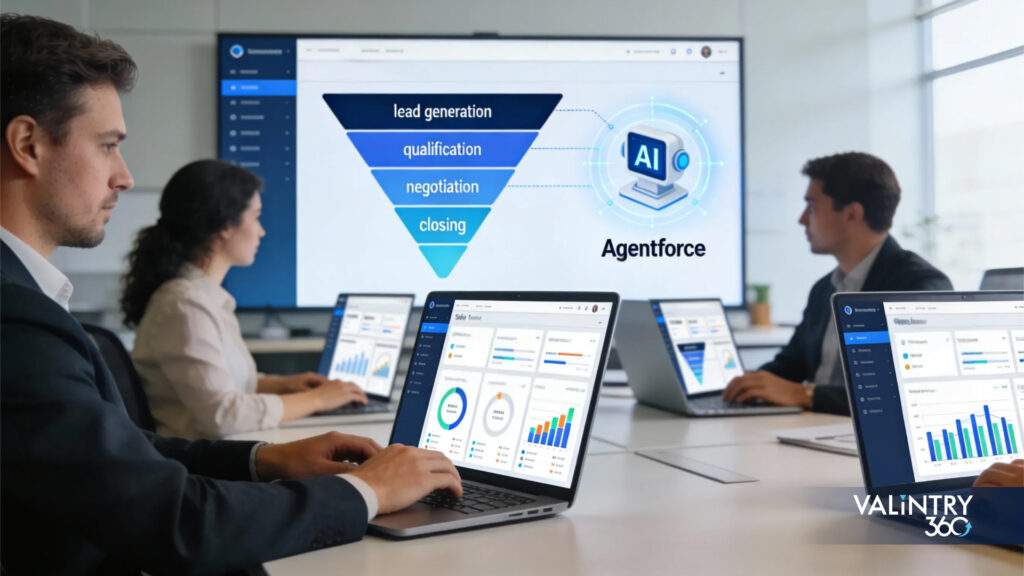
Now that the sales cycle is clearly mapped, the next step is to improve each stage using Agentforce. By applying focused automation at key points, sales teams can reduce delays, improve deal movement, and maintain steady progress across the pipeline.
Prospecting: Automate Outreach with SDR Agents
Agentforce supports prospecting by handling routine tasks that usually take up valuable selling time. AI-based SDR agents manage lead qualification, outreach, and early engagement around the clock. As a result, sales teams stay focused on meaningful conversations instead of manual follow-ups. These agents capture insights from every interaction and update the CRM automatically. Qualified leads move smoothly to sales representatives, which allows deeper discussions to begin without delay. Moreover, high-intent prospects are identified early, outreach flows across multiple channels, and meeting scheduling becomes faster and easier.
Discovery: Use AI to Surface Key Buyer Insights
During discovery, Agentforce reviews conversations and activity data to highlight buyer intent, detect concerns, and suggest helpful content in real time. This support allows sales teams to understand buyer needs faster while keeping discussions relevant and focused.
The platform evaluates several critical areas:
- Problem urgency and business impact
- Decision paths and authority roles
- Buyer motivation and success drivers
- Readiness for adoption and rollout
As a result, sales teams spend more time building trust while data review and insight gathering stay automated and consistent.
Demo: Personalize Presentations with Real-Time Data
In enterprise sales, generic demos rarely address real buyer needs. Agentforce supports tailored demos by adjusting presentation details based on industry, role, and business context. This approach creates relevant scenarios that align closely with the buyer’s environment. Demo workflows update dynamically with role-based examples, realistic business processes, and targeted use cases. As a result, preparation time drops, engagement improves, and buyer interest stays high throughout the presentation.
Proposal: Auto-Generate Quotes and Documents
Proposal development often slows down enterprise deals. Agentforce speeds up this stage by generating pricing, quotes, and documents directly from CRM records and earlier discussions. This approach reduces repetitive work, maintains consistent pricing logic, and limits manual errors. Moreover, faster proposal delivery builds trust, improves response time, and keeps deal momentum steady.
Close: Use Nudges and Reminders to Drive Urgency
As deals near completion, Agentforce maintains forward movement through smart reminders and activity prompts. The system tracks buyer actions, stakeholder input, and engagement patterns to suggest the best next steps. In addition, internal champions receive timely prompts, follow-ups stay consistent, and risks surface early. As a result, closing activities remain organized, focused, and timely.
By improving each stage of the enterprise sales cycle with Agentforce, sales teams reduce manual effort, maintain deal focus, and improve pipeline flow. Over time, this structured approach shortens sales timelines, improves forecast accuracy, and supports steady revenue growth.
Align Sales and Marketing for Faster Conversions
While Agentforce improves each sales stage, stronger results appear when sales and marketing teams work as one unit. When both functions share goals, data, and insights, lead quality improves, follow-ups become timely, and conversions happen faster across the enterprise sales cycle.
Share Insights Across Teams
Sales and marketing misalignment often leads to wasted effort, poor lead quality, and slow deal movement. However, structured collaboration builds clarity, focus, and steady progress.
The most effective approach includes:
- Shared responsibility for brand awareness, lead flow, and deal progress
- Regular cross-team discussions to exchange insights and feedback
- Unified understanding of buyer profiles and decision paths
- Shared access to CRM data, activity history, and engagement patterns
When both teams agree on what defines a qualified lead, conversion quality improves, while deal momentum stays consistent.
Use Agentforce to Deliver Timely Content
Agentforce acts as the central bridge between sales and marketing activities. The platform reviews engagement signals, tracks campaign impact, and highlights areas that need quick action.
With Agentforce, teams can jointly manage:
- Personalized email campaigns aligned with buyer interests
- Automated journeys that support consistent engagement
- Targeted content delivery based on buyer behavior
In addition, unified customer profiles bring together insights from multiple data sources. This unified view supports better timing, stronger message relevance, and improved long-term engagement across the enterprise sales cycle.
Pre-Educate Leads Before Sales Engagement
Before formal sales discussions begin, structured lead nurturing helps prospects understand challenges, clarify priorities, and build confidence. This early guidance builds trust and prepares buyers for meaningful conversations. By focusing on customer education through helpful content, sales teams appear as problem-solvers rather than product promoters. Each interaction strengthens credibility and builds long-term value, especially in complex enterprise sales environments.
This method also helps identify high-intent prospects based on engagement patterns. As a result, sales teams prioritize leads with genuine interest, which improves focus, strengthens pipeline quality, and shortens the overall sales cycle.
Train and Support Your Sales Team with AI Coaching
Even the best sales process delivers weak results without skilled representatives who can apply it with clarity and confidence. Strengthening sales team capability through AI coaching multiplies performance across every stage of the enterprise sales cycle, while also improving consistency and deal quality.
Use Agentforce Sales Coach for Real-Time Feedback
Agentforce Sales Coach delivers personalized, deal-focused feedback during active customer conversations. Unlike traditional coaching methods that occur long after calls, this approach offers guidance at the exact moment it is needed, which improves recall and practical use.
This real-time analysis reviews tone, message clarity, pacing, and objection responses while conversations take place. It also highlights filler words, listening gaps, and response patterns that impact buyer trust. Most importantly, this coaching model supports every sales representative, allowing consistent skill development across the full team, not just top performers.
Simulate Calls and Objection Handling
Sales skills improve through steady practice. However, traditional role-play often feels forced and happens rarely. Agentforce improves this experience through realistic AI-based simulations that allow representatives to:
- Practice challenging buyer conversations in safe environments
- Refine objection handling without risk
- Receive deal-specific feedback for continuous improvement
These guided simulations help sales professionals build confidence, sharpen responses, and improve control during real conversations. As a result, objection handling becomes natural, discussions stay focused, and deal movement becomes faster and more predictable.
Reduce Onboarding Time for New Reps
Training new sales representatives often takes several months, which delays productivity and strains existing teams. AI coaching shortens this learning period by offering guided practice, real-time feedback, and continuous skill development from day one. Agentforce Sales Coach acts as a personal guide for each new hire, offering structured coaching across discovery calls, demos, and closing conversations. New team members gain experience faster through simulated scenarios, guided messaging support, and instant correction.
In addition, Agentforce reviews winning deal patterns to highlight the most effective messaging, content, and response methods for each buyer group. This removes guesswork and gives new sales professionals clear direction for every interaction. Beyond training speed, faster onboarding preserves institutional knowledge, improves morale, and supports consistent performance across the team. As a result, organizations gain greater return from sales talent while steadily shortening the overall enterprise sales cycle.
Track Performance and Iterate Continuously
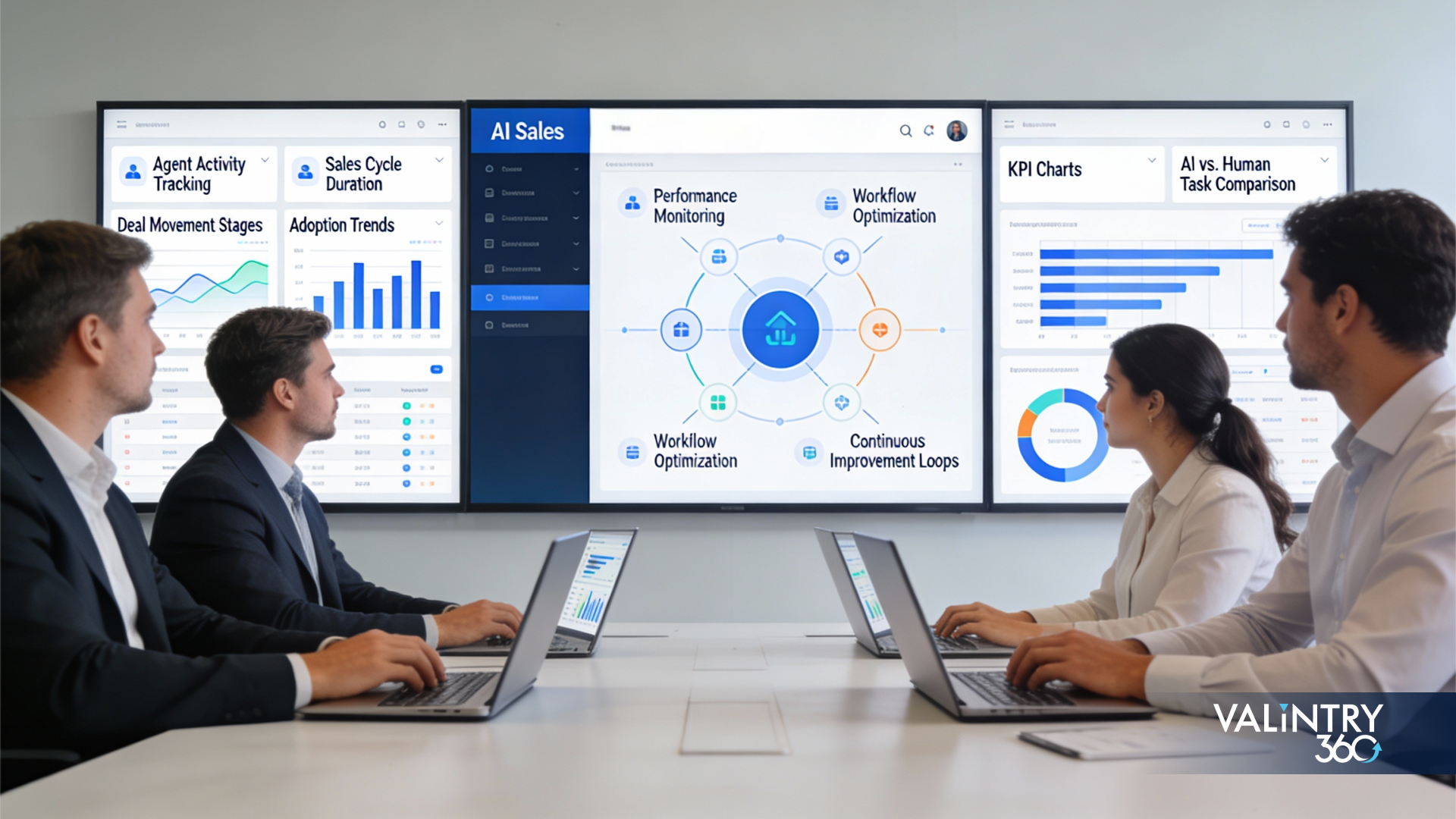
Continuous improvement plays a critical role in refining the enterprise sales cycle. Once Agentforce becomes part of daily sales operations, steady tracking and regular adjustments help maintain strong performance. A disciplined review process allows teams to spot patterns early, correct gaps quickly, and maintain consistent progress across every sales stage.
Monitor Sales Cycle Metrics in Command Center
Agentforce Command Center acts as a centralized dashboard for sales operations, offering clear visibility into AI agent activity and sales performance indicators. This monitoring layer allows teams to:
- Track agent performance in real time, including activity flow, response quality, and exception handling
- Review adoption trends to understand which AI workflows provide the greatest operational value
- Analyze session paths to gain a complete view of engagement across departments
- Compare AI-driven tasks and human actions within customized performance dashboards
For steady improvement, focus on stage-wise cycle duration, deal movement consistency, and the gap between planned and actual progress. Reviewing these indicators on a regular schedule helps uncover trends that daily activity reports may not reveal.
Refine Prompts and Workflows Based on Results
After implementation, Agentforce prompts and workflows require consistent review and thoughtful refinement. The true value of AI adoption lies not only in automation but in how effectively instructions guide behavior and decision paths.
Start by tracking performance indicators such as:
- Time savings across individual sales roles
- Changes in lead progression compared to earlier cycles
- Workflow usage frequency and engagement levels
- Feedback on output clarity, relevance, and usefulness
Next, use controlled testing environments to simulate agent responses across different scenarios. This approach allows teams to evaluate workflows, correct logic paths, and adjust messaging before full-scale rollout, which helps maintain smooth operations and predictable customer interactions.
Scale What Works Across the Team
Once successful workflows emerge, extend these methods carefully across the sales organization. Begin by enhancing current workflows, strengthening prompt logic, and adding analytical layers that support smarter task routing.
Over time, advanced actions such as automated follow-ups, activity prioritization, and lead scoring updates can be linked directly to positive engagement signals. This structured expansion keeps operations consistent while improving deal velocity. For sales leaders, pairing behavioral tracking with performance numbers offers stronger insight. Monitor habits that sales professionals can adjust daily, such as follow-up timing, conversation quality, and activity consistency. Then, link these behaviors to revenue goals through personalized action plans and regular progress reviews.
By applying disciplined tracking and steady refinement, Agentforce becomes more than a sales tool. It turns the enterprise sales cycle into a transparent, measurable, and steadily improving process that supports long-term growth and predictable outcomes.
Conclusion
Enterprise sales cycles often involve long timelines, layered decisions, and complex workflows that strain both sales teams and leadership. Agentforce changes how this process operates in practical and measurable ways. Teams using this AI-driven approach report faster deal movement, stronger lead quality, and smoother engagement across every stage, all of which directly support steady revenue performance.
Throughout this guide, we explored how mapping the current sales process builds a clear foundation for focused improvement. From there, Agentforce supports every step of the sales cycle, including automated prospecting, AI-guided discovery, role-based demos, and simplified proposal workflows. As a result, sales professionals spend less time on manual tasks and more time building trust, understanding buyer needs, and driving real progress.
In addition, Agentforce connects sales and marketing teams through shared insights and unified engagement strategies. This close alignment supports consistent messaging, faster lead movement, and stronger pipeline quality. At the same time, AI coaching strengthens sales performance through real-time feedback, structured practice, and faster onboarding, which supports consistent skill growth across the full team. Most importantly, Agentforce supports ongoing improvement through disciplined tracking and refinement. The Command Center dashboard offers clear visibility into performance trends, while the Testing Center helps refine workflows and prompts based on real activity patterns. This structured feedback loop supports steady learning and long-term performance gains.
Now is the moment to act. Enterprise sales teams across every industry face similar challenges, including long deal cycles, heavy process loads, and fragmented team efforts. Organizations that apply AI-powered sales systems move faster, work smarter, and build stronger buyer trust. By adopting Agentforce, sales teams gain clarity, speed, and consistency, which leads to shorter sales cycles and stronger business outcomes. In today’s enterprise environment, long-term success favors teams that deliver clear value, steady engagement, and efficient execution at every stage.
Related Posts
- Agentforce
Agentforce vs Salesforce Flow: Which Should You Use…
Your Salesforce org may already depend on Flow for record updates, approval routing, notifications, scheduled jobs, guided screens, and other repeatable processes. Each path is configured in advance, so the system follows the same rules whenever the same conditions appear.Agentforce…
- Agentforce
Agentforce Readiness Checklist: Is Your Salesforce Org Ready?
Agentforce reads whatever your Salesforce org already contains, and it acts through the automation you've already built. That inheritance is the whole readiness problem, in one sentence.An agent inherits your duplicate contact records, your too-wide permission sets, and that Flow…
- Agentforce
Agentforce Implementation Cost in 2026
Salesforce publishes a price for a credit, a conversation, a user license, and a resolved case. Those numbers price the meter.Your project is everything that happens before the meter starts running: defining the process, cleaning the records the agent will…