
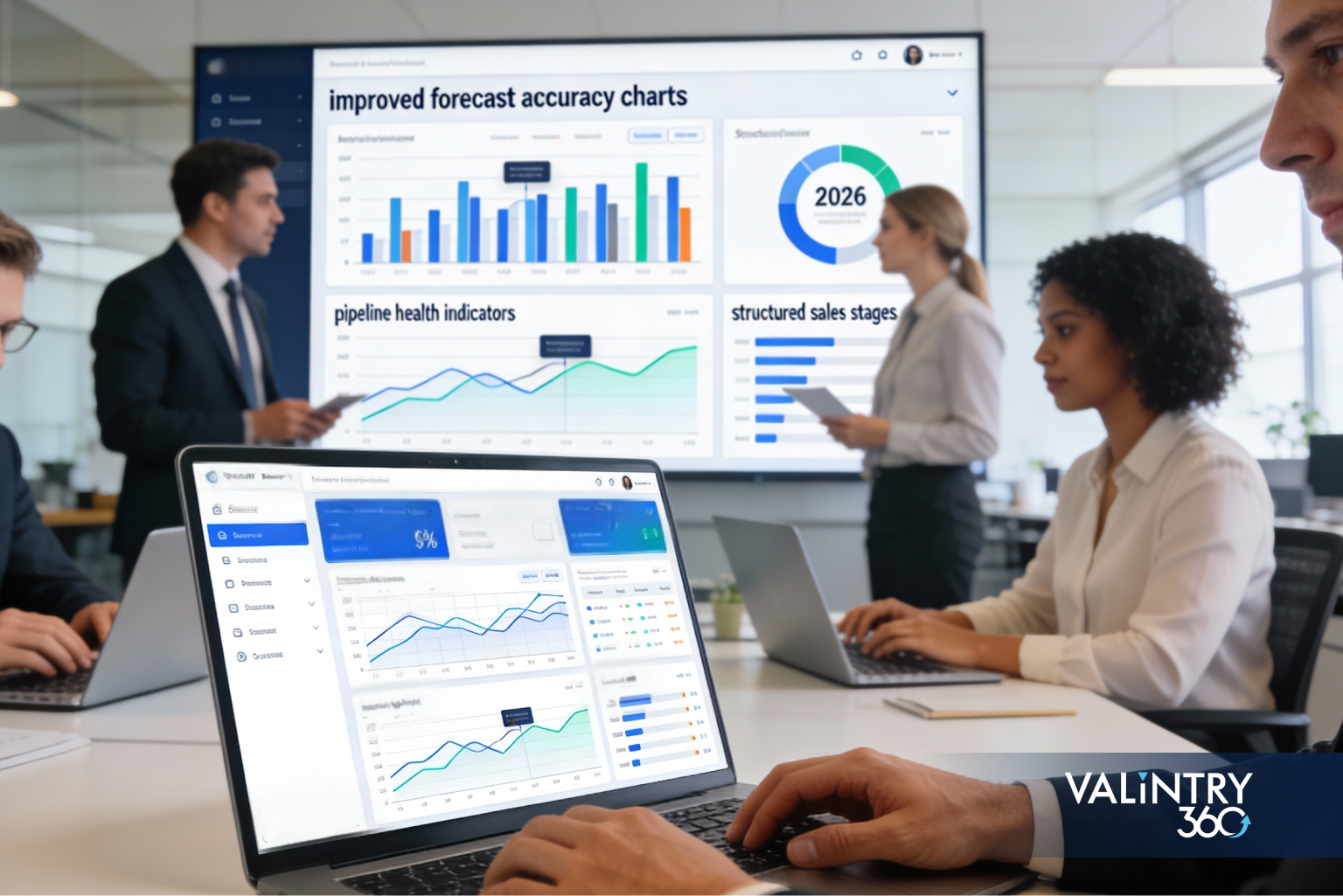
Accurate sales forecast planning remains a challenge for many organizations, even though it plays a vital role in business stability. Despite growing access to data and tools, forecast results often fall short due to unclear processes, manual errors, and inconsistent inputs. As a result, leadership teams struggle to plan growth, manage resources, and maintain steady performance.
These challenges highlight why improving sales forecast accuracy must become a strategic priority. When forecasts lack clarity, businesses face planning gaps, operational delays, and missed opportunities. In many cases, outdated forecasting methods and limited data visibility remain the root causes. Therefore, learning how to improve forecast accuracy is not only about better predictions, but also about building a strong base for long-term business growth.
In this expert blog, we explore practical methods to improve sales forecasting for 2026 and beyond. From structured data analysis to modern AI-driven tools, this guide shares clear strategies that help convert forecasting from uncertain estimation into a reliable planning system that supports smarter decisions and predictable outcomes.
Overview
Why Sales Forecast Accuracy Matters in 2026
The financial impact of sales forecast accuracy continues to grow as business environments become more complex and competitive. For modern organizations, the difference between steady progress and stalled performance often depends on how well revenue can be predicted. As market conditions remain uncertain, accurate forecasting is no longer just a reporting task. Instead, it has become a core business skill that guides strategy, planning, and execution.
Impact on Revenue Planning and Budgeting
Accurate sales forecasts form the base of sound financial planning across every department. Clear revenue predictions support working capital planning, purchasing schedules, inventory control, and long-term investment decisions. When forecasting accuracy improves, organizations gain better visibility into cash flow, cost management, and profit planning.
In contrast, weak forecasts lead to resource misalignment, excess stock, delayed investments, and missed growth opportunities. These issues quickly compound, creating financial strain and operational disruption. More importantly, consistent forecasting accuracy supports confident planning, allowing leaders to prepare for multiple business scenarios and adjust direction without hesitation. Beyond budgeting, finance leaders now rely heavily on accurate forecasts to guide long-term strategy. Clear revenue visibility allows stronger scenario planning, risk management, and business agility, all of which remain essential in uncertain markets.
How Poor Forecasting Affects Operations
Inaccurate forecasts often trigger a chain reaction that spreads across the entire organization. When planning assumptions fail, operational challenges appear quickly and escalate:
- Delayed project timelines that disrupt customer delivery
- Missed business opportunities due to slow response
- Reduced productivity caused by poor resource allocation
- Staffing gaps or surplus created by weak workforce planning
Inventory management also suffers when forecasts lack accuracy. Stock shortages, excess storage, and wasted production lead to rising costs and strained operations. Over time, these issues weaken profit margins and slow business momentum.
Across departments, weak forecasting creates pressure throughout supply networks. Supplier coordination becomes harder, distribution planning loses clarity, and partner confidence weakens. These ripple effects add friction across the value chain, making daily operations more complex and less predictable.
Why Accuracy Is More Critical Than Ever
Forecast accuracy has become more difficult to achieve, yet far more essential for success. Faster buying cycles, shifting customer expectations, and rapid market changes demand real-time insight and rapid adjustment. Without strong forecasting systems, decision-makers struggle to respond quickly to change. Limited data visibility delays action, while outdated planning models reduce confidence. As a result, organizations face higher risk when making investment, hiring, and growth decisions.
Modern businesses now rely on advanced analytics and AI-based forecasting tools to improve clarity and precision. These systems support better demand planning, stronger sales execution, and more confident strategic moves. Organizations that apply such methods gain operational stability, sharper focus, and stronger market positioning. As market volatility continues into 2026, accurate sales forecasting stands at the center of strategic business planning. It supports disciplined execution, steady growth, and informed leadership across every level of the organization.
Common Reasons Forecasts Go Wrong

Even advanced forecasting tools fail when basic organizational gaps remain unresolved. In many cases, forecasting issues do not stem from technology but from daily habits, unclear processes, and inconsistent execution. To improve sales forecast accuracy, it is essential to first understand the common causes that lead to unreliable predictions.
Inconsistent Data and CRM Hygiene
Weak data quality forms the base of most forecasting problems. When sales teams record incomplete updates, delay CRM entries, or maintain scattered records, forecast reliability drops quickly. Heavy administrative workload often pushes accurate data tracking down the priority list, leading to outdated records and uneven reporting.
As a result, forecasts rely on flawed inputs, which causes leadership teams to plan using unclear signals. Poor CRM hygiene also leads to missed insights, inaccurate pipeline values, and weak visibility into deal progress.
Common data challenges include:
- Opportunities with outdated timelines
- Deals sitting in late stages without activity
- Inconsistent use of forecast categories
- Fields updated only during reporting cycles
- Incorrect or missing deal values
Without disciplined data practices, even strong sales processes struggle to produce accurate forecasts.
Overreliance on Gut Feeling
Many forecasts break down because decisions depend more on instinct than objective evidence. While experience matters, relying solely on judgment introduces bias and unpredictability.
This approach often results in:
- Overly optimistic pipeline estimates
- Delayed removal of stalled deals
- Emotional attachment to low-probability opportunities
- Reduced confidence from leadership teams
Sales professionals may hold onto deals long after progress stalls, hoping conditions change. At the same time, fear of missing targets can cause others to delay honest reporting. Together, these behaviors weaken forecast integrity and erode trust.
Ignoring External Market Factors
Forecasts created without market awareness often fall short. External conditions such as economic shifts, seasonal demand, industry changes, and competitive pressure directly influence buying behavior.
When planning ignores these factors, forecasts lose context and realism. During market slowdowns, buying cycles lengthen and deal sizes shrink. During growth periods, demand may exceed planning capacity. Without factoring in these trends, businesses struggle to balance inventory, staffing, and financial planning.
Lack of Cross-Team Alignment
In many organizations, forecasting operates in silos. Sales teams manage their numbers independently, marketing builds campaigns separately, operations plan with limited visibility, and finance sets goals based on fragmented data.
Common missteps include:
- Allowing one department to manage forecasting alone
- Using different tracking tools across teams
- Relying heavily on historical results instead of current signals
- Overlooking market movement and customer behavior
This separation leads to conflicting assumptions, planning gaps, and reduced execution clarity. To improve forecast accuracy, organizations must align goals, data sources, and review processes across all departments before investing in advanced forecasting systems.
8 Proven Ways to Improve Sales Forecast Accuracy
Improving sales forecast accuracy requires structured methods built on reliable data, consistent processes, and disciplined analysis. By applying proven forecasting practices, sales teams can reduce uncertainty, strengthen planning, and improve confidence in revenue projections. Below are eight practical approaches that support consistent forecasting improvement.
1. Use Historical Data as a Baseline
Reviewing past sales performance provides a strong starting point for forecasting. By analyzing revenue across products, pricing levels, sales roles, and time periods, teams can establish a dependable sales baseline. This baseline highlights repeating patterns, seasonal shifts, and long-term trends, which help shape realistic future projections. Over time, historical insights improve context, reduce guesswork, and support steadier forecasting.
2. Apply Time Series Forecasting for Trends
Time series analysis reviews sequential sales data to uncover trends, seasonal behavior, and recurring cycles. This method evaluates how performance changes over consistent intervals, helping sales teams understand momentum shifts. By isolating long-term direction, seasonal variations, and short-term noise, organizations gain deeper clarity into future performance patterns. This approach proves especially helpful when consistent historical data is available.
3. Leverage Regression and Multivariable Models
Regression-based forecasting examines relationships between revenue and influencing factors. These models study how elements such as campaign activity, pricing changes, and market conditions affect results. Multivariable analysis allows teams to assess several factors at once, helping determine which drivers carry the most impact. Over time, these insights support more structured decision-making and refined forecasting assumptions.
4. Incorporate AI and Machine Learning Tools
AI-powered forecasting tools review large datasets quickly and update projections in near real time. Machine learning models detect hidden patterns, recognize shifting trends, and adapt forecasts based on ongoing data changes. In addition, AI supports better lead evaluation, customer segmentation, and workflow automation. This intelligent analysis improves forecast clarity while reducing manual processing effort.
5. Use Opportunity Stage and Weighted Pipeline Models
Weighted pipeline forecasting applies probability values to opportunities based on their position in the sales funnel. This approach recognizes that not every opportunity results in a closed deal, which leads to more realistic projections. By combining deal value with probability scores, teams gain a clearer picture of expected revenue. Stage-based forecasting also reviews opportunity volume at each step, offering better insight into near-term performance.
6. Track Lead Quality and Source Performance
Lead quality analysis measures how likely prospects are to convert and contribute revenue. By reviewing lead sources, engagement levels, and conversion behavior, sales teams identify which channels deliver the strongest outcomes. This approach improves focus, supports efficient resource allocation, and strengthens overall pipeline quality. Over time, improved lead filtering supports steadier forecasting accuracy.
7. Factor in Sales Cycle Length and Deal Age
Understanding how long deals typically take to close allows teams to predict timing more accurately. By monitoring opportunity age and comparing it to historical cycle length, sales leaders can estimate closure probability. This method highlights stalled deals early, supports pipeline cleanup, and improves timing projections for revenue recognition.
8. Run Scenario Planning and Test-Market Analysis
Scenario planning builds multiple forecast paths instead of relying on a single outcome. Teams prepare alternative projections based on different win rates, cycle speeds, and market shifts. These scenarios include expected outcomes, conservative cases, and growth-focused views. This structured approach strengthens strategic planning, improves risk readiness, and supports faster response to unexpected changes.
Choosing the Right Forecasting Method for Your Business

Selecting the right forecasting approach depends less on complexity and more on fit. The best method aligns with your business model, available data, and planning needs. When forecasting methods match real operational conditions, sales teams gain clearer insight, stronger control, and more reliable planning outcomes.
Match Method to Business Maturity and Data Availability
A company’s stage of growth plays a major role in forecasting approach selection. Early-stage businesses with limited sales history benefit most from qualitative methods that rely on market research, expert insight, and comparable industry patterns. As transaction records grow, forecasting can shift toward trend analysis based on early performance indicators.
Over time, established organizations with stable sales records gain the ability to identify seasonal shifts, growth cycles, and long-term demand patterns. This progression allows forecasting to move from broad directional estimates toward more refined projections that support operational planning and strategic decision-making.
Consider Forecast Purpose: Strategic vs. Operational
The purpose of the forecast directly influences method selection. Operational forecasts, which support inventory planning, staffing, and daily execution, require tighter accuracy and frequent updates. In contrast, strategic forecasts guide long-term growth direction and can tolerate broader assumptions.
For near-term planning, pipeline activity, deal movement, and live CRM data provide the strongest signals. Meanwhile, longer-term projections rely more heavily on historical trends, market insight, and broader economic indicators. By aligning forecasting technique with planning intent, organizations improve clarity and decision confidence.
Balance Between Speed, Accuracy, and Complexity
Successful forecasting depends on balancing three essential factors: speed, precision, and effort. Each organization must determine where this balance fits best based on internal capabilities and market conditions.
- Data quality and availability: Clean and structured records support quantitative forecasting, while limited data requires qualitative judgment.
- Market stability: Predictable markets support structured modeling, while uncertain conditions require scenario-based planning.
- Team maturity: Disciplined CRM practices support data-driven methods, whereas uneven data entry benefits from blended approaches.
High-performing organizations often adopt hybrid forecasting that blends several methods. This flexibility allows adaptation as business conditions change and data maturity improves. As companies grow, forecasting naturally shifts from simple judgment-based estimates toward more structured analytical methods that reflect expanding insight and operational scale.
Best Practices to Maintain Forecast Accuracy Over Time
Maintaining forecast accuracy requires steady discipline long after systems and processes are in place. Long-term accuracy depends on consistent habits, clear structure, and regular review cycles that prevent data decline and process drift.
Clean and Enrich Your CRM Data Regularly
Strong forecasting depends on reliable data. Over time, records naturally become outdated, incomplete, or inconsistent. Regular CRM reviews help identify missing fields, outdated timelines, and gaps in activity tracking. Prioritizing updates that affect near-term forecasts helps improve immediate accuracy.
In addition, applying validation rules and automated data enrichment tools reduces manual errors and improves record completeness. This ongoing data care strengthens forecast reliability while reducing administrative workload for sales teams.
Standardize Pipeline Stages and Definitions
Forecasting quickly loses accuracy when teams interpret pipeline stages differently. When terms such as “qualified” or “commit” vary across individuals or departments, confusion follows. Clear and visible stage definitions create shared understanding. Documenting observable exit signals and placing definitions directly inside CRM systems and playbooks helps teams follow consistent criteria. This shared structure builds alignment, improves reporting clarity, and supports more dependable forecasting across the organization.
Review and Adjust Forecasts Frequently
Consistent review cycles help detect changes early and support timely adjustments. Effective forecast governance includes multiple review levels:
- Weekly: Managers review individual forecasts, deal movement, and pipeline shifts
- Monthly: Leadership examines performance patterns, risks, and planning adjustments
- Quarterly: Executives align forecasts with strategic direction and operational planning
These structured checkpoints improve communication, reduce surprises, and maintain forecast stability.
Train Reps on Forecasting Discipline
Sales professionals need consistent guidance on accurate forecasting habits. Coaching should focus on reducing optimism bias, improving realistic assessment, and encouraging honest reporting. Clear accountability improves data quality and forecast reliability. When honesty receives positive reinforcement, teams share risk earlier and adjust faster. Over time, this culture strengthens trust, transparency, and long-term forecasting accuracy.
Use Forecasting Software with Transparency Features
Modern forecasting systems support clarity by providing visibility into forecast logic and data movement. When teams understand how projections change and why assumptions shift, confidence improves. Transparent forecasting builds trust across sales, finance, and leadership teams. This clarity supports stronger decision-making, faster response to change, and better planning outcomes.
Conclusion
Sales forecast accuracy has shifted from simple reporting into a core business discipline. Strong forecasting supports steady growth, efficient planning, and smarter decisions. In contrast, weak forecasting leads to missed opportunities, operational stress, and unstable business outcomes.
The path to stronger forecasting starts with solid fundamentals. Clean CRM data, shared definitions, and close team alignment form the base for dependable predictions. Without these basics, even advanced tools fail to deliver meaningful results. Therefore, disciplined data practices and consistent workflows must come before system upgrades.
At its core, forecast accuracy blends structured analysis with informed judgment. Historical trends, pattern tracking, and data modeling provide direction, while human insight helps interpret market movement and buyer behavior. High-performing organizations combine both elements to build reliable forecasts.
As market uncertainty increases, accurate forecasting becomes more valuable than ever. Organizations that build strong forecasting habits today gain lasting advantage through better planning, faster response, and clearer execution.
Although perfect forecasting remains difficult, continuous improvement produces long-term gains. Regular reviews, steady training, and disciplined forecasting habits create a cycle of progress that strengthens accuracy over time.
Key takeaways:
- Strong forecasting supports steady revenue growth
- Clean data and shared definitions form the base
- Team alignment improves prediction reliability
- Blending data and judgment strengthens insight
- Regular review cycles reduce surprises
- Continuous improvement builds long-term value
Sales forecast accuracy reflects an organization’s ability to plan, adapt, and move forward with confidence. Companies that master this discipline position themselves for steady success, regardless of market shifts.
Related Posts
Why Salesforce Consulting Is Moving From Customization to…
Salesforce keeps getting better at building things itself. Flow can now handle branching logic and callouts that used to require Apex. AppExchange has thousands of pre-built solutions for problems companies used to solve from scratch. Agentforce can reason through open-ended…
Salesforce Consulting in the Agentforce Era: Do You…
Salesforce's own marketing makes the pitch aggressively simple: Agentforce is already built into the platform, can reuse existing Salesforce workflows and APIs, and gives admins a conversational builder for creating agents. No complex data integration, no custom automation build.At the…
- Uncategorized
Salesforce Consulting Engagement Models in 2026: Fixed Price…
A Salesforce consulting relationship can be structured several different ways, and each structure changes who carries risk, who controls priorities, and what the consulting partner is actually accountable for. A defined implementation might be quoted as fixed price or time…