
AI Agent Development Solutions
VALiNTRY360 designs, builds and tests AI agents on Salesforce Agentforce, with evaluation, guardrails and support built in, so your agents work in production and not only in a demo.

What Are AI Agent Development Solutions?
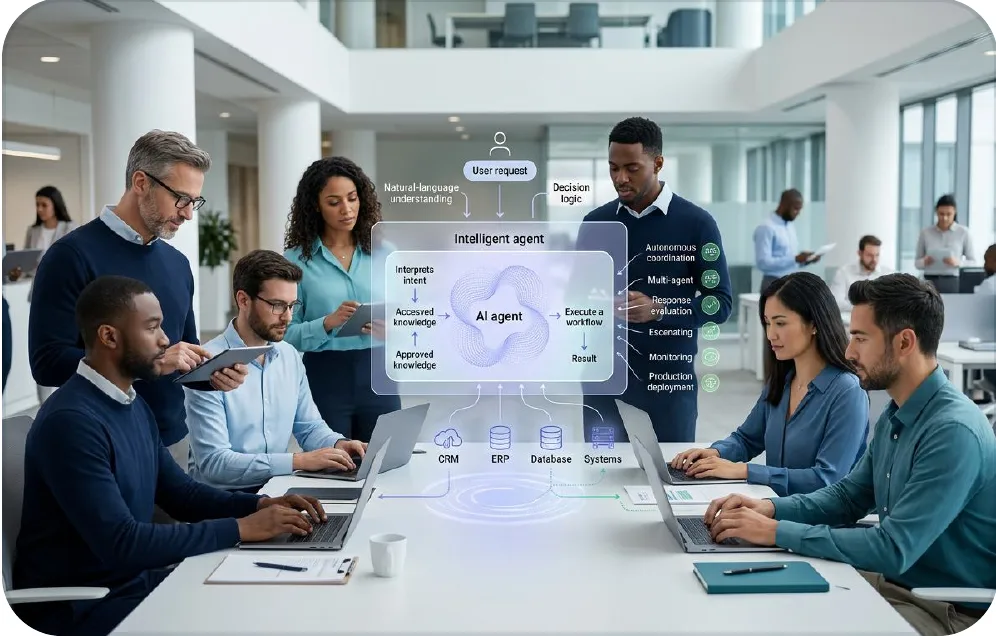
AI agent development solutions cover the work of building software agents that plan tasks, call tools, use your data, and act within limits you set. A chatbot answers a question, while an agent decides what to do next, uses the systems it is approved to access, and hands work to a person when judgment is needed. Building an agent that survives real traffic takes more than a prompt. It needs a defined job, clean data, tested actions, evaluation, cost controls, and a clear owner. At VALiNTRY360, we act as your AI agent development partner for Salesforce. We build agents on Agentforce, connect them to your systems, test them against real scenarios, and support them after launch. Our work builds on our Agentforce AI consulting and our Salesforce AI solutions.
AI Agent Types We Build
We build the agent that fits the job. Some answer people, and some run in the background with no screen at all.
Agent Type
What It Does
How We Implement It
Service Agent
Answers customer questions and creates or updates cases
We ground it in reviewed knowledge, connect messaging and set handoff rules. See our Agentforce for Service work.
Sales Engagement Agent
Follows up on leads by email and books meetings
We connect email and calendars and write approved messaging. See our Agentforce SDR agent page.
Employee Agent
Answers internal questions and runs simple record tasks
We limit it to approved content and set access by role.
Headless Agent
Runs background or system-to-system work through Flow, Apex or API
We design the entry point, session handling and controls. See our Agentforce headless agents page.
Multi-Agent System
Splits a large job across agents that hand tasks to each other
We define each agent’s job, the handoff and who owns the result.
Our AI Agent Development Services
We deliver AI agent development as six connected services. You can start with one agent or a roadmap for several, and each service ends in a deliverable your team can review.
Agent Strategy and Use Case Design
We choose the job for each agent and define how you will judge it. You get a written brief with the agent’s purpose, limits, owner and success measures.
- Workshops with business owners, IT and frontline users
- Use cases ranked by value, risk and data readiness
- Baseline metrics recorded before build
Agent Design and Build in Agentforce Studio
We build agents in Agentforce Studio, using Agentforce Builder for subagents, actions, instructions and variables. Where logic needs tighter control, we use Agent Script.
- Subagents and instructions written around one clear job
- Actions built with Flow, Apex, MuleSoft APIs and prompt templates
- Versioned builds that move from sandbox to production
Custom Actions and Integrations
We connect agents to the systems they need to read from and act on. Each action is small, named and tested on its own before an agent can call it.
- Action specifications with inputs, outputs and failure behavior
- API and MCP connections to ERP, billing and ticketing systems
- Our Agentforce integration services for larger connection projects
Knowledge and Data Grounding
We ground agents in content and records you approve, so answers rest on facts. We clean up what the agent will read before it reads it.
- Data library built from reviewed content
- Data 360 setup where a unified record is needed
- Freshness rules so stale content does not drive answers
Testing, Evaluation and Guardrails
We test every agent before launch and keep testing after it. We write the scenarios, run them in Preview and in batches, and review the trace of each failure.
- Written scenario list covering normal, edge and adversarial cases
- Batch testing and trace review for each change
- Approval steps and access limits for sensitive actions
Deployment, Monitoring and Managed Support
We launch in phases, watch the numbers and tune. Our Agentforce managed services team supports your administrators after go-live.
- Phased release to a small group first
- Monthly review of quality, cost and exceptions
- Expand, adjust or retire recommendation for each agent
Build, Buy or Partner: How to Decide
Every team faces the same choice. You can build in-house, start from prebuilt agents or work with a partner. Most organizations end up using a mix.
Option
Best For
Watch For
Build in-house
Teams with Salesforce developers and time to learn
Slow time to value and a long learning curve
Start from prebuilt templates
Standard jobs such as service or lead follow-up
Gaps between the template and your process
Partner custom build
Jobs that need your systems, data and rules
Handover: insist on documentation, tests and training
Quickstart first
Teams that want proof before a larger program
Scope limits: see our Agentforce Quickstart
We start from prebuilt templates when they fit and build custom only where a real gap exists. We also name every prompt, action and test set as a deliverable you own.
Agent Development Problems We Solve
Agents fail in production in a handful of predictable ways. We plan for each one before launch.
01Loops and Wrong Tool Calls
An agent can repeat a step or call an action that does not fit the request. The cost shows up in the bill before anyone sees the error.
Our solution:
We set step limits, write clear action descriptions and test for loops and misfires before release. Agent Script gives us tighter control where an open-ended instruction is too loose.
02No Evaluation Set
Many teams demo an agent on the same few questions and call it done. The first real user finds the gap.
Our solution:
We write the scenario list early, including hard and hostile cases, and rerun it after every change. A failing scenario blocks release.
03Costs That Drift
An agent that works can still cost too much if it makes too many calls or runs too often. Usage grows quietly.
Our solution:
We forecast cost per task before build and track it monthly. Cheap, deterministic steps stay in Flow, and the agent handles only the part that needs judgment.
04Stale or Messy Knowledge
An agent grounded in outdated or poorly formatted content gives confident wrong answers.
Our solution:
We review the content, remove duplicates and set an owner and a refresh schedule. Our AI readiness services cover larger data and content cleanups.
How We Measure an Agent
An agent you cannot measure is an agent you cannot improve. We agree the measures before build and report them every month.
Measure
What It Tells You
How We Use It
Task completion rate
How often the agent finishes the job without help
We set a target before launch and track it by scenario
Escalation rate
How often a person has to step in
We review each escalation to improve instructions or actions
Cost per task
What each completed task costs in usage
We compare it with the manual cost and watch for drift
Latency
How long users wait for an answer
We trim slow actions and long chains
Human review load
How much staff time the agent creates
We make sure the agent saves more time than it consumes
We report these as ranges and trends, not single numbers, because early volumes are small. Every figure comes from your own pilot, not a benchmark.
VALIDATION & ADVISORY PROOF
What Clients Say About Working With VALiNTRY360
AI agent development builds on Salesforce work we already deliver. Add a relevant client testimonial here that highlights VALiNTRY360’s build quality, responsiveness or ongoing support.
Sean Rose
@seanrose
Really, really liking @reflectnotes so far. It’s just the right amount of simple/fast for a personal note taking app and does most of the hard work of organizing in the background.
Ryan Delk
@delk
Don’t take it from me: @reflectnotes is magic.
Demetria Giles
@drosewritings
Playing around with @reflectnotes. I’m back logging key thoughts, details and soundbites from episodes, books, meetings, articles, etc from the past week. So far, it’s a knowledge worker’s dream come true.
Fabrizio Rinaldi
@linuz90
I’m keeping @reflectnotes open *all* the time, and I’m using both for simple journaling, and long form writing. It’s rare to see a single app work so well for both.
Jeremy McPeak
@jwmcpeak
I just received an invite to @reflectnotes, and holy crap! It is well thought out, and I can see this being my note- taking platform going forward. Well done! I’m looking forward to seeing how the app progresses.
Jonathan Simcoe
@jdsimcoe
All righty. I have to give a massive shout-out to @maccaw for pioneering @reflectnotes. It has already matured to a point where it is a daily driver for me. The speed, focus, and attention to detail (especially perfect bits of structured data) is superb.
Include the client’s name, job title, company and the testimonial where approval is available.
How We Keep Your Agent Project on Track
AI agent projects move faster when decisions are made early and the scope stays clear. We run short reviews throughout the build so your team can approve the agent’s purpose, access, content, and launch plan before they become costly changes.
One Clear Business Goal
We agree what the agent will do, who it will help, and how your team will measure success.
Early Access Review
We review licenses, permissions, data, and security requirements before the build depends on them.
Real-World Testing
Your team tests the agent with common, unclear, and sensitive requests before launch.
Defined Ownership After Launch
We document who owns content, monitoring, changes, and escalations once the agent is live.
When an Agent Is the Wrong Tool
Not every job needs an agent. A Flow or a report is cheaper, faster and easier to predict. We check each idea against a short list before we recommend building one.
If the Task Is
A Better Fit Is
Why
Fixed rules with known inputs
Flow or Apex
Rules run the same way every time and cost less per run
A calculation or a report
Formula, report or dashboard
No interpretation is needed
A one-time data fix
Data loader or a script
An agent adds cost and risk for a single run
Free text that needs reading
An agent
Interpretation is the reason agents exist
A multi-step task across systems with judgment calls
An agent with approval steps
The agent handles variation and a person handles exceptions
Many strong projects pair the two. A Flow handles the fixed steps, and an agent handles the one step that needs judgment. That split keeps cost down and behavior predictable.
Our AI Agent Development Lifecycle
Our six-step lifecycle moves from idea to a governed, supported agent. Each step has set activities, a deliverable and a decision point.
Step 1: Define
We agree the job, the owner and the success measures.
- Workshops with business, IT and frontline users
- Written agent brief and baseline metrics
- Go or no-go decision on the use case
Step 2: Prepare
We check the data, access and systems the agent will touch.
- Edition, license and permission review
- Content and data quality review
- Agent user created with minimal access
Step 3: Build
We create the agent and its actions in a sandbox.
- Subagents, instructions and variables in Agentforce Builder
- Actions on Flow, Apex, MuleSoft or MCP
- Agent Script where tighter control is needed
Step 4: Test
We test before anyone depends on the agent.
- Scenario list covering normal, edge and hostile cases
- Batch tests and trace review after every change
- Fixes and retest until the list passes
Step 5: Launch
We release to a small group under close watch.
- Channel connection and handoff routing
- Daily review in the first week
- Comparison with the baseline
Step 6: Operate
We monitor, tune and decide what comes next.
- Monthly review of quality, cost and exceptions
- Runbooks and handover for your administrators
- Expand, adjust or retire recommendation
Timelines depend on the number of systems, the quality of your data and how many agents you start with. We give you a dated plan after the first workshop.
Two habits run through every step. We document as we go, so your team can read and change what we build. And we keep each release small, because a small change is easy to test and easy to undo. When an agent misbehaves in production, a small release history is the fastest way to find the cause.
Salesforce Tools We Use to Build Agents
Salesforce gives builders several tools, and the right mix depends on the agent. We choose among them for each job.
Tool
What It Does
How We Use It
Agentforce Studio and Builder
Low-code environment to build, test and deploy agents with a canvas view
We build most agents here, using templates where they fit.
Agent Script
A language for agent logic, with conditions, loops, transitions and variables
We use it where an instruction needs firmer control.
Agentforce DX
Pro-code tools for the Salesforce CLI and VS Code
We use it for source control and repeatable deployments.
Agent API
REST access to agents from outside Salesforce
We use it for headless agents and outside callers.
Flow, Apex and MuleSoft
Actions that read and write data in Salesforce and other systems
We build small, tested actions on the right one for each job.
Data 360 and data libraries
Unified data and grounded knowledge
We scope them to the job instead of the whole company.
Salesforce moved agent creation into Agentforce Studio, and the legacy builder in Setup no longer creates new agents. We build in Studio and can upgrade older agents for you.
AI Agent Security, Governance and Human Oversight
An agent acts for your business, so its limits matter as much as its skills. Salesforce supports permissions, field-level security, the Einstein Trust Layer, and approval steps. Your organization decides how to use them, and we configure the right controls with you.
Dedicated Agent User
Separate Identity: Each agent runs under its own dedicated user, rather than sharing a person’s account or an administrator account.
Controlled Access: The agent user receives only the licenses, permission sets, and data access required for its approved job.
Least-Privilege Actions
Focused Permissions: Each action can read or update only the objects, fields, and records needed to complete the assigned task.
Controlled Write Access: Write permissions begin closed and are opened one object at a time, with a clear business owner and reason.
Human Approval
Approval for Sensitive Actions: Actions that move money, change customer records, or use regulated data remain behind a person’s approval.
Test Before Expanding: We review real test results before recommending that an agent handle a sensitive action with less oversight.
Grounded Answers
Approved Sources Only: Agents answer from reviewed content, connected records, and defined instructions, not unapproved or unknown information.
Clear Escalation Path: Requests outside the agent’s scope are handed to the right person instead of being guessed or answered incorrectly.
Audit and Monitoring
Visible Activity: We define what your team can review, including what the agent read, changed, and returned during each interaction.
Documented Controls: Compliance depends on your configuration and agreements, so we document the relevant controls for your security and compliance reviewers. For a related view, see our guide to human-in-the-loop AI sales automation.
Limits and Considerations We Plan Around
AI agent platforms change quickly, so we confirm each item below against current documentation during scoping.
Consideration
What to Know
How We Plan For It
Platform fit
Agentforce works best when your data and processes sit in or near Salesforce
We tell you when another approach fits better
Instruction control
Natural-language instructions can drift on complex logic
We use Agent Script for steps that need firm rules
Tool count
Agents with too many tools choose worse
We keep each agent’s tool list short and split large jobs
Evaluation effort
Good test sets take real time to write
We build the scenario list early and reuse it
Usage cost
Agent usage is consumption based
We forecast by tasks and review monthly
Maintenance
Content, systems and policies change
We assign owners and a review schedule
Release path
Versions must be committed before activation, and committed versions cannot be edited
We build in a sandbox and publish new versions for changes
Salesforce Case Studies Behind Our Agent Work
Good agents rest on a clean Salesforce foundation. These projects show the workflow automation, connected data, and user processes that support a successful AI agent rollout.

BIC Graphic: One Shared Customer View Across Sales and Service
VALiNTRY360 implemented Salesforce Sales Cloud and Service Cloud, connected the platform to BIC Graphic’s ERP, and streamlined workflows for sales, quoting, and service teams. The result was a seven-minute reduction in average handle time and 27%+ more new pipeline opportunities.

Tri-County Hearing: Automated Follow-Up Without Custom Code
VALiNTRY360 delivered a Health Cloud Quick Start with High Velocity Sales and automation to route leads and manage patient follow-up. Tri-County Hearing can now reach each patient seven times within 60 days without significant custom programming.
What Does AI Agent Development Cost?
Cost has several layers, and the build fee is only one of them. Salesforce pricing and editions change, so we confirm the terms in your agreements before we estimate anything.
Cost Driver
Who Owns It
How We Manage It
Agent design and build
VALiNTRY360
Fixed phases with defined deliverables and change control
Agentforce licenses and credits
Salesforce
Confirm your contract terms and included credits
Agent usage
Salesforce
Forecast by tasks per day and cost per task
Data 360 and integrations
Salesforce and third parties
Scope connectors and data volume before build
Maintenance and support
VALiNTRY360 or your team
Set a monthly review and a named owner
Why Choose VALiNTRY360 for AI Agent Development?
Agents are only as good as the foundation and discipline around them. We keep the scope tight, the tests early and the handover complete.
Our team works across Agentforce, Flow, Apex, MuleSoft and Data 360, so you do not need separate vendors for the agent, the integrations and the data. One accountable team means fewer handoffs and a single owner for the result.
We also stay honest about fit. If an agent is the wrong tool for a job, because a Flow would do or your data is not ready, we tell you and recommend the simpler path first.
01
One job per agent
We build around a single, measurable outcome.
02
Evaluation before launch
We write the test set early and keep running it.
03
Governance built in
We set access, approval and handoff rules before release.
04
Cost forecast
We model usage by task and review it monthly.
05
You own the work
Prompts, actions and test sets are documented deliverables.
06
Support after launch
We tune and support agents through managed services.

100+ Certified Specialists Behind Your AI Agent Development Solutions
A successful AI agent development solution needs more than configuration. It needs the right expertise across CRM architecture, data migration, integrations, automation, security, testing, user training, and change management. VALiNTRY360 brings 100+ certified specialists together to help your team move from discovery to a reliable Salesforce platform that supports real business processes.
Our team helps define the right roadmap, configure the platform, migrate data carefully, connect the systems your teams use, test with real scenarios, and prepare your admins for go-live. You get practical support from people who understand both AI agent development and the day-to-day work your CRM needs to improve.
AI Agent Development Solutions
FAQ by VALiNTRY360
AI agent development solutions cover the design, build, testing and support of software agents that plan tasks, use tools and data, and act within limits. For Salesforce teams, that usually means building agents on Agentforce and connecting them to the systems they need.
A chatbot follows a script or answers questions. An agent decides which step to take next, calls actions, uses your data and hands off when needed. An agent therefore needs testing, access controls and monitoring that a simple chatbot does not.
Use prebuilt templates for standard jobs, build in-house if you have the developers and time, and use a partner for custom work across your systems. Many teams mix all three. Whatever you choose, make sure prompts, actions and tests are documented and owned by you.
The best first agent handles a frequent task with clear inputs, approved actions, and a result you can measure. We assess volume, data quality, risk, integration needs, and ownership before recommending where to start.
A single agent with a clear job and ready data can reach launch in weeks. Multi-system or multi-agent work takes longer. We give you a dated plan after the first workshop, because data quality and integrations move the schedule more than the agent itself.
We write a scenario list that covers normal, edge and hostile cases, run it in Preview and in batches, and review the trace of each failure. We rerun the list after every change, and a failing scenario blocks release.
We track task completion rate, escalation rate, cost per task, latency and human review load against a baseline taken before launch. We report them as trends, and every figure comes from your own pilot.
Each agent runs as a dedicated user with least-privilege access. Sensitive actions need human approval, answers come from approved content, and we log what the agent did. Compliance still depends on your configuration and agreements, and we document the controls.
Yes. We connect agents to ERP, billing, ticketing and data systems through Flow, Apex, MuleSoft APIs or MCP servers. We start with read-only lookups and add write access after testing. See our integration services for larger projects.
Yes. We review the agent's instructions, actions, data and tests, then fix gaps, add evaluation and set up monitoring. If it was built in the legacy builder, we can upgrade it to Agentforce Studio.
An agent needs a defined job, approved instructions, clean data, and a small set of reliable actions. We review the content, records, and process rules first, because agents cannot correct missing or outdated information on their own.
Yes. An agent can support approved channels such as web messaging, employee experiences, email, or Slack. We recommend starting with one channel, testing the experience there, and expanding only after the agent performs reliably.
Yes. Content changes, business processes evolve, and usage can expose gaps that testing did not find. We provide support and managed services to review performance, update instructions, refine actions, and keep the agent useful.
Yes. We define the situations where the agent must stop and route the request to a person, such as sensitive decisions, missing information, or low confidence. The handoff includes available context so users do not start again.
Yes. Starting with one measurable use case gives your team a tested pattern for data access, actions, testing, security, and ownership. Once it proves value, we can plan the next agents in a practical order.