

- Agentforce
As organizations adopt AI-driven automation within Salesforce environments, Agentforce introduces a powerful shift—from rule-based workflows to autonomous digital agents capable of making decisions and executing actions. This evolution creates new opportunities, but also new risks. When agents interact with customer data, trigger workflows, or influence revenue operations, visibility becomes mission-critical. Traditional monitoring approaches were not designed for systems that reason, adapt, and act independently.
Agentforce observability provides the foundation needed to maintain trust, reliability, and governance in these environments. By combining logging, monitoring, and structured incident response, businesses can confidently scale AI-powered automation while protecting operations, compliance, and customer experience.
Overview
- Why Observability Matters for Salesforce Agent Automation
- Core Pillars: Logging, Monitoring, and Traceability for Agentforce
- Designing an Observability Architecture for Enterprise Agents
- Incident Response Strategies for Autonomous Agent Actions
- Governance, Security, and Compliance in AI-Driven Workflows
- Turning Observability Into Business Advantage With the Right Partner
- Conclusion
Why Observability Matters for Salesforce Agent Automation
Autonomous agents operate differently from traditional software. Instead of deterministic logic paths, they rely on contextual reasoning, integrations, and dynamic decision-making.
This introduces new operational questions:
- Why did an agent make a specific decision?
- What data influenced the action?
- Was the behavior within policy boundaries?
- How quickly can the system recover from errors?
Without observability, organizations face blind spots that increase operational and reputational risk.
Key business drivers include:
- Operational reliability — preventing automation failures from disrupting workflows
- Trust and transparency — ensuring stakeholders understand agent behavior
- Regulatory compliance — maintaining audit trails for automated decisions
- Performance optimization — identifying inefficiencies in agent workflows
- Risk management — detecting anomalies before they escalate
Observability shifts automation from experimental to enterprise-grade.
Core Pillars: Logging, Monitoring, and Traceability for Agentforce
Effective Agentforce observability depends on three foundational capabilities working together.
Logging
Logging captures detailed records of agent actions, system interactions, and decision inputs.
Important logging components:
- Agent prompts and responses
- Data access events
- Workflow execution paths
- Integration calls and API responses
- User overrides or interventions
High-quality logs enable forensic analysis when issues occur.
Monitoring
Monitoring focuses on real-time system health and performance metrics.
Critical monitoring indicators include:
- Agent execution latency
- Success vs failure rates
- Workflow completion times
- Integration reliability
- Resource consumption
Monitoring allows teams to detect emerging problems before they impact operations.
Traceability (Often Overlooked)
Traceability connects decisions to context.
It answers:
- Which data influenced an action?
- Which model or rule generated the output?
- What sequence of events led to the outcome?
Traceability is particularly important for compliance, governance, and debugging complex behaviors.
Pillar | Purpose | Business Impact |
Logging | Historical records | Accountability and audits |
Monitoring | Real-time visibility | Operational stability |
Traceability | Decision context | Trust and compliance |
Organizations that implement all three pillars achieve significantly higher reliability than those relying on monitoring alone.
Designing an Observability Architecture for Enterprise Agents
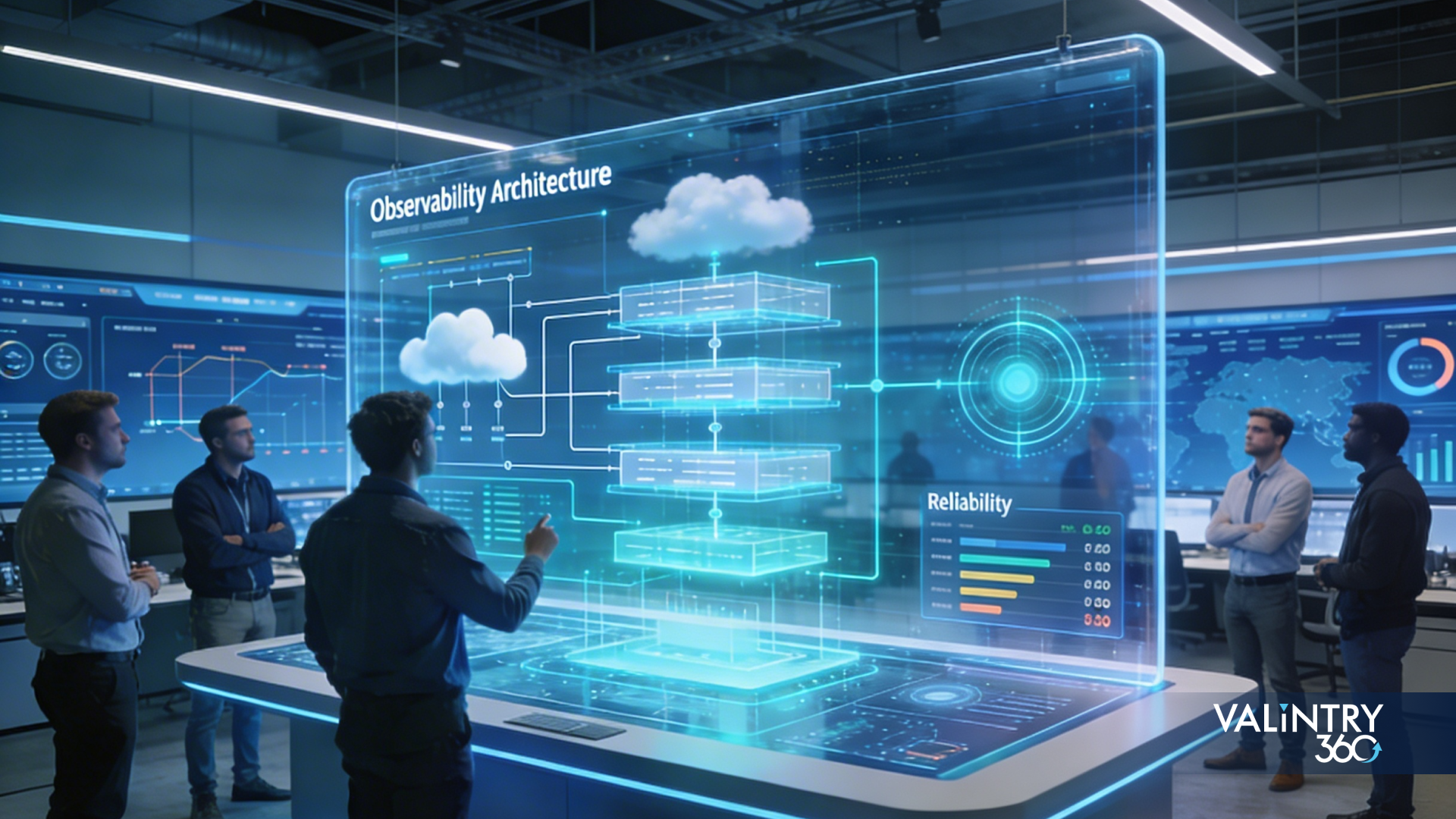
Agentforce environments often span multiple systems: Salesforce clouds, external APIs, AI services, and enterprise platforms. Observability must therefore operate across the entire ecosystem.
A modern architecture typically includes:
Data Collection Layer
- Event streaming from Salesforce
- Integration logs from middleware
- AI inference telemetry
- User interaction records
Processing and Correlation Layer
- Log aggregation platforms
- Event correlation engines
- Context enrichment pipelines
Visualization and Alerting Layer
- Dashboards tailored to business roles
- Automated alerts based on thresholds
- Predictive anomaly detection
Governance Layer
- Policy enforcement monitoring
- Access controls and audit logs
- Compliance reporting tools
One emerging best practice is decision observability, which tracks not only what happened but why it happened. This becomes essential when agents influence customer interactions or revenue outcomes.
Another important design principle is human-in-the-loop visibility, allowing teams to intervene when automation confidence drops below acceptable thresholds.
Incident Response Strategies for Autonomous Agent Actions
Traditional incident response assumes deterministic systems. AI agents require adapted strategies because issues may involve reasoning errors rather than technical failures.
An effective incident response framework includes:
Detection
- Automated anomaly detection
- Behavioral drift monitoring
- Threshold-based alerts
- Compliance violation triggers
Investigation
Teams must analyze:
- Agent decision context
- Input data quality
- Model behavior patterns
- Integration dependencies
Containment
Rapid containment mechanisms include:
- Temporary agent disablement
- Workflow rollback
- Policy overrides
- Human approval gating
Resolution
Resolution may involve:
- Prompt adjustments
- Model configuration changes
- Data corrections
- Integration fixes
Post-Incident Learning
Organizations should continuously improve by:
- Updating monitoring thresholds
- Enhancing guardrails
- Refining escalation protocols
Incident Stage | Key Focus |
Detection | Identify anomalies early |
Investigation | Understand decision context |
Containment | Limit operational impact |
Resolution | Fix root cause |
Learning | Prevent recurrence |
Companies that treat agent incidents with the same rigor as cybersecurity events achieve stronger resilience.
Governance, Security, and Compliance in AI-Driven Workflows
As automation becomes more autonomous, governance becomes inseparable from observability.
Key governance priorities include:
- Role-based access controls for agent permissions
- Data privacy monitoring
- Policy enforcement auditing
- Ethical AI usage tracking
- Regulatory compliance reporting
One critical but often underestimated risk is automation drift, where agent behavior gradually deviates from intended business rules due to changing data patterns or integrations.
Observability helps detect drift before it becomes a compliance or operational issue.
Security considerations also expand:
- Monitoring unauthorized data access
- Detecting abnormal automation patterns
- Protecting integration endpoints
- Preventing privilege escalation through agents
Organizations that embed governance into observability frameworks create sustainable automation ecosystems rather than short-term deployments.
Turning Observability Into Business Advantage With the Right Partner

Implementing Agentforce observability requires more than tools. It demands architectural planning, governance strategy, and deep Salesforce expertise.
Many organizations discover challenges such as:
- Fragmented visibility across systems
- Incomplete logging strategies
- Misaligned monitoring metrics
- Lack of incident response frameworks
- Integration complexity
Working with experienced Salesforce specialists helps bridge these gaps.
VALiNTRY360 supports enterprises by aligning observability with business outcomes rather than treating it as a technical add-on. Through strategic consulting, implementation expertise, and optimization services, organizations gain clarity into agent behavior while maintaining operational confidence.
The difference is not just technology—it is structured enablement that allows businesses to scale automation safely.
Organizations that align AI observability with Salesforce monitoring tools gain stronger control and faster troubleshooting capabilities.
Before deploying AI agents broadly, organizations should evaluate readiness across multiple dimensions.
Conclusion
Agentforce represents a major step forward in intelligent automation within Salesforce ecosystems. However, autonomy without visibility introduces risk. Observability—through logging, monitoring, traceability, and structured incident response—creates the foundation for reliable, compliant, and scalable AI-driven operations.
Organizations that invest early in observability gain stronger trust, faster optimization cycles, and reduced operational uncertainty. With the right strategy and expertise, businesses can transform autonomous agents from experimental tools into dependable drivers of growth and innovation.
Related Posts
- Agentforce
Agentforce vs Salesforce Flow: Which Should You Use…
Your Salesforce org may already depend on Flow for record updates, approval routing, notifications, scheduled jobs, guided screens, and other repeatable processes. Each path is configured in advance, so the system follows the same rules whenever the same conditions appear.Agentforce…
- Agentforce
Agentforce Readiness Checklist: Is Your Salesforce Org Ready?
Agentforce reads whatever your Salesforce org already contains, and it acts through the automation you've already built. That inheritance is the whole readiness problem, in one sentence.An agent inherits your duplicate contact records, your too-wide permission sets, and that Flow…
- Agentforce
Agentforce Implementation Cost in 2026
Salesforce publishes a price for a credit, a conversation, a user license, and a resolved case. Those numbers price the meter.Your project is everything that happens before the meter starts running: defining the process, cleaning the records the agent will…