
- Salesforce Consulting Services
For business leaders, ROI from Salesforce isn’t just about dollars spent — it’s about how well technology enables strategy. True return on investment comes when Salesforce doesn’t simply “run,” but becomes a growth engine that empowers teams, sharpens insights, and scales with the business. Measuring ROI from Salesforce Consulting and Solutions requires looking beyond software metrics to understand how expertise, adoption, and alignment translate into tangible results.
The right Salesforce consulting partnership can reveal opportunities you didn’t know were hidden in your data, processes, and workflows — turning Salesforce from a platform into a performance multiplier.
Overview
- What does ROI from a Salesforce consulting partner actually look like?
- How do I calculate ROI on Salesforce services in real numbers?
- Why adoption, data quality, and process alignment matter more than features
- How a consulting partner helps you realize value faster (speed to value)
- What should I track after go-live to prove ongoing ROI?
- Conclusion
What does ROI from a Salesforce consulting partner actually look like?
When organizations talk about Salesforce ROI, they often think of increased sales or reduced costs. But that’s only part of the picture. Working with a Salesforce consulting partner extends impact across revenue, efficiency, and strategic visibility.
Direct ROI typically shows up in measurable metrics such as:
- Shorter sales cycles due to automated follow-ups
- Higher close rates from improved lead nurturing
- Increased pipeline accuracy through unified data
Indirect ROI often drives the greatest long-term value:
- Fewer manual processes, freeing teams for higher-value work
- Enhanced customer experiences from connected data
- Better forecasting accuracy that informs smarter decisions
A partner like VALiNTRY360 – Salesforce Consulting and Solutions helps organizations capture both types of ROI. By aligning Salesforce with your unique business model, they ensure that value isn’t theoretical — it’s operational.
How do I calculate ROI on Salesforce services in real numbers?

The ROI formula is simple:
ROI (%) = (Net Gain from Salesforce Initiatives ÷ Total Investment) × 100
But applying it requires clear baselines. Before engaging a consulting partner, document current performance indicators such as:
- Lead conversion rates
- Average deal size
- Time spent on manual reporting
- Service response or resolution times
Then, post-implementation, remeasure.
Example:
If automating lead routing reduces response time by 2 hours and boosts conversion by 10%, that’s a measurable gain. Multiply those saved hours and additional wins by your team’s average revenue per deal or hourly value.
Even modest improvements across multiple metrics — faster quoting, cleaner dashboards, fewer integration issues — compound into significant ROI. Consulting partners make these improvements quantifiable by ensuring Salesforce is configured to both track and optimize the right data points.
Why adoption, data quality, and process alignment matter more than features
The most advanced Salesforce instance delivers little ROI if teams don’t use it effectively. Many organizations overinvest in features and underinvest in alignment — the connection between technology, process, and people.
- Adoption drives ROI. When every sales rep, marketer, and service agent sees Salesforce as a productivity tool rather than an obligation, outcomes accelerate.
- Data quality sustains ROI. Poor data leads to flawed forecasts and wasted time. A consulting partner enforces data governance, ensuring decision-makers trust what they see.
- Process alignment multiplies ROI. When sales, marketing, and operations share a unified process, Salesforce becomes a single source of truth — not a fragmented set of reports.
Seasoned consulting partners like VALiNTRY360 focus first on these fundamentals. Their guidance reduces future rework and ensures each enhancement builds on a solid foundation.
How a consulting partner helps you realize value faster (speed to value)
In Salesforce, time-to-value is often as critical as total ROI. The sooner your system begins delivering insights and automation, the sooner your business benefits.
Speed to value comes from:
- Proven implementation frameworks that prevent delays
- Clean integrations that eliminate data silos
- Automated workflows that accelerate daily tasks
- Dashboards ready on day one for immediate visibility
Many organizations attempt self-implementation, only to lose momentum in complexity. Experienced partners compress “months into weeks” by applying best practices and lessons learned from hundreds of deployments.
Additionally, they help avoid technical debt — unnecessary customization or inefficient design choices that slow systems over time. This forward-looking approach ensures Salesforce evolves with your business, not against it.
What should I track after go-live to prove ongoing ROI?
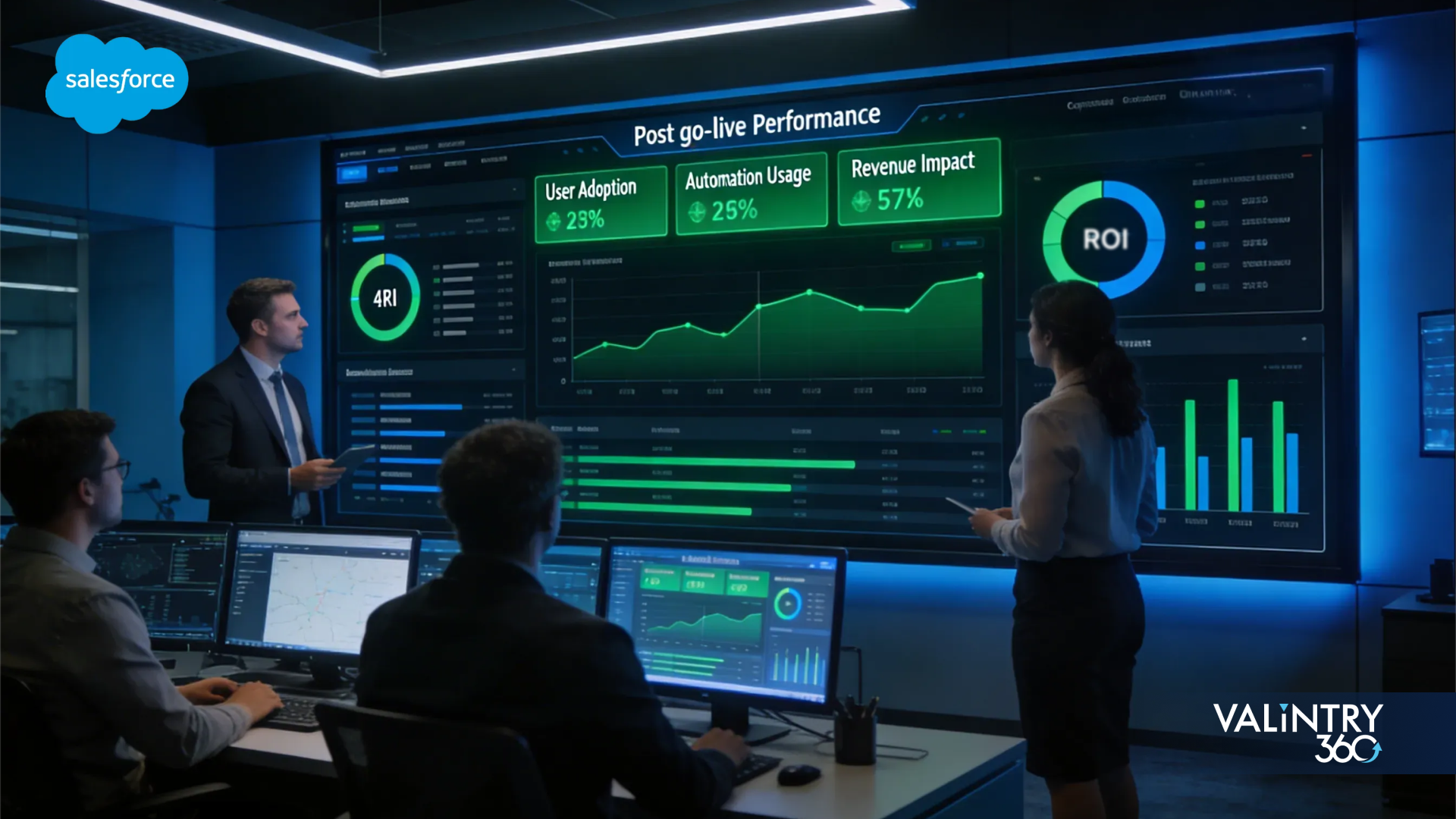
Salesforce ROI isn’t a one-time measurement — it’s a continuous evaluation of performance improvement. Executives should monitor metrics that link directly to revenue, efficiency, and customer experience.
Key post-launch ROI indicators include:
- Lead conversion rate: Measures pipeline quality and sales effectiveness
- Sales velocity: Tracks how quickly opportunities move from open to closed
- Forecast accuracy: Reflects data reliability and managerial visibility
- Case resolution time: Shows how automation and insights impact customer satisfaction
- Cost per acquisition: Indicates marketing and sales efficiency
- User productivity per rep: Evaluates adoption and process efficiency
Regular review of these metrics helps leaders identify whether Salesforce is driving consistent returns — and where additional optimization may yield new gains.
An ongoing relationship with a trusted consulting partner ensures continuous improvement, helping you capture incremental ROI as Salesforce and your business evolve.
Conclusion
Measuring ROI from Salesforce Consulting and Solutions isn’t about tracking a single metric — it’s about understanding how technology amplifies your organization’s strategy. When Salesforce is properly aligned, adopted, and optimized, its impact extends far beyond cost savings. It drives clarity, agility, and confident decision-making.
Businesses that work with experienced partners like VALiNTRY360 often find that ROI becomes more predictable, scalable, and sustainable — not through shortcuts, but through thoughtful execution. The result is a Salesforce environment that continually delivers measurable value across your entire enterprise.
Related Posts
- Salesforce Consulting Services
Salesforce Architecture for SaaS Companies From $10M to…
Experience Cloud, CPQ, and a clean Sales Cloud data model can carry a SaaS company a long way. But the setup that worked when your team was smaller starts to strain once pricing models expand, renewals pile up, product usage…
- Salesforce Consulting Services
Why Salesforce Integrations Fail – and How to…
Introduction: When an Integration Stays Online but the Business Process Breaks A Salesforce integration can pass every technical check and still fail the business that depends on it. The connection authenticates and the API returns success, while records still arrive…
- Salesforce Consulting Services
Why Salesforce Reports Can’t Be Trusted
A VP of Sales opens the pipeline dashboard on Monday and sees $4.2M. RevOps runs the saved pipeline report an hour later and gets $3.8M. Finance walks into the forecast meeting carrying $3.1M.All 3 numbers came out of the same…