
- Salesforce Consulting Engagement
The cost of a misaligned Salesforce proposal isn’t just budget—it’s stalled adoption, clunky workflows, and slower pipeline or service resolution. Choosing among the Best Salesforce Implementation Partners should feel analytical, not hopeful. Below is a pragmatic Salesforce proposal checklist and a vendor comparison rubric that senior leaders can use to separate credible partners from risky bets. Expect specifics: measurable outcomes, staffing transparency, data migration discipline, testing and change management rigor, and post-go-live support that protects ROI. Our goal is to help you see what great looks like, where CRM implementation risk hides, and how to validate claims before you sign.
Overview
Why Salesforce Proposals Go Wrong (Signals You’ll Miss ROI)
- Vague success metrics. Promises of “streamlined processes” or “360° views” without baseline and target KPIs make accountability impossible. Result: scope drifts, adoption lags.
- Staffing bait-and-switch. A-list architects in the pitch, junior delivery in reality. You pay senior rates while decisions are made by less experienced builders.
- Over-customization. Excess code when configuration would do. Total cost balloons, upgrades break, and handoffs become fragile.
- Ignored data quality. Migration plans skip profiling, dedupe, and governance. Dirty data erodes user trust and torpedoes dashboards.
Opportunity cost: The wrong partner delays time-to-value, blocks revenue acceleration, and forces rework that crowds out strategic initiatives.
Red Flags in Salesforce Proposals You Shouldn’t Ignore
Use this research-driven checklist during your Salesforce partner evaluation.
1. Ambiguous scope vs. measurable deliverables
How to spot: Outcomes described as activities (e.g., “configure Sales Cloud”) without acceptance criteria.
What good looks like: Business outcomes tied to KPIs (e.g., “increase lead-to-opportunity conversion from 18% to 24% in 2 quarters”).
Buyer Test: “Show the KPI baseline, target, and how each deliverable moves it.”
2. No org-wide discovery plan (stakeholder mapping, process mining)
How to spot: Discovery = two workshops; no cross-functional interviews.
What good looks like: RACI, stakeholder map, and process maps covering lead-to-cash and case-to-resolution.
Buyer Test: “Who are our must-interview roles and what artifacts will you produce?”
3. Generic timelines; no dependency map or risk log
How to spot: Pretty Gantt; no critical path, no risk register.
What good looks like: Dependencies (e.g., SSO readiness), explicit risks with owners/mitigations.
Buyer Test: “Share your top five assumed dependencies and risk mitigations.”
4. Over-reliance on custom code vs. native capabilities
How to spot: Apex everywhere, minimal mention of Flow, Data Cloud, or standard features.
What good looks like: Configuration-first; clear build-vs-buy guardrails.
Buyer Test: “List components we’ll configure first and thresholds that trigger code.”
5. Missing data strategy (migration, governance, dedupe, MDM)
How to spot: “We’ll import your data” with no profiling, dedupe, or MDM plan.
What good looks like: A Salesforce data migration plan with profiling, mapping, test loads, and stewardship model.
Buyer Test: “Walk through your data profiling outputs and dedupe approach.”
6. No enablement plan (training, adoption KPIs, change mgmt)
How to spot: One training session at go-live.
What good looks like: Role-based training, comms plan, champions network, adoption metrics with targets.
Buyer Test: “What adoption KPIs and reinforcement cadence will we use for 90 days?”
7. Light testing strategy; no UAT plan or automation
How to spot: “We test as we go.” No UAT scripts, no defect SLAs.
What good looks like: Testing matrix (unit, SIT, UAT), scripted scenarios, automation where stable, defect triage SLAs.
Buyer Test: “Show sample UAT scripts and your defect lifecycle.”
8. Thin integrations plan (security, API limits, monitoring)
How to spot: One-line “integrate with ERP.” No mention of Named Credentials, API budgets, or observability.
What good looks like: Integration patterns, security posture, rate-limit modeling, error handling, and monitoring.
Buyer Test: “How will we monitor failures and protect API limits on day one?”
9. No post-go-live support/SLAs or optimization roadmap
How to spot: Project ends at go-live.
What good looks like: Hypercare with SLAs, backlog grooming, and a quarterly optimization roadmap.
Buyer Test: “Share your hypercare playbook and sample SLA metrics.”
10. Too-good-to-be-true pricing; unclear staffing pyramid
How to spot: Low total with hidden change orders; unnamed resources.
What good looks like: Transparent roles, rates, utilization, and a realistic contingency.
Buyer Test: “Provide the named team, certifications, weekly hours, and risk contingency.”
What Strong Salesforce Partners Put in Writing

Think of this as a model proposal—clear, auditable, and designed to reduce CRM implementation risk.
- Business outcomes & KPI cadence. Baseline (e.g., sales cycle = 62 days), targets (reduce to 48 days), measured monthly; owners assigned.
- Discovery artifacts. RACI, stakeholder map, process maps, prioritized backlog, and a living risk register with probability/impact.
- Technical design decisions. Build-vs-buy matrix; configuration-first with guardrails for code; reference architectures for Sales, Service, and integrations.
- Data migration playbook + cutover plan. Profiling → mapping → test loads (T-1/T-2) → reconciliation reports; cutover runbook with rollback.
- Change management & training plan. Persona-based training; champions; comms calendar; adoption dashboards (logins, task completion, pipeline hygiene).
- Security/compliance. SSO, least-privilege via profiles/permission sets, audit logging, sensitive data handling.
- Testing matrix & exit criteria. Unit/SIT/UAT coverage, pass/fail thresholds, defect SLAs, and go-live gates.
- Go-live readiness & hypercare. Checklist (perf, data, security, training complete); 2–4 weeks hypercare with response/resolution SLAs.
- Governance & roadmap. Quarterly council, backlog triage, release calendar, and value tracking.
Subtle alignment: VALiNTRY360 proposals anchor to business outcomes and adoption metrics, use configuration before code, and include structured data migration, rigorous testing, and a defined hypercare/optimization model. See our services [Link placeholder] and a relevant case study [Link placeholder].
Mini-templates:
- Outcome line: “Increase first-call resolution from 64% → 75% within 2 quarters; owner: Support Ops; report: weekly CX dashboard.”
- Risk entry: “Dependency on SSO by 2025-11-15; risk: schedule; owner: IT; mitigation: temporary MFA.”
Compare Partners with This Shortlist Framework
How to Compare the Best Salesforce Implementation Partners
Use the 0–5 rubric below (0 = absent, 5 = exemplary). Multiply by the weight to get a weighted score.
| Criteria | Weight % | Vendor Score (0–5) | Weighted Score |
|---|---|---|---|
| Outcomes & KPI rigor | 12 | ||
| Discovery depth & artifacts | 9 | ||
| Solution architecture maturity | 9 | ||
| Integration experience & patterns | 9 | ||
| Data governance & migration discipline | 9 | ||
| Testing discipline & defect SLAs | 8 | ||
| Change management & adoption plan | 8 | ||
| Security posture & compliance | 7 | ||
| Salesforce certifications & team makeup | 7 | ||
| Reference relevance (industry/size) | 7 | ||
| Total cost transparency | 8 | ||
| Post-go-live model & SLAs | 7 |
Weights sum to 100%.
How to run a scorecard evaluation call: Send the rubric in advance. Ask each vendor to walk through evidence, not assertions: sample KPIs, discovery outputs, a Salesforce proposal checklist, data migration runbooks, and test scripts. Score live with cross-functional stakeholders (Sales, Service, IT). Capture proof links. After the calls, normalize scores, pressure-test assumptions, and conduct reference checks targeted to your riskiest areas.
Implementation Success Plan (From Selection to Go-Live)
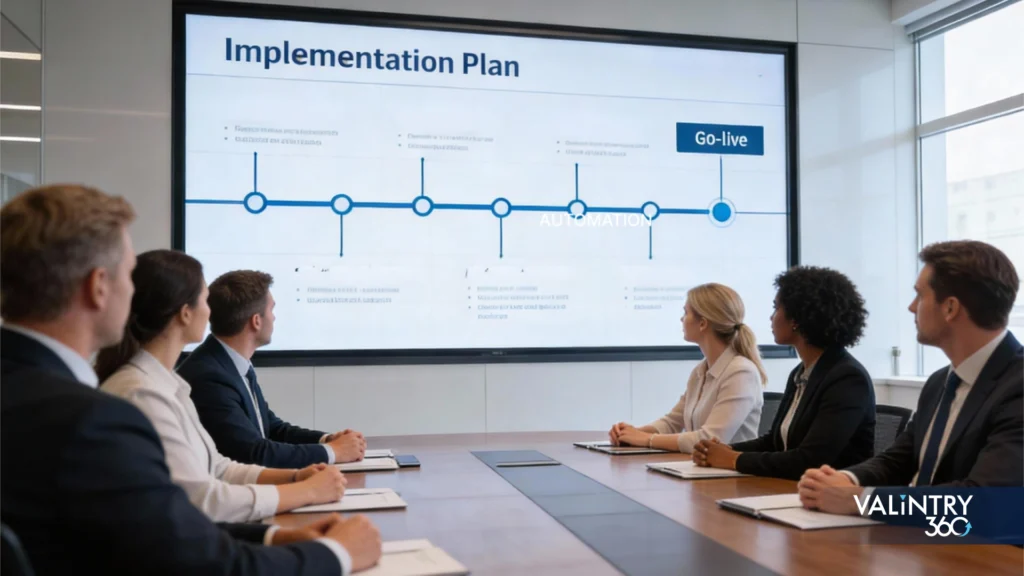
Sequenced plan
- RFP & shortlist (Weeks 0–2): Align outcomes, KPIs, and constraints; issue RFP using the rubric.
- Deep-dive discovery (Weeks 2–5): Workshops, process mining, RACI, and backlog creation.
- Pilot/prototype (Weeks 5–8): Prove core journeys (lead-to-cash or case-to-resolution); validate data model and integrations.
- Build & phased rollout (Weeks 8–16+): Configuration-first; code where justified; enablement in waves.
- Cutover & go-live (Week 16+): Execute runbook, reconciliation, and go/no-go gates.
- Hypercare (Weeks 16–20): SLA-backed support; backlog burn-down and training reinforcement.
- Continuous improvement (Quarterly): Governance council, roadmap updates, value tracking.
30/60/90-day adoption & optimization checklist
- Day 30: 80%+ user logins weekly, pipeline hygiene rules live, top-10 defects resolved.
- Day 60: UAT debt <5 items; 70% of reps completing daily tasks in Salesforce; first optimization release shipped.
- Day 90: KPI review against targets (time-to-value, user adoption, data quality score, pipeline velocity, service resolution time, CSAT); next-quarter roadmap approved.
Core KPIs
- Time-to-value, user adoption, data quality, pipeline velocity, service resolution time, CSAT.
Client vignette (anonymized): A mid-market manufacturer replaced a code-heavy org with a configuration-first design. With transparent staffing and a disciplined Salesforce data migration plan, they cut sales cycle time by 18% and improved case first-call resolution by 9 points within 90 days of go-live—supported by structured testing and a defined hypercare model.
Conclusion
Red flags in Salesforce proposals often hide in plain sight: fuzzy outcomes, thin discovery, code-first designs, and weak post-go-live support. The upside of clarity is faster time-to-value and durable adoption. Use the checklist and rubric before you commit, and pressure-test every claim with a concrete “Buyer Test.” If you’d like a free proposal sanity-check, VALiNTRY360 can review scope, risk, and ROI assumptions and offer a concise validation of outcomes, staffing, and roadmap—no pressure, just clarity.
Related Posts
- Salesforce Consulting Engagement
Salesforce Consulting Engagement Models in 2026: Fixed Price…
A Salesforce consulting relationship can be structured several different ways, and each structure changes who carries risk, who controls priorities, and what the consulting partner is actually accountable for. A defined implementation might be quoted as fixed price or time…
- Salesforce Consulting Engagement
Salesforce Consulting Engagement Models Compared: Hourly, Fixed Fee,…
A Salesforce project can change commercial shape before the first Flow reaches a sandbox. Discovery may reveal 4 undocumented integrations, 2 automation paths updating the same field, a data migration that needs deduplication, and a security model that cannot support…