

- Salesforce Sales Cloud
Sales leaders know that even the strongest CRM can’t overcome sluggish proposal cycles or inconsistent follow-ups. In a high-velocity market, the difference between “close won” and “stalled” often lies in how quickly—and intelligently—your teams respond. Generative AI inside Salesforce is transforming how proposals, quotes, and follow-ups happen—automating what once took hours into minutes while preserving accuracy, compliance, and personalization.
For organizations using Salesforce, the opportunity is no longer theoretical. With the right architecture, guardrails, and change management, AI-driven sales automation can compress deal cycles, increase win rates, and scale best practices across teams.
Overview
The Future of Proposals: Generative AI Inside Salesforce
Manual proposal creation is one of the biggest friction points in B2B sales. Reps spend valuable time pulling data from Opportunities, CPQ, and product catalogs, then coordinating legal clauses and pricing approvals. Generative AI changes that by generating complete, compliant proposals directly within Salesforce.
How it works:
- AI leverages Opportunity and CPQ data—product details, pricing tiers, discounts—to draft proposals instantly.
- It references approved clause libraries and templates, ensuring consistency across legal and brand messaging.
- Version control is built in: each iteration is logged in Salesforce Files or Quip with a timestamp and owner record.
- Reps can trigger updates through Salesforce Flow or Slack integration (e.g., “Generate revised proposal for ACME deal”).
Example use case:
- Before: A SaaS company’s proposal cycle averaged 5 business days, with frequent data errors and version confusion.
- After: Using AI-assisted proposal generation in Salesforce, the same process took under 24 hours with zero missed approval steps and 40% faster deal close times.
What good looks like:
- Proposal turnaround time ↓ 30–50%
- Approval cycle time ↓ 20–35%
- Proposal accuracy ↑ 25–40%
Takeaway: Generative AI turns Salesforce into a proposal engine that’s accurate, compliant, and fast—freeing reps to sell, not format.
Intelligent Follow-Ups That Never Miss a Beat
Even the best proposals lose momentum without timely, relevant follow-ups. Generative AI brings intelligence to this step by analyzing buyer signals and engagement data to personalize outreach—without human delay.
AI-assisted follow-ups in Salesforce can:
- Trigger personalized follow-up messages when deal stage changes or prospect activity spikes (e.g., email opens, site visits, or meeting cancellations).
- Use Sales Cloud Einstein Activity Capture to recommend tone, timing, and message length.
- Maintain compliance by referencing approved prompt templates stored in Salesforce Metadata or Prompt Builder.
- Sync with email, calendar, and Slack to streamline cadence execution.
Mini case vignette:
A manufacturing firm with long deal cycles implemented AI-driven follow-ups for opportunities over $100K. Within three months, reply rates rose 22%, meeting-booked rates improved 18%, and forecast accuracy increased 15% thanks to better visibility into buyer engagement.
What good looks like:
- Follow-up reply rates ↑ 15–25%
- Meeting conversion ↑ 10–20%
- Forecast accuracy ↑ 10–15%
Takeaway: Intelligent, automated follow-ups keep deals warm and data-rich—giving leaders visibility and reps momentum.
Building a Secure, Compliant AI Architecture

AI sales automation is only as strong as its data governance. Inside Salesforce, proper architecture ensures the right balance between automation and control.
Core architecture considerations:
- Data readiness: Clean Opportunity, Product, and Contact data—structured for AI consumption.
- Prompt governance: Approved prompt templates and tone libraries reviewed quarterly for compliance and brand alignment.
- Security: Field-level access controls, PII masking, and Salesforce Shield for event monitoring.
- Audit & oversight: Logging every AI-generated artifact (proposal, message) with creator, timestamp, and source record.
- Human-in-the-loop approvals: AI drafts, humans review. Salesforce Flow or Approval Process ensures accountability.
Risk mitigations:
- Use clause libraries for proposal text to reduce hallucination risk.
- Store all AI outputs within Salesforce records for traceability.
- Run sandbox pilots to test model behavior before production rollout.
Takeaway: With governance-first design, AI automation in Salesforce enhances trust and compliance while driving measurable efficiency.
Driving Adoption: Change Management That Works
Technology is only half the equation. Sustained success requires thoughtful change management that balances user trust, productivity, and oversight.
VALiNTRY360 – Salesforce Consulting and Solutions often guides clients through a structured adoption framework:
- Pilot with purpose: Start small—one product line or sales team—to validate outcomes and refine prompts.
- Co-create templates: Engage top-performing reps to build AI prompt libraries that reflect real selling language.
- Measure early success: Track cycle time, response rates, and user satisfaction to demonstrate ROI.
- Enable & train: Short, role-based enablement modules embedded in Salesforce (e.g., in-app walkthroughs or Slack reminders).
- Iterate with governance: Quarterly reviews of prompts, templates, and AI models to align with changing business needs.
What good looks like:
- Rep adoption >80% within 60 days
- Proposal revision errors ↓ 35%
- Sales cycle length ↓ 20%
- User satisfaction ↑ 25%
Takeaway: When AI becomes a trusted co-pilot—through training, governance, and communication—adoption follows naturally.
Your Roadmap to Time-to-Value with Salesforce AI
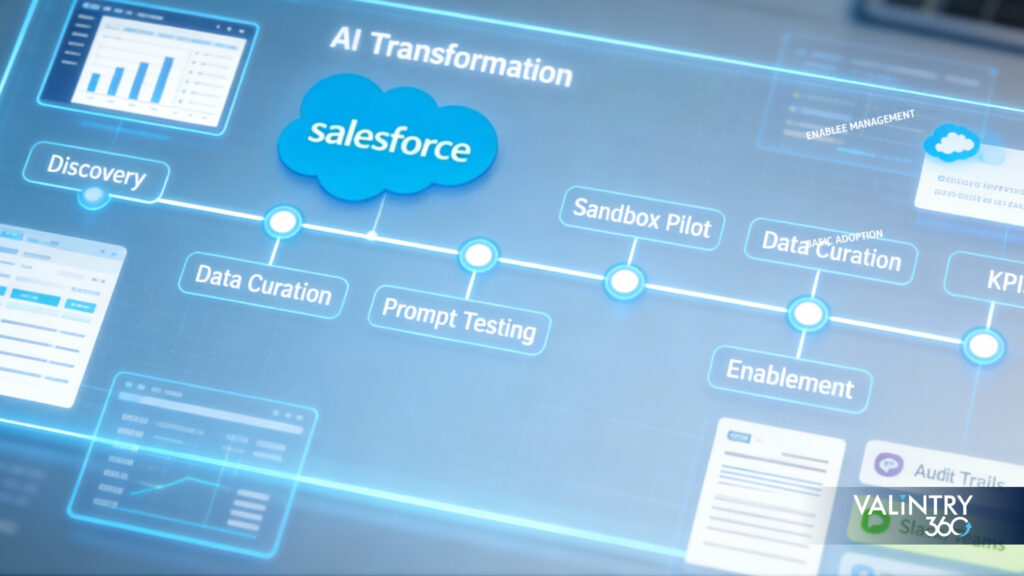
Executives don’t need another AI experiment—they need a roadmap that drives value fast. A structured rollout reduces risk, accelerates results, and aligns teams on measurable outcomes.
Implementation checklist:
- Discovery: Assess current Salesforce data, sales workflows, and content repositories.
- Sandbox pilot: Deploy generative AI for one proposal or follow-up use case.
- Dataset curation: Ensure data accuracy and permission structures.
- Prompt testing: Validate AI outputs for tone, compliance, and field mapping.
- Governance design: Establish oversight committee and audit trail policies.
- Enablement: Train users, document workflows, and collect feedback.
- KPIs & optimization: Track cycle time, win rate, and adoption metrics for continuous improvement.
Integrated quick wins:
- Connect Salesforce CPQ to AI proposal templates.
- Integrate Slack or Microsoft Teams for AI-triggered alerts.
- Add e-signature automation (e.g., DocuSign) for seamless close.
Takeaway: A phased, well-governed approach minimizes disruption and maximizes ROI—delivering measurable gains in the first 90 days.
Conclusion
AI sales automation is no longer futuristic—it’s a competitive differentiator already reshaping how Salesforce-driven organizations sell. From instant proposal generation to intelligent follow-ups, success depends on design, governance, and adoption.
VALiNTRY360 – Salesforce Consulting and Solutions helps businesses move from concept to measurable impact with confidence. Through proven frameworks, deep Salesforce expertise, and pragmatic AI design, we help clients achieve faster deals, higher win rates, and scalable success.
Explore a discovery session with VALiNTRY360 to identify where AI can unlock time, trust, and revenue—risk-free, insight-first, and tailored to your business.
Related Posts
- Salesforce Sales Cloud
Measuring ROI of AI Sales Automation for Salesforce…
CROs and revenue leaders aren’t short on AI promises—they’re short on proof. In Salesforce environments, AI sales automation can absolutely deliver measurable performance gains—but only when it’s built on clean data, clear processes, and disciplined tracking. The challenge isn’t whether…
- Salesforce Sales Cloud
How to Use AI Sales Automation: A Simple…
AI sales automation is reshaping how sales teams manage customer outreach and lead generation. Imagine reducing a 25-minute manual task to just 30 seconds. With less than one hour of initial configuration, this level of efficiency is now possible using…
- Salesforce Sales Cloud
Human-in-the-Loop AI Sales Automation with Salesforce
The appeal of AI sales automation is compelling: faster lead routing, smarter forecasting, streamlined quoting, and more time for selling. Yet in a sales organization you also need judgement, control and trust—not a black-box tool that surprises you. That’s where…